Unit 2 · Topic 2.7 · about 30 minutes · 7 parts · 14 scored checks, 2 of them multiple choice
AP Physics 1: Algebra-Based 2.7: Kinetic and Static Friction
 Tap to open the picture full size
Part 1 Think first A brick on its face or on its end
Commit to a guess first. Being wrong now makes the right idea stick better.
Predict first
You drag a brick across a wooden table at a slow, steady speed by pulling it with a spring scale. First the brick lies on its big flat face. Then you stand it on its small end, which touches the table with about a quarter of the area. How does the steady reading on the scale compare?
In short. Friction is the force a surface exerts along itself on an object touching it: kinetic friction when the two surfaces slide relative to each other, static friction when they do not.
- Kinetic friction points opposite to the way each surface slides relative to the other, and its size is .
- Static friction takes whatever size and direction keep the surfaces from slipping, up to a maximum of .
- Both coefficients depend on the materials in contact, and is usually greater than for the same pair of surfaces.
Part 2 Learn it Four short ideas, each checked as you go
2a. Sliding friction and how big it is
When two surfaces in contact slide across each other, each exerts a kinetic friction force on the other. A sled skidding over snow, a book shoved across a desk, a hockey player scraping to a stop: in each, the surfaces move relative to each other.
Its size depends on two things. One is how hard the surfaces press together, the normal force : the part of a surface's push on an object that is perpendicular to the surface, directed away from it. The other is what the two surfaces are made of, summed up in the coefficient of kinetic friction, . Rubber on dry concrete has a large one; a steel skate blade on ice has a tiny one. Then
The coefficient has no unit, because it is one force divided by another.
Contact area is not in the equation. The brick on its end has the same weight, the same normal force and the same two materials, so it has the same friction.
Find the normal force from what presses the surfaces together. On a level floor with nothing else pushing up or down, . Stack a second box on top and the floor pushes up harder. On a ramp tilted at it is only , as in 2.2 Forces and Free-Body Diagrams.
Quick check · Decide and justify
You slide a wooden dresser across a wooden floor at a steady speed, and it takes a hard push. Then you stick a felt pad under each of its four wooden feet, each pad exactly the size of the foot it covers. Now the same dresser slides at a steady speed with a much smaller push. What made the kinetic friction force smaller?
Which reason supports your answer?
2b. Which way kinetic friction points
Kinetic friction on a surface points opposite to the way that surface slides relative to the other surface.
Shove a book to the right across a desk. The book slides right over the desk, so friction on the book points left. Seen from the book, the desk slides left underneath it, so friction on the desk points right. Those two forces are a third-law pair, as in 2.3 Newton’s Third Law.
When the other surface sits still, as a floor or a desk usually does, this is the familiar rule that friction opposes the motion. The familiar rule breaks when the other surface moves. A cat sits on a rug, and someone yanks the rug to the left. The rug slides left under the cat's paws, which means the paws slide right relative to the rug. So kinetic friction on the paws points left, the same way the rug is going, and it drags the cat along a little.
So do not ask which way the object moves. Ask which way this surface slides compared with the one it touches, and point friction the other way.
Quick check · Multiple choice
A performer yanks a tablecloth to the right, out from under a plate. While the cloth slides under it, the plate moves a short way to the right, much more slowly than the cloth. Which way does the kinetic friction force exerted by the cloth on the plate point?
2c. Static friction holds things still
When two surfaces touch but do not move relative to each other, static friction may act between them. Slipping and sliding both mean the surfaces are moving relative to each other, and static friction is what prevents that.
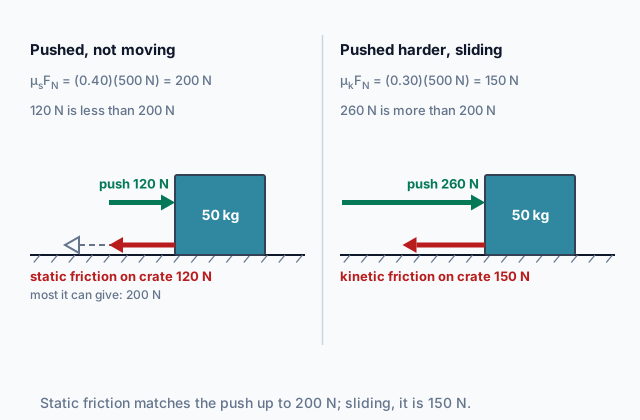
Static friction has no fixed size. It takes whatever value, and whatever direction, keeps the surfaces from slipping. On the left of the diagram, a 50 kg crate pushed with 120 N stays put, so the floor's static friction on it is 120 N, pointing left, exactly matching the push. Push with 60 N and it is 60 N. Leave the crate alone on a level floor and it is zero, since nothing is trying to make it slide.
The direction adjusts too. A box resting on a tilted plank would slide down if the plank were slick, so static friction points up the plank. Splitting the gravitational force along the plank and across it, as in 2.5 Newton’s Second Law, gives a part along the plank of .
So static friction obeys an inequality, not an equation:
where is the coefficient of static friction. The right side is a ceiling, not the value. To find the value, ask what static friction has to balance.
Quick check · Spot the error
A 20 kg crate rests on a level floor, and the coefficient of static friction between them is 0.60. A worker pushes it horizontally with 50 N, and the crate does not move. A student works out the friction force on the crate. Tap the first line that goes wrong.
2d. The most static friction can give
Push harder and static friction keeps matching you, until it reaches its maximum:
Past that it cannot hold. The surfaces slip, and kinetic friction takes over. In the diagram the crate's maximum is N. A 260 N push gets it sliding, and from then on friction is N, however hard you keep pushing.
That drop is typical. For a given pair of surfaces, is usually greater than , so it takes more force to get something sliding than to keep it sliding. You have felt this shoving a heavy couch: it resists, then lurches, then moves more easily.
Use for the force only at the edge of slipping: when a question says an object is just about to slide, or asks for the largest force friction can hold. For anything at rest with room to spare, find static friction from what it has to balance.
Quick check · Sketch the graph
A 25 kg crate sits on a level floor. The coefficient of static friction between the crate and the floor is 0.60, and the coefficient of kinetic friction is 0.40. Starting each time from rest, a worker pushes the crate horizontally with a steady push, trying pushes from 0 N to 200 N. Sketch the size of the friction force exerted by the floor on the crate for each push. The first point is fixed at 0.
One shape that fits
Drag a point up or down, or tap it and use the arrow keys. The shape is checked, and the graph must pass through the values the question gives.
Part 3 Watch it done A box resting on a tilted plank
Watch each step, then finish the problem yourself.
A 2.0 kg wooden box rests on a rough plank tilted at 20° to the horizontal, and it does not slide. The coefficient of static friction between the box and the plank is 0.70. Find the static friction force exerted by the plank on the box.
Step 1 · Name the forces and choose axes
Three forces act on the box. Gravity, N, points straight down. The normal force from the plank is perpendicular to the plank, away from it. Static friction acts along the plank: without it the box would slide down, so it points up the plank. Take along the plank, with up the slope positive, and perpendicular to the plank.
Step 2 · Find the normal force
The box does not sink into the plank or lift off it, so across the plank the forces balance: N.
Step 3 · Find the most static friction could give
N. That is a ceiling on the friction, not its value.
Why this step?
Why is 13.2 N not the static friction force on the box?
Static friction takes only the value it needs to keep the box from slipping. The box is at rest and not about to slide, so along the plank friction just balances the part of gravity pulling the box down the slope. The 13.2 N tells you only whether the plank can hold the box at all.
Your step · Calculate
Finish it. A 2.0 kg wooden box rests on a rough plank tilted at 20° to the horizontal, and it does not slide. The coefficient of static friction between the box and the plank is 0.70. Take up the slope as positive. How large is the static friction force exerted by the plank on the box? Give your answer to the nearest 0.1 N.
N
Part 4 Try it A shipping warehouse
Two jobs in a warehouse with a smooth concrete floor. In the first, two boxes slide as one. In the second, the surface under a parcel is itself moving.
Try it · Calculate
At a shipping warehouse, a 6.0 kg box sits on top of a 4.0 kg box, and a worker pushes the bottom box horizontally across a level concrete floor. The two slide together at a steady speed, and the top box does not slip on the bottom one. The coefficient of kinetic friction between the bottom box and the floor is 0.30. How large is the kinetic friction force exerted by the floor on the bottom box?
Try it · Decide and justify
At a shipping warehouse, a parcel rests on a level conveyor belt. The belt starts up from rest and speeds up to the right, and the parcel moves along with it without slipping. While the belt speeds up, which way does the friction force exerted by the belt on the parcel point?
Which reason supports your answer?
Part 5 Explain it Measure it, plot it, read the slope
Nothing you type leaves this page.
Free response is 50% of the exam score. This one is shaped like Question 3, Experimental Design and Analysis.
Free-response practice · Question 3 style
A student wants to test whether the kinetic friction force on a sliding wooden block is proportional to the normal force on it, and to measure the coefficient of kinetic friction between the block and a level wooden board. She has the block, a set of slotted masses that can be stacked on it, a force sensor with a hook, an electronic balance, a meter stick and a stopwatch. Use m/s².
(a) Describe a procedure she could follow to collect the data she needs. Say what she measures, with which equipment, and how she makes sure the sensor reading equals the kinetic friction force. Give enough detail that another student could repeat it.
(b) Her results are listed here. Each mass is the total of the block and the masses stacked on it, and each force is the steady sensor reading. On paper, calculate the normal force for each trial, then plot the friction force against the normal force and draw a best-fit line.
- 0.50 kg: 1.6 N
- 1.00 kg: 2.8 N
- 1.50 kg: 4.6 N
- 2.00 kg: 6.1 N
- 2.50 kg: 7.4 N
(c) Explain whether her data support the claim that the kinetic friction force is proportional to the normal force, and calculate the coefficient of kinetic friction from your line.
(d) Her partner repeats the whole experiment but pulls a little too hard, so the block speeds up slightly during every reading, at about the same rate each time. Explain whether the coefficient he gets from his graph is larger than, smaller than or equal to the true value.
Model answer
(a) Measure the mass of the block alone, and of the block with each stack of slotted masses, on the balance. Lay the board flat, hook the force sensor to the block and hold the sensor level, so it pulls parallel to the board. Pull the block along the board at a slow, steady speed and record the steady reading, not the bigger reading just as it starts to move. Mark 0.50 m intervals on the board with the meter stick and time the block across each with the stopwatch; equal times for equal distances confirm the speed is constant. At constant velocity the forces on the block balance, so the sensor's pull equals the kinetic friction force. Do three trials for each mass and average them, for at least five different total masses. The board is level and the pull is horizontal, so the normal force is .
(b) The normal forces are 5.0, 10, 15, 20 and 25 N. The five points lie close to a straight line, and a best-fit line runs from about (0, 0) to about (25 N, 7.5 N).
(c) The points fall close to a straight line through the origin, so doubling the normal force doubles the friction force: the data support proportionality. Since , the slope of the line is the coefficient: .
(d) Larger. While the block speeds up, the sensor has to pull harder than friction alone, by , so every reading is too high. Since , each reading is . With the same in every trial the line is steeper by , so the coefficient read from its slope is larger than the true value.
Score your own answer. This is a self-check, not a grade. Tick each point your answer makes.
Part 6 Check yourself Friction readings on four surfaces
Both case questions use the table of the block's force readings.
A student pulls a 2.0 kg wooden block across four different level surfaces with a force sensor held level. On each surface she starts from zero and slowly increases her pull, recording the largest reading just before the block starts to slide. Then she keeps the block sliding at a slow, steady speed and records the steady reading.
| Surface | Largest reading before sliding (N) | Steady reading while sliding (N) |
|---|---|---|
| Wood board | 8.0 | 6.0 |
| Felt | 6.4 | 4.6 |
| Sandpaper | 14.0 | 11.0 |
| Rubber mat | 18.0 | 15.0 |
Case question 1 · Calculate
Using the table of the block's force readings, what is the coefficient of kinetic friction between the 2.0 kg wooden block and the felt? Give your answer to the nearest 0.01.
Case question 2 · Multiple choice
Using the table of the block's force readings: the block rests on the wood board, and the student pulls it horizontally with 5.0 N. The block does not move. How large is the friction force exerted by the board on the block?
The rest stand on their own and do not use the case.
Check yourself · Draw the forces
A student shoves a wooden block up a rough ramp that rises to the right at 35° from the horizontal. The block has left her hand and is still sliding up the ramp. The coefficient of kinetic friction between the block and the ramp is 0.30. Build the block's free-body diagram, choosing each force's direction from the ramp's own directions and its length compared with the others.
The dot is the block. One diagram that fits
Pick each force exerted on the block, then choose the way it points and how long its arrow is compared with the others. The arrows are drawn for you.
Check yourself · Draw the forces
A 40 kg dresser stands on a level floor. The coefficient of static friction between its feet and the floor is 0.50. You push the dresser to the right with a horizontal push of 80 N, and it does not move. Build its free-body diagram, and set each arrow's length to compare with the others.
The dot is the dresser. One diagram that fits
Pick each force exerted on the dresser, then choose the way it points and how long its arrow is compared with the others. The arrows are drawn for you.
Check yourself · Fill the statement
Two workers pull a wooden crate across a concrete floor at a slow, steady speed. Tap a blank, then the words that complete the sentence.
Tipping the crate onto its narrower side changes , and the friction force . Setting an identical crate on top of it changes , and the friction force .
Part 7 Keep it Bring back earlier ideas
Pulling an older idea back up is what makes it last.
A new situation. A horse is hitched to a cart, both at rest on a flat road, and the horse starts to pull. A student argues: "The cart pulls back on the horse exactly as hard as the horse pulls forward on the cart. Those two forces cancel, so the cart can never start moving." Decide whether the argument holds up, then trace the pairs.
From 2.3 Newton’s Third Law · Fill the statement
A horse pulls a cart forward from rest along a flat road. Tap a blank, then the force that completes the sentence.
The horse pulls the cart forward, so the cart pulls . The horse's hooves push the road backward, so the road pushes . Earth pulls the horse down, so the horse pulls .
A worker pushes a 30 kg crate east across a level warehouse floor with a horizontal push, and the crate speeds up as it slides. The table lists every force exerted on the crate while it speeds up.
| Force | Exerted by | Size (N) |
|---|---|---|
| Gravitational force | Earth | 300 |
| Normal force | Floor | 300 |
| Push | Worker | 150 |
| Kinetic friction | Floor | 90 |
From 2.2 Forces and Free-Body Diagrams · Draw the forces
A worker pushes a crate east across a level floor, and it speeds up. Using the table of forces on the crate, build its free-body diagram, with east to the right, and set each arrow's length to compare with the others.
The dot is the crate. One diagram that fits
Pick each force exerted on the crate, then choose the way it points and how long its arrow is compared with the others. The arrows are drawn for you.
In three lines
- Kinetic friction acts between surfaces sliding relative to each other, opposite each one's sliding, with size whatever the contact area.
- Static friction takes whatever size and direction keep surfaces from slipping, up to its maximum .
- The coefficients depend on the materials in contact, and is usually greater than .
Vocabulary
- Kinetic friction
- The friction force between two surfaces in contact that move relative to each other, exerted opposite to the motion of each surface relative to the other.
- Static friction
- The friction force between contacting surfaces that are not moving relative to each other, which adopts the value and direction required to prevent slipping, up to a maximum of .
- Coefficient of kinetic friction
- The number , set by the materials of the two surfaces, that multiplies the normal force to give the kinetic friction force.
- Coefficient of static friction
- The number , set by the materials of the two surfaces, that multiplies the normal force to give the maximum static friction force; it is typically greater than .
- Normal force
- The perpendicular component of the force exerted on an object by the surface it is in contact with, directed away from the surface.
- Slipping
- Two surfaces in contact moving relative to each other; sliding means the same.
Course alignment, for teachers
AP Physics 1: Algebra-Based topic 2.7, Unit 2: Force and Translational Dynamics.
- Skill 1.C: Create qualitative sketches of graphs that represent features of a model or the behavior of a physical system.
- Skill 2.B: Calculate or estimate an unknown quantity with units from known quantities, by selecting and following a logical computational pathway.
- Skill 2.C: Compare physical quantities between two or more scenarios or at different times and locations in a single scenario.
- Skill 3.B: Apply an appropriate law, definition, theoretical relationship, or model to make a claim.
This lesson maps all 11 essential knowledge statements of the topic to the part that teaches each one: 11 are checked by a scored question. The map is in the lesson file.