Unit 5 · Topic 5.3 · about 30 minutes · 7 parts · 12 scored checks, 1 of them multiple choice
AP Physics 1: Algebra-Based 5.3: Torque
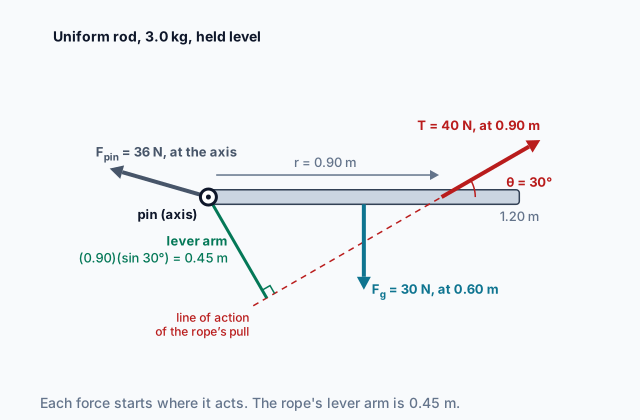 Tap to open the picture full size
Part 1 Think first Pushing a door the wrong way
Commit to a guess first. Being wrong now makes the right idea stick better.
Predict first
A heavy door stands half open. You grab its outer edge, as far from the hinges as you can reach, and push hard. But you push straight along the door, directly toward the hinges. What does the door do?
In short. Torque is the turning effect a force has on a rigid object about an axis, and its size is .
- Only the component of the force perpendicular to , the line from the axis to the point where the force is exerted, produces a torque.
- The lever arm is the perpendicular distance from the axis to the force's line of action, and gives the same torque as .
- A force diagram of a rigid object starts each arrow where that force is exerted, so you can see where it acts relative to the axis; a torque's sense is clockwise or counterclockwise.
Part 2 Learn it Four short ideas, each checked as you go
2a. Only the part across the line turns it
A force can turn a rigid object about an axis, and the size of that turning effect is the torque, written . In rotation, torque plays the part that force played in 2.4 Newton’s First Law and 2.5 Newton’s Second Law: later in this unit, a net torque is what changes how fast something rotates.
To find a torque, start at the axis and draw the position vector to the point where the force is exerted. Then split the force into two components, as you did for work in 3.2 Work: one along and one perpendicular to it. Only the perpendicular component, , makes a torque. The component along pulls the object straight away from the axis or pushes it straight in, the axle pushes back, and nothing turns.
That is the reverse of work, where only the component along the motion counted. Push the door at the handle, square to the door, and all of your push turns it. Tilt the push toward the hinges and less of it points across the door, so less of it turns the door. Point it straight at the hinges and none of it does.
Quick check · Decide and justify
A mechanic fits a wrench on a stuck bolt and grips the end of the handle, 0.25 m from the center of the bolt. She pulls with 80 N, straight along the handle, directly away from the bolt. Does her pull exert a torque on the wrench about the bolt?
Which reason supports your answer?
2b. Torque from r, F and an angle
The perpendicular component is , where is the angle between the force and when the two are drawn tail to tail. So the size of the torque is
With in meters and in newtons, torque is in newton meters, N·m.
Check the ends of the range. At , and the whole force turns the object. At or , : the force points straight along , away from the axis or toward it, and the torque is zero.
In the diagram at the top of the page, a rope pulls on a rod with 40 N, 0.90 m from the pin, at 30° to the rod. Its torque about the pin is N·m.
Measure from the axis to the point where the force is exerted, wherever the axis is: at the end of the rod here, at the middle of a seesaw. And this equation gives the torque's size only. Whether it tends to turn the object clockwise or counterclockwise you read from the picture, and that is all the direction a torque has in this course.
Quick check · Calculate
A child pushes on the rim of a playground merry-go-round, 1.5 m from its center, with a force of 120 N. She stands outside it and pushes in and across, so the angle between her push and the line from the center out to the point where she pushes is 140°. What is the size of the torque her push exerts about the center? Give your answer to the nearest 1 N·m.
2c. The lever arm
There is a second route to the same number. Extend the force in both directions into a line: its line of action. The lever arm is the perpendicular distance from the axis to that line. Then
where is the lever arm. In the right triangle made by , the line of action and the perpendicular to it, . So this is the same torque as , with the sine attached to the distance instead of the force. In the diagram, the rope's lever arm is m, and N·m, as before.
The lever arm makes one fact plain. A force whose line of action passes through the axis has a lever arm of zero, so it exerts no torque however large it is: a pull straight along a wrench handle, or the push of a hinge pin on its own door.
Use whichever route is quicker. The lever arm suits a picture where the perpendicular distance is easy to see; suits a problem that hands you the angle.
Quick check · Match
A light rod 0.60 m long turns about a pin through one end. Each force listed is 60 N and is exerted in the plane the rod turns in. Tap a force, then the lever arm it has about the pin.
2d. Force diagrams: where each force acts
A free-body diagram from 2.2 Forces and Free-Body Diagrams puts every force on one dot, because for motion as a whole, where a force acts does not matter. For turning, it is the whole question. A force diagram is drawn like a free-body diagram, with each force's relative size and direction, but each arrow starts at the point where that force is exerted, so you can see where it acts relative to the axis.
The diagram at the top of the page is one: a uniform 3.0 kg rod, 1.20 m long, pinned at its left end and held level by a rope. Gravity, 30 N, can be treated as acting at the rod's center of mass (2.6 Gravitational Force), which for a uniform rod is at its middle (2.1 Systems and Center of Mass), 0.60 m from the pin. The rope pulls at 0.90 m, and the pin pushes on the rod at the axis itself.
Read the torques off it. The pin's force acts at the axis, so it makes none. Gravity, square to the rod, makes N·m and tends to turn the rod clockwise about the pin. The rope's 18 N·m tends to turn it counterclockwise. Why two equal torques in opposite senses leave the rod at rest comes in a later topic. When a problem needs signs, pick one sense as positive and say which.
Quick check · Sort it
A board is pinned at its left end so it can turn about the pin, and at this instant it lies level. You see it from the side, with the pin on your left. Tap each force on the board, then what it does about the pin.
Tends to turn it counterclockwise
Tends to turn it clockwise
No torque about the pin
Part 3 Watch it done Pulling a door open by its handle
Watch each step, then finish the problem yourself.
A classroom door is 0.90 m wide and turns about the hinge line along one edge. A student pulls on its handle, which is 0.10 m in from the door's free edge, with a force of 30 N. Seen from above, her pull makes a 60° angle with the door. What is the size of the torque her pull exerts on the door about the hinges?
Step 1 · Find the axis and r
The door turns about the hinge line, so that is the axis. The handle is 0.10 m in from the free edge of a 0.90 m door, so the position vector runs along the door from the hinges to the handle, and m.
Why this step?
Why is 0.80 m and not 0.90 m, the width of the door?
runs from the axis to the point where the force is exerted. She pulls at the handle, not at the edge, so the last 0.10 m of door beyond the handle plays no part. A pull at the very edge would use 0.90 m.
Step 2 · Find the angle and the perpendicular component
lies along the door, so is the angle between the pull and the door, 60°. Only N turns the door. The other component, N, pulls along the door, straight away from the hinges.
Your step · Calculate
Finish it. A door 0.90 m wide turns about its hinge line. A student pulls with 30 N on its handle, 0.10 m in from the free edge, and seen from above her pull makes a 60° angle with the door. What is the size of the torque her pull exerts about the hinges? Give your answer to the nearest 0.1 N·m.
N·m
Part 4 Try it Pushing a bicycle pedal
A new situation. A bicycle crank runs from the axle to the pedal, and a rider pushes more or less straight down on the pedal as it comes over the top and down the front. The crank turns as she pushes, so the angle between the crank and that downward push keeps changing, and so does the torque. Work out one position, then practice with a wrench on a bolt.
Try it · Calculate
A cyclist pushes straight down on a pedal with a force of 500 N. The crank is 0.17 m long from the axle to the pedal, and at this moment it points forward and 40° below the horizontal. What is the size of the torque her push exerts on the crank about the axle? Give your answer to the nearest 1 N·m.
Part 5 Explain it Claim, derive, connect
Nothing you type leaves this page. Check your answer against the model and each scoring point.
Free response is 50% of the exam score. This one is shaped like Question 4, Qualitative/Quantitative Translation.
Free-response practice · Question 4 style
A door of width turns about a vertical hinge line along one edge. You push on it with a horizontal force of fixed size , at a distance from the hinge line. Seen from above, is the angle between your push and the line along the door from the hinges to the point where you push.
(a) Make a claim, in words and without equations, about how the size of the torque your push exerts about the hinges changes (i) as you move your push from the free edge toward the hinges, keeping it perpendicular to the door, and (ii) as you tilt your push at the free edge away from perpendicular, toward pointing along the door at the hinges. Explain your reasoning.
(b) Starting from , derive an expression for the size of the torque in terms of , and . Then derive the lever arm of your push in terms of and , and show that gives the same expression.
(c) Explain how your expression in (b) is consistent with both parts of your claim in (a).
(d) A friend pushes perpendicular to the door at its middle, , with a force of the same size . You push at the free edge, . Derive the angle at which your push exerts the same size of torque as your friend's. Of the two angles that work, give the one between and , tilted toward the hinges as in (a)(ii).
Model answer
(a) (i) The torque gets smaller as the push moves toward the hinges, in proportion to its distance from them: halfway to the hinges, half the torque. A push right at the hinges exerts none. With the push perpendicular to the door, its line of action crosses the door at a right angle, so the lever arm, the perpendicular distance from the hinge line to that line of action, is just how far from the hinges you push. Moving the push toward the hinges shortens the lever arm, and the same force on a shorter lever arm makes less torque. (ii) Tilting the push toward the hinges also makes the torque smaller, because less of the push points across the door and more of it presses along the door into the hinges, which push back. When the push points straight along the door at the hinges, none of it is across the door and the torque is zero, however hard you push.
(b) The position vector runs along the door from the hinge line to the point where you push, so , and the angle between it and the push is . So . The line of action of the push passes through that point. The perpendicular from the hinge line to it is the side opposite the angle at that point in a right triangle whose hypotenuse is . That angle is , or when the push tilts toward the hinges, and both have the same sine, so and , the same expression.
(c) With , , which is proportional to : halving the distance halves the torque, and at the torque is zero, as claimed in (i). At the free edge, , largest at , where . As the push tilts toward the hinges, grows toward , falls toward 0, and at the torque is zero although has not changed, as claimed in (ii).
(d) Your friend's torque is , and yours is . Setting them equal gives , so (the other solution, , tilts away from the hinges). A push at the edge tilted from square turns the door exactly as well as a square push at the middle.
Score your own answer. This is a self-check, not a grade. Tick each point your answer makes.
Part 6 Check yourself Forces on a pinned board
Both case questions use the table of forces on the board.
A uniform board 1.60 m long is pinned at its left end, so it can turn about a horizontal axle through the pin. At one instant the board is level, and besides the pin, three things exert forces on it. Each distance is measured along the board from the pin. Each angle is between the force and the board, which runs along the line from the pin to the point where the force acts. The pin also pushes on the board, at the axle.
| Force | Size (N) | Distance from the pin (m) | Direction | Angle with the board |
|---|---|---|---|---|
| Gravitational force exerted by Earth | 40 | 0.80 | Straight down | 90° |
| Pull of a rope | 50 | 1.60 | Up and to the right | 20° |
| Push of a hand | 30 | 1.40 | Straight up | 90° |
Case question 1 · Multiple choice
A student draws a force diagram of the board from the table, with each arrow as long as its force is large. Which description of her diagram is correct?
Case question 2 · Calculate
Using the table of forces on the 1.60 m board, what is the size of the torque the rope exerts on the board about the pin? Give your answer to the nearest 1 N·m.
The rest stand on their own and do not use the case.
Check yourself · Spot the error
A student pushes on a door 0.70 m from its hinge line with a force of 40 N. Seen from above, the push is tilted 25° away from perpendicular to the door. A classmate finds the size of the torque about the hinges. Tap the first line that goes wrong.
Check yourself · Fill the statement
A plumber cannot loosen a stuck nut with a wrench. She slides a pipe over the handle, so she can pull twice as far from the nut, and pulls perpendicular to the pipe with the same force as before. Tap a blank, then an answer.
Twice as far out, with the pull still perpendicular, her pull's is twice as long, so the torque on the nut is as large as before. If she pulled straight along the pipe instead, the line of action of her pull would pass the nut.
Part 7 Keep it Bring back earlier ideas
Pulling an older idea back up is what makes it last.
From 3.2 Work · Sort it
Each card names a force on an object while the object moves. Tap a card, then the sign of the work that force does on that object.
Positive work
Negative work
Zero work
From 2.2 Forces and Free-Body Diagrams · Draw the forces
You toss a ball straight up. It has left your hand and is still rising. Air resistance is negligible. Build the free-body diagram of the ball.
The dot is the ball. One diagram that fits
Pick each force exerted on the ball, then choose the way it points. The arrows are drawn for you.
In three lines
- Torque is the turning effect of a force about an axis, and only the force component perpendicular to produces it: .
- The lever arm is the perpendicular distance from the axis to the line of action, so , and a force through the axis exerts no torque.
- A force diagram draws each force where it is exerted on a rigid object, and a torque's sense is clockwise or counterclockwise.
Vocabulary
- Torque
- The turning effect of a force about an axis of rotation, produced only by the force component perpendicular to the position vector from the axis to the point where the force is exerted, with size .
- Lever arm
- The perpendicular distance from the axis of rotation to the line of action of the exerted force.
- Line of action
- The straight line through the point where a force is exerted, running in the direction of the force.
- Force diagram
- A diagram, similar to a free-body diagram, that shows the relative size and direction of each force on a rigid system and where each is exerted relative to the axis of rotation.
Course alignment, for teachers
AP Physics 1: Algebra-Based topic 5.3, Unit 5: Torque and Rotational Dynamics.
- Skill 1.A: Create diagrams, tables, charts, or schematics to represent physical situations.
- Skill 2.A: Derive a symbolic expression from known quantities by selecting and following a logical mathematical pathway.
- Skill 2.D: Predict new values or factors of change of physical quantities using functional dependence between variables.
- Skill 3.B: Apply an appropriate law, definition, theoretical relationship, or model to make a claim.
This lesson maps all 6 essential knowledge statements of the topic to the part that teaches each one: 6 are checked by a scored question. The map is in the lesson file.