Unit 5 · Topic 5.5 · about 30 minutes · 7 parts · 13 scored checks, 2 of them multiple choice
AP Physics 1: Algebra-Based 5.5: Rotational Equilibrium and Newton’s First Law in Rotational Form
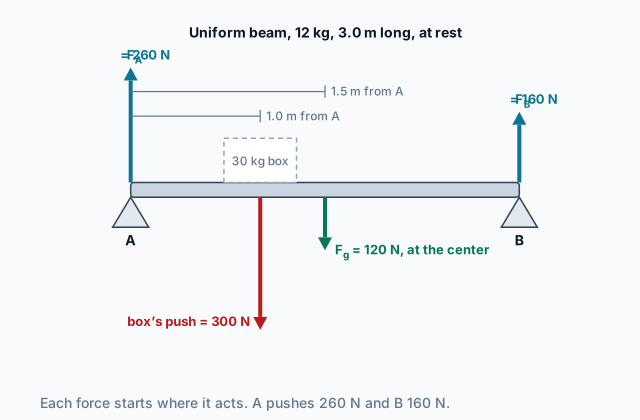 Tap to open the picture full size
Part 1 Think first Two pushes on a floating stick
Commit to a guess first. Being wrong now makes the right idea stick better.
Predict first
A meter stick lies at rest on an air hockey table, so it floats with negligible friction. Two friends push on it at the same moment, one at each end, with forces of the same size in opposite directions. Each push is square to the stick. What does the stick do?
In short. A system is in rotational equilibrium when the net torque on it is zero, and Newton's first law in rotational form says its angular velocity then stays constant.
- Rotational equilibrium means : with one sense taken as positive, the clockwise and counterclockwise torques about the axis cancel.
- Constant angular velocity can be zero or a steady spin, and when the torques on a rigid system do not balance, its angular velocity must be changing.
- When an object is in equilibrium for both forces and torques, the torques add to zero about any axis, so putting the axis where an unknown force acts removes that force from the equation.
Part 2 Learn it Four short ideas, each checked as you go
2a. Torques that add to zero
In 5.3 Torque each force on a rigid object got a torque about an axis, and a sense: clockwise or counterclockwise. Pick one sense as positive and say which; the other is negative. The net torque is the sum of all the torques exerted on the object, signs included, .
An object is in rotational equilibrium when that sum is zero:
That is the rotational partner of translational equilibrium in 2.4 Newton’s First Law, where the forces add to zero. It does not say every torque is zero. It says the counterclockwise torques exactly cancel the clockwise ones.
A seesaw shows it. Look at it from the side and take counterclockwise as positive. The board is uniform and pivots at its center, so its own weight acts at the pivot and makes no torque. A 30 kg child sits 1.5 m left of the pivot and pushes down with 300 N, which tends to turn the board counterclockwise: N·m. A 45 kg child sits 1.0 m right of the pivot: N·m. The sum is zero, and the board stays balanced. The heavier child sits closer in, because what has to match is the torques, not the weights.
Quick check · Calculate
A uniform seesaw 4.0 m long pivots at its center. A 25 kg child sits at one end, 2.0 m from the pivot. On the other side of the pivot, her father pushes straight down on the board 1.25 m from the pivot, and the seesaw stays level and at rest. How large is his push? Give your answer to the nearest 1 N.
2b. A steady spin counts too
Newton's first law in 2.4 Newton’s First Law says a system's velocity stays constant when the net force on it is zero. Rotation has its own version: a system has a constant angular velocity only if the net torque exerted on it is zero.
Constant includes zero, and it includes a steady spin. A bicycle wheel spinning at 8 rad/s on a stand with a frictionless bearing keeps spinning at 8 rad/s with nothing pushing it round, just as a puck keeps sliding across frictionless ice. No torque is needed to keep it turning. So rotational equilibrium does not mean "not turning". It means the angular velocity is not changing.
A record turntable playing at a steady rate is in rotational equilibrium with its motor running. The motor's torque and the drag torque from the bearing and the needle are equal in size and opposite in sense, so they cancel.
Turn the law around and you get a corollary of the second law: if the torques on a rigid system do not balance, its angular velocity must be changing. Cut the turntable's power and the drag torque is left alone, so it slows down. A wheel whose angular velocity grows, shrinks or reverses has a net torque on it.
Quick check · Decide and justify
A ceiling fan's blades turn counterclockwise, seen from below, at a steady 12 rad/s. The motor exerts a torque on the blades, and the air exerts a drag torque on them in the opposite sense. A student says the motor's torque must be larger than the air's, or the blades would not keep turning counterclockwise. Is the student right?
Which reason supports your answer?
2c. Two kinds of equilibrium, checked separately
Translational equilibrium is about forces: zero net force, so the velocity of the center of mass stays constant. Rotational equilibrium is about torques: zero net torque, so the angular velocity stays constant. A system can have either one without the other.
The meter stick on the air hockey table has balanced forces and unbalanced torques. Its center stays put, but it starts to spin.
Now drop a ball without spinning it, before air resistance matters. Gravity is the only force on it, and it acts at the ball's center of mass, so about that point its lever arm is zero and it exerts no torque. The ball speeds up as it falls, so it is not in translational equilibrium. Its angular velocity stays at zero, so it is in rotational equilibrium.
So check the two separately: add the forces for one, and the torques for the other. Free-body and force diagrams are the tools. A free-body diagram puts every force on one dot and shows whether they cancel. A force diagram, from 5.3 Torque, starts each arrow where its force acts, which is what you need to find each torque.
Quick check · Sort it
Each card describes an object at one moment. Tap a card, then the kind of equilibrium the object is in.
Rotational equilibrium only
Translational equilibrium only
Both kinds
Neither kind
2d. Choose the axis that hides an unknown
The diagram at the top of the page is a force diagram. A uniform 12 kg beam, 3.0 m long, rests level on a support at each end, A on the left and B on the right, and a 30 kg box sits on it 1.0 m from A. The supports' forces, and , are unknown.
The beam is at rest, so it is in both kinds of equilibrium, and then the torques add to zero about any axis you pick. Pick one where an unknown force acts. That force has no lever arm about it, so it drops out of the equation.
About A, with counterclockwise positive as you look at the diagram: , so N. Then the forces: , so N.
Summing torques about B instead gives in one step: , so N again. A is the larger because the box sits nearer to it. Every lever arm in one equation is measured from the axis you chose for that equation.
Quick check · Multiple choice
A uniform plank rests level on two sawhorses, one under each end, and a painter stands on it nearer the left end. You know the plank's weight, the painter's weight and where she stands. To find the force of the left sawhorse from a single torque equation, about which point should you sum the torques?
Part 3 Watch it done A sign held out from a wall
Watch each step, then finish the problem yourself.
A shop sign hangs from a uniform rod 1.6 m long with a mass of 5.0 kg. The rod sticks straight out from a wall, level, and is free to turn about a pin at the wall. The 8.0 kg sign hangs by a short chain from a point 1.2 m from the wall. A cable from the rod's far end runs up to the wall and makes a 30° angle with the rod. Everything is at rest. Find the tension in the cable.
Step 1 · Draw the force diagram
Four forces act on the rod, each drawn where it is exerted. The rod's weight, N, acts straight down at its center, 0.80 m from the pin. The chain pulls straight down with N, 1.2 m from the pin. The cable pulls with tension at the far end, 1.6 m from the pin, up and back toward the wall at 30° to the rod. The pin pushes on the rod at the wall, with a size and direction you do not know.
Step 2 · Choose the axis and the positive sense
Sum the torques about the pin. Look at the rod with the wall on your left, and take counterclockwise as positive.
Why this step?
Why put the axis at the pin, and not at the rod's center?
The pin's force is unknown in both size and direction. It acts at the pin, so about the pin its lever arm is zero and it drops out, leaving as the only unknown. About the center, the pin's force would stay in the equation.
Step 3 · The torques of the two downward forces
Both downward forces act to the right of the pin, so both tend to turn the rod clockwise: N·m. The cable's pull at the far end has a component perpendicular to the rod pointing up, so its torque is counterclockwise, .
Your step · Calculate
Finish it. A uniform rod 1.6 m long with a mass of 5.0 kg sticks straight out, level, from a pin at a wall. An 8.0 kg sign hangs from it 1.2 m from the wall, and a cable from the rod's far end runs up to the wall at 30° to the rod. Everything is at rest. Taking counterclockwise as positive with the wall on your left, what is the tension in the cable? Give your answer to the nearest 1 N.
N
Part 4 Try it A diving board held by a bolt
A new situation, where one support pulls instead of pushing. A uniform diving board, 3.0 m long with a mass of 20 kg, is held at its back end by a bolt and rests on a support 1.0 m in front of the bolt. A 55 kg diver stands at the front end, and the board is level and at rest. Look at the board from the side with the bolt on your left, and take counterclockwise as positive.
Try it · Calculate
A uniform diving board, 3.0 m long with a mass of 20 kg, is held at its back end by a bolt and rests on a support 1.0 m in front of the bolt. A 55 kg diver stands at the front end, and the board is level and at rest. How large is the force the bolt exerts on the board? Give your answer to the nearest 10 N.
Try it · Decide and justify
A uniform diving board is held at its back end by a bolt and rests on a support a little in front of the bolt. A diver stands at the front end, and the board is level and at rest. Seen from the side with the bolt on your left, does the bolt push the board up or pull it down?
Which reason supports your answer?
Part 5 Explain it A diagram, an equation and a graph
Nothing you type leaves this page. Check your answer against the model and each scoring point.
Free response is 50% of the exam score. This one is shaped like Question 2, Translation Between Representations.
Free-response practice · Question 2 style
A uniform plank of length m lies level across a ditch, resting on support A under its left end and support B under its right end. A student walks slowly across it from A toward B. A force sensor under support B records the upward force that B exerts on the plank when the student stands a distance from A. Use m/s².
The readings:
- m, N
- m, N
- m, N
- m, N
- m, N
(a) On paper, draw a force diagram of the plank while the student stands at m. Draw each force as an arrow starting where it is exerted, label each with what exerts it, and draw the two supports' arrows so their lengths show which support pushes harder.
(b) Taking the axis at A, derive an expression for in terms of the student's mass , the plank's mass , , and .
(c) Plot the readings on a graph of against and draw a best-fit line. Then read the graph through your expression from (b) to turn it into masses: determine from the slope and from the vertical intercept.
(d) Justify that your diagram from (a) agrees with your graph when the student stands at m.
(i) Write a torque equation about the center of the plank, and use it to show why the force from A is larger than the force from B, and by how much.
(ii) Read at m from your best-fit line, use your result from (i) to find the force from A, and say how the two values match the arrows you drew in (a).
Model answer
(a) Four arrows on the plank. Support A pushes up at the left end and support B pushes up at the right end, with A's arrow longer than B's. The student pushes down on the plank 1.0 m from A, and the gravitational force exerted by Earth on the plank points down from its center, 2.0 m from A. The two upward arrows together are as long as the two downward ones together.
(b) About A, the force from A has no lever arm. Take counterclockwise as positive with A on the left: , so .
(c) The points scatter a few newtons either side of a straight line, as the expression says they should: is linear in . A best-fit line runs from about 150 N at to about 650 N at m, so its slope is about N/m. The expression says the slope is , so kg. The intercept, about 150 N, is , so kg. A line drawn by eye with a slope anywhere from 120 to 130 N/m gives from 48 to 52 kg, and an intercept from 145 to 155 N gives from 29 to 31 kg. The intercept makes sense on its own: with the student standing right over A, B holds up half the plank and none of the student.
(d)(i) About the plank's center, its own weight has no lever arm. and both act 2.0 m from the center, turning the plank clockwise and counterclockwise. The student's 500 N acts 1.0 m left of center, turning it counterclockwise. So , and N. A must push harder than B because the student stands on A's side of the center.
(d)(ii) The best-fit line gives N at 1.0 m (the single reading there, 271 N, sits a few newtons below the line), so N. So in the diagram from (a), A's arrow should be almost twice as long as B's, longer by the length that stands for half the student's weight.
Score your own answer. This is a self-check, not a grade. Tick each point your answer makes.
Part 6 Check yourself Strings on a lab turntable
Both case questions use the table of pulls on the turntable.
A turntable in a physics lab is a heavy disk on a vertical axle, and friction at the axle is negligible. Three hubs of different radii are fixed to the disk, one above another, and a string is wrapped around each. Three students pull the strings, each along a line tangent to its hub, so each pull is perpendicular to the line from the axle to the point where its string leaves the hub. Seen from above, counterclockwise is positive.
| String | Pull (N) | Hub radius (m) | Sense of its torque, seen from above |
|---|---|---|---|
| 1 | 6.0 | 0.20 | Counterclockwise |
| 2 | 7.0 | 0.15 | Clockwise |
| 3 | 4.5 | 0.080 | Clockwise |
Case question 1 · Calculate
Using the table of pulls on the lab turntable, with counterclockwise positive as seen from above: what is the net torque the three strings exert on the turntable about its axle? Give your answer to the nearest 0.01 N·m, with its sign.
Case question 2 · Multiple choice
Using the table of pulls on the lab turntable: at the moment the students start pulling, the turntable is already turning counterclockwise, seen from above, at 2.0 rad/s. They keep pulling as the table shows. Does its angular velocity stay at 2.0 rad/s while they pull?
The rest stand on their own and do not use the case.
Check yourself · Spot the error
A student holds a 4.0 kg dumbbell with her forearm level. Treat the forearm as a rod that turns about the elbow. Its weight, 15 N, acts 0.15 m from the elbow, the dumbbell is in her hand 0.35 m from the elbow, and the biceps muscle pulls straight up on the forearm 0.040 m from the elbow. A classmate finds the muscle's force and the force the upper arm bone exerts on the forearm at the elbow, with the elbow on the left and both up and counterclockwise taken as positive. Tap the first line that goes wrong.
Check yourself · Match
Each object turns, or could turn, about a fixed axis. Tap an object, then what is true of the torques on it and its angular velocity.
Part 7 Keep it Bring back earlier ideas
Pulling an older idea back up is what makes it last.
From 2.4 Newton’s First Law · Calculate
Two sled dogs pull a sled north across level snow on separate lines, one with a force of 120 N and the other with 90 N. Friction from the snow pushes south on the sled with 160 N, and the wind pushes south on the sled and its rider with 30 N. The vertical forces on the sled and rider balance. Take north as positive. What is the net force on the sled and rider?
From 5.3 Torque · Match
A light rod 0.60 m long turns about a pin through one end. Each force listed is 60 N and is exerted in the plane the rod turns in. Tap a force, then the lever arm it has about the pin.
In three lines
- Rotational equilibrium means the net torque is zero, , with clockwise and counterclockwise torques given opposite signs.
- A system's angular velocity stays constant, at zero or in a steady spin, only if the net torque on it is zero; unbalanced torques change it.
- Rotational and translational equilibrium are separate conditions, and summing torques about the point where an unknown force acts removes it.
Vocabulary
- Net torque
- The sum of all the torques exerted on a system about an axis, with torques in one sense, clockwise or counterclockwise, counted positive and the other negative.
- Rotational equilibrium
- A configuration of torques such that the net torque exerted on the system is zero, so its angular velocity stays constant.
- Translational equilibrium
- The state of a system when the net force exerted on it is zero, so the velocity of its center of mass stays constant.
- Newton's first law in rotational form
- A system will have a constant angular velocity only if the net torque exerted on the system is zero.
Course alignment, for teachers
AP Physics 1: Algebra-Based topic 5.5, Unit 5: Torque and Rotational Dynamics.
- Skill 1.C: Create qualitative sketches of graphs that represent features of a model or the behavior of a physical system.
- Skill 2.A: Derive a symbolic expression from known quantities by selecting and following a logical mathematical pathway.
- Skill 2.B: Calculate or estimate an unknown quantity with units from known quantities, by selecting and following a logical computational pathway.
- Skill 3.B: Apply an appropriate law, definition, theoretical relationship, or model to make a claim.
This lesson maps all 5 essential knowledge statements of the topic to the part that teaches each one: 5 are checked by a scored question. The map is in the lesson file.