Unit 1 · Topic 1.2 · about 30 minutes · 7 parts · 12 scored checks, 3 of them multiple choice
AP Physics 1: Algebra-Based 1.2: Displacement, Velocity, and Acceleration
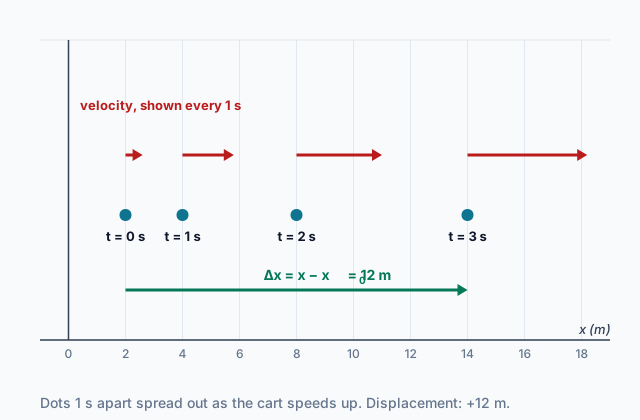 Tap to open the picture full size
Part 1 Think first There and back
Guess before you learn. A wrong guess still makes the answer stick.
Predict first
A swimmer swims one length of a 50 m pool and straight back to the wall she started from. The whole swim takes 80 seconds. What was her average velocity for the swim?
In short. Displacement is an object's change in position; average velocity is that displacement divided by the time interval, and average acceleration is the change in velocity divided by the time interval.
- In the object model you treat a moving thing as a single point that keeps its mass, and its displacement is , final position minus initial position.
- and are worked from the object's initial and final states, and the sign of each is its direction.
- An object is accelerating whenever the size or the direction of its velocity changes, and an average taken over a very short time interval is very close to the instantaneous value.
Part 2 Learn it Four ideas, with a check after each
2a. A point, and where it ends up
Before you describe motion, decide what is moving. A car has spinning wheels and passengers who shift in their seats, but if all you care about is where the car is on the road, none of that matters. The object model ignores an object's size, shape and internal configuration and treats it as a single point. That point still carries the object's mass (and its charge, if it has one), so a 1500 kg car modeled as an object is a 1500 kg point.
A point has one position, , measured along an axis you choose. Say where is and which way is positive.
Displacement is the change in position:
Here is where the object started and is where it ended. Final minus initial, every time. The cart in the diagram rolls from m to m, so m. Roll it back from 14 m to 2 m and m: the same size, the opposite direction. Displacement ignores the path in between. Only the start and the end count.
Quick check · Fill the statement
A freight train moves along a straight track, with east as the positive direction. It starts at m and stops at m. Tap a blank, then tap an answer.
Modeled as an object, the whole train is a single that keeps the train's . Its displacement is .
2b. Average velocity
Average velocity is displacement divided by the time interval in which it happens:
Along one axis you work with its component, , and its sign gives the direction.
You need two states of the object, the initial one and the final one: where it was and when, then where it is and when. is the length of the interval, the later clock reading minus the earlier one. It is not the clock reading itself.
Say a runner on a straight track is at m when the stopwatch reads 2 s, and at m when it reads 12 s. Then m and s, so m/s. The plus sign is the direction.
Average velocity is not average speed. Average speed is the total distance traveled divided by the time, a scalar that counts every meter of the path. If the runner had gone on to 90 m and jogged back to 70 m within the same 10 s, her distance would grow by 40 m, but her average velocity would still be m/s.
Quick check · Calculate
An elevator moves in a vertical shaft. Take up as positive, with positions measured from the ground floor. When a clock reads 4 s the elevator is at 30 m, and when the clock reads 12 s it is at 6 m. What is its average velocity over that interval?
2c. Average acceleration, and what accelerating means
Average acceleration is the change in velocity divided by the time interval in which it happens:
Along one axis that is .
with , final minus initial, signs included. A cyclist who goes from m/s to m/s in 3 s has , meters per second gained each second.
The sign of an acceleration is a direction. It does not tell you whether the object is speeding up. When the velocity and the acceleration point the same way, the object speeds up; when they point opposite ways, it slows down. A train braking while it moves in the positive direction has a negative acceleration.
An object is accelerating whenever its velocity changes, in size, in direction, or both. Take toward a wall as positive. A ball that hits the wall at m/s and bounces off at m/s has the same speed before and after, but its velocity changed by m/s, so it accelerated. A car holding a steady 20 m/s around a curve is accelerating too, because the direction of its velocity keeps turning.
Quick check · Decide and justify
Take east as positive. A car driving west speeds up from a velocity of m/s to m/s in 3 s. Is its average acceleration positive or negative?
Which reason supports your answer?
2d. Shrinking the interval
A speedometer shows how fast a car is going at one instant, not over a whole trip. That reading is an instantaneous value, and you can close in on it with the averages you already have.
A cart speeds up along a track. Here is its average velocity over shorter and shorter intervals, each starting at s.
| Interval | (m) | (s) | (m/s) |
|---|---|---|---|
| 2.0 s to 3.0 s | 6.0 | 1.0 | 6.0 |
| 2.0 s to 2.5 s | 2.75 | 0.5 | 5.5 |
| 2.0 s to 2.1 s | 0.51 | 0.1 | 5.1 |
| 2.0 s to 2.01 s | 0.0501 | 0.01 | 5.01 |
As the interval shrinks, the average settles toward 5 m/s. An average over a very small time interval is very close to the instantaneous value, so the cart's instantaneous velocity at 2.0 s is 5 m/s. Acceleration works the same way: average it over a tiny interval and you get very close to the instantaneous acceleration.
A long interval blurs everything that happens inside it. The 6.0 m/s over the whole second from 2.0 s to 3.0 s is too high, because the cart is going faster than 5 m/s for all of that second.
Quick check · Multiple choice
A ball rolls down a straight ramp, speeding up the whole way. You want its instantaneous velocity as it passes a chalk mark halfway down. Which measurement gives the value closest to it?
Part 3 Watch it done A dog runs out and back
Watch each step, then do the last one yourself.
A dog runs along a straight fence. Positions are measured from the house, and away from the house is positive. At the dog is at m. It runs out to 22 m, reaching it at s, then turns and trots back to 12 m, arriving at s. Find its average speed and its average velocity over the whole 5 s.
Step 1 · Model the dog
Its legs and tail do not matter here, so treat the dog as an object: one point at position . The three positions that matter are 4 m, 22 m and 12 m.
Step 2 · Distance and average speed
Distance adds up every meter run, whichever way: 18 m out and 10 m back is 28 m. Average speed is distance over time, m/s.
Why this step?
Why not divide that 28 m by 5 s to get the average velocity as well?
Velocity is a vector, and its average is built from displacement, the change in position from the first state to the last. The 10 m back cancels part of the 18 m out. Average speed counts both legs; average velocity only compares where the dog ended with where it began.
Your step · Calculate
Finish it. What is the dog's average velocity over the whole 5 s? Away from the house is positive.
m/s
Part 4 Try it New situations
Try it · Calculate
A hockey puck slides toward the boards at 8 m/s, hits them, and rebounds straight back at 6 m/s. It is in contact with the boards for 0.04 s. Take the direction toward the boards as positive. What is the puck's average acceleration during the contact?
Part 5 Explain it Derive it, then put numbers in
Nothing you type leaves this page. Check your answer against the model and each scoring point.
Free response is 50% of the exam score. This one is shaped like Question 1, Mathematical Routines.
Free-response practice · Question 1 style
A delivery van drives east along a straight highway; take east as positive. It covers a distance at a constant speed , then a second distance farther east at a constant speed . (a) Derive an expression for the van's average velocity over the whole trip, in terms of and . (b) Calculate the average velocity for m/s and m/s. (c) The driver says the average velocity must be 25 m/s, halfway between the two speeds. Explain whether the driver is right, using the time spent on each part of the trip.
Model answer
(a) The two parts take and , and the displacement is east. So , east. (b) m/s, east. (c) The driver is wrong. Each part is the same distance, so the van spends longer on the slower part: against . Average velocity is total displacement over total time, which weights each speed by the time spent at it, so the result sits closer to 20 m/s than 30 m/s and comes out below 25 m/s.
Score your own answer. This is a self-check, not a grade. Tick each point your answer makes.
Part 6 Check yourself A cyclist on a timed ride
The two case questions use the coach's table. Answer them from it.
A cyclist rides east along a straight, flat road; take east as positive. Her coach, standing beside the road with a stopwatch and a radar gun, records her position and her velocity every 4 seconds.
| (s) | (m) | (m/s) |
|---|---|---|
| 0 | 40 | 2 |
| 4 | 56 | 6 |
| 8 | 88 | 10 |
| 12 | 128 | 10 |
| 16 | 160 | 6 |
Case question 1 · Calculate
Using the coach's readings, what is the cyclist's average acceleration from s to s? East is positive.
Case question 2 · Multiple choice
Using the coach's readings, what is the cyclist's average velocity over the whole 16 s? East is positive.
The rest stand on their own and do not use the case.
Check yourself · Sort it
Tap a card, then say whether the object in it is accelerating.
Accelerating
Not accelerating
Check yourself · Spot the error
A city bus drives east along a straight street; take east as positive. It covers 3000 m in 300 s, waits 100 s at a stop, then covers 1000 m more in 100 s. A student works out the bus's average velocity for the whole trip. Tap the first line that goes wrong.
Part 7 Keep it Bring back earlier ideas
Pulling an older idea back up is what makes it last.
From 1.1 Scalars and Vectors in One Dimension · Multiple choice
Take right as positive. A cart rolls 3.0 m to the right, then 5.0 m to the left. What is the component of its total displacement?
From 1.1 Scalars and Vectors in One Dimension · Spot the error
Take right as positive. Cart P has m/s and cart Q has m/s. A student works out which cart is faster. Tap the first line that goes wrong.
In three lines
- Displacement is final position minus initial position, , and it ignores the path in between.
- Average velocity is and average acceleration is ; each sign is a direction, not a verdict on speeding up.
- An object accelerates whenever the size or direction of its velocity changes, and averages over tiny intervals approach instantaneous values.
Vocabulary
- Object model
- A model that ignores an object's size, shape and internal configuration and treats it as a single point that keeps properties such as its mass and charge.
- Displacement
- The change in an object's position, , final position minus initial position.
- Average velocity
- The displacement of an object divided by the time interval in which that displacement occurs, .
- Average acceleration
- The change in velocity divided by the time interval in which that change occurs, .
- Instantaneous velocity
- The velocity at a single instant, which an average velocity over a very small time interval comes very close to.
- Instantaneous acceleration
- The acceleration at a single instant, which an average acceleration over a very small time interval comes very close to.
Course alignment, for teachers
AP Physics 1: Algebra-Based topic 1.2, Unit 1: Kinematics.
- Skill 1.C: Create qualitative sketches of graphs that represent features of a model or the behavior of a physical system.
- Skill 2.B: Calculate or estimate an unknown quantity with units from known quantities, by selecting and following a logical computational pathway.
- Skill 2.C: Compare physical quantities between two or more scenarios or at different times and locations in a single scenario.
- Skill 3.C: Justify or support a claim using evidence from experimental data, physical representations, or physical principles or laws.
This lesson maps all 7 essential knowledge statements of the topic to the part that teaches each one: 7 are checked by a scored question. The map is in the lesson file.