Unit 1 · Topic 1.5 · about 30 minutes · 7 parts · 12 scored checks, 1 of them multiple choice
AP Physics 1: Algebra-Based 1.5: Vectors and Motion in Two Dimensions
 Tap to open the picture full size
Part 1 Think first Two coins off a table
Commit to a guess first. Being wrong now makes the right idea stick better.
Predict first
You stand at the edge of a table. At the same instant, you flick one coin so it shoots off the edge sideways, fast, and you let a second coin drop straight down from the same height. Air resistance is negligible. Which coin hits the floor first?
In short. Motion in two dimensions is handled by splitting each vector into perpendicular components and treating each direction as its own one-dimensional motion, with the same time in both.
- A vector is the resultant of two perpendicular components: with measured from the axis, and , and going back, and .
- Each component follows the one-dimensional kinematic equations on its own, and the time is the one quantity the two directions share.
- A projectile has and with up as positive, so never changes while changes by 10 m/s every second.
Part 2 Learn it Four short ideas, each checked as you go
2a. One vector, two perpendicular parts
On a flat page, any vector can be built from two perpendicular components, one along each axis of a coordinate system you choose. The vector is the resultant of its components: the single arrow you get by putting them tip to tail.
A drone flies from its launch pad to a point 30 m east and 40 m up. Its displacement is one arrow, 50 m long, slanting upward. With east as and up as , the same displacement is m and m. The one arrow and the two signed numbers say exactly the same thing.
You pick the axes, and any perpendicular pair works. Horizontal and vertical is the usual choice for something thrown. For a cart rolling down a ramp, axes along and across the ramp are often simpler, because then the cart's velocity has a component along the ramp only. Turn the axes and the components change, but the vector does not.
Two things you cannot do: take one component from each of two different coordinate systems, or forget the sign. Each component carries its direction in its sign, the way a velocity along a line did in 1.1.
Quick check · Decide and justify
A cart rolls down a straight ramp tilted 30° above the horizontal, moving at 4 m/s along the ramp. Ana takes as horizontal, in the direction the cart is heading, and as straight up. She writes the cart's velocity components as m/s and m/s. Ben takes as down the ramp and as perpendicular to the ramp, away from it. He writes m/s and . Who has described the cart's velocity correctly?
Which reason supports your answer?
2b. Sine, cosine and the right triangle
To split a vector into components, draw it as the long side of a right triangle whose two short sides lie along your axes. With the angle between the vector and side , and side across from that angle:
So the side next to the angle is , and the side across from it is . A ball thrown at 15 m/s, 40° above the horizontal, has m/s and m/s, taking forward and up as positive.
Cosine goes with the side next to the angle, not with every time. If the angle is measured from the vertical, the roles swap.
Going the other way, the Pythagorean relation gives the size and the tangent gives the direction. A velocity of 9 m/s east and 12 m/s north has a magnitude of m/s, pointing north of east. Keep your calculator in degree mode.
Quick check · Calculate
By lunchtime, a hiker's displacement from camp is 7.0 km east and 4.0 km north. Take east as and north as . At what angle north of east does her displacement point? Give your answer to the nearest degree.
2c. Two motions, one clock
Motion in two dimensions becomes manageable once you split it into components along perpendicular axes: each component behaves like the motion along a line from 1.3. The horizontal motion has its own , and . The vertical motion has its own , and . Use the kinematic equations for each, and never put an quantity into a equation.
The one thing the two motions share is time. A ball is in the air for one interval, and that same goes into both directions. So the usual plan is to find from whichever direction you know more about, then carry it to the other.
That is why the coins in Think first land together. Both start with , from the same height, with the same , so they have the same vertical equation, with up as positive. The flicked coin's sideways velocity appears only in its equation. It moves sideways while it falls, but it does not fall any more slowly.
Quick check · Calculate
A ball is thrown horizontally at 12 m/s from the top of a cliff 20 m above the level ground below. Air resistance is negligible. Take up as positive and the direction of the throw as . How far from the base of the cliff, measured horizontally, does the ball land? Give your answer to the nearest 0.1 m.
2d. Projectiles: steady sideways, accelerating down
Projectile motion is the special case of motion in two dimensions with zero acceleration in one direction and a constant, nonzero acceleration in the other. A thrown or kicked ball with negligible air resistance is the standard example. With horizontal and up as :
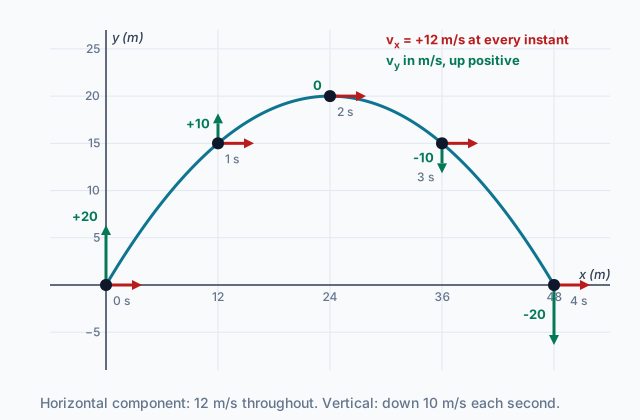
Horizontally, stays at for the whole flight, so . Vertically, the motion is the tossed ball of 1.3: drops by 10 m/s every second, on the way up, at the top and on the way down.
The diagram shows a ball launched with m/s and m/s. The horizontal arrow is the same length at every mark. The vertical arrow shrinks, vanishes at 2 s, then grows downward.
At the top, but is still 12 m/s. The velocity there is horizontal and as small as it gets during the flight, but it is not zero. Only a ball thrown straight up stops at the top. The top is also where you find the greatest height: put into .
Quick check · Sketch the graph
A ball is thrown at 20 m/s, 30° above the horizontal, from the top of a 40 m cliff, and lands on the ground below 4 s later. Air resistance is negligible. Take up as positive. Sketch the vertical component of the ball's velocity, , against time from 0 to 4 s.
One shape that fits
Drag a point up or down, or tap it and use the arrow keys. The shape is checked, and the graph must pass through the values the question gives.
Part 3 Watch it done A kick from launch to landing
Watch each step, then do the last one yourself.
A soccer ball is kicked from level ground at 20 m/s, 30° above the horizontal, and lands back on the ground. Air resistance is negligible. Take forward as and up as . How far from the kick does it land?
Step 1 · Split the launch velocity
m/s and m/s. From here on, the two directions are worked separately.
Step 2 · Use the vertical motion to find the time
Vertically, , and the ball lands at the height it started, so : . The root is the kick itself, so the ball lands at s.
Why this step?
Why does the horizontal component, 17.3 m/s, play no part in finding the time?
Because how long the ball stays up is set by the vertical motion alone: how fast it starts upward, and gravity, which acts only vertically. The forward speed changes where the ball lands, not when.
Step 3 · Plan the horizontal motion
Horizontally, , so stays at 17.3 m/s for the whole flight, and with the same the vertical motion gave.
Your step · Calculate
Finish it. A soccer ball is kicked from level ground at 20 m/s, 30° above the horizontal, and lands back on the ground. Air resistance is negligible. Take forward as and up as . How far from the kick does it land? Give your answer to the nearest meter.
m
Part 4 Try it Launch it at an angle
Try it · Sort it
A ball is launched at an angle from level ground and lands at the height it started from. Air resistance is negligible. Tap each quantity, then whether it stays the same for the whole flight or changes.
Stays the same
Changes
Part 5 Explain it Design it, graph it, read the slope
Nothing you type leaves this page.
Free response is 50% of the exam score. This one is shaped like Question 3, Experimental Design and Analysis.
Free-response practice · Question 3 style
A student wants to measure by rolling a ball off a table. She releases a steel ball from different points on a short ramp on the tabletop, so it leaves the table horizontally at different speeds. She has a photogate, a meterstick, a caliper and a sheet of carbon paper.
(a) Describe a procedure she could follow to measure the ball's launch speed and how far from the table it lands, for several launch speeds. Say what she measures, with which equipment, and how she gets the launch speed. Give enough detail that another student could repeat it.
(b) She plots the landing distance on the vertical axis against the launch speed on the horizontal axis. Explain why the points should fall on a straight line through the origin, and what physical quantity the slope of that line represents.
(c) Her best-fit line has a slope of 0.41 s, and the tabletop is 0.84 m above the floor. Calculate the value of her data give.
(d) Her photogate's beam crosses the ball a little below its center, so the ball blocks the beam over a chord shorter than its diameter. She still divides the diameter by the blocking time. Explain whether this makes her value of from (c) too large or too small.
Model answer
(a) Fix the photogate at the table edge, with its beam at the height of the ball's center, so the ball passes through it just before it leaves. Measure the ball's diameter with the caliper. The photogate measures the time the ball blocks its beam, and the launch speed is . Measure the table's height with the meterstick. Tape carbon paper to the floor where the ball lands so each landing leaves a mark, and measure with the meterstick from the point on the floor directly below the edge, found by holding the meterstick upright against the edge, to the mark. Release the ball from at least five different points on the ramp, three trials from each, and average and for each point.
(b) After the ball leaves the edge, and for every launch, so its fall time depends only on the height, not on . Horizontally , so . With the same for every launch, is proportional to : a straight line through the origin whose slope is , the time the ball is in the air.
(c) The vertical motion gives , so , about .
(d) The beam is blocked for less time than it takes the ball to move one full diameter, so every is too short and every is too high by the same factor. Each is real, so every point moves right by that factor and the slope comes out smaller than the true fall time. A smaller in gives a value of that is too large.
Score your own answer. This is a self-check, not a grade. Tick each point your answer makes.
Part 6 Check yourself A ball across the gym
Both case questions use the gym ball's position table.
A student films a ball kicked across a gym and reads its position from the video every 0.4 s. The ball leaves the floor at and lands on the floor again. Positions are measured from the launch point, with forward as and up as . Air resistance is negligible.
| Time (s) | Horizontal position x (m) | Height y (m) |
|---|---|---|
| 0 | 0 | 0 |
| 0.4 | 2.4 | 2.4 |
| 0.8 | 4.8 | 3.2 |
| 1.2 | 7.2 | 2.4 |
| 1.6 | 9.6 | 0 |
Case question 1 · Calculate
Using the gym ball's position table, with forward as and up as , what is the ball's speed at s?
Case question 2 · Multiple choice
Using the gym ball's position table, with forward as and up as , at what angle above the horizontal was the ball launched?
The rest stand on their own and do not use the case.
Check yourself · Spot the error
A ball rolls off a table 1.8 m high and leaves the edge horizontally at 4 m/s. Air resistance is negligible. Take up as positive and the ball's direction of travel as . A student works out how far from the table the ball lands. Tap the first line that goes wrong.
Check yourself · Match
A ball is thrown at 12 m/s from the edge of a flat roof, in five different directions, each one either toward the street or straight up. Take as horizontal, toward the street, and as up. Tap each throw, then the components of its launch velocity.
Part 7 Keep it Bring back earlier ideas
Pulling an older idea back up is what makes it last.
From 1.3 Representing Motion · Sketch the graph
A ball is tossed straight up at 20 m/s and caught 4 s later at the height it left your hand. Air resistance is negligible. Take up as positive. Sketch the ball's velocity against time from 0 to 4 s. The first point is fixed at 20 m/s.
One shape that fits
Drag a point up or down, or tap it and use the arrow keys. The shape is checked, and the graph must pass through the values the question gives.
From 1.1 Scalars and Vectors in One Dimension · Decide and justify
Take right as positive. A cart rolls to the left at 4 m/s. Lena writes its velocity as m/s. Jordan says she must also put an arrow over the , or her answer has no direction. Who is right?
Which reason supports your answer?
In three lines
- A vector is the resultant of perpendicular components; sine and cosine split it, and the Pythagorean relation and tangent put it back together.
- Motion in two dimensions is two one-dimensional motions, one per component, sharing the same time.
- A projectile keeps a constant while changes by 10 m/s each second, so at the top its velocity is horizontal, not zero.
Vocabulary
- Resultant
- The single vector that two or more vectors add up to, tip to tail; a vector is the resultant of its perpendicular components.
- Perpendicular components
- The two parts of a vector along a pair of axes at right angles, each a signed number that together rebuild the vector.
- Coordinate system
- The pair of perpendicular axes, each with a positive direction, that you choose for resolving vectors; the components depend on it, the vector does not.
- Motion in two dimensions
- Motion that is not along one line, analyzed by separating it into components and applying the one-dimensional kinematic relationships to each.
- Projectile motion
- Motion in two dimensions with zero acceleration in one dimension and constant, nonzero acceleration in the other, such as a ball moving under gravity alone.
Course alignment, for teachers
AP Physics 1: Algebra-Based topic 1.5, Unit 1: Kinematics.
- Skill 1.B: Create quantitative graphs with appropriate scales and units, including plotting data.
- Skill 2.A: Derive a symbolic expression from known quantities by selecting and following a logical mathematical pathway.
- Skill 2.D: Predict new values or factors of change of physical quantities using functional dependence between variables.
- Skill 3.A: Create experimental procedures that are appropriate for a given scientific question.
- Skill 3.C: Justify or support a claim using evidence from experimental data, physical representations, or physical principles or laws.
This lesson maps all 5 essential knowledge statements of the topic to the part that teaches each one: 5 are checked by a scored question. The map is in the lesson file.