Unit 3 · Topic 3.5 · about 30 minutes · 7 parts · 12 scored checks, 2 of them multiple choice
AP Physics 1: Algebra-Based 3.5: Power
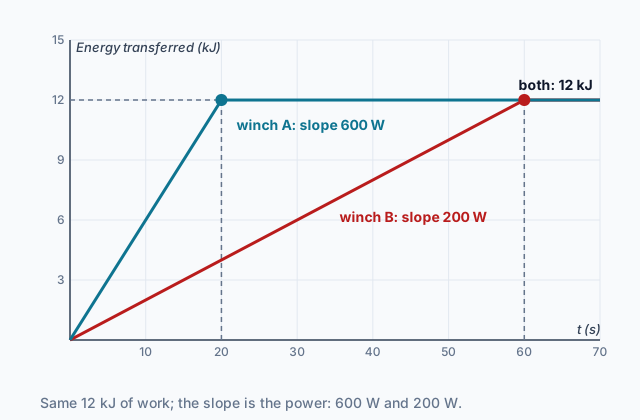 Tap to open the picture full size
Part 1 Think first Walking or jogging with a sled
Commit to a guess first. Being wrong now makes the right idea stick better.
Predict first
You drag a loaded sled across level snow with a rope held horizontally, always pulling with a steady 50 N. First you walk, and the sled moves at a steady 1.0 m/s. Then you jog, and it moves at a steady 2.0 m/s. In each second, how does the energy your pull transfers to the sled while you jog compare with while you walk?
In short. Power is the rate at which a system's energy changes, by transfer into or out of the system or by conversion from one type to another within it, measured in watts, joules per second.
- Average power is the energy transferred or converted divided by the time it took, , which is also the total work done divided by that time, .
- At one instant, a constant force delivers power , where is the angle between the force and the object's velocity.
- The same job done in less time takes the same energy at a greater power, so work and power answer different questions.
Part 2 Learn it Three short ideas, each checked as you go
5a. Power is a rate
Power is the rate at which energy changes: how many joules move each second. Its unit is the watt, and 1 W is 1 J/s. A kilowatt, 1 kW, is 1000 W.
Power always describes energy changing for some system, so name the system first. The energy can be transferred into it. A rope that pulls a sled faster across ice does positive work on the sled and puts energy in. It can be transferred out. Friction from the snow on a sled that is slowing down takes energy out. Or it can be converted from one type to another inside the system, with nothing crossing its boundary. Take a ball and Earth as the system, and as the ball falls, the system's gravitational potential energy turns into kinetic energy. How fast that happens is a power too.
The same change can happen quickly or slowly. Lifting a box onto a shelf in one second or in ten takes the same energy, but the quick lift moves it at ten times the rate.
Quick check · Sort it
Each card names a system and something happening to it. Tap a card, then say how the system's energy is changing.
Transferred into the system
Transferred out of the system
Converted within the system
5b. Average power
Average power is the energy transferred or converted, divided by the time it took:
When a force does the transferring, the energy it moves is its work from 3.2 Work. So average power is also the total work done divided by the time it took:
The graph at the top of the page shows two winches, each lifting a 150 kg pallet 8.0 m at a steady speed. Each cable pulls with the pallet's weight, 1500 N, through 8.0 m, so each does J of work. Winch A takes 20 s, an average of 600 W. Winch B takes 60 s, 200 W. On a graph of energy against time, the slope is the power. A faster winch does no more work on the same job; it does the work sooner.
The energy can be of any type. A sprinter who gains 2400 J of kinetic energy in the first 3.0 s of a race gains it at an average of 800 W.
Quick check · Calculate
A 1200 kg car speeds up along a level road from 10 m/s to 20 m/s in 6.0 s. What is the average rate at which the car's kinetic energy increases? Give your answer in kilowatts.
5c. Power at one instant
Average power covers a stretch of time. Sometimes you want the power at one instant. Over a very short time , a constant force does work , so the rate is , and over a very short time is the speed at that instant. The instantaneous power delivered to an object by a constant force is
Here is the angle between the force and the object's velocity, and only the part of the force along the velocity counts.
Push a shopping cart with 30 N in the direction it rolls. At 1.5 m/s your push delivers W. Push just as hard when it rolls at 3.0 m/s and you deliver 90 W, because each second your hands go twice as far. So when the speed changes, the power of a constant force changes too, and the power at one instant can differ from the average.
The angle works as it did for work. Friction on a sliding box points opposite the velocity, , so its power is negative: energy is leaving the box. A force perpendicular to the velocity delivers zero power.
Quick check · Multiple choice
A child pulls a wagon along a level sidewalk with a constant 40 N force along its handle, which is tilted 60 degrees above the horizontal. At one instant the wagon moves at 1.5 m/s. At what rate is the child's pull doing work on the wagon at that instant?
Part 3 Watch it done A sled pulled across ice
Watch each step, then finish the problem yourself.
A 20 kg sled sits at rest on smooth, level ice, where friction is negligible. A student pulls it with a horizontal rope, with a steady 40 N, for 4.0 s. Take the direction of the pull as positive. Find the average power the rope delivers over the 4.0 s, and the instantaneous power it delivers at the end of the 4.0 s.
Step 1 · Find the motion
With friction negligible, the rope's pull is the only horizontal force, so m/s². Starting from rest, after 4.0 s the sled moves at m/s and has gone m.
Step 2 · Average power from the work
The pull points along the displacement, so J. Then W. As a check, the sled's kinetic energy rose from 0 to J, the same energy.
Why this step?
The pull is the same 40 N for the whole 4.0 s. Why does the rope not deliver 160 W at every moment?
Power from a force depends on how fast the point where it pulls is moving. At the start the sled is at rest, so the pull delivers no power at all. As the sled speeds up it covers more distance each second, so the same pull does more work each second than the second before. The 160 W is the average over the whole pull.
Step 3 · Set up the instantaneous power
At the end of the 4.0 s the pull is still parallel to the velocity, so and , with the speed at that instant.
Your step · Calculate
Finish it. A 20 kg sled starts at rest on smooth, level ice, where friction is negligible. A horizontal rope pulls it with a steady 40 N for 4.0 s, and at the end of the 4.0 s the sled moves at 8.0 m/s in the direction of the pull. What is the instantaneous power the rope delivers to the sled at that moment?
W
Part 4 Try it A box slowing to a stop
A new situation: a force taking energy out while the speed falls. Friction is constant, but the speed is not, so think about what that does to the power before you draw. Then practice average and instantaneous power with new numbers each time.
Try it · Sketch the graph
A 2.0 kg box slides across a rough, level floor. It starts at 6.0 m/s, and kinetic friction from the floor exerts a constant 4.0 N on it, so it slows steadily and stops after 3.0 s. Sketch the rate at which friction takes energy out of the box against time, from 0 to 3.0 s.
One shape that fits
Drag a point up or down, or tap it and use the arrow keys. The shape is checked, and the graph must pass through the values the question gives.
Part 5 Explain it Claim, derive, connect
Nothing you type leaves this page. Check your answer against the model and each scoring point.
Free response is 50% of the exam score. This one is shaped like Question 4, Qualitative/Quantitative Translation.
Free-response practice · Question 4 style
A motor lifts crates straight up with a cable, each through the same height , at a constant speed. The motor always delivers the same power to the crate it is lifting. Crate 1 has mass and Crate 2 has mass . Ignore the brief speeding up and slowing down at the ends of each lift, and ignore air resistance.
(a) Make a claim about how the time the motor takes to lift Crate 2 through compares with the time for Crate 1, and how Crate 2's speed compares with Crate 1's. Explain your reasoning in words, without equations.
(b) Starting from , derive an expression for the time the motor takes to lift a crate of mass through , in terms of , , and physical constants, as appropriate.
(c) Starting from , derive an expression for the constant speed of a crate of mass , in terms of , and physical constants, as appropriate.
(d) Explain how your expressions in (b) and (c) are consistent with your claim in (a).
(e) A classmate says a motor with twice the power would do twice as much work lifting Crate 1 through . Use your reasoning in (b) to explain whether the classmate is correct.
Model answer
(a) Crate 2 takes twice as long, and it rises at half the speed. Raising twice the mass through the same height needs twice as much energy, and the motor supplies energy at the same rate, so it needs twice the time. To keep the heavier crate moving at a constant speed, the cable has to pull twice as hard. The same rate of energy transfer with twice the force means the crate covers half the distance each second. Put another way, it rises the same height in twice the time, so its speed is half.
(b) Take the crate and Earth as the system. The speed is constant, so the kinetic energy does not change, and the energy the cable transfers goes into gravitational potential energy: . Then .
(c) At constant speed the net force on the crate is zero, so the cable's force is , upward, parallel to the velocity, with . Then , so .
(d) In (b), is proportional to : Crate 2 gives , twice Crate 1's . In (c), is inversely proportional to : Crate 2 gives , half of Crate 1's . Both match the claim. The two expressions also agree with each other, since .
(e) The classmate is not correct. The work needed is whatever the motor, because it depends only on the mass and the height. Twice the power does that same work in half the time: .
Score your own answer. This is a self-check, not a grade. Tick each point your answer makes.
Part 6 Check yourself A stair test
Both case questions use the stair-test table.
A gym class runs a stair test. Each student runs up the same staircase, which rises 6.0 m vertically, and a coach times the climb. For each student, count only the gain in gravitational potential energy of the student-Earth system, and ignore any change in kinetic energy.
| Student | Mass (kg) | Time to climb (s) |
|---|---|---|
| Priya | 48 | 4.0 |
| Marcus | 80 | 7.0 |
| Lena | 65 | 5.0 |
| Owen | 70 | 6.5 |
Case question 1 · Calculate
Using the stair-test table, for a staircase that rises 6.0 m: what is the average rate at which the gravitational potential energy of the Priya-Earth system increases while Priya climbs?
Case question 2 · Multiple choice
Using the stair-test table, for a staircase that rises 6.0 m: which student increases the gravitational potential energy of the student-Earth system at the greatest average rate?
The rest stand on their own and do not use the case.
Check yourself · Spot the error
A rope pulls a sled across smooth, level ice with a constant 60 N force, tilted 30 degrees above the horizontal. A student finds the power the rope delivers to the sled at two moments. Tap the first line that goes wrong.
Check yourself · Match
Tap each situation, then the power your hands deliver to the box or cart.
Check yourself · Decide and justify
Two cranes lift identical 500 kg loads of steel at a steady speed from the ground to the top of the same 30 m building. Crane X takes 40 s and crane Y takes 60 s. Which crane's cable does more work on its load?
Which reason supports your answer?
Part 7 Keep it Bring back earlier ideas
Pulling an older idea back up is what makes it last.
Two jobs the lesson has not shown. In the first, decide the sign of the work before you work out its size. In the second, the pull on a sled changes partway, and you track how the work piles up meter by meter.
From 3.2 Work · Calculate
A mover lowers a 30 kg box 2.0 m straight down at a steady speed, using a rope tied to the top of the box. How much work does the rope do on the box? Include the sign.
A new situation: two objects moving opposite ways at the same time. Two skaters glide toward each other across smooth ice, one heading east and one heading west. Decide what their kinetic energies add up to as one system. Then practice the kinetic energy of a single object with new numbers each time.
From 3.1 Translational Kinetic Energy · Calculate
Two skaters glide toward each other on smooth ice. Take east as positive. A 50 kg skater moves east at 3.0 m/s, and a 40 kg skater moves west at 4.0 m/s. What is the total translational kinetic energy of the two skaters? Give your answer to the nearest joule.
In three lines
- Power is the rate at which a system's energy changes, by transfer in or out or by conversion within it, in watts, joules per second.
- Average power is the energy transferred or converted, or the work done, divided by the time: .
- A constant force delivers instantaneous power , which changes whenever the speed does.
Vocabulary
- Power
- The rate at which energy changes with respect to time, either by transfer into or out of a system or by conversion from one type to another within a system, measured in watts (joules per second).
- Average power
- The amount of energy transferred or converted divided by the time the transfer or conversion took, , which is also the total work done divided by that time.
- Instantaneous power
- The power at a single instant; for a constant force on an object, the force's component parallel to the object's velocity times the speed, .
Course alignment, for teachers
AP Physics 1: Algebra-Based topic 3.5, Unit 3: Work, Energy, and Power.
- Skill 1.B: Create quantitative graphs with appropriate scales and units, including plotting data.
- Skill 2.A: Derive a symbolic expression from known quantities by selecting and following a logical mathematical pathway.
- Skill 2.C: Compare physical quantities between two or more scenarios or at different times and locations in a single scenario.
- Skill 3.A: Create experimental procedures that are appropriate for a given scientific question.
- Skill 3.C: Justify or support a claim using evidence from experimental data, physical representations, or physical principles or laws.
This lesson maps all 4 essential knowledge statements of the topic to the part that teaches each one: 4 are checked by a scored question. The map is in the lesson file.