Unit 3 · Topic 3.4 · about 30 minutes · 7 parts · 12 scored checks, 1 of them multiple choice
AP Physics 1: Algebra-Based 3.4: Conservation of Energy
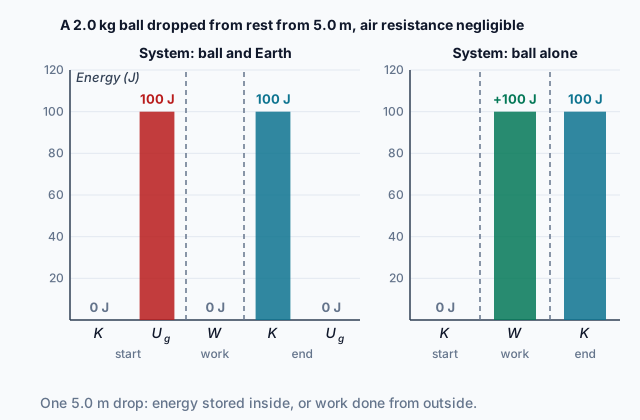 Tap to open the picture full size
Part 1 Think first A bowling ball on a rope
Commit to a guess first. Being wrong now makes the right idea stick better.
Predict first
A bowling ball hangs from a long rope tied to the ceiling. You pull it back until it just touches the tip of your nose, let it go from rest without a push, and stand perfectly still. It swings across the room and back toward you. Air resistance on the ball is small, but it is not zero. What happens when the ball comes back?
In short. Energy is conserved in every interaction, and whether a system's own energy stays constant depends on which objects you put in the system.
- A system of one object can have only kinetic energy; a system whose objects interact through conservative forces, or that changes shape and springs back, can have potential energy too, and is its mechanical energy.
- A change in one kind of energy inside a system is balanced by changes in the others, or by energy crossing the boundary as work, and the system's total changes by exactly what crosses.
- With no work done on it from outside and no nonconservative forces inside it, a system's mechanical energy is constant; friction inside a system turns mechanical energy into thermal energy and sound.
Part 2 Learn it Four short ideas, each checked as you go
2a. What a system can hold
Start with the smallest system there is, a single object. A baseball on its own can have kinetic energy and nothing else. Potential energy, as you saw in 3.3 Potential Energy, is stored in the arrangement of two or more objects, and one object has nothing to be arranged with. Earth still pulls on the lone baseball, but Earth is outside that system. A single object here means one rigid thing that cannot change shape; a spring or a trampoline mat on its own can store energy in its shape, so it is better treated as a system of parts.
Put Earth in the system and the pair can also have gravitational potential energy. A system can have potential energy when its objects interact through conservative forces, such as gravity or an ideal spring's force, or when it changes shape and springs back, the way a trampoline mat stretches under a gymnast and returns.
The sum of a system's kinetic and potential energies is its mechanical energy:
Count every term the system has. A block bouncing on a vertical spring, with the spring and Earth in the system, has three: the block's kinetic energy, the spring's elastic potential energy, and the gravitational potential energy of the block and Earth.
Quick check · Match
Tap each system, then all the kinds of energy it can have.
2b. Trading one kind for another
Inside a system, energy changes from one kind to another. Any change in one kind is balanced by an equal and opposite change in the others, or by energy crossing into or out of the system.
When no work is done on the system from outside, and nothing inside it acts as a nonconservative force (no friction, no air resistance), nothing crosses and nothing is dissipated. Then the mechanical energy stays constant:
The diagram at the top of the page follows a 2.0 kg ball dropped from rest from 5.0 m, with air resistance negligible. Take the ball and Earth as the system, with at the ground. At the top, and J. Just before it lands, , so J and m/s. Halfway down it has 50 J of each. Every joule of potential energy the system gives up shows up as kinetic energy.
If the object is already moving at the start, its starting kinetic energy goes on the left side too.
Quick check · Calculate
A child on a sled, 30 kg together, is moving at 3.0 m/s at the top of an icy slope, then slides down to the bottom, 1.8 m lower. Friction and air resistance are negligible. Take the sled, the child and Earth as the system. What is the sled's speed at the bottom of the slope? Give your answer to the nearest 0.1 m/s.
2c. The system decides
Whether a system's energy stays constant depends on what you put inside it. The diagram at the top of the page shows the same 5.0 m drop as energy bar charts for two systems. With the ball and Earth, the 100 J of gravitational potential energy becomes 100 J of kinetic energy, and the work column is empty. With the ball alone, there is no potential energy to draw. Earth is outside, so its pull does J of work on the ball, and that work is energy entering the system.
Both charts are right. Energy is conserved in every interaction; the choice of system changes how you count it. If the work done on a system is not zero, energy is transferred between the system and its environment, and the system's total energy changes by exactly the amount transferred. If you want a system whose total energy is constant, choose one that contains everything that interacts.
So count gravity once. With Earth in the system, gravity shows up as a change in . With Earth outside, it shows up as work.
Quick check · Decide and justify
A crate slides from rest down a smooth ramp, where friction and air resistance are negligible. Take the crate and Earth as the system; the ramp is outside it. How does the system's mechanical energy change as the crate slides down?
Which reason supports your answer?
2d. Where mechanical energy goes
Slide a hockey puck across rough concrete and it slows down and stops. Take the puck and the concrete as the system. The puck's kinetic energy drops to zero, and nothing in the system stores it as potential energy, so the system's mechanical energy goes down.
The energy has not vanished. Kinetic friction between the puck and the concrete is a nonconservative force, and it turns the mechanical energy into thermal energy, warming both surfaces a little, and into the scraping sound you hear. That is what friction and air resistance do: they dissipate mechanical energy as thermal energy or sound. Count the thermal energy and the sound, and the total energy of the puck, the concrete and the air around them is the same at the end as at the start.
So a system's mechanical energy stays constant only when no work is done on it from outside and no nonconservative forces act inside it. Energy is conserved in every interaction, but a system's own total stays constant only if none of that energy leaves it. The scraping sound travels out through the air, which is outside the puck-and-concrete system, so that system's total energy drops too, by exactly the energy the sound carries away.
Quick check · Sort it
Each card describes a motion and names a system. Tap a card, then what happens to that system's mechanical energy.
Stays constant
Changes because of work from outside
Is dissipated inside the system
Part 3 Watch it done A spring launches a block up a ramp
Watch each step, then finish the problem yourself.
A 0.25 kg block rests against an ideal spring with spring constant 500 N/m, on a level floor that curves smoothly up into a ramp. The spring is compressed 0.12 m from its relaxed length and then released, and the block slides up the ramp. Friction and air resistance are negligible. Take up as positive. How high above the floor does the block rise before it stops?
Step 1 · Choose the system
Take the block, the spring and Earth. The floor and the ramp push at right angles to the block's motion, so they do no work on the system, and with friction negligible nothing inside it is nonconservative. The system's mechanical energy is constant.
Why this step?
Why put the spring and Earth inside the system instead of leaving them out?
Inside, each one's effect is a stored energy, or , and no work crosses the boundary, so one equation covers the whole trip. Left outside, each would do work on the block, and the spring's push weakens as it extends, so its work would need the area under a changing force.
Step 2 · Mechanical energy at the start
The block is at rest, so . Put at floor level. The spring stores J, so the mechanical energy is 3.6 J.
Step 3 · Mechanical energy at the highest point
The block has left the spring, which is back at its relaxed length, so . At its highest point the block stops for an instant, so . All 3.6 J is now gravitational: J.
Your step · Calculate
Finish it. A 0.25 kg block on a level floor is pressed against an ideal spring with spring constant 500 N/m, compressing it 0.12 m from its relaxed length. Released, it slides along the floor, which curves smoothly up into a ramp. Friction and air resistance are negligible. Take up as positive. How high above the floor does the block rise before it stops? Give your answer to the nearest 0.01 m.
m
Part 4 Try it Following the fall
A new view of a fall. Instead of comparing the two ends, follow the energy meter by meter on the way down. Then practice with a falling stone or a spring launch, with new numbers each time.
Try it · Sketch the graph
A 0.50 kg ball is dropped from rest from 8.0 m above the ground, with air resistance negligible. Take the ball and Earth as the system. Sketch the ball's kinetic energy against the distance it has fallen, from 0 to 8.0 m. The first point is fixed at 0.
One shape that fits
Drag a point up or down, or tap it and use the arrow keys. The shape is checked, and the graph must pass through the values the question gives.
Part 5 Explain it Design a test, then read the slope
Nothing you type leaves this page. Check your answer against the model and each scoring point.
Free response is 50% of the exam score. This one is shaped like Question 3, Experimental Design and Analysis.
Free-response practice · Question 3 style
A student wants to test whether the mechanical energy of a glider-Earth system stays constant as a glider slides down a tilted air track. Air blown through small holes in the track lifts the glider, so friction is negligible, and air resistance is negligible too. One end of the track is raised on blocks, and a thin card stands upright on top of the glider. She has a photogate, a meterstick and a ruler. Use m/s².
(a) Describe a procedure she could follow to measure the glider's speed as it passes the photogate and the vertical distance it has dropped to get there, for at least five release points, with repeated runs at each. Say what she measures, with which equipment, and give enough detail that another student could repeat it.
(b) Take the glider and Earth as the system. Explain why its mechanical energy should stay constant, then derive an expression for in terms of and for a glider released from rest. Say which graph should be a straight line, and what its slope should be.
Her averaged results for five release points:
- m, m/s
- m, m/s
- m, m/s
- m, m/s
- m, m/s
(c) On paper, calculate for each run, plot against and draw a best-fit line. Calculate its slope, and explain whether her data support the claim that the system's mechanical energy stays constant.
(d) Her partner uses the same release points and the same photogate, but for each run he records the distance the glider travels along the track instead of the vertical drop. Explain whether the slope of his graph is larger than, smaller than or equal to hers, and what he would conclude about the mechanical energy.
Model answer
(a) Raise one end of the track and fix the photogate near the low end. Measure the card's width with the ruler. Mark a release point. With the meterstick, measure the height of the glider's top edge above the table at the mark and again with the card in the photogate's beam; the difference is . Hold the glider still at the mark and let go without pushing. The photogate records the time the card blocks its beam, and . Do three runs from each mark and average them, for at least five release points.
(b) The track's push on the glider is perpendicular to its motion, so it does no work, and with friction and air resistance negligible nothing nonconservative acts. Gravity acts inside the system. No work is done on the system from outside, so its mechanical energy is constant. Released from rest, , so . A graph of against should be a straight line through the origin with slope .
(c) The values of are 0.98, 2.02, 2.96, 4.04 and 4.93 m²/s². The points lie close to one straight line through the origin. Two points on my best-fit line, not data points, are and , so the slope is . That is within about 1 percent of , so the data support the claim: the kinetic energy the glider gains matches the potential energy the system loses.
(d) Smaller. On a tilted track the glider travels farther along the track than it drops, by the same factor on every run. His speeds are the same as hers, so every point moves to the right by that factor, and the slope comes out less than 20 m/s². He would wrongly conclude that the system loses mechanical energy on the way down.
Score your own answer. This is a self-check, not a grade. Tick each point your answer makes.
Part 6 Check yourself A block on a rough ramp
Both case questions use the ramp table.
A 2.0 kg wooden block is released from rest at point P on a rough, curved ramp and slides down to point R on the floor, passing point Q on the way. Speed sensors record its speed at each point. Air resistance and sound are negligible.
| Point | Height above the floor (m) | Speed (m/s) |
|---|---|---|
| P | 3.0 | 0.0 |
| Q | 1.0 | 5.0 |
| R | 0.0 | 6.0 |
Case question 1 · Calculate
Using the ramp table, with up as positive and the gravitational potential energy zero at floor level: what is the change in the mechanical energy of the block-Earth system as the 2.0 kg block goes from P to R? Include the sign.
Case question 2 · Multiple choice
Using the ramp table: which choice of system has a total energy that stays the same as the block slides from P to R?
The rest stand on their own and do not use the case.
Check yourself · Spot the error
A 0.50 kg stone is dropped from rest from a cliff 20 m above a lake, with air resistance negligible. A student works out how fast it hits the water. Tap the first line that goes wrong.
Check yourself · Fill the statement
A book slides across a table and comes to a stop. Take the book, the table and the room around them as the system. Tap a blank, then an answer.
As the book slows, the system's mechanical energy , and its total energy . The difference between its mechanical energy at the start and at the end has become .
Part 7 Keep it Bring back earlier ideas
Pulling an older idea back up is what makes it last.
From 3.2 Work · Fill the statement
Tap a blank, then an answer.
When a box is carried from the floor up to a shelf and back down to the floor, the total work gravity does on it is . When a box is slid across a floor and back to where it started, the total work friction does on it is . A force whose work depends only on where a system starts and ends is , and only a force like that has a that goes with it.
From 3.3 Potential Energy · Fill the statement
A spring toy has an ideal spring. Tap a blank, then an answer.
Compressing the spring 3 cm stores stretching it 3 cm. Compressing it 9 cm stores as much energy as compressing it 3 cm. With the zero at its relaxed length, the energy the spring stores is never .
In three lines
- A single object has only kinetic energy; a system of interacting objects can also have potential energy, and is its mechanical energy.
- Energy is conserved in every interaction: a change in one kind is balanced inside the system or by work crossing its boundary.
- With no work from outside and no friction inside, mechanical energy is constant; friction inside turns it into thermal energy and sound.
Vocabulary
- Mechanical energy
- The sum of a system's kinetic and potential energies, .
- Conservation of energy
- The principle that energy is conserved in all interactions, so any change in a system's energy is balanced by other changes inside it or by energy transferred across its boundary.
- Nonconservative force
- A force, such as friction or air resistance, whose work depends on the path and which dissipates mechanical energy as thermal energy or sound.
Course alignment, for teachers
AP Physics 1: Algebra-Based topic 3.4, Unit 3: Work, Energy, and Power.
- Skill 1.A: Create diagrams, tables, charts, or schematics to represent physical situations.
- Skill 2.A: Derive a symbolic expression from known quantities by selecting and following a logical mathematical pathway.
- Skill 2.C: Compare physical quantities between two or more scenarios or at different times and locations in a single scenario.
- Skill 3.C: Justify or support a claim using evidence from experimental data, physical representations, or physical principles or laws.
This lesson maps all 9 essential knowledge statements of the topic to the part that teaches each one: 9 are checked by a scored question. The map is in the lesson file.