Unit 7 · Topic 7.3 · about 30 minutes · 7 parts · 13 scored checks, 1 of them multiple choice
AP Physics 1: Algebra-Based 7.3: Representing and Analyzing SHM
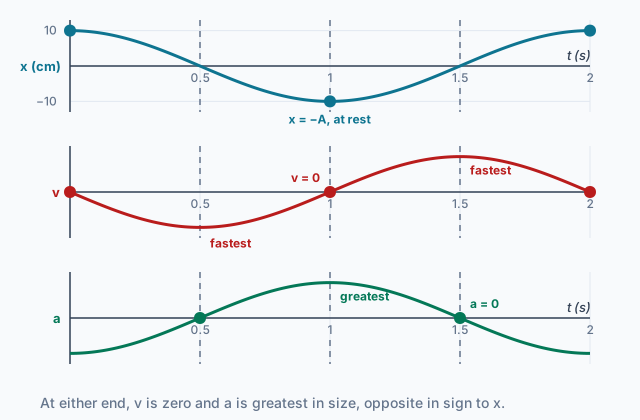 Tap to open the picture full size
Part 1 Think first Two blocks, two pulls
Commit to a guess first. Being wrong now makes the right idea stick better.
Predict first
Two identical blocks sit on a level, frictionless track, each joined to an identical spring. You pull one block 2 cm from where it rests and the other 6 cm, then let go of both at the same instant. Which block passes through its resting position first?
In short. In simple harmonic motion the displacement from equilibrium follows or , and the displacement, velocity and acceleration each reach a maximum, a minimum and zero at predictable places in every cycle.
- Cosine fits an object released from rest at ; sine fits one passing through equilibrium in the positive direction at . The angle is in radians.
- At either end the velocity is zero and the acceleration has its greatest magnitude, opposite in sign to ; through equilibrium the speed is greatest and the acceleration is zero.
- On a graph the period is the time between two points where the object is at the same place moving the same way, such as two peaks, not two zero crossings in a row. The amplitude is the height of a peak above the axis, and the velocity is the slope of the position graph.
Part 2 Learn it Four ideas about one oscillation, each checked as you go
2a. An equation for where the object is
An object in simple harmonic motion moves back and forth about its equilibrium position, where the net force on it is zero. Measure its displacement from there, not from the end of the track or the wall. The largest displacement it reaches is the amplitude, .
The displacement follows one of two equations:
Here is the frequency from 7.2 Frequency and Period of SHM, and one full cycle takes . Which equation fits depends on where the object is when the clock starts. Cosine starts at its largest value, , so it describes an object released from rest at . Sine starts at zero and rises, so it describes an object passing through equilibrium, moving in the positive direction, at .
The angle is in radians. Put your calculator in radian mode before you type a number. A block released from rest at cm with Hz has , with in seconds. At s the angle is 0.785 rad, and cm.
Quick check · Calculate
A block on a level, frictionless surface is joined to a horizontal spring. Right is positive, and is measured from the block's equilibrium position. The block is pulled to cm and released from rest at , and it oscillates at a frequency of 1.25 Hz. Where is the block at s? Give your answer in centimeters, to the nearest 0.1 cm, with its sign.
2b. Where it stops, and where it is fastest
Follow a block on a horizontal spring through one cycle, starting at rest at . The spring pulls it back toward equilibrium, so it speeds up, and it is moving fastest as it passes . Past equilibrium the spring pulls the other way. As in 2.8 Spring Forces, the force depends on where the block is, not on which way it is moving. So the block slows, stops for an instant at , and comes back.
The extremes and zeros line up like this:
- At either end, : the velocity is zero, and the acceleration has its greatest magnitude, pointing back toward equilibrium. Its sign is always opposite to the sign of .
- At equilibrium, : the speed is greatest and the acceleration is zero, because the net force there is zero.
So velocity and acceleration peak at different places. At each turnaround the block is at rest and accelerating harder than anywhere else, both at the same instant.
The equation gives the times. For the block is at at and , at equilibrium at and , and at at .
Quick check · Sort it
A block on a horizontal spring slides back and forth on a frictionless surface. Tap each card, then the place in the motion where it is true.
At either end of the motion
Passing through equilibrium
2c. Reading the graphs
The diagram shows one oscillator three ways: , with its velocity and acceleration below it.
Read the period as the time from one peak of the position graph to the next, here 2.0 s. Any two points work if the object is at the same place moving the same way at both, such as two peaks or two troughs. Two zero crossings in a row do not: the object passes through them moving opposite ways, half a period apart. Read the amplitude as the height of a peak above the time axis, 10 cm here, not the 20 cm from peak to trough.
From 1.3 Representing Motion, velocity is the slope of the position graph. At each peak and trough that slope is zero, so the velocity graph crosses zero there. Where the position graph crosses the axis it is steepest, so the speed is greatest there. The velocity graph is the same wave, shifted a quarter cycle. The acceleration graph is the position graph upside down: most positive where is most negative, and zero where is zero.
The shape of the position graph carries the same story. It is rounded at the peaks, where the object slows to a stop, and steepest as it crosses the axis, where the object is fastest. A sketch with sharp points at the peaks describes a different motion.
Quick check · Sketch the graph
A cart on a level track is joined to a horizontal spring, and its wheels roll freely. Right is positive, and is measured from equilibrium. At the cart passes through equilibrium moving right. Its amplitude is 10 cm and its period is 1.0 s, so . Sketch the cart's position from 0 to 1.0 s, one point every 0.125 s. The first point is fixed at 0.
One shape that fits
Drag a point up or down, or tap it and use the arrow keys. The shape is checked, and the graph must pass through the values the question gives.
2d. A bigger swing, the same period
Pull a block on a spring twice as far before you let go, and you double its amplitude. Its period does not change.
That can feel wrong, because the block now covers twice the distance each cycle. But at twice the stretch the spring pulls twice as hard, so the block gains speed faster and moves faster at every point of the trip. Over a whole cycle the longer path and the higher speeds cancel. The period equations from 7.2 Frequency and Period of SHM say the same thing: for a block on a spring and for a pendulum at small angles have no amplitude in them.
On a graph, a larger amplitude makes taller peaks, and the peaks stay at the same times. In the equation , changes and does not.
The distance covered each cycle and the greatest speed both grow with the amplitude. Only the timing stays put.
Quick check · Decide and justify
A pendulum in a science museum swings through a small angle and takes 4.0 s for each full cycle. A visitor gives it a harder start, so it swings twice as far to each side, still through a small angle. How long does one full cycle take now?
Which reason supports your answer?
Part 3 Watch it done A block released from rest
Watch each step, then finish the problem yourself.
A block on a level, frictionless surface is joined to a horizontal spring. Right is positive, and is measured from equilibrium. You pull the block to cm and release it from rest at . A stopwatch shows that 10 full oscillations take 12.5 s. Where is the block at s?
Step 1 · Find the period and the frequency
Ten cycles in 12.5 s means one cycle takes s. Then Hz. Timing ten cycles and dividing beats timing one, because the slip in starting and stopping the watch is shared across all ten.
Step 2 · Choose the equation
At the block is at rest at cm, the largest it ever has. Cosine starts at its largest value, so .
Why this step?
Why cosine and not sine for this block?
Sine is zero at , so would have the block at equilibrium, moving, when the clock starts. This block starts at rest at cm, and only cosine gives at .
Step 3 · Place the block before calculating
A quarter cycle is s and half a cycle is 0.63 s. At 0.40 s the block has passed equilibrium and is heading for cm, so whatever the calculator says, the answer should be negative and smaller in size than 15 cm.
Your step · Calculate
Finish it. A block on a horizontal spring, with right as positive and measured from equilibrium, is released from rest at cm at and oscillates at 0.80 Hz. Where is it at s? Give your answer in centimeters, to the nearest 0.1 cm, with its sign.
cm
Part 4 Try it A block bobbing on a vertical spring
Now a new setup. A block hangs from a vertical spring and bobs up and down. Its equilibrium position is where it would hang at rest, and is measured from there, not from the spring's relaxed length. Take up as positive. Gravity and the spring together give a net force that always points back toward equilibrium, so what you learned with the horizontal spring carries over.
At the block passes through equilibrium moving up. Its amplitude is 4.0 cm and its frequency is 1.0 Hz, so and one cycle takes 1.0 s.
Try it · Match
A block bobs on a vertical spring with , where is measured from equilibrium and up is positive. Tap each time, then what the block is doing at that moment.
Try it · Fill the statement
A block bobs on a vertical spring with , where is measured from equilibrium and up is positive. Look at the moment s. Tap a blank, then an answer.
At 0.35 s the block is its equilibrium position and moving . Its speed is .
Part 5 Explain it Derive the times, then put numbers in
Nothing you type leaves this page. Check your answer against the model and each scoring point.
Free response is 50% of the exam score. This one is shaped like Question 1, Mathematical Routines.
Free-response practice · Question 1 style
A cart on a level track is joined to a horizontal spring, and its wheels roll freely. Right is positive, and is measured from the cart's equilibrium position. At the cart passes through equilibrium moving to the right. It oscillates with an amplitude of 8.0 cm and a frequency of 2.0 Hz.
(a) Determine an equation for the cart's position as a function of time, and calculate the period of the motion.
(b) Derive expressions, in terms of , for the first two times after at which the cart is at rest for an instant. Then calculate both times.
(c) Calculate the cart's position at s. Determine the direction of the cart's velocity and the direction of its acceleration at that moment, and justify each.
(d) The cart is set going again with an amplitude of 12 cm, still passing through equilibrium moving right at . Determine the first time after at which it is at rest for an instant, and justify your answer.
Model answer
(a) The cart starts at equilibrium moving in the positive direction, which is how sine starts: . The period is s.
(b) The cart is at rest for an instant at the ends, where , so . The first two angles that do this are and , so and . With Hz, s, at cm, and s, at cm.
(c) With the angle in radians, cm. From (b), the cart was at rest at cm at 0.375 s, and it next passes through equilibrium a full period after it started, at 0.50 s. So at 0.45 s it is on its way from cm back to equilibrium, and its velocity points to the right. Its displacement is negative, and in simple harmonic motion the acceleration is opposite in sign to the displacement, so its acceleration also points to the right.
(d) Still 0.125 s. From (b), the first moment at rest is , which has no amplitude in it, and the frequency has not changed: the period of a cart on a spring, , depends only on the cart's mass and the spring constant, and neither changed. The cart now reaches cm at the moment it used to reach cm, moving faster on the way.
Score your own answer. This is a self-check, not a grade. Tick each point your answer makes.
Part 6 Check yourself A glider on an air track
Both case questions use the glider's graph.
A glider on a level air track is joined to a spring and moves with negligible friction. A motion sensor records the glider's position , measured from equilibrium with right as positive, every 0.025 s. The graph shows its readings for the first 0.60 s.
The glider's position
Peaks of +5.0 cm at 0 s and 0.40 s, troughs of -5.0 cm at 0.20 s and 0.60 s.
Case question 1 · Calculate
Using the glider's position graph, with right as positive: what is the frequency of the glider's oscillation? Give your answer in hertz, to the nearest 0.1 Hz.
Case question 2 · Multiple choice
Using the glider's position graph, with right as positive: at which of these times is the glider's acceleration greatest in the positive direction?
The rest stand on their own and do not use the case.
Check yourself · Spot the error
A block on a horizontal spring moves with and Hz, where is measured from equilibrium and right is positive. A student finds the first time after at which the block moves fastest. Tap the first line that goes wrong.
Check yourself · Sketch the graph
A puck on a level air table is joined to a spring and moves back and forth with negligible friction. Right is positive, and is measured from equilibrium. At the puck passes through equilibrium moving right, so , and its period is 1.6 s. Its greatest speed is 0.08 m/s. Sketch the puck's velocity from 0 to 1.6 s, one point every 0.2 s.
One shape that fits
Drag a point up or down, or tap it and use the arrow keys. The shape is checked, and the graph must pass through the values the question gives.
Part 7 Keep it Bring back earlier ideas
Pulling an older idea back up is what makes it last.
From 2.8 Spring Forces · Spot the error
A block on a level, frictionless table is joined to a horizontal ideal spring with N/m, whose left end is fixed to a wall. Right is positive, and is how far the spring's end is from where it sits when the spring is relaxed. A student pushes the block left, compressing the spring 0.05 m, then lets go, and explains the spring's force. Tap the first line that goes wrong.
From 1.3 Representing Motion · Sketch the graph
A ball is tossed straight up at 20 m/s and caught 4 s later at the height it left your hand. Air resistance is negligible. Take up as positive. Sketch the ball's velocity against time from 0 to 4 s. The first point is fixed at 20 m/s.
One shape that fits
Drag a point up or down, or tap it and use the arrow keys. The shape is checked, and the graph must pass through the values the question gives.
In three lines
- In simple harmonic motion for an object released from rest at , and for one passing equilibrium in the positive direction at , with the angle in radians.
- At the ends the velocity is zero and the acceleration is greatest, opposite in sign to ; through equilibrium the speed is greatest and the acceleration is zero.
- The period is the time between two points on a graph where the object is at the same place moving the same way, such as two peaks, and changing the amplitude does not change it.
Vocabulary
- Simple harmonic motion
- Periodic motion in which the restoring force on an object is proportional to its displacement from equilibrium, so the displacement follows or .
- Equilibrium position
- A location at which the net force exerted on an object or system is zero; an oscillator's displacement is measured from it.
- Amplitude
- The greatest displacement of an oscillating object from its equilibrium position, the in .
- Period
- The time an oscillating object takes to complete one full cycle, , which does not change when the amplitude of simple harmonic motion changes.
- Frequency
- The number of full cycles an oscillating object completes each second, measured in hertz.
Course alignment, for teachers
AP Physics 1: Algebra-Based topic 7.3, Unit 7: Oscillations.
- Skill 1.C: Create qualitative sketches of graphs that represent features of a model or the behavior of a physical system.
- Skill 2.A: Derive a symbolic expression from known quantities by selecting and following a logical mathematical pathway.
- Skill 2.D: Predict new values or factors of change of physical quantities using functional dependence between variables.
- Skill 3.C: Justify or support a claim using evidence from experimental data, physical representations, or physical principles or laws.
This lesson maps all 5 essential knowledge statements of the topic to the part that teaches each one: 5 are checked by a scored question. The map is in the lesson file.