Unit 8 · Topic 8.2 · about 30 minutes · 7 parts · 13 scored checks, 1 of them multiple choice
AP Physics 1: Algebra-Based 8.2: Pressure
 Tap to open the picture full size
Part 1 Think first Three vases, one depth
Commit to a guess first. Being wrong now makes the right idea stick better.
Predict first
A florist fills three glass vases with water to the same depth, 30 cm. One is a tall, narrow tube. One is a wide bowl that holds ten times as much water. One is wide at the bottom and narrow at the top. A small pressure sensor lies on the bottom of each. Which sensor reads the highest pressure?
In short. Pressure is the perpendicular force on a surface divided by the area of that surface, and in a fluid it comes from huge numbers of particles striking whatever the fluid touches.
- , in pascals. Pressure is a scalar: on any surface it produces a force perpendicular to that surface.
- An incompressible fluid keeps the same volume and density however hard it is pressed.
- The absolute pressure in a fluid is : a reference pressure such as the atmosphere's, plus the gauge pressure of the column of fluid above the point.
Part 2 Learn it Four short ideas, each checked as you go
2a. Force spread over an area
Push a thumbtack into a corkboard. Your thumb and the cork push on the tack's two ends with forces of about the same size, yet the point sinks into the cork and your thumb is fine. The difference is the area each force is spread over. Pressure is the size of the force pressing perpendicular to a surface, divided by the area of that surface:
Its unit is the newton per square meter, called the pascal (Pa). A 600 N person standing on two feet with 0.030 m² of sole touching the floor exerts Pa on it; on one foot, twice that.
Only the perpendicular part of a force counts. Push a sanding block against a wall at a slant, and the part of your push along the wall tries to slide the block, while only the part straight into the wall presses on it. A force exactly along a surface puts no pressure on it.
Pressure has a size and no direction, so it is a scalar. The force it produces does have one: perpendicular to whatever surface it acts on. The same air pressure inside a car tire pushes outward on the tread and sideways on each sidewall.
Quick check · Calculate
You press a sanding block against a vertical wall with a 40 N push directed at 60° to the wall's surface. The block's flat face, 0.0080 m² in area, is in full contact with the wall. The block's weight acts along the wall, so it adds nothing to the push into the wall. What is the average pressure the block exerts on the wall? Give your answer to the nearest 10 Pa.
2b. Where a fluid's pressure comes from
A fluid has no fixed shape, so it presses on everything it touches: the walls and bottom of its container and anything dipped into it. That push comes from the fluid's particles. There are enormous numbers of them, moving in every direction, and each one that strikes a surface bounces off it. During each hit the particle and the surface push on each other. No single hit matters. Add up all of them on a patch of surface, and the total force per area is the fluid's pressure there.
Particles arrive from every side, so the pressure at a point in a fluid does not point anywhere. Hold a small sensor at one spot in a pool and turn it: face up, face sideways, face down, it gives the same reading. Whichever way the face points, the force on it is perpendicular to the face.
A liquid such as water is very hard to squeeze. In this course it is treated as incompressible: press harder on a given amount of it and its pressure rises, but its volume and its density stay the same. Air is different. Squeeze it into a smaller space and it gets denser.
Quick check · Fill the statement
A sealed plastic syringe is completely full of water, which you treat as incompressible, and you push hard on its plunger. Tap a blank, then a phrase.
The water presses on the plunger because huge numbers of water particles it every second. Pushing harder raises the water's pressure, but its volume . The water presses on the plunger, the barrel's wall and the sealed tip alike, each time with a force to that surface.
2c. Deeper means more pressure
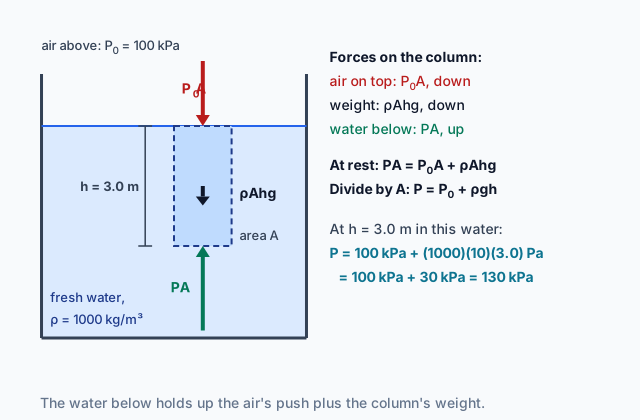
The diagram picks out a column of water reaching from a point 3.0 m down straight up to the surface, with a flat bottom of area . The column is at rest, so the forces on it balance, as in 2.4 Newton’s First Law. The water around its sides pushes in equally from every side. Vertically, the water below pushes up on its bottom, while its weight (2.6 Gravitational Force) and the air pressing on its top both act down.
The column's volume is , so its mass is , using its density, mass per volume, and its weight is . Leave the air out for a moment. The extra pressure on the bottom needed to hold up that weight is weight divided by area:
This is the gauge pressure of a vertical column of fluid. Here is the depth below the fluid's surface. In fresh water, density 1000 kg/m³, each meter down adds Pa.
The area canceled, and nothing about the container is left. A narrow pipe and a wide lake, filled to the same depth with the same liquid, have the same gauge pressure at the bottom. Because the liquid is incompressible, its density is the same at every depth, so each meter down adds the same amount.
Quick check · Sketch the graph
A lake holds fresh water, density 1000 kg/m³, treated as incompressible. Sketch the gauge pressure in the lake against depth below the surface, from the surface down to 8 m. The first point, at the surface, is fixed at 0.
One shape that fits
Drag a point up or down, or tap it and use the arrow keys. The shape is checked, and the graph must pass through the values the question gives.
2d. Absolute and gauge pressure
The column in the last idea had air on top of it, and air is a fluid too. At Earth's surface the atmosphere presses on everything with a pressure of about Pa. A sensor deep in a lake feels the air's push, passed down through the water, plus the water's own . Add the air's force back onto the column and divide by again, and you get the absolute pressure at depth :
is a reference pressure, the pressure at the fluid's surface. For a lake or an open tank it is atmospheric pressure, . The part is the gauge pressure, the pressure beyond the reference. A tire gauge reads exactly that: it reads zero on a flat tire, though the air in it is still at atmospheric pressure.
Which one a question asks for changes the number a lot. At 5.0 m in fresh water the gauge pressure is 50,000 Pa and the absolute pressure is 150,000 Pa. Go to 10 m and the gauge pressure doubles to 100,000 Pa, while the absolute pressure only rises to 200,000 Pa, because the atmosphere's share stays the same.
Quick check · Match
A pond holds fresh water, density 1000 kg/m³, under air at 100 kPa. Tap a pressure in the pond, then its value.
Part 3 Watch it done How deep is the sensor?
Watch each step, then finish the problem yourself.
An open tank holds oil with a density of 800 kg/m³, treated as incompressible. A sensor fixed below the oil's surface reads an absolute pressure of 160 kPa, and the air above the tank is at atmospheric pressure, Pa. How far below the surface is the sensor?
Step 1 · Name the pressures
The sensor reads absolute pressure, . The tank is open, so the reference pressure at the oil's surface is atmospheric: Pa, which is 100 kPa. The unknown is , the depth below that surface.
Step 2 · Take away the atmosphere's share
The oil above the sensor accounts only for the gauge pressure: kPa, which is 60,000 Pa.
Why this step?
Why subtract the atmospheric pressure before using ?
counts only the weight of the oil column above the sensor, per area. The air presses on the oil's surface too, and its 100 kPa is in the reading at every depth, even right at the surface. Leaving it in would treat the air's push as if it were more oil, and the depth would come out far too large.
Your step · Calculate
Finish it. In an open tank of oil with density 800 kg/m³, under air at Pa, a sensor reads an absolute pressure of 160 kPa. How far below the oil's surface is the sensor? Give your answer to the nearest 0.1 m.
m
Part 4 Try it A piston on trapped air
Now the fluid is air, and it is holding something up. A cylinder stands upright with its bottom sealed, and a piston rests on the air trapped inside it, held up by nothing else. The outside air presses down on the piston's top face, and the trapped air presses up on its bottom face. Each of those pushes is a pressure times an area, perpendicular to the face.
Try it · Draw the forces
A piston, a light disk with a lead weight fixed to its top, 10 kg in all, rests on air trapped in an upright cylinder whose bottom is sealed. Treat the disk and the weight as one object, the piston. Each face of the disk has an area of 0.0020 m², friction between the piston and the cylinder wall is negligible, and the outside air, at Pa, presses on the piston's top face. Build the free-body diagram of the piston, and set each arrow's length to compare the forces.
The dot is the piston. One diagram that fits
Pick each force exerted on the piston, then choose the way it points and how long its arrow is compared with the others. The arrows are drawn for you.
Try it · Calculate
A piston, a light disk with a lead weight fixed to its top, 10 kg in all, rests on air trapped in an upright cylinder whose bottom is sealed. Treat the disk and the weight as one object, the piston. Each face of the disk has an area of 0.0020 m², friction is negligible, and the outside air, at Pa, presses on the piston's top face. What is the absolute pressure of the trapped air? Give your answer to the nearest 1 kPa.
Part 5 Explain it A pressure graph, its equation and two liquids
Nothing you type leaves this page. Check your answer against the model and each scoring point.
Free response is 50% of the exam score. This one is shaped like Question 2, Translation Between Representations.
Free-response practice · Question 2 style
An open tank holds a liquid of unknown density, treated as incompressible, with air at Pa above it. A student lowers a pressure sensor into it and makes a graph of the absolute pressure at the sensor against the sensor's depth below the liquid's surface. The graph is a straight line from 100 kPa at to 136 kPa at m.
(a) On paper, sketch the student's graph with labeled axes and both end values marked. Calculate its slope, with units.
(b) Starting from the forces on a vertical column of the liquid that reaches from the surface down to depth , derive an equation for in terms of that holds at any depth in this liquid. Justify that the graph's vertical intercept and its slope agree with your equation, saying which physical quantity each one stands for. Then calculate the liquid's density.
(c) The tank is drained and refilled to the same level with fresh water, density 1000 kg/m³. On the same axes, sketch the line the student would now get. Using your equation, explain which feature the two lines share and which one differs.
(d) A classmate claims that, in either liquid, the pressure 4.0 m down is twice the pressure 2.0 m down, because there is twice as much liquid above. Using your graph and your equation, explain whether the claim is right for the absolute pressure, and whether it is right for the gauge pressure.
(e) Explain why treating the liquid as incompressible makes the graph a straight line rather than a curve.
Model answer
(a) Depth in meters on the horizontal axis, absolute pressure in kPa on the vertical axis. A straight line from 100 kPa at up to 136 kPa at m. Slope kPa/m, which is 9000 Pa/m.
(b) Take a column of liquid with a flat bottom of area , reaching from the surface down to depth . It is at rest, so the liquid below pushes up on its bottom with , balancing the air's push down on its top, , and its weight, . The side pushes are horizontal and cancel. So , and dividing by , . This is a straight line in with vertical intercept and slope . At the sensor is at the surface, where only the air presses, so the intercept should be atmospheric pressure, Pa, and the graph starts at 100 kPa, which is that value. The slope is the gauge pressure added per meter of depth, : kg/m³. Using m/s² instead gives about 920 kg/m³, which is also accepted.
(c) The water's line starts at the same 100 kPa, because the same air presses on the surface and does not depend on the liquid. It is steeper, slope Pa/m, reaching 140 kPa at 4.0 m, because only the slope contains the density.
(d) Absolute pressure: no. In the first liquid, kPa at 2.0 m and 136 kPa at 4.0 m, a ratio of about 1.15. On the graph, the line does not pass through the origin, so doubling does not double ; the term is the same at both depths. Gauge pressure: yes. is proportional to , 18 kPa at 2.0 m and 36 kPa at 4.0 m. On the graph it is the height of the line above the 100 kPa intercept, and that doubles. In water the numbers are 120 and 140 kPa absolute, 20 and 40 kPa gauge, and the same conclusions hold.
(e) Incompressible means the liquid's density stays the same however much pressure it is under, so the liquid deep down, under more pressure, is no denser than at the top. Every extra meter of depth adds a meter of liquid with the same density, so it adds the same kPa. Equal steps in give equal steps in , which is a straight line. If deeper liquid were squeezed denser, each meter would add more than the one before, and the graph would curve upward.
Score your own answer. This is a self-check, not a grade. Tick each point your answer makes.
Part 6 Check yourself Four storage tanks
Both case questions use the four tanks' table.
A factory stores four liquids in open tanks of different shapes. Each tank has a pressure sensor on its flat bottom, and air at Pa presses on the open surface of every liquid. Each liquid is treated as incompressible, and m/s².
| Tank | Liquid | Density (kg/m³) | Depth of liquid (m) | Volume of liquid (m³) |
|---|---|---|---|---|
| A | Seawater | 1030 | 3.6 | 4.0 |
| B | Fresh water | 1000 | 3.0 | 30 |
| C | Oil | 800 | 4.2 | 12 |
| D | Glycerin | 1260 | 2.6 | 9.0 |
Case question 1 · Multiple choice
Using the four tanks' table, which tank's bottom sensor reads the greatest gauge pressure?
Case question 2 · Calculate
Using the four tanks' table, with air at Pa on each surface: what is the absolute pressure at the bottom of tank C? Give your answer to the nearest 0.1 kPa.
The rest stand on their own and do not use the case.
Check yourself · Spot the error
An open tank is filled with oil of density 900 kg/m³ to a depth of 5.0 m, with air at Pa above it. A valve sits in the tank's side wall 1.5 m above the bottom. A student finds the gauge pressure and then the absolute pressure at the valve. Tap the first line that goes wrong.
Check yourself · Decide and justify
A diver holds a small pressure sensor 4.0 m below the surface of a pool, with its flat sensing face pointing up, and notes the reading. Without changing its depth, she turns it so the face points sideways. How does the new reading compare with the first?
Which reason supports your answer?
Part 7 Keep it Bring back earlier ideas
Pulling an older idea back up is what makes it last.
From 2.4 Newton’s First Law · Spot the error
A 1200 kg elevator rises at a steady 2 m/s. Air resistance is negligible, and up is positive. A student works out how hard its cable pulls up on it. Tap the first line that goes wrong.
From 2.6 Gravitational Force · Calculate
On a small moon with no air, the gravitational force the moon exerts on a 0.50 kg test mass is 0.80 N. An astronaut there drops a 3.0 kg hammer from rest. What is the size of the hammer's acceleration as it falls? Give your answer to the nearest 0.1 m/s².
In three lines
- Pressure is the perpendicular force per area, , a scalar that pushes perpendicular to any surface it acts on.
- A fluid's pressure is the combined effect of its particles striking a surface, and an incompressible fluid keeps its volume and density under pressure.
- At depth , the gauge pressure is and the absolute pressure is , whatever the container's shape.
Vocabulary
- Pressure
- The magnitude of the perpendicular force component exerted per unit area over a surface, , a scalar measured in pascals.
- Incompressible fluid
- A fluid whose volume and density, for a given amount of it, stay the same no matter how much pressure is exerted on it.
- Reference pressure
- The pressure at the fluid's surface, such as the atmospheric pressure , that the gauge pressure is measured from.
- Gauge pressure
- The pressure at a point beyond the reference pressure, which for a vertical column of fluid is .
- Absolute pressure
- The total pressure at a point in a fluid, the reference pressure plus the gauge pressure, .
Course alignment, for teachers
AP Physics 1: Algebra-Based topic 8.2, Unit 8: Fluids.
- Skill 1.C: Create qualitative sketches of graphs that represent features of a model or the behavior of a physical system.
- Skill 2.B: Calculate or estimate an unknown quantity with units from known quantities, by selecting and following a logical computational pathway.
- Skill 2.C: Compare physical quantities between two or more scenarios or at different times and locations in a single scenario.
- Skill 3.C: Justify or support a claim using evidence from experimental data, physical representations, or physical principles or laws.
This lesson maps all 6 essential knowledge statements of the topic to the part that teaches each one: 6 are checked by a scored question. The map is in the lesson file.