Unit 3 · Topic 3.3 · about 30 minutes · 7 parts · 12 scored checks, 3 of them multiple choice
AP Physics 1: Algebra-Based 3.3: Potential Energy
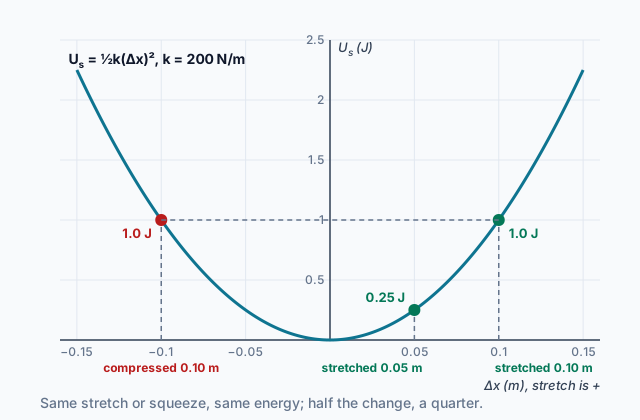 Tap to open the picture full size
Part 1 Think first A backpack and two zeros
Commit to a guess first. Being wrong now makes the right idea stick better.
Predict first
You lift a 2.0 kg backpack from the floor onto a desk 0.80 m higher. You count heights from the floor, and you say the energy stored by the backpack and Earth together is 16 J with the backpack on the desk. Your friend counts heights from the desktop, so she says it is 0 J there. The backpack then slides off and falls to the floor. How much stored energy does each of you say was given up in the fall?
In short. Potential energy is energy stored in the arrangement of a system of objects that interact through conservative forces, such as gravity or the force of an ideal spring.
- It belongs to a system of two or more objects, never to one object alone, and it is a scalar that depends on where the objects are.
- For a spring ; near a planet's surface ; in general ; and a system of more than two objects adds a term for each pair.
- The observer decides where potential energy is zero, choosing whatever makes the analysis simplest.
Part 2 Learn it Four short ideas, each checked as you go
3a. Potential energy belongs to a system
A book on a high shelf seems to hold energy up there. It does not, on its own. The energy is stored in the arrangement of the book and Earth, which pull on each other through gravity. Potential energy belongs to a system of two or more objects, never to a single object.
A system has potential energy when the objects in it interact with each other only through conservative forces, the forces from 3.2 Work whose work depends only on where the objects start and end. Gravity and the force of an ideal spring are conservative. Friction and air resistance are not, so a crate and the floor it scrapes across store no potential energy from that rubbing.
Potential energy is a scalar. It has a size and no direction, and it depends on the positions of the objects in the system, not on how they are moving. A book held still at shelf height and a book tossed up past shelf height, at the instant it passes, give the book-Earth system the same potential energy.
Quick check · Sort it
Each card describes a system and the interaction between the objects in it. Tap a card, then decide whether that interaction gives the system potential energy.
Gives the system potential energy
Gives it no potential energy
3b. Where you put the zero is up to you
Near Earth's surface the gravitational field is nearly constant. So when an object of mass rises by , the potential energy of the object-Earth system changes by
Take up as positive. Rising makes positive and grows; falling makes negative and shrinks.
That equation gives a change. To give a single value of , you first decide where , and the decision is yours. Pick whatever makes the problem simplest: the floor, the tabletop, the lowest point of the motion. The value at any height is then , with measured from your zero level.
Take the backpack again: 2.0 kg, lifted 0.80 m from the floor to a desk. With the zero at the floor, the desk value is J. With the zero at the desk, the desk value is 0 J and the floor value is J. A negative value only means below your zero. Either way the change is the same 16 J, and only changes in potential energy have any physical effect.
Quick check · Calculate
A 3.0 kg flowerpot sits on a windowsill 4.0 m above the ground. A roofer working at the roof edge, 6.0 m above the ground, sets the gravitational potential energy of the flowerpot-Earth system to zero with the pot at the height of the roof edge. Take up as positive. Using the roofer's zero, what is the system's gravitational potential energy with the pot on the windowsill?
3c. Energy in a stretched or squeezed spring
A block pressed against a spring, or hanging from one, makes a system whose objects interact through the spring's force, which is conservative. Its elastic potential energy is
Here is the spring constant and is how far the spring is stretched or compressed from its equilibrium length, the relaxed length from 2.8 Spring Forces. That is not where a hanging block comes to rest, which 2.8 Spring Forces called the equilibrium position: a block hanging at rest has already stretched the spring. This formula has the zero chosen already: when the spring is relaxed.
Because is squared, the sign drops out, so a spring compressed 0.10 m stores just as much energy as the same spring stretched 0.10 m. The graph at the top of this page shows it for N/m: 1.0 J either way. The square also makes the energy grow faster than the stretch. Half the stretch, 0.05 m, stores a quarter of the energy, 0.25 J.
Work in meters. A 10 cm stretch typed in as 10 gives an answer ten thousand times too big.
Quick check · Fill the statement
A spring toy has an ideal spring. Tap a blank, then an answer.
Compressing the spring 3 cm stores stretching it 3 cm. Compressing it 9 cm stores as much energy as compressing it 3 cm. With the zero at its relaxed length, the energy the spring stores is never .
3d. Far from the surface, and more than two objects
works because the gravitational field barely changes over a few meters, or even a few kilometers. For moons, planets, stars and satellites, use the general form for two roughly spherical masses whose centers are a distance apart:
This form puts its zero where the two objects are infinitely far apart. Gravity pulls them together, so every closer arrangement stores less than that, and is negative at every finite . Move the objects apart and rises toward zero: it becomes less negative. And note that it has where the force from 2.6 Gravitational Force has .
A system of more than two objects has a potential energy for each pair, and the total is their sum. Three stars make three pairs: A with B, A with C, and B with C. A block hanging from a spring near Earth has two pairs that count: block with spring, and block with Earth. The spring's mass is negligible, so it adds no gravitational term.
Quick check · Multiple choice
A satellite orbits a planet at a distance from the planet's center. With the zero at infinite separation, the gravitational potential energy of the satellite-planet system is J. The satellite is moved out to a distance from the center. What is the system's gravitational potential energy now?
Part 3 Watch it done A block hanging from a spring
Watch each step, then finish the problem yourself.
A 0.50 kg block hangs at rest from the lower end of a vertical ideal spring with spring constant 50 N/m. Take up as positive, and take the gravitational potential energy of the block-Earth system to be zero at the height where the block would sit with the spring relaxed. Find the total potential energy of the block-spring-Earth system with the block hanging at rest.
Step 1 · Find the stretch
At rest the spring's pull balances gravity, as in 2.8 Spring Forces: in size , so the stretch is m. The block hangs 0.10 m below where it would sit with the spring relaxed.
Step 2 · Elastic potential energy of the block and spring
J. Squaring makes it positive whether the spring is stretched or squeezed.
Why this step?
Why is the 0.10 m stretch, and not the spring's whole length from the ceiling down to the block?
depends on how much the spring's length has changed from its relaxed length. The relaxed part of its length stores nothing; only the stretch beyond it does.
Step 3 · Set up the gravitational term
The zero is at the relaxed position, and the block is 0.10 m below it, so its from the zero is m. The block-Earth pair contributes with that negative . The system has three objects but only these two pairs count, because the spring's mass is negligible.
Your step · Calculate
Finish it. A 0.50 kg block hangs at rest from a vertical ideal spring with spring constant 50 N/m. Take up as positive, and take the gravitational potential energy of the block-Earth system to be zero at the height where the block would sit with the spring relaxed. What is the total potential energy of the block-spring-Earth system with the block hanging at rest?
J
Part 4 Try it Two zeros, one trip
A new situation. A box comes down from a balcony, and two people keep track of it, each with a different zero. Decide first whose change is bigger, then practice the two calculations with new numbers each time.
Try it · Decide and justify
A 4.0 kg box is carried down from a balcony 9.0 m above the street to the street. Ana sets the gravitational potential energy of the box-Earth system to zero with the box at street level. Ben sets it to zero with the box at the balcony. How do the sizes of the changes in gravitational potential energy they each find for the trip down compare?
Which reason supports your answer?
Part 5 Explain it Derive it, then put in numbers
Nothing you type leaves this page. Check your answer against the model and each scoring point.
Free response is 50% of the exam score. This one is shaped like Question 1, Mathematical Routines.
Free-response practice · Question 1 style
A satellite of mass is lifted from Earth's surface to a height above it. Treat Earth as a sphere of mass and radius . The gravitational potential energy of the satellite-Earth system is , here with and , where is the distance between their centers and the zero is at infinite separation.
(a) Derive an expression for the change in the gravitational potential energy of the satellite-Earth system, , in terms of , , , and .
(b) The gravitational field at Earth's surface is . Derive an expression for in terms of , , and , and explain why it becomes , with , when is much smaller than .
(c) A 500 kg satellite is lifted to a height equal to Earth's radius, m. Use N/kg. Calculate from your expression in (b), and calculate the value would give.
(d) An engineer prefers to put with the satellite at Earth's surface, so for her . Explain whether her value of for the trip in (c) differs from yours.
Model answer
(a) .
(b) From , . Then . When is much smaller than , is almost , so is almost 1 and .
(c) With , , so J. The near-surface form gives J, twice as much. It treats the field as 10 N/kg all the way up, but the field weakens as the satellite rises.
(d) No. Her expression is the general one plus the constant , so each of her values is the same constant above each of mine. In the difference final minus initial the constant cancels, and her is also J. Where the zero goes changes the values, not the changes.
Score your own answer. This is a self-check, not a grade. Tick each point your answer makes.
Part 6 Check yourself A mountain trail
Both case questions use the trail map's elevations.
A 60 kg hiker follows a mountain trail from the trailhead down to a lake, up to a ridge, and on to the summit. A trail map lists the elevation of each stop above sea level.
| Stop | Elevation above sea level (m) |
|---|---|
| Trailhead | 1250 |
| Lake | 1180 |
| Ridge | 1420 |
| Summit | 1610 |
Case question 1 · Calculate
Using the trail map's elevations, with up as positive: what is the change in the gravitational potential energy of the hiker-Earth system as the 60 kg hiker goes from the lake to the summit? Give your answer in kilojoules.
Case question 2 · Multiple choice
Using the trail map's elevations, with up as positive: a park ranger sets the gravitational potential energy of the hiker-Earth system to zero with the 60 kg hiker at the trailhead. On the ranger's count, what is the system's gravitational potential energy with the hiker at the lake?
The rest stand on their own and do not use the case.
Check yourself · Spot the error
A toy dart launcher has an ideal spring with spring constant 800 N/m. The spring is 12.0 cm long when relaxed, and loading a dart squeezes it to 7.0 cm long. A student works out the elastic potential energy stored with a dart loaded. Tap the first line that goes wrong.
Check yourself · Match
Tap each system, then the expression for its potential energy.
Part 7 Keep it Bring back earlier ideas
Pulling an older idea back up is what makes it last.
From 2.8 Spring Forces · Match
A block on a level, frictionless table is joined to a horizontal ideal spring with N/m, and the spring's other end is fixed to a wall. Right is positive, and is how far the spring's end is from where it sits when the spring is relaxed. Tap each displacement, then the force the spring exerts on the block.
From 2.6 Gravitational Force · Multiple choice
Satellite A, of mass 1000 kg, orbits Earth at a distance from Earth's center. Satellite B, of mass 2000 kg, orbits at a distance from Earth's center. How does the gravitational force Earth exerts on satellite B compare with the force on satellite A, and which way does the force on B point?
In three lines
- Potential energy belongs to a system of objects interacting through conservative forces, and it is a scalar set by their positions.
- for a spring, near a surface, in general, with a term for each pair.
- The zero is your choice; it changes the values and never the changes.
Vocabulary
- Potential energy
- Energy stored in the arrangement of a system of two or more objects that interact through conservative forces; a scalar that depends on the objects' positions.
- Conservative force
- A force, such as gravity or an ideal spring's force, whose work depends only on the starting and ending positions of the objects, which is what lets a potential energy go with it.
- Elastic potential energy
- The potential energy of a system with an ideal spring, , where is the stretch or compression from the spring's equilibrium length.
- Gravitational potential energy
- The potential energy of objects that attract each other by gravity, in general, which changes by for an object near a planet's surface.
Course alignment, for teachers
AP Physics 1: Algebra-Based topic 3.3, Unit 3: Work, Energy, and Power.
- Skill 1.C: Create qualitative sketches of graphs that represent features of a model or the behavior of a physical system.
- Skill 2.C: Compare physical quantities between two or more scenarios or at different times and locations in a single scenario.
- Skill 2.D: Predict new values or factors of change of physical quantities using functional dependence between variables.
- Skill 3.B: Apply an appropriate law, definition, theoretical relationship, or model to make a claim.
This lesson maps all 8 essential knowledge statements of the topic to the part that teaches each one: 8 are checked by a scored question. The map is in the lesson file.