Unit 5 · Topic 5.6 · about 30 minutes · 7 parts · 11 scored checks, 1 of them multiple choice
AP Physics 1: Algebra-Based 5.6: Newton’s Second Law in Rotational Form
 Tap to open the picture full size
Part 1 Think first Same push, same friends, different spin
Commit to a guess first. Being wrong now makes the right idea stick better.
Predict first
Four friends sit on a playground merry-go-round, and friction at its axle is negligible. Starting from rest, you push at the rim, along its edge, with the same force for 3 seconds. You do this twice. The first time, all four friends huddle close to the center pole. The second time, all four sit out at the edge. When you stop pushing, which time is the merry-go-round turning faster?
In short. A rigid object's angular acceleration equals the net torque exerted on it divided by its rotational inertia, .
- An object's angular velocity changes only when the net torque on it is not zero; torques that cancel leave it turning at a constant rate.
- The angular acceleration is proportional to the net torque and inversely proportional to the rotational inertia. It has the net torque's sense, clockwise or counterclockwise, no matter which way the object is turning.
- A pulley with a hanging block takes two separate analyses: torques about the axle for the pulley, Newton's second law for the block, joined by the string.
Part 2 Learn it Three short ideas, each checked as you go
2a. A net torque changes the spin
In 2.4 Newton’s First Law and 2.5 Newton’s Second Law, an object's velocity changed only when the net force on it was not zero. Rotation follows the same rule with torque in place of force: a rigid object's angular velocity changes, by speeding up, slowing down or reversing, when the net torque exerted on it is not zero.
Net means you add the torques with their senses. Pick clockwise or counterclockwise as positive, give each torque from 5.3 Torque its sign, and add.
A ceiling fan running at a steady rate has two torques on it. The motor's turns it forward and the air's drag turns it back. They are equal and opposite, the net torque is zero, and the fan's angular velocity stays the same. Switch the motor off and only the drag is left. Now the net torque is not zero, and the fan slows.
So the steady fan still has torques on it. Whether its rotation changes depends on their sum, not on whether any torque is there.
Quick check · Sort it
Tap each rotating object, then whether its angular velocity is changing at the moment described.
Its angular velocity is changing
Its angular velocity is not changing
2b. Angular acceleration from net torque
How fast the angular velocity changes is the angular acceleration from 5.1 Rotational Kinematics. For a rigid system,
It reads like from 2.5 Newton’s Second Law. The angular acceleration is directly proportional to the net torque: double the net torque and the angular velocity changes twice as fast. It is inversely proportional to the rotational inertia , the system's resistance to changes in rotation: the same net torque on twice the rotational inertia gives half the angular acceleration. With torque in N·m and in kg·m², comes out in rad/s².
The angular acceleration has the same sense as the net torque, clockwise or counterclockwise, no matter which way the object is already turning. A wheel spinning clockwise with a net counterclockwise torque on it has a counterclockwise angular acceleration, so it slows down. Sign it as in 5.1 Rotational Kinematics: with counterclockwise positive, that wheel's angular velocity is negative and its angular acceleration positive.
Quick check · Calculate
Two children push on a playground merry-go-round whose rotational inertia about its axle is 500 kg·m², and friction at the axle is negligible. One child's push exerts a counterclockwise torque of 300 N·m about the axle. The other, pushing the opposite way, exerts a clockwise torque of 120 N·m. Take counterclockwise as positive. What is the merry-go-round's angular acceleration? Give your answer to the nearest 0.01 rad/s².
2c. Two objects, two analyses
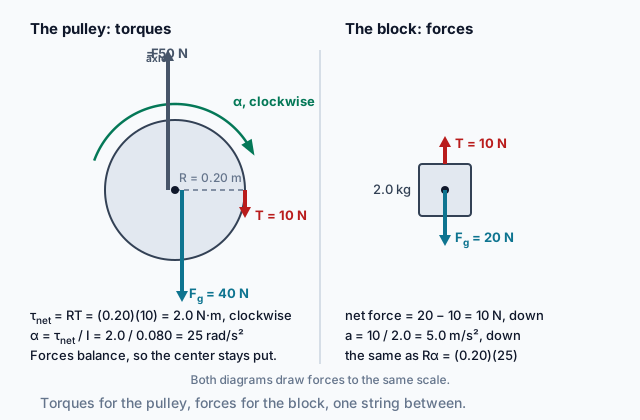
A pulley with a block hanging from a string wrapped around it is two objects, and each gets its own analysis. The diagram at the top of the page shows both.
The pulley turns about a fixed axle, so it gets torques about the axle. The axle's push and gravity both act at the axle and make no torque. Only the string does, pulling down on the rim with tension at lever arm : N·m, clockwise, and rad/s². Its forces still balance, because its center does not move.
The block does not rotate. It gets Newton's second law from 2.5 Newton’s Second Law, with down positive: , so m/s².
The string ties the two together. It does not slip, so the block's acceleration equals the rim's tangential acceleration from 5.2 Connecting Linear and Rotational Motion: m/s². And is less than the block's weight, because the block speeds up on the way down.
A problem may give you neither the tension nor the acceleration, and the two equations still find both. The string's rule turns the pulley's equation into . Put that into the block's equation: , so m/s², the same answer, and then N.
Quick check · Decide and justify
A 3.0 kg block hangs from a light string wrapped around a heavy pulley that turns on a fixed, frictionless axle. The block is released from rest and speeds up as it falls, and air resistance is negligible. While it falls, how does the size of the tension in the string compare with the size of the gravitational force on the block, 30 N?
Which reason supports your answer?
Part 3 Watch it done A block on a string, a pulley on an axle
Watch each step, then finish the problem yourself.
A pulley turns on a fixed, frictionless axle. Its radius is 0.10 m and its rotational inertia about the axle is 0.030 kg·m². A light string wrapped around the pulley holds a block, which hangs straight down from the pulley's right edge. The block is released, and as it falls a force sensor in the string reads a steady 6.0 N. The string does not slip. Find the pulley's angular acceleration, the block's acceleration and the block's mass.
Step 1 · The pulley: net torque
The axle's force and the gravitational force on the pulley both act at the axle, so their lever arms are zero. The string pulls down on the rim, perpendicular to the radius, so N·m, clockwise as you look at it with the block on the right.
Why this step?
Why is the torque times 6.0 N, the sensor's reading, and not times the block's weight?
The block's weight is a force Earth exerts on the block, not on the pulley. What touches the pulley's rim is the string, so its tension is the force that turns the pulley. And the block speeds up as it falls, so the string pulls up on it less than its weight: they are different numbers.
Step 2 · The pulley: angular acceleration
rad/s², clockwise, the sense of the net torque.
Step 3 · The string links the two
The string does not slip, so the block moves with the rim, and its acceleration is the rim's tangential acceleration from 5.2 Connecting Linear and Rotational Motion: m/s², down. That is all the rotational analysis can say. The block's mass comes from the block's own forces.
Your step · Calculate
Finish it. A pulley on a fixed, frictionless axle has radius 0.10 m and rotational inertia 0.030 kg·m². A block hangs from a light string wrapped around it, and as the block falls, a force sensor in the string reads 6.0 N. The string does not slip, and the block's acceleration is 2.0 m/s² downward. Take down as positive. What is the block's mass? Give your answer to the nearest 0.01 kg.
kg
Part 4 Try it A sandbag on a stage drum
Above a theater stage, a sandbag hangs from a rope wound around a drum that turns on a fixed axle. A stagehand releases the drum's brake, the sandbag drops, and the drum spins up as the rope unwinds. The drum gets the rotational analysis and the sandbag the linear one, so start with the sandbag on its own.
Try it · Draw the forces
A sandbag hangs from a rope wound around a stage drum that turns on a fixed axle. The drum's brake is released, and the sandbag falls straight down, speeding up as the rope unwinds. Air resistance is negligible. Build the sandbag's free-body diagram, and set each arrow's length to compare with the others.
The dot is the sandbag. One diagram that fits
Pick each force exerted on the sandbag, then choose the way it points and how long its arrow is compared with the others. The arrows are drawn for you.
Part 5 Explain it A rod released from level
Nothing you type leaves this page. Check your answer against the model and each scoring point.
Free response is 50% of the exam score. This one is shaped like Question 1, Mathematical Routines.
Free-response practice · Question 1 style
A uniform rod of mass and length is pinned at its left end to a frictionless horizontal axle, so it can swing in a vertical plane. A student holds the rod level and releases it from rest. The rod's rotational inertia about the axle is . As the student sees it, the rod swings clockwise; take clockwise as positive.
(a) Derive an expression for the rod's angular acceleration just after it is released, in terms of and .
(b) The rod is 1.5 m long. Calculate its angular acceleration just after release, and state its sense.
(c) Calculate the magnitude of the tangential acceleration of the rod's free end just after release, and compare it with .
(d) The rod's mass is 2.0 kg. Just after release the rod is at rest, so its center of mass has only a tangential acceleration, straight down. Calculate the force the axle exerts on the rod at that instant, and explain why it is not equal to the gravitational force on the rod.
Model answer
(a) Take torques about the axle. The axle's force acts at the axis, so it makes no torque. The gravitational force can be treated as acting at the rod's center of mass, its middle, from the axle, and with the rod level it is perpendicular to the rod. So , clockwise, and
The mass cancels.
(b) , positive, so clockwise, the sense of the net torque.
(c) The free end is m from the axle, so . That is 1.5 times : the free end starts down faster than an object dropped from rest.
(d) The center of mass is 0.75 m from the axle, so , down. Now a separate linear analysis of the rod (2.5 Newton’s Second Law), with down positive: , so N, upward. It is less than the rod's 20 N weight because the center of mass is accelerating downward, so the net force on the rod must point down. The axle would hold up the whole weight only if the center of mass were not accelerating.
Score your own answer. This is a self-check, not a grade. Tick each point your answer makes.
Part 6 Check yourself Four flywheels on a test bench
Both case questions use the table of flywheels.
An engineering class tests four flywheels on one bench. Each turns on its own fixed axle and starts from rest. A motor exerts a constant counterclockwise torque on each one, as seen from the front, and friction at the axle exerts a constant clockwise torque against it while it turns.
| Flywheel | Rotational inertia (kg·m²) | Motor torque (N·m) | Friction torque (N·m) |
|---|---|---|---|
| P | 0.80 | 9.6 | 1.0 |
| Q | 0.20 | 3.2 | 1.4 |
| R | 0.40 | 6.0 | 0.8 |
| S | 0.60 | 10.0 | 4.0 |
Case question 1 · Multiple choice
Using the table of four flywheels, which flywheel has the greatest angular acceleration while its motor runs?
Case question 2 · Calculate
Using the table of four flywheels, take counterclockwise as positive. What is flywheel Q's angular acceleration while its motor runs? Give your answer to the nearest 0.1 rad/s².
The rest stand on their own and do not use the case.
Check yourself · Spot the error
A grinding wheel spins clockwise on a fixed axle with its motor off. A brake pad pressed against its rim exerts a counterclockwise torque of 3.0 N·m about the axle, and no other torque acts. The wheel's rotational inertia about the axle is 0.25 kg·m². Take counterclockwise as positive. A classmate finds the wheel's angular acceleration. Tap the first line that goes wrong.
Check yourself · Fill the statement
Two flywheels, A and B, turn on frictionless axles, and flywheel B has twice the rotational inertia of flywheel A. Tap a blank, then an answer.
With the same net torque on each, flywheel B's angular acceleration is as large as flywheel A's. To give B the same angular acceleration as A, the net torque on B must be as large as the net torque on A. If the net torque on A then drops to zero while A is spinning, A's angular velocity .
Part 7 Keep it Bring back earlier ideas
Pulling an older idea back up is what makes it last.
From 2.5 Newton’s Second Law · Match
A cart on a level track, with friction negligible, has an acceleration when the net force on it is and its mass is . Tap each change, then the cart's new acceleration.
From 5.3 Torque · Calculate
A child pushes on the rim of a playground merry-go-round, 1.5 m from its center, with a force of 120 N. She stands outside it and pushes in and across, so the angle between her push and the line from the center out to the point where she pushes is 140°. What is the size of the torque her push exerts about the center? Give your answer to the nearest 1 N·m.
In three lines
- A rigid object's angular velocity changes only when the net torque on it is not zero.
- , in the sense of the net torque (clockwise or counterclockwise), no matter which way the object is turning.
- A pulley and its hanging block take separate analyses, torques for one and forces for the other, joined by the string.
Vocabulary
- Angular acceleration
- The rate at which a rigid system's angular velocity changes, equal to the net torque on the system divided by its rotational inertia and in the same direction as the net torque.
- Net torque
- The sum of the torques exerted on a system about an axis, with clockwise and counterclockwise torques given opposite signs.
- Rotational inertia
- A rigid system's resistance to changes in its rotation, which depends on its mass and on how that mass is distributed relative to the axis of rotation.
- Rigid system
- A system that holds its shape as it rotates, so all of its points share the same angular velocity and angular acceleration.
Course alignment, for teachers
AP Physics 1: Algebra-Based topic 5.6, Unit 5: Torque and Rotational Dynamics.
- Skill 1.A: Create diagrams, tables, charts, or schematics to represent physical situations.
- Skill 2.A: Derive a symbolic expression from known quantities by selecting and following a logical mathematical pathway.
- Skill 2.C: Compare physical quantities between two or more scenarios or at different times and locations in a single scenario.
- Skill 3.C: Justify or support a claim using evidence from experimental data, physical representations, or physical principles or laws.
This lesson maps all 3 essential knowledge statements of the topic to the part that teaches each one: 3 are checked by a scored question. The map is in the lesson file.