Unit 2 · Topic 2.2 · about 30 minutes · 7 parts · 12 scored checks, 3 of them multiple choice
AP Physics 1: Algebra-Based 2.2: Forces and Free-Body Diagrams
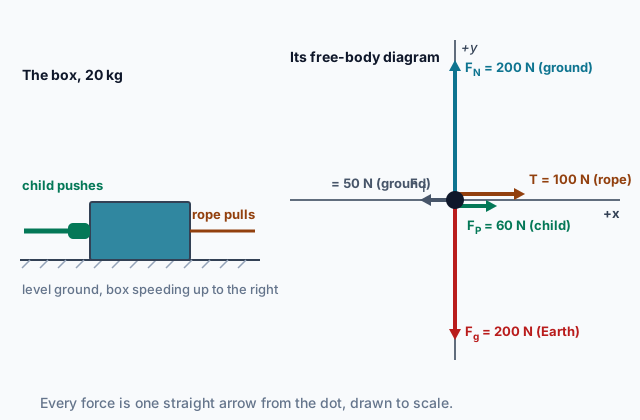 Tap to open the picture full size
Part 1 Think first Lifting yourself by your own hair
Commit to a guess first. Being wrong now makes the right idea stick better.
Predict first
In an old tall tale, Baron Munchausen rides his horse into a swamp and starts to sink. He grabs his own hair, pulls up as hard as he can, and lifts himself and the horse out. Could a person who is strong enough really do that?
In short. A force is a push or pull exerted on an object by another object, and a free-body diagram shows every force exerted on one object as an arrow drawn from a dot.
- Every force has a size, in newtons, and a direction, and something exerts it: by touching the object (a contact force) or, like gravity, from a distance.
- Contact forces such as the normal force, friction and tension come from electric forces between the atoms of the surfaces that touch.
- On the diagram each force is one straight arrow starting on the dot, never split into components, with forces that point the same way drawn side by side; one axis along the acceleration makes the equations simplest.
Part 2 Learn it Four short ideas, each checked as you go
2a. A force takes two objects
A force is a push or a pull, and it always involves two objects: the one that exerts it and the one it is exerted on. Earth pulls on a falling apple. A rope pulls on a sled. The floor pushes up on your feet. If you cannot name the other object, there is no force.
That test clears up a common mistake. A hockey puck gliding across the ice after it leaves the stick has no forward force on it. The stick no longer touches it, and nothing else pushes it forward. Moving does not take a force of its own; 2.4 explains why.
Forces are vectors. Each has a size, measured in newtons (N), and a direction, so two 50 N pushes in opposite directions do something very different from two 50 N pushes the same way. The net force on an object is the vector sum of all the forces on it.
An object or system cannot exert a net force on itself. Sit on a chair and pull up hard on its seat. Your arms pull the seat up, but they also pull your shoulders down, and both pulls are inside the you-and-chair system. Only something outside it, like the floor, can change how the system moves.
Quick check · Decide and justify
A student sits in a car that has stalled on a level road, with the parking brake off. She braces her back against the seat and pushes forward on the dashboard as hard as she can, and the car does not move. Her friend says a stronger person pushing the same way from inside the car could get it rolling. Is the friend right?
Which reason supports your answer?
2b. Contact forces, and gravity
Most forces in this course are contact forces: they act only while two objects touch. The floor's push on your shoes is one. It is called the normal force, because it points perpendicular (normal) to the surface. Friction, the force along a surface that resists sliding, is another. So is tension, the pull of a rope or string, and so is the push of air on a moving cyclist.
Up close, every contact force is electric. The atoms in your shoe and the atoms in the floor never merge. When they are squeezed together, their electrons repel each other, and that repulsion, added up over trillions of atoms, is the normal force you feel. Press harder and the atoms are squeezed a little closer, so they push back harder. That is how a floor knows how hard to push.
Gravity is different. Earth pulls on a skydiver whether or not anything touches her, so the gravitational force acts at a distance. Near Earth's surface it points straight down, and on an object of mass its size is , about 10 N for every kilogram. You will see more of it in 2.6.
Quick check · Fill the statement
You press your palm flat against a wall, and the wall pushes back on your hand. Tap a blank, then a word.
The wall's push on your hand is a force. At the scale of atoms, it is the force between the atoms of your skin and the atoms of the wall, added up over trillions of atoms. Press harder and those atoms are squeezed , so the wall pushes back harder.
2c. Drawing the free-body diagram
A free-body diagram shows every force exerted on one object or system by its surroundings, and nothing else. Draw the object as a dot. That works because an object or system can be treated as if all its mass sat at its center of mass, which you met in 2.1. Then draw each force as a straight arrow that starts on the dot and points the way the force points, labeled with what exerts it.
To find the forces, ask two questions. What touches the object? Each thing touching it can push on it or rub along it. What pulls on it without touching? Near Earth, gravity.
The diagram at the top of this page is a box dragged across the ground, pulled forward by a rope and pushed forward by a child, while the ground's friction acts against the sliding. Each forward force gets its own arrow, drawn side by side so neither hides the other, and the arrows are drawn to scale.
Leave three things off. A force the object exerts on something else belongs on that other object's diagram. A net force is the sum of the arrows already there, not another arrow. And a force is never split into components on the diagram: a rope pulling at an angle is one arrow along the rope. Splitting happens later, in the equations.
Quick check · Draw the forces
You toss a ball straight up. It has left your hand and is still rising. Air resistance is negligible. Build the free-body diagram of the ball.
The dot is the ball. One diagram that fits
Pick each force exerted on the ball, then choose the way it points. The arrows are drawn for you.
2d. From the diagram to an equation
The point of a free-body diagram is the equations you write from it. Writing them takes one piece of background that 2.5 develops fully: along any axis, the forces on an object add up to its mass times its acceleration along that axis, and . Each arrow becomes a term, positive or negative depending on which way it points.
So choose your axes with care. If one axis runs along the acceleration, the acceleration along the other axis is zero, and that equation is a simple balance. For a crate pulled across a level floor, horizontal and vertical axes do this.
On a ramp they do not. A skier gliding down a smooth slope tilted at accelerates along the slope, so put along the slope and perpendicular to it. The normal force then lies along , and only gravity points off both axes. You split gravity in the equation, never on the diagram: its part perpendicular to the slope is . The skier never sinks into the snow or lifts off it, so and , which is less than .
Quick check · Multiple choice
A loaded sled slides down a straight, icy hill tilted 20° below the horizontal, speeding up as it goes. Friction is negligible. You want to write equations from the sled's free-body diagram. Which choice of axes makes that simplest?
Part 3 Watch it done A passenger in a rising elevator
Watch each step, then finish the problem yourself.
A 60 kg passenger stands in an elevator that is starting up from the ground floor, speeding up with an acceleration of 2 m/s² upward. Draw her free-body diagram, then find the force the elevator floor exerts on her.
Step 1 · List the forces on her
The floor touches her feet and pushes up on her: a normal force, . Nothing else touches her. Earth pulls her down with N. The cable pulls on the elevator, not on her, so it stays off her diagram.
Why this step?
Why does the cable's pull stay off the passenger's diagram, when it is what lifts the elevator?
Because her diagram shows only forces exerted on her, and the cable is attached to the elevator, not to her. The cable pulls the elevator up, the elevator floor pushes on her, and that push is already on her diagram as .
Step 2 · Draw it
A dot for the passenger, with pointing straight down from it and pointing straight up from it. Nothing else.
Step 3 · Choose the axis and write the equation
Her acceleration is upward, so take up as , along it. Read the signs off the diagram: points up and is positive, points down and is negative. So , with .
Your step · Calculate
Finish it. A 60 kg passenger stands in an elevator that is starting up from the ground floor, speeding up with an acceleration of 2 m/s² upward. Take up as positive. How large is the normal force the elevator floor exerts on her?
N
Part 4 Try it A crate on a loading ramp
A new situation: a tilted surface, and this time something holds the object in place. A crate of apples sits on the loading ramp of a delivery truck. The ramp rises to the right at 35° above the horizontal, its surface is rough, and the crate stays put without sliding. Before you build the diagram, picture the axes along the ramp and across it.
Try it · Draw the forces
A crate rests on a rough loading ramp that rises to the right at 35° above the horizontal, and it does not slide. Build the crate's free-body diagram, choosing each force's direction from the ramp's own directions and its length compared with the others.
The dot is the crate. One diagram that fits
Pick each force exerted on the crate, then choose the way it points and how long its arrow is compared with the others. The arrows are drawn for you.
Part 5 Explain it Diagram, expression and graph
Nothing you type leaves this page.
Free response is 50% of the exam score. This one is shaped like Question 2, Translation Between Representations.
Free-response practice · Question 2 style
A student pulls a 10 kg toolbox to the right across a level floor with a rope. The rope pulls on the toolbox with a tension directed at an angle above the horizontal, to the right, and the toolbox slides to the right along the floor. Friction from the floor is not negligible. Take up as , and use m/s².
(a) On paper, draw the free-body diagram of the toolbox. Represent each force as a straight arrow starting on the dot, and label each one with what exerts it.
(b) Starting from your diagram, derive an expression for the normal force that the floor exerts on the toolbox, in terms of , , and .
(c) The student could pull at the same 30° with any tension. On axes of against , sketch the normal force for tensions from up to the tension at which the normal force reaches zero. Label the value at each end of your graph.
(d) Justify that your graph and your expression from (b) agree. Refer to the sign of the graph's slope and to both of its intercepts.
Model answer
(a) A dot for the toolbox with four arrows starting on it: the gravitational force exerted by Earth, , straight down; the normal force exerted by the floor, , straight up and shorter than ; the rope's pull, , one arrow up and to the right at 30° above the horizontal; and friction exerted by the floor, , to the left, against the sliding. There is no force of motion, no net force arrow, and no separate arrow for either part of the rope's pull.
(b) The toolbox stays on the floor, so . With up positive, and the rope's vertical part, , are positive and is negative: , so .
(c) A straight line that starts at N when and falls to at N. At N, for example, it reads 80 N.
(d) The expression is , which is linear in , so the graph is a straight line. Its slope is : negative, because the harder the rope pulls, the more of the toolbox's weight its vertical part holds up and the less the floor has to push. Putting into the expression gives N, the intercept on the axis. Setting gives N, the intercept on the axis. A drop of 100 N over 200 N of tension is the same slope, .
Score your own answer. This is a self-check, not a grade. Tick each point your answer makes.
Part 6 Check yourself A crate on a warehouse floor
Both case questions use the table of forces on the crate.
A worker pushes a 30 kg crate east across a level warehouse floor with a horizontal push, and the crate speeds up as it slides. The table lists every force exerted on the crate while it speeds up.
| Force | Exerted by | Size (N) |
|---|---|---|
| Gravitational force | Earth | 300 |
| Normal force | Floor | 300 |
| Push | Worker | 150 |
| Kinetic friction | Floor | 90 |
Case question 1 · Draw the forces
A worker pushes a crate east across a level floor, and it speeds up. Using the table of forces on the crate, build its free-body diagram, with east to the right, and set each arrow's length to compare with the others.
The dot is the crate. One diagram that fits
Pick each force exerted on the crate, then choose the way it points and how long its arrow is compared with the others. The arrows are drawn for you.
Case question 2 · Multiple choice
Using the table of forces on the crate, take east as and up as . Write the push as and friction as . The crate speeds up eastward with acceleration and does not leave the floor. Which pair of equations follows from its free-body diagram?
The rest stand on their own and do not use the case.
Check yourself · Spot the error
A traveler pulls a rolling suitcase across a level airport floor by its handle, which points up and to the right at 40° above the horizontal. A student explains how she draws the suitcase's free-body diagram. Tap the first line that goes wrong.
Check yourself · Sort it
Tap each force, then whether it is a contact force or a force exerted without touching.
Contact force
Exerted without touching
Part 7 Keep it Bring back earlier ideas
Pulling an older idea back up is what makes it last.
From 1.5 Vectors and Motion in Two Dimensions · Match
A ball is thrown at 12 m/s from the edge of a flat roof, in five different directions, each one either toward the street or straight up. Take as horizontal, toward the street, and as up. Tap each throw, then the components of its launch velocity.
From 1.1 Scalars and Vectors in One Dimension · Multiple choice
Right is positive. Arrows for the velocities of carts A and B are drawn to the same scale. Cart A's arrow points left and is twice as long as cart B's arrow, which points right. Which statement is correct?
In three lines
- A force is exerted on an object by another object, and an object or system cannot exert a net force on itself.
- Contact forces come from electric forces between atoms; gravity acts at a distance.
- A free-body diagram is a dot with one straight arrow per force on it, and axes along the acceleration make its equations simplest.
Vocabulary
- Force
- A vector quantity that describes an interaction between two objects or systems, a push or a pull exerted on one by the other.
- Net force
- The vector sum of all the forces exerted on an object or system, which is never drawn as one more arrow on a free-body diagram.
- Contact force
- A force between objects or systems that are touching, the large-scale result of electric forces between their atoms.
- Free-body diagram
- A diagram that shows each of the forces exerted on a single object or system by its environment, as arrows starting on a dot.
- Center of mass
- The point where a system can be treated as if all of its mass were located, which the dot of a free-body diagram represents.
Course alignment, for teachers
AP Physics 1: Algebra-Based topic 2.2, Unit 2: Force and Translational Dynamics.
- Skill 1.A: Create diagrams, tables, charts, or schematics to represent physical situations.
- Skill 2.B: Calculate or estimate an unknown quantity with units from known quantities, by selecting and following a logical computational pathway.
- Skill 2.C: Compare physical quantities between two or more scenarios or at different times and locations in a single scenario.
- Skill 3.C: Justify or support a claim using evidence from experimental data, physical representations, or physical principles or laws.
This lesson maps all 8 essential knowledge statements of the topic to the part that teaches each one: 8 are checked by a scored question. The map is in the lesson file.