Unit 5 · Topic 5.4 · about 30 minutes · 7 parts · 13 scored checks, 2 of them multiple choice
AP Physics 1: Algebra-Based 5.4: Rotational Inertia
 Tap to open the picture full size
Part 1 Think first Two batons, the same weights
Commit to a guess first. Being wrong now makes the right idea stick better.
Predict first
A friend makes two practice batons from identical light rods, with two identical weights taped to each. On baton 1 the weights sit close to the middle of the rod; on baton 2 they sit at the very ends. You hold each baton at its middle and twist it back and forth, starting and stopping it as fast as you can. Which baton is harder to start and stop?
In short. Rotational inertia measures how much a rigid system resists a change in its rotation about a given axis, and it depends on the system's mass and on how that mass is spread relative to the axis.
- A small object a perpendicular distance from the axis has , and several objects together have , each measured from the same axis.
- Of all parallel axes, the one through the system's center of mass gives the smallest rotational inertia.
- The parallel axis theorem, , gives the rotational inertia about any axis parallel to one through the center of mass, a distance from it.
Part 2 Learn it Four short ideas, each checked as you go
2a. What rotational inertia measures
In 2.4 Newton’s First Law and 2.5 Newton’s Second Law, mass measured how hard it is to change an object's velocity: the same net force speeds up a loaded cart less than an empty one. Rotation has its own version. Rotational inertia, written , measures how much a rigid system resists a change in its rotation: being started, sped up, slowed down or stopped.
Mass matters, but so does where the mass sits relative to the axis of rotation. The two batons in Think first had the same mass, and the one with its weights at the ends was much harder to start and stop. A bicycle wheel works the same way. Nearly all of its mass is in the rim and tire, far from the axle, and once it is spinning on a repair stand it takes a firm grip to stop it.
Rotational inertia belongs to the system and the axis it turns about. It does not depend on how fast the system is turning or on how hard anything pushes on it. A wheel spinning fast and the same wheel sitting still have the same rotational inertia about the same axle.
Quick check · Decide and justify
A bike shop has a thin metal hoop and a solid metal disk with the same mass and the same radius. Each can turn on an axle through its center, perpendicular to its flat face. Which one is harder to start spinning from rest on its axle?
Which reason supports your answer?
2b. Point objects: , then add
For an object small enough to treat as a point, a perpendicular distance from the axis,
in kg·m². The distance is squared, so it counts for more than the mass. Double the mass and doubles, but move the same object twice as far out and becomes four times as large.
For several objects turning together about one axis, find each one's about that axis and add them:
Measure every from the axis, straight across to it at a right angle, never from the end of the object or from one of the other objects.
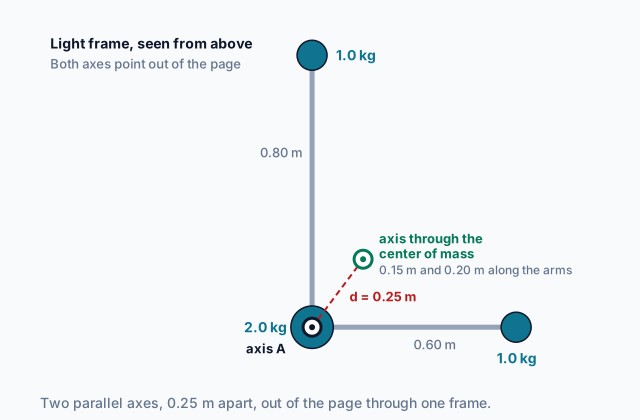
The diagram at the top of the page shows the light L-shaped frame whose center of mass you found in 2.1 Systems and Center of Mass, seen from above. About axis A, through the corner ball, kg·m². The 2.0 kg ball is the heaviest of the three, yet it adds nothing, because it sits on the axis.
Quick check · Sketch the graph
Two small 1.0 kg beads can be clamped anywhere on a light rod that spins about an axis through its middle, perpendicular to the rod. The beads are always clamped the same distance from the axis, one on each side. Sketch the rotational inertia of the rod and beads about the axis against , from 0 to 0.40 m. The first point is fixed at 0.
One shape that fits
Drag a point up or down, or tap it and use the arrow keys. The shape is checked, and the graph must pass through the values the question gives.
2c. The axis through the center of mass
Change the axis and the same rigid system has a different rotational inertia, because every distance changes. Among axes that all point the same way, the rotational inertia is smallest about the one that passes through the system's center of mass.
Take the frame again. Its center of mass is 0.15 m along one arm and 0.20 m along the other from the corner. Measure each ball's distance from a parallel axis through that point (the Pythagorean theorem does it) and add up : the total is 0.75 kg·m², less than the 1.00 kg·m² about axis A. A parallel axis anywhere else gives more than 0.75 kg·m².
You can feel this with a broom. Twirl it about its balance point, its center of mass, and it turns easily. Hold it at the end of the handle and swing it the same way, and it fights you, because now most of its mass is far from your hand.
Why the center of mass? It is the balance point of the mass. Shift the axis a little and it moves closer to some of the mass and farther from the rest, and about the center of mass those two shares balance, so what is gained on one side is lost on the other. What is left over is the of the next idea, and nothing cancels it.
Quick check · Multiple choice
A light rod 1.00 m long has a 3.0 kg ball fixed at its left end and a 1.0 kg ball at its right end. It can be set turning about an axis perpendicular to the rod through any point along it. Through which point should that axis pass to make the system's rotational inertia as small as possible?
2d. The parallel axis theorem
There is a shortcut from the center-of-mass value to any parallel axis. If is a rigid system's rotational inertia about an axis through its center of mass, then about any axis parallel to that one, a distance away,
where is the system's total mass. is never negative, so the theorem agrees with what you just saw: every other parallel axis gives more.
Check it on the frame. Axis A is m from the center of mass, and the total mass is 4.0 kg, so kg·m², the same as adding the three balls one at a time.
For an extended object such as a rod or a door, you never work out the rotational inertia from scratch: a problem gives it to you. It may be given about the center of mass or about some other axis, so check which. When it is about the center of mass, the theorem moves it to the axis you need. Adding to a value about some other axis gives a wrong answer.
Quick check · Match
A uniform rod of mass 2.0 kg and length 1.20 m has a rotational inertia of 0.24 kg·m² about an axis through its center, perpendicular to the rod. Every axis listed is parallel to that one. Tap an axis, then the rod's rotational inertia about it.
Part 3 Watch it done A door about its hinges
Watch each step, then finish the problem yourself.
A uniform classroom door has a mass of 20 kg and is 0.90 m wide. It turns about its hinge line, along one vertical edge. You are given that its rotational inertia about a vertical axis through its center of mass is 1.35 kg·m². What is its rotational inertia about the hinge line?
Step 1 · Find the axis the given value is about
The door is uniform, so its center of mass is at its middle (2.1 Systems and Center of Mass), halfway across. The given 1.35 kg·m² is about a vertical line through that point. The hinge line is vertical too, so the two axes are parallel, and the distance between them is half the width: m.
Why this step?
Why is 0.45 m and not 0.90 m, the width of the door?
The theorem measures between the two axes: from the line through the center of mass, where the given value applies, to the hinge line. That line is halfway across the door, 0.45 m from the hinges. The full 0.90 m reaches the far edge of the door, which is not an axis in this problem.
Step 2 · Set up the theorem
, with the whole door's mass, 20 kg, and m. Before you work it out, know what to expect: the hinge line does not pass through the center of mass, so the answer must be larger than 1.35 kg·m².
Your step · Calculate
Finish it. A uniform 20 kg door 0.90 m wide turns about its hinge line, along one vertical edge. Its rotational inertia about a parallel vertical axis through its center of mass is given as 1.35 kg·m². What is its rotational inertia about the hinge line? Give your answer to the nearest 0.01 kg·m².
kg·m^2
Part 4 Try it A drone turning in place
A new situation, with more than two objects. A crop-spraying drone hovers over a field and turns in place to face a new row, spinning about a vertical axis through its center. Its heavy parts all lie in one level plane, and for this question each can be treated as a point. Work out its rotational inertia, then practice with objects on a light rod.
Try it · Calculate
A crop-spraying drone hovers and turns in place about a vertical axis through its center. Its four motors, 2.5 kg each, sit at the ends of light arms, each 1.2 m from the axis. A 4.0 kg spray pump is mounted 0.50 m from the axis. All of these parts lie in one level plane. Treat each part as a point and the arms as massless. What is the drone's rotational inertia about that axis? Give your answer to the nearest 0.1 kg·m².
Part 5 Explain it Design a test of where the mass sits
Nothing you type leaves this page. Check your answer against the model and each scoring point.
Free response is 50% of the exam score. This one is shaped like Question 3, Experimental Design and Analysis.
Free-response practice · Question 3 style
A student wants to test how the rotational inertia of a rigid system depends on where its mass sits. She fixes a light rod level on a vertical axle through the rod's middle, and clamps two identical cylinders on it, one on each side, each a distance from the axle. A string wound around a small hub on the axle, of radius 0.020 m, runs over a pulley to a hanging 0.050 kg block. The block falls so slowly that the string's pull stays within 1 percent of the block's 0.50 N weight, so the string exerts the same torque on the hub in every run, N·m, and friction in the axle is negligible. She also has a rotary motion sensor on the axle, which records angular velocity against time, a meterstick and a balance. Use m/s².
Background, from 5.6: when one constant torque is the only torque on a rigid system, its angular acceleration is . A larger rotational inertia means a smaller angular acceleration.
(a) Describe a procedure for measuring the angular acceleration of the rod and cylinders for at least five values of . Say what she measures, with which equipment, and give enough detail that another student could repeat it.
(b) The rod and hub together have a rotational inertia about the axle. Treating each cylinder as a point at its center, derive an expression for the total rotational inertia of the rod, hub and both cylinders in terms of , the mass of one cylinder and . Then use the background relation to identify a graph of her measurements that should be a straight line, and state what its slope and its vertical intercept each represent.
The balance gives 0.200 kg for each cylinder. Her averaged results, with measured from the axle to the center of each cylinder:
- m:
- m:
- m:
- m:
- m:
(c) On paper, plot the graph you named in (b) and draw a best-fit line. Calculate its slope, use it to find the total mass of the two cylinders, and explain whether her data support the model that each cylinder adds to the rotational inertia.
(d) Her partner repeats every run, but he measures each from the axle to the inner edge of each cylinder, 0.015 m closer to the axle than its center. Explain whether the total cylinder mass he finds from his slope is larger than, smaller than or equal to the 0.400 kg the balance gives.
Model answer
(a) Weigh each cylinder on the balance. Clamp the two cylinders on opposite sides of the axle and measure with the meterstick, from the center of the axle to the center of each cylinder, setting both to the same value. Wind the string the same number of turns each time, hold the rod still, and let go so the block starts from rest. The rotary motion sensor records angular velocity against time; while the block falls the graph is a straight line, and its slope is . Do three runs at each and average them, for at least five values of from 0.050 m to 0.250 m.
(b) Each cylinder is a point a distance from the axle, so each adds , and the total is the sum about the axle: . With the same torque every run, . So a graph of against should be a straight line. Its slope is , the two cylinders' mass divided by the torque, and its vertical intercept is , set by the rod and hub alone.
(c) The values of are 0.0025, 0.0100, 0.0225, 0.0400 and 0.0625 m², and of are 0.69, 1.01, 1.49, 2.22 and 3.09 s² (radians carry no unit). The points lie close to one straight line. Two points on my best-fit line, not data points, are and , so the slope is . Then kg, which matches the balance. The points lie on a straight line against , as the model predicts, and its slope gives the cylinders' real mass, so the data support the model that each cylinder adds . The intercept, 0.60 s², gives kg·m² for the rod and hub.
(d) Larger. Each of his distances is 0.015 m too small, so each is too small by , an amount that grows with . His points at large shift left more than those at small , so the same rise in happens over a shorter run, and his line is steeper, about 44 s²/m². Multiplying by gives about 0.44 kg, more than the 0.400 kg the balance gives.
Score your own answer. This is a self-check, not a grade. Tick each point your answer makes.
Part 6 Check yourself Four pairs on a spinner
Both case questions use the table of riders.
A playground spinner is a light, level beam on a vertical post, and it turns about the post, at the middle of the beam. Its own rotational inertia is small enough to ignore, and each child on it can be treated as a point. Four pairs of children take turns riding it, sitting on opposite sides of the post. Each distance in the table is measured from the post.
| Pair | Child 1 | Child 2 |
|---|---|---|
| P | 30 kg at 1.0 m | 30 kg at 1.0 m |
| Q | 15 kg at 1.8 m | 15 kg at 1.8 m |
| R | 45 kg at 0.80 m | 45 kg at 0.80 m |
| S | 24 kg at 1.8 m | 36 kg at 0.50 m |
Case question 1 · Calculate
Using the spinner's table, what is the rotational inertia of the spinner with pair S on it, about the post? Give your answer to the nearest 1 kg·m².
Case question 2 · Multiple choice
Using the spinner's table: with which pair of children on it is the spinner hardest to start turning from rest?
The rest stand on their own and do not use the case.
Check yourself · Spot the error
Three small balls are fixed to a light frame shaped like a right triangle, lying flat. Ball A, 1.0 kg, is at the right-angle corner. Ball B, 2.0 kg, is 0.30 m from A along one side, and ball C, 1.5 kg, is 0.40 m from A along the other side. The frame turns about an axis through ball B, perpendicular to the frame. A student finds the rotational inertia about that axis. Tap the first line that goes wrong.
Check yourself · Sort it
Each card describes one change to a rigid system that turns about an axis. Tap a card, then what the change does to the system's rotational inertia about the axis it then turns about.
It increases
It decreases
It stays the same
Check yourself · Fill the statement
A uniform meter stick of mass 0.15 kg has a rotational inertia of 0.0125 kg·m² about an axis through its 0.50 m mark, perpendicular to the stick. A student wants its rotational inertia about a parallel axis through the 0.80 m mark. Tap a blank, then an answer.
The given value is about an axis through the stick's , which is where the parallel axis theorem has to start. The new axis is from that one, so the student adds 0.15 kg times to the given value.
Part 7 Keep it Bring back earlier ideas
Pulling an older idea back up is what makes it last.
From 2.1 Systems and Center of Mass · Calculate
Two carts sit on a straight track. Positions are measured from the left end of the track, with right as positive. A 0.40 kg cart is at m and a 1.20 kg cart is at m. Where is the center of mass of the two-cart system? Give your answer to the nearest 0.01 m.
From 2.5 Newton’s Second Law · Match
A cart on a level track, with friction negligible, has an acceleration when the net force on it is and its mass is . Tap each change, then the cart's new acceleration.
In three lines
- Rotational inertia measures how much a rigid system resists a change in its rotation, and it depends on the mass and on how far that mass sits from the axis.
- A point object has , and several together have , each measured from the same axis.
- Rotational inertia is smallest about an axis through the center of mass, and gives it about any parallel axis.
Vocabulary
- Rotational inertia
- A measure of a rigid system's resistance to changes in rotation, set by the system's mass and how that mass is distributed relative to the axis of rotation; for a point object, .
- Axis of rotation
- The line a rigid system turns about, from which each perpendicular distance in is measured.
- Parallel axis theorem
- The relation , which gives a rigid system's rotational inertia about any axis parallel to an axis through its center of mass, a distance away.
Course alignment, for teachers
AP Physics 1: Algebra-Based topic 5.4, Unit 5: Torque and Rotational Dynamics.
- Skill 1.B: Create quantitative graphs with appropriate scales and units, including plotting data.
- Skill 2.B: Calculate or estimate an unknown quantity with units from known quantities, by selecting and following a logical computational pathway.
- Skill 2.C: Compare physical quantities between two or more scenarios or at different times and locations in a single scenario.
- Skill 3.A: Create experimental procedures that are appropriate for a given scientific question.
- Skill 3.B: Apply an appropriate law, definition, theoretical relationship, or model to make a claim.
This lesson maps all 5 essential knowledge statements of the topic to the part that teaches each one: 5 are checked by a scored question. The map is in the lesson file.