Unit 3 · Topic 3.2 · about 30 minutes · 7 parts · 13 scored checks, 2 of them multiple choice
AP Physics 1: Algebra-Based 3.2: Work
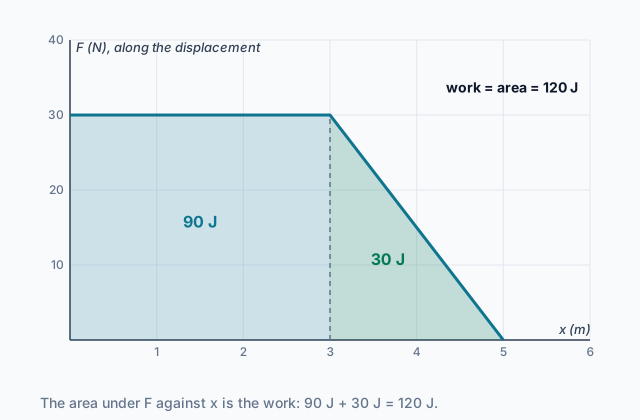 Tap to open the picture full size
Part 1 Think first Two weightlifters
Commit to a guess first. Being wrong now makes the right idea stick better.
Predict first
One weightlifter holds a 100 kg barbell perfectly still over her head for 10 seconds, straining and sweating the whole time. A second lifter raises a 20 kg bar from the floor to over his head once, a rise of about 2 m. In the physics sense, which lifter did more work on a bar?
In short. Work is the energy a force transfers into or out of a system as the point where the force is exerted moves, and for a constant force .
- Work is a scalar with a sign: positive when the force has a part along the displacement, negative when it has a part against it, zero when it is perpendicular.
- The net work done by all the forces on an object equals its change in kinetic energy, and on a graph of against displacement the work is the area under the graph.
- Gravity's work depends only on where the system starts and ends; the work done by friction and air resistance depends on the path, and the energy they remove is dissipated.
Part 2 Learn it Four short ideas, each checked as you go
2a. Work moves energy in or out
When a force is exerted on a system and the point where it pushes or pulls moves, energy is transferred into or out of the system. That transfer is work, measured in joules (1 J is 1 N·m).
For a constant force, only the part of the force along the displacement counts:
Here is how far the point where the force is exerted moves, and is the angle between the force and that displacement. Pull a rolling suitcase 10 m through an airport with 40 N along a handle tilted 60 degrees above the floor, and the handle does J of work on it, not 400 J.
Work is a scalar. It has no direction, but it has a sign. A force with a part along the displacement does positive work and puts energy in. A force with a part against it, such as friction on a sliding box, does negative work and takes energy out. A force perpendicular to the displacement does zero work.
A perpendicular force can still matter. The string on a ball whirled in a flat circle keeps turning the ball, but it always pulls at right angles to the motion, so it never changes the ball's speed or its kinetic energy.
Quick check · Sort it
Each card names a force on an object while the object moves. Tap a card, then the sign of the work that force does on that object.
Positive work
Negative work
Zero work
2b. Work is the area under a force graph
A graph of against displacement holds the work in its area. For a constant force the region under the line is a rectangle, tall and wide, so its area is , the same work as before.
Forces are often not constant, and the area still gives the work. The diagram at the top of the page shows a push on a sled: 30 N along the motion for the first 3.0 m, then easing off steadily to nothing at 5.0 m. Split the region into shapes you can measure. The rectangle is J and the triangle is J, so the push does 120 J of work over the 5.0 m. Using the largest force, or the last one, times the whole distance gives the wrong answer for a force that changes.
Where the graph dips below the axis, the force points against the displacement, and that area counts as negative work. A graph with equal areas above and below the axis belongs to a force that did zero work overall, even though it did positive work over one stretch and negative work over another.
Quick check · Calculate
A worker pushes a crate 4.0 m across a warehouse floor, pushing horizontally in the direction the crate moves. She starts with a 50 N push, and as she tires her push falls steadily to 20 N at the end of the 4.0 m. How much work does her push do on the crate?
2c. Net work changes kinetic energy
Several forces usually act at once. Add the work each one does, signs included, and the total is the net work. The work-energy theorem says that total is the change in the object's kinetic energy:
Positive net work, and the object speeds up. Negative, and it slows down. Zero, and its speed stays the same, even while two forces each do plenty of work. Push a box across a carpet at a steady walk and your push does positive work while friction does the same amount of negative work.
For each force, is how far the point where that force is exerted moves. That tells you what kind of system you have. Push a solid box and every part of it, its center of mass included, moves as far as your hands do. The box can be modeled as an object, and the work can only change its kinetic energy. Now push in the free end of a spring whose other end rests against a wall. Your hand moves, the far end does not, and the spring's center of mass moves only part of the way. Your force changes the spring's shape, its configuration, which the next topic picks up.
Quick check · Decide and justify
A student pushes a 20 kg box 3.0 m across a carpeted floor with a horizontal push, at a steady walking speed the whole way. A classmate says the student's push did no work on the box, since the box's kinetic energy never changed. Did the student's push do work on the box?
Which reason supports your answer?
2d. When the path matters
Carry a 10 kg box from the floor to a shelf 1.5 m up. Lift it straight up, and gravity, 100 N downward, does J of work on it. Slide it up a ramp 3.0 m long instead, and only the part of gravity along the ramp counts, 50 N, but over twice the distance: J again. Gravity's work depends only on where the box starts and ends, not on the path. Carry the box back down and gravity does J, so over the round trip its work is zero. A force like this is conservative, and only conservative forces have potential energies, which come in the next topic.
Friction is different. It points against the motion at every step, so its work is times the length of the path traveled, not the size of the displacement: with . Drag a box along a winding route and friction takes more energy out than along a straight one, and a round trip leaves its work negative. Friction and air resistance are nonconservative: their work depends on the path. The mechanical energy they remove is dissipated, mostly as thermal energy and partly as sound.
Quick check · Fill the statement
Tap a blank, then an answer.
When a box is carried from the floor up to a shelf and back down to the floor, the total work gravity does on it is . When a box is slid across a floor and back to where it started, the total work friction does on it is . A force whose work depends only on where a system starts and ends is , and only a force like that has a that goes with it.
Part 3 Watch it done A sled pulled by a rope
Watch each step, then finish the problem yourself.
A child on a sled has a total mass of 20 kg and starts at rest on level snow. Her brother pulls the rope with a force of 80 N, held 60 degrees above the horizontal, and drags the sled 10 m. Friction from the snow on the sled is 24 N. Find the sled's speed after the 10 m.
Step 1 · List the forces and each one's angle to the displacement
The sled moves 10 m horizontally. The rope's pull is at to that displacement. Friction points backward, at . Gravity points down and the normal force from the snow points up, each at . The sled is solid, so every force's point of application moves the same 10 m as its center of mass, and the sled can be modeled as an object.
Step 2 · Find the work each force does
Rope: J. Friction: J. Gravity and the normal force: , so each does zero work.
Why this step?
Gravity on the sled is 200 N, far bigger than the rope's pull. Why does it do no work at all?
The sled moves sideways and gravity points straight down, at right angles to the displacement. A force does work only through its part along the displacement, and gravity has none. The same goes for the normal force. Neither one changes how fast the sled goes across the snow.
Step 3 · Add the work
The net work is J. By the work-energy theorem, that is the change in the sled's kinetic energy, and the sled started with none.
Your step · Calculate
Finish it. A 20 kg sled starts at rest on level snow. A rope pulls it with 80 N at 60 degrees above the horizontal for 10 m, while friction from the snow exerts 24 N on it. The net work on the sled is 160 J. What is the sled's speed at the end of the 10 m? Give your answer to the nearest 0.1 m/s.
m/s
Part 4 Try it Lowering and dragging
Two jobs the lesson has not shown. In the first, decide the sign of the work before you work out its size. In the second, the pull on a sled changes partway, and you track how the work piles up meter by meter.
Try it · Calculate
A mover lowers a 30 kg box 2.0 m straight down at a steady speed, using a rope tied to the top of the box. How much work does the rope do on the box? Include the sign.
Try it · Sketch the graph
A student drags a loaded sled 4.0 m across level snow with a rope held horizontally. For the first 2.0 m she pulls with a steady 40 N. Then, tiring, she pulls with a steady 20 N for the last 2.0 m. Sketch the total work her pull has done on the sled against the distance dragged, from 0 to 4.0 m. The first point is fixed at 0.
One shape that fits
Drag a point up or down, or tap it and use the arrow keys. The shape is checked, and the graph must pass through the values the question gives.
Part 5 Explain it A force graph, a diagram and the energy
Nothing you type leaves this page. Check your answer against the model and each scoring point.
Free response is 50% of the exam score. This one is shaped like Question 2, Translation Between Representations.
Free-response practice · Question 2 style
A 5.0 kg block sits at rest on a level sheet of ice, where friction is negligible. Starting at , a student pulls the block to the right with a horizontal string. The pull grows steadily from 4.0 N at to 12.0 N at m, then stays at 12.0 N from m to m. Take right as positive.
(a) On paper, draw a free-body diagram of the block at m. Represent each force as a straight arrow starting on the dot, and label each one with what exerts it.
(b) Sketch a graph of the force exerted by the string on the block against , from to m. Label the force at , at m and at m.
(c) Using your graph, calculate the work the string does on the block from 0 to 0.50 m, and from 0.50 m to 1.00 m.
(d) Using your free-body diagram, justify why the work done by the string alone equals the change in the block's kinetic energy.
(e) A classmate says the block gains the same kinetic energy in each half of the pull, because the pull reaches 12.0 N in both halves. Calculate the block's speed at m, and use your graph to explain whether the classmate is right.
Model answer
(a) Three arrows from the dot: the gravitational force exerted by Earth, , down; the normal force exerted by the ice, , up and the same length; and the string's pull, , to the right. No friction arrow and no force of motion.
(b) A straight line rising from 4.0 N at to 12.0 N at m, then a level line at 12.0 N out to m.
(c) From 0 to 0.50 m the region under the graph is a trapezoid: a rectangle J plus a triangle J, so 4.0 J in all. From 0.50 m to 1.00 m it is a rectangle, J.
(d) The block moves horizontally. and are vertical, perpendicular to the displacement, so each does zero work. With friction negligible, the pull is the only force with a part along the displacement, so the net work is the string's work. The block is rigid, so the point where the string pulls moves as far as its center of mass, and the block can be modeled as an object whose work goes into kinetic energy: .
(e) The total work is J. The block starts at rest, so gives m/s. The classmate is wrong. Kinetic energy gained equals the area under the graph, not the force at the end. The second half's rectangle, 6.0 J, has more area than the first half's trapezoid, 4.0 J, because in the first half the pull was less than 12.0 N everywhere but the end.
Score your own answer. This is a self-check, not a grade. Tick each point your answer makes.
Part 6 Check yourself Three routes to a loading platform
Both case questions use the loading-platform table.
A worker moves a 12 kg box from the floor onto a loading platform 1.5 m above the floor. The box starts and ends at rest. She tries three routes, and the table gives each route's path length and the friction force on the box along that route.
| Route | How the box moves | Path length (m) | Friction force on the box (N) |
|---|---|---|---|
| A | Lifted straight up | 1.5 | 0 |
| B | Pushed up a short, steep ramp | 3.0 | 21 |
| C | Pushed up a long, gentle ramp | 5.0 | 23 |
Case question 1 · Calculate
Using the loading-platform table, how much work does gravity do on the 12 kg box as it is pushed along route C, from the floor to the platform 1.5 m up? Include the sign.
Case question 2 · Multiple choice
Using the loading-platform table, along which route does friction dissipate the most mechanical energy as the box is moved onto the platform?
The rest stand on their own and do not use the case.
Check yourself · Spot the error
A 0.50 kg hockey puck slides 8.0 m across level ice, starting at 4.0 m/s, while friction from the ice exerts 0.40 N on it. A student finds the puck's final speed. Tap the first line that goes wrong.
Check yourself · Match
Tap a force, then what is true of the work it does.
Part 7 Keep it Bring back earlier ideas
Pulling an older idea back up is what makes it last.
From 2.7 Kinetic and Static Friction · Fill the statement
Two workers pull a wooden crate across a concrete floor at a slow, steady speed. Tap a blank, then the words that complete the sentence.
Tipping the crate onto its narrower side changes , and the friction force . Setting an identical crate on top of it changes , and the friction force .
A delivery robot drives along a straight hallway. East is positive. Its log lists the four legs of one trip in order. The robot also has an odometer, which counts how far its wheels roll.
| Leg | Move |
|---|---|
| 1 | 6.0 m east |
| 2 | 2.5 m west |
| 3 | 4.0 m west |
| 4 | 1.5 m east |
From 1.1 Scalars and Vectors in One Dimension · Multiple choice
East is positive. A hallway robot drives four legs in order: 6.0 m east, 2.5 m west, 4.0 m west and 1.5 m east. Its odometer counts how far its wheels roll. After the trip, how does the odometer reading compare with the magnitude of the robot's total displacement?
In three lines
- Work is energy transferred into or out of a system by a force over a distance, , and its sign tells you which way the energy went.
- The net work on an object equals its change in kinetic energy, and the work done by a changing force is the area under its graph against displacement.
- Gravity's work depends only on the start and end points; friction and air resistance do work that depends on the path, and the energy they take is dissipated.
Vocabulary
- Work
- The amount of energy transferred into or out of a system by a force exerted on it over a distance; for a constant force, .
- Net work
- The sum of the work done by all the forces exerted on an object, which equals the change in its kinetic energy.
- Work-energy theorem
- The statement that the change in an object's kinetic energy equals the sum of the work done on it by all the forces exerted on it.
- Conservative force
- A force whose work on a system is path-independent, depending only on the system's initial and final configurations, so its work is zero when the system returns to where it started.
- Nonconservative force
- A force whose work on a system is path-dependent, such as friction or air resistance.
Course alignment, for teachers
AP Physics 1: Algebra-Based topic 3.2, Unit 3: Work, Energy, and Power.
- Skill 1.B: Create quantitative graphs with appropriate scales and units, including plotting data.
- Skill 2.B: Calculate or estimate an unknown quantity with units from known quantities, by selecting and following a logical computational pathway.
- Skill 2.D: Predict new values or factors of change of physical quantities using functional dependence between variables.
- Skill 3.A: Create experimental procedures that are appropriate for a given scientific question.
- Skill 3.B: Apply an appropriate law, definition, theoretical relationship, or model to make a claim.
This lesson maps all 15 essential knowledge statements of the topic to the part that teaches each one: 15 are checked by a scored question. The map is in the lesson file.