Unit 8 · Topic 8.4 · about 30 minutes · 7 parts · 12 scored checks, 1 of them multiple choice
AP Physics 1: Algebra-Based 8.4: Fluids and Conservation Laws
 Tap to open the picture full size
Part 1 Think first Two gauges on one pipe
Commit to a guess first. Being wrong now makes the right idea stick better.
Predict first
Water flows steadily through a level pipe that is completely full. Partway along, the pipe narrows, so the water goes from a wide section into a narrow one. A pressure gauge is fitted to each section. Which gauge reads the higher pressure?
In short. A flowing fluid obeys two conservation laws: a filled pipe carries the same volume through every cross section each second, and Bernoulli's equation keeps the mechanical energy per volume the same all along the flow.
- A pressure difference makes a fluid flow, and the volume flow rate is the same everywhere along a filled pipe, so .
- Bernoulli's equation, , is conservation of mechanical energy per volume, so a change in height shows up as a change in speed, in pressure, or both.
- Torricelli's theorem, , follows from Bernoulli's equation and gives the speed of fluid leaving an opening a height below the fluid's top surface.
Part 2 Learn it Four short ideas, each checked as you go
2a. What makes a fluid flow
Pressure is the perpendicular force per area a fluid exerts on any surface it touches, including the next bit of the same fluid. Picture a short slab of water in a level pipe. The water behind it pushes it forward, and the water ahead pushes it back. If the pressure behind is greater, the forward push wins, and by Newton's second law (2.5 Newton’s Second Law) the slab speeds up. So water at rest in a level pipe starts to flow from where the pressure is higher toward where it is lower. Open a faucet and the high pressure in the water main drives water out into the air.
With equal pressures at both ends, water at rest in a level pipe stays at rest. Water already moving through a level pipe of constant width needs no difference to keep it moving, any more than a puck needs a push to keep sliding on frictionless ice (2.4 Newton’s First Law).
In this course every fluid is ideal, so it cannot be compressed, and every pipe is completely filled unless a problem says otherwise. So a pipe open at both ends has no room to store extra water. Each liter pushed in at one end pushes a liter out of the other, so water leaves at the same rate it enters.
Quick check · Fill the statement
A level pipe, completely filled with water, is open at both ends. Treat the water as an ideal fluid. Tap a blank, then an answer.
Water at rest in the pipe starts to flow only when the two ends are at pressures, and it speeds up toward the -pressure end. Once it flows steadily, the volume of water leaving the far end each second is the volume entering the near end.
2b. The same volume through every cross section
How much fluid passes a point each second depends on how big the opening is and how fast the fluid moves through it. In a time , fluid moving at speed through a cross-sectional area fills a cylinder of length , so its volume is . The volume flow rate is
in cubic meters per second. A pipe of area carrying water at 2.0 m/s delivers , or 20 liters, every second.
Now follow the water through a pipe that changes width. The pipe is full and the water cannot be compressed, so between any two cross sections no water piles up and none goes missing. The same volume passes each one every second:
This is the continuity equation. The density does not change, so it also says the same mass passes every cross section each second: mass is conserved. The bookkeeping is the one you used for momentum in 4.3 Conservation of Linear Momentum, where what is inside a system changes only by what crosses its boundary.
Where the pipe narrows, the water speeds up. Cut the area to a third and the speed triples.
Quick check · Calculate
Water fills a garden hose and moves at 1.2 m/s where the hose's cross-sectional area is . It leaves through a nozzle whose opening has an area of . Treat the water as an ideal fluid. How fast does the water move through the nozzle's opening? Give your answer to the nearest 0.1 m/s.
2c. Bernoulli's equation: energy per volume
Follow one cubic meter of water along a pipe. Its mass in kilograms is the density , so its kinetic energy is . Its gravitational potential energy, with Earth in the system, is . Pressure is energy per volume too: a force pushing water a length along a pipe does work , and is the volume pushed. An ideal fluid dissipates nothing, so, as in 3.4 Conservation of Energy, the mechanical energy per volume is the same at every point along the flow:
That is Bernoulli's equation, a budget whose three terms always add to the same total.
A difference in height between two places in the fluid has to show up in the other two terms. When water rises, grows, so the speed term and the pressure term together shrink by that much. In a pipe of constant width, continuity holds the speed fixed, so the whole climb comes out of the pressure: water pumped up 10 m loses Pa, about one atmosphere. Going down, the pressure term or the speed term gains instead. In a level pipe, a gain in speed comes out of the pressure, which is why the wide section's gauge reads higher.
Quick check · Decide and justify
Water is pumped steadily up a vertical pipe of constant cross-sectional area, from a basement to a faucet 4.0 m higher. The water is an ideal fluid that fills the pipe. How does the pressure in the water at the top of the pipe compare with the pressure at the bottom?
Which reason supports your answer?
2d. Torricelli's theorem
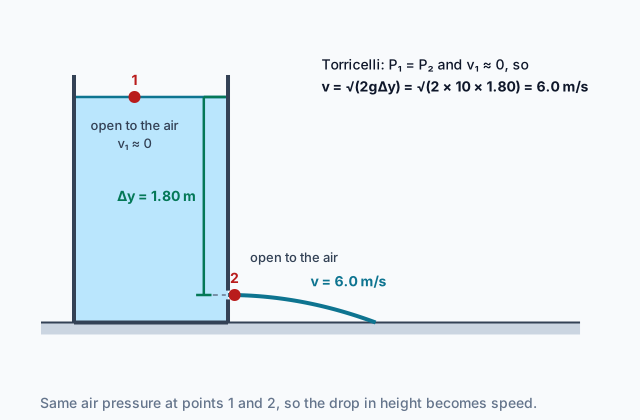
The diagram shows a wide, open tank with a small hole in its side. Take point 1 on the water's surface and point 2 in the stream just outside the hole. Both are open to the air, so and the pressure terms cancel. The tank is wide, so its surface sinks so slowly that is close to 0. What is left of Bernoulli's equation is
where is the height of the top surface above the opening. That is Torricelli's theorem. In the diagram, m/s.
The density cancelled, so any ideal fluid leaves at that speed. It is the same speed a stone reaches falling 1.80 m from rest (3.4 Conservation of Energy), because in both a drop in height pays for all the kinetic energy.
Use the air's pressure at point 2, outside the hole. Inside the tank at that depth the pressure is higher, and that higher pressure is what pushes the water out, but it is not the pressure in the stream.
Quick check · Sketch the graph
A tall, wide, open tank of water has small holes in its side at 1.0, 2.0, 3.0 and 4.0 m below the water's surface. Treat the water as an ideal fluid and the level as staying put. Sketch the speed at which water leaves a hole against the hole's depth below the surface, from 0 to 4.0 m. The first point is fixed at 0.
One shape that fits
Drag a point up or down, or tap it and use the arrow keys. Only the shape is checked.
Part 3 Watch it done Water pressure on the second floor
Watch each step, then finish the problem yourself.
Water enters a house's plumbing in the basement at an absolute pressure of 200 kPa, moving at 2.0 m/s through a pipe of cross-sectional area . The pipe rises 3.0 m to a second-floor bathroom, where its area is . Water is an ideal fluid of density that fills the pipe. Take up as positive. Find the absolute pressure in the water upstairs.
Step 1 · Find the speed upstairs from continuity
The pipe is full and the water is ideal, so : m/s. Half the area, twice the speed.
Step 2 · Write Bernoulli's equation and solve it for the unknown
Take point 1 in the basement and point 2 upstairs, with and m. Solving for gives
Why this step?
Why do both terms after make the pressure upstairs lower?
Upstairs the water is both faster and higher, so each cubic meter has more kinetic energy and more gravitational potential energy than in the basement. The total per cubic meter stays the same along an ideal flow, so the pressure term pays for both gains. That is why is negative here and is subtracted.
Your step · Calculate
Finish it. Water, an ideal fluid of density that fills the pipe, enters a house's plumbing in the basement at an absolute pressure of 200 kPa, moving at 2.0 m/s through a pipe of cross-sectional area . The pipe rises 3.0 m to a second-floor bathroom, where its area is . Take up as positive. What is the absolute pressure in the water upstairs? Give your answer to the nearest 1 kPa.
kPa
Part 4 Try it A rainwater tank and a watering can
A new situation, with Torricelli's theorem and the volume flow rate working together. A rainwater tank collects water off a roof, and a spigot near its bottom fills a watering can. The tank is wide, so while one can fills, its water level drops by only a few centimeters, small next to its depth.
Try it · Calculate
The water surface in a wide, open rainwater tank is 1.25 m above the opening of a spigot near its bottom. The spigot is open to the air, and its opening has a cross-sectional area of . Treat the water as an ideal fluid and its level as staying put while a 9.0 L watering can fills, where . How long does the can take to fill? Give your answer to the nearest 0.1 s.
Part 5 Explain it Claim, derive, connect
Nothing you type leaves this page. Check your answer against the model and each scoring point.
Free response is 50% of the exam score. This one is shaped like Question 4, Qualitative/Quantitative Translation.
Free-response practice · Question 4 style
Water, an ideal fluid of density , flows steadily through a level pipe that it fills completely. The pipe narrows from a wide section of cross-sectional area to a narrow section of area . In the wide section the water moves at speed and its pressure is .
(a) Make a claim about how the water's speed and its pressure in the narrow section compare with those in the wide section. Explain your reasoning in words, without equations.
(b) Starting from the continuity equation and Bernoulli's equation, derive an expression for the pressure difference between the wide and narrow sections, in terms of , , and .
(c) Explain how your expression in (b) is consistent with your claim in (a).
(d) A classmate says that if the narrow section's area were halved, with and unchanged, the pressure difference would double. Use your expression in (b) to explain whether the classmate is correct.
Model answer
(a) In the narrow section the water moves faster and its pressure is lower. The pipe is full and water cannot be compressed, so each second the same volume that passes through the wide section must pass through the narrow one, and a smaller opening only passes that volume if the water moves through it faster. So each bit of water speeds up as it goes from the wide section into the narrow one. Speeding up takes a net force forward, and along a level pipe the only pushes on that bit of water come from the water behind it and the water ahead of it. The push from behind, from the wide section, must be the larger, so the pressure is greater in the wide section and lower in the narrow one.
(b) Continuity: , so . The pipe is level, so and the height terms cancel from Bernoulli's equation: . Then .
(c) The narrow section has the smaller area, so and is greater than : the water is faster there, as claimed. Squaring a number greater than 1 gives a number greater than 1, so the bracket is positive and : the pressure in the narrow section is lower, as claimed. With no narrowing, , the bracket is 0, and the speed and pressure do not change, which also fits.
(d) The classmate is not correct; the difference more than doubles. Write , so the difference is proportional to . Halving doubles , which makes it proportional to . That is more than for any , since . For example, with the bracket goes from 3 to 15, five times as large.
Score your own answer. This is a self-check, not a grade. Tick each point your answer makes.
Part 6 Check yourself An irrigation line
Both case questions use the irrigation line's table.
Water flows steadily through a farm's irrigation line, passing through section A, then section B, then section C. The water is an ideal fluid of density and fills the line. Sections A and B are at the same height, and section C is on a rise. In section A the water moves at 1.50 m/s.
| Section | Cross-sectional area (m²) | Height above section A (m) |
|---|---|---|
| A | 0.0120 | 0.0 |
| B | 0.0060 | 0.0 |
| C | 0.0120 | 4.0 |
Case question 1 · Calculate
Using the irrigation line's table, with the water moving at 1.50 m/s in section A: what is the volume flow rate through section B, in liters per second? One liter is . Give your answer to the nearest 1 L/s.
Case question 2 · Multiple choice
Using the irrigation line's table, with the water moving at 1.50 m/s in section A: how do the water pressures in the three sections rank, from greatest to least?
The rest stand on their own and do not use the case.
Check yourself · Spot the error
A wide, open tank of water has a small hole in its side, 0.80 m below the water's surface, and the stream leaves into the air. Take up as positive. A student tries to find how fast the water leaves the hole. Tap the first line that goes wrong.
Check yourself · Sort it
Each card names two points in a steady flow of water, an ideal fluid that fills its pipe, listed in the order the water reaches them. Tap a card, then where the water's pressure is greater.
At the first point
At the second point
The same at both points
Part 7 Keep it Bring back earlier ideas
Pulling an older idea back up is what makes it last.
From 3.4 Conservation of Energy · Calculate
A child on a sled, 30 kg together, is moving at 3.0 m/s at the top of an icy slope, then slides down to the bottom, 1.8 m lower. Friction and air resistance are negligible. Take the sled, the child and Earth as the system. What is the sled's speed at the bottom of the slope? Give your answer to the nearest 0.1 m/s.
From 2.5 Newton’s Second Law · Calculate
A rope pulls a 25 kg sled east across level snow with a horizontal force of 80 N. The snow exerts a friction force of 30 N on the sled, pointing west. Take east as positive. What is the sled's acceleration? Give your answer to the nearest 0.1 m/s².
In three lines
- A pressure difference makes a fluid flow, and in a filled pipe the volume flow rate is the same at every cross section: .
- Bernoulli's equation keeps the same along an ideal flow, so at the same height faster water has lower pressure, and at the same speed higher water has lower pressure.
- From a wide open tank, fluid leaves an opening at , the speed an object reaches falling from rest through that same height.
Vocabulary
- Volume flow rate
- The volume of fluid passing a cross section each second, , the product of the cross-sectional area and the fluid's speed.
- Continuity equation
- : in an incompressible fluid filling a pipe, the same volume, and so the same mass, passes every cross section each second.
- Bernoulli's equation
- , the conservation of mechanical energy per volume along the flow of an ideal fluid.
- Torricelli's theorem
- The speed of fluid leaving an opening a height below the fluid's top surface, , derived from conservation of energy.
- Ideal fluid
- A fluid that is incompressible and has no viscosity, which this course assumes for every fluid unless a problem says otherwise.
Course alignment, for teachers
AP Physics 1: Algebra-Based topic 8.4, Unit 8: Fluids.
- Skill 1.B: Create quantitative graphs with appropriate scales and units, including plotting data.
- Skill 2.A: Derive a symbolic expression from known quantities by selecting and following a logical mathematical pathway.
- Skill 2.C: Compare physical quantities between two or more scenarios or at different times and locations in a single scenario.
- Skill 3.A: Create experimental procedures that are appropriate for a given scientific question.
- Skill 3.B: Apply an appropriate law, definition, theoretical relationship, or model to make a claim.
This lesson maps all 7 essential knowledge statements of the topic to the part that teaches each one: 7 are checked by a scored question. The map is in the lesson file.