Unit 7 · Topic 7.4 · about 30 minutes · 7 parts · 12 scored checks, 1 of them multiple choice
AP Physics 1: Algebra-Based 7.4: Energy of Simple Harmonic Oscillators
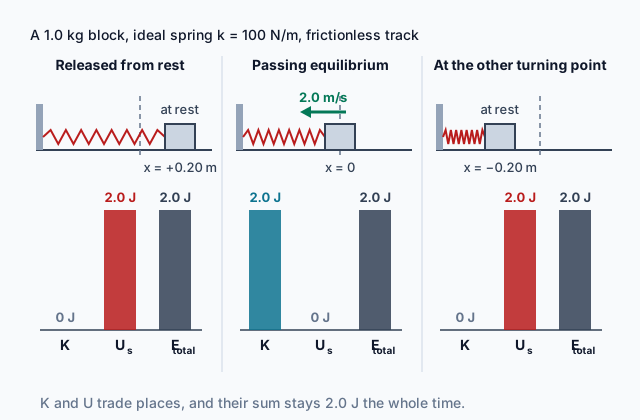 Tap to open the picture full size
Part 1 Think first A glider halfway in
Commit to a guess first. Being wrong now makes the right idea stick better.
Predict first
A glider on a level air track is tied to a spring, and friction is negligible. You pull the glider 10 cm from where it would rest and let go. It slides back and forth between your 10 cm mark and a point 10 cm on the other side. Think about the moment it passes the 5 cm mark on its way in. What share of the energy you gave the system is in the moving glider at that moment, rather than in the spring?
In short. In simple harmonic motion energy moves back and forth between kinetic and potential energy, and the system's total energy, , stays constant.
- The kinetic energy is greatest where the potential energy is least, passing through equilibrium.
- At a turning point the kinetic energy is zero, its minimum, and the potential energy is greatest.
- For a block on a spring the total energy is , so changing the amplitude changes the total energy.
Part 2 Learn it Three short ideas, each checked as you go
2a. Two stores, one total
Hook a block to a horizontal ideal spring on a level, frictionless track, pull it out and let go. Take the block and the spring as the system. The block has kinetic energy whenever it moves. The spring has elastic potential energy whenever it is stretched or squeezed from its relaxed length, , as in 3.3 Potential Energy. On a level track the block's equilibrium position is where the spring is relaxed, so is just the block's distance from equilibrium.
The system's total energy is the sum of the two:
The track pushes up and Earth pulls down, both at right angles to the motion, so neither does work, and with no friction nothing is dissipated. So, just as in 3.4 Conservation of Energy, the total stays constant. Energy moves from one store to the other, and the sum never changes.
That lets you find either store anywhere. Take a spring with N/m, pulled out 0.20 m and released from rest. At release the block is not moving, so J. At 0.10 m from equilibrium the spring holds J, so the block has J.
Quick check · Calculate
A block on a level, frictionless track is tied to a horizontal ideal spring with spring constant 80 N/m. It is pulled 0.25 m from equilibrium and released from rest. What is the block's kinetic energy when it is 0.15 m from equilibrium? Give your answer to the nearest 0.1 J.
2b. Where each one peaks
Follow one trip in the diagram at the top of the page: a 1.0 kg block on a spring with N/m, released from rest at m. At release it is at rest, so , and the spring, stretched as far as it ever gets, stores all 2.0 J. That is a turning point. Kinetic energy can never be less than zero, so at a turning point is at its minimum, zero, and is at its maximum.
As the block heads in, the spring shortens, its energy falls, and the block speeds up. At equilibrium the spring is at its relaxed length, so , its minimum, and is at its maximum, the whole 2.0 J. The block passes through at its top speed, 2.0 m/s. Then the spring squeezes, climbs again, the block slows, and at m it stops at the other turning point with all 2.0 J back in the spring.
So the two peak in opposite places. is largest where is smallest, and is largest where is smallest.
A pendulum does the same with gravitational potential energy of the bob and Earth. Take the zero at the lowest point: the bob is fastest at the bottom of its swing and stops for an instant at each end.
Quick check · Sort it
Each card describes one moment in an oscillation with friction and air resistance negligible. For a block on a spring the potential energy is the spring's. For a pendulum, take the gravitational potential energy of the bob and Earth as zero at the lowest point of the swing. Tap a card, then how the system's energy is split at that moment.
All kinetic
All potential
Some of each
2c. The amplitude sets the total
At a turning point all the energy is in the spring, and the stretch there is the amplitude . So for a block on a spring
Pull the block out twice as far and the system has four times the energy, because the spring's energy grows with the square of its stretch. Pull it out half as far and it has a quarter. A stiffer spring pulled out the same distance stores more: twice the spring constant, twice the energy. The block's mass is not in the equation at all. A heavier block on the same spring, pulled out the same distance, gets the same total energy and moves more slowly with it.
The top speed comes from the same total. At equilibrium all of it is kinetic, so . Four times the energy gives the same block twice the top speed, not four times, because kinetic energy grows with the square of the speed.
What the amplitude does not change is the period, as you saw in 7.3 Representing and Analyzing SHM. A block pulled out farther moves faster over a longer path and takes the same time.
Quick check · Decide and justify
A block on a level, frictionless track is tied to a horizontal ideal spring. You pull it 4.0 cm from equilibrium and release it from rest. Then you stop it and release it from rest 8.0 cm from equilibrium instead. How does the total energy of the block-spring system in the second run compare with the first?
Which reason supports your answer?
Part 3 Watch it done The speed partway in
Watch each step, then finish the problem yourself.
A 0.50 kg block on a level, frictionless track is tied to a horizontal ideal spring with spring constant 200 N/m. It is pulled 0.15 m from equilibrium and released from rest. How fast is it moving when it is 0.09 m from equilibrium?
Step 1 · Choose the system
Take the block and the spring. The track pushes up and Earth pulls down, both at right angles to the block's motion, so neither does work, and with no friction nothing is dissipated. The system's total energy, , stays the same.
Step 2 · Find the total at the release point
At release the block is at rest, so and all the energy is in the spring: J.
Why this step?
Why find the total energy at the release point, when the question is about 0.09 m?
The total is the same at every point of the motion, so you can find it wherever that is easiest. At the release point you know the stretch and you know , so one term gives the whole total.
Step 3 · Split the total at 0.09 m
There the spring stores J, so the block's kinetic energy is J.
Your step · Calculate
Finish it. A 0.50 kg block on a level, frictionless track is tied to a horizontal ideal spring with spring constant 200 N/m, pulled 0.15 m from equilibrium and released from rest. When it is 0.09 m from equilibrium, the system's total energy is 2.25 J and the spring stores 0.81 J, so the block has 1.44 J of kinetic energy. How fast is the block moving there? Give your answer to the nearest 0.1 m/s.
m/s
Part 4 Try it Watch the energy move
A new view of the same motion. In the lab you can watch the two energies trade places against time and see what the amplitude and the mass do to them. Then draw a graph the lab does not show: the kinetic energy against the block's position.
Try it · Sketch the graph
A block on a level, frictionless track is tied to a horizontal ideal spring with spring constant 60 N/m. It is pulled to x = +0.30 m, with x measured from equilibrium and right as positive, and released from rest. Sketch the block's kinetic energy against its position, from x = -0.30 m to x = +0.30 m. The first point is fixed at 0.
One shape that fits
Drag a point up or down, or tap it and use the arrow keys. The shape is checked, and the graph must pass through the values the question gives.
Part 5 Explain it Two ways to put in more energy
Nothing you type leaves this page. Check your answer against the model and each scoring point.
Free response is 50% of the exam score. This one is shaped like Question 4, Qualitative/Quantitative Translation.
Free-response practice · Question 4 style
A block of mass sits on a level, frictionless track, attached to a horizontal ideal spring with spring constant whose other end is fixed to a wall. In the original setup the block is pulled a distance from equilibrium and released from rest. Two students each change one thing.
- Student 1 uses the same block and spring and pulls the block out a distance .
- Student 2 uses the same block, replaces the spring with one whose spring constant is , and pulls the block out a distance .
(a) Make a claim about how the total energy of the block-spring system and the block's greatest speed in each student's setup compare with those in the original setup, and whether the two students' setups match each other. Explain your reasoning in words, without equations.
(b) Starting from and the energy of the system as the block passes equilibrium, derive an expression for the block's greatest speed in terms of , and . Then write the total energy and the greatest speed in each student's setup in terms of the original and .
(c) Explain how your expressions in (b) are consistent with your claim in (a), including why the block's mass does not appear in the total energy but does appear in the greatest speed.
Model answer
(a) Both students give the system four times the original total energy and give the block twice the original greatest speed, so their two setups match each other on both. A spring's force grows in step with its stretch. Pulling the same spring twice as far means pushing against a force that keeps growing, over twice the distance: twice the average force over twice the distance stores four times the energy. A spring four times as stiff, pulled the same distance, pushes back four times as hard at every point, which also stores four times the energy. The block starts at rest, so all of that energy starts in the spring, and as the block passes equilibrium all of it is kinetic. The block is the same, and kinetic energy grows with the square of the speed, so four times the energy means only twice the speed.
(b) At equilibrium the spring is relaxed, so and all the energy is kinetic: , so
Student 1: , and .
Student 2: , and .
(c) The total energy is proportional to and to , so doubling multiplies it by and making four times as large multiplies it by 4, the same factor, as claimed. The greatest speed is proportional to and to , so doubling doubles it and four times the spring constant multiplies it by , again the same. That square root is the last step of the claim in symbols: for the same mass, four times the kinetic energy is twice the speed. The mass is not in because at release all the energy is stored in the spring, and that depends only on the spring and its stretch. It is in because the same energy moves a heavier block more slowly.
Score your own answer. This is a self-check, not a grade. Tick each point your answer makes.
Part 6 Check yourself A glider on an air track
Both case questions use the glider table.
A 0.50 kg glider sits on a level air track, where friction and air resistance are negligible, tied to a horizontal ideal spring whose other end is fixed. A student pulls it 0.25 m from equilibrium and releases it from rest. A motion sensor records the glider's speed as it passes four positions, each measured from equilibrium.
| Distance from equilibrium (m) | Speed (m/s) |
|---|---|
| 0.25 | 0.0 |
| 0.20 | 1.2 |
| 0.15 | 1.6 |
| 0.00 | 2.0 |
Case question 1 · Calculate
Using the glider table, for the 0.50 kg glider released from rest 0.25 m from equilibrium: what is the spring constant of the spring? Give your answer to the nearest 1 N/m.
Case question 2 · Multiple choice
Using the glider table, how much energy does the spring store when the 0.50 kg glider is 0.15 m from equilibrium?
The rest stand on their own and do not use the case.
Check yourself · Spot the error
A 0.50 kg block on a level, frictionless track is tied to a horizontal ideal spring with spring constant 200 N/m. It is pulled 0.050 m from equilibrium and released from rest. A student works out how fast it moves when it is 0.025 m from equilibrium. Tap the first line that goes wrong.
Check yourself · Match
A block on a level, frictionless track is tied to a horizontal ideal spring, pulled out from equilibrium and released from rest. Each change below is the only change made to that setup. Tap a change, then what it does to the system's total energy.
Check yourself · Fill the statement
A block on a level, frictionless track oscillates on a horizontal ideal spring. Tap a blank, then an answer.
As the block moves from a turning point toward equilibrium, the spring's potential energy and the block's kinetic energy . As the block passes through equilibrium, its kinetic energy is the system's total energy.
Part 7 Keep it Bring back earlier ideas
Pulling an older idea back up is what makes it last.
From 3.3 Potential Energy · Fill the statement
A spring toy has an ideal spring. Tap a blank, then an answer.
Compressing the spring 3 cm stores stretching it 3 cm. Compressing it 9 cm stores as much energy as compressing it 3 cm. With the zero at its relaxed length, the energy the spring stores is never .
From 2.8 Spring Forces · Match
A block on a level, frictionless table is joined to a horizontal ideal spring with N/m, and the spring's other end is fixed to a wall. Right is positive, and is how far the spring's end is from where it sits when the spring is relaxed. Tap each displacement, then the force the spring exerts on the block.
In three lines
- An oscillator's total energy is , and with no friction it stays constant.
- Kinetic energy is greatest at equilibrium, where potential energy is least, and zero at the turning points, where potential energy is greatest.
- For a block on a spring , so changing the amplitude changes the total energy.
Vocabulary
- Total energy
- The sum of a system's kinetic and potential energies, , which stays constant for a system in simple harmonic motion.
- Equilibrium position
- A location at which the net force exerted on an object or system is zero; an oscillating object passes it with its greatest kinetic energy.
- Amplitude
- The greatest distance an oscillating object moves from its equilibrium position; for a block on a spring it sets the total energy, .
Course alignment, for teachers
AP Physics 1: Algebra-Based topic 7.4, Unit 7: Oscillations.
- Skill 1.A: Create diagrams, tables, charts, or schematics to represent physical situations.
- Skill 2.B: Calculate or estimate an unknown quantity with units from known quantities, by selecting and following a logical computational pathway.
- Skill 2.C: Compare physical quantities between two or more scenarios or at different times and locations in a single scenario.
- Skill 3.B: Apply an appropriate law, definition, theoretical relationship, or model to make a claim.
This lesson maps all 6 essential knowledge statements of the topic to the part that teaches each one: 6 are checked by a scored question. The map is in the lesson file.