Unit 2 · Topic 2.3 · about 30 minutes · 7 parts · 13 scored checks, 3 of them multiple choice
AP Physics 1: Algebra-Based 2.3: Newton’s Third Law
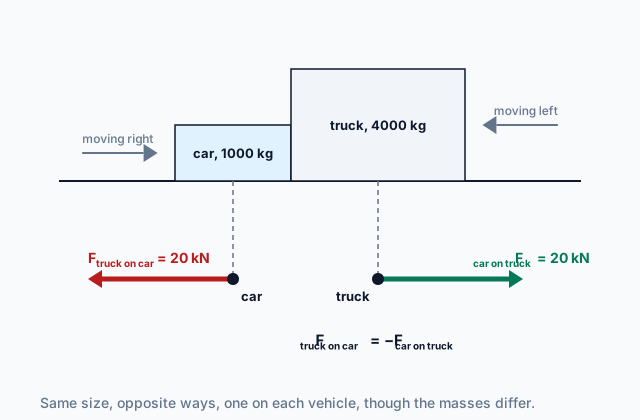 Tap to open the picture full size
Part 1 Think first A tug on a spring scale
Commit to a guess first. Being wrong now makes the right idea stick better.
Predict first
Two friends pull on opposite ends of a spring scale, one pulling left and the other pulling right, each with a force of 100 N. The scale does not move. What does the scale read?
In short. Newton's third law says that when two objects interact, each exerts a force on the other, and the two forces are equal in size and opposite in direction.
- The two forces of a third-law pair are the same type of force and act on different objects, so they are never on the same free-body diagram and never cancel.
- Forces between objects inside a system are internal, and they do not change how the system's center of mass moves.
- An ideal string has negligible mass, does not stretch and has the same tension at every point; a string, rope or chain with mass can have different tension at different points.
Part 2 Learn it Four short ideas, each checked as you go
2a. Every force has a partner
A force is one side of an interaction between two objects. When object A pushes or pulls on object B, B pushes or pulls on A at the same moment. Newton's third law says those two forces are equal in size and opposite in direction:
The two forces of a third-law pair are the same size, point opposite ways and are the same type of force. And they act on different objects, so they are never on the same free-body diagram.
Kick a ball. Your foot pushes the ball forward, and the ball pushes your foot backward just as hard; you feel it in your toes. Both are contact forces. Now drop the ball. Earth pulls it down, and the ball pulls Earth up with a force of the same size. Both are gravitational. Gravity is the only force in this course that acts across a distance; every other force needs the objects to touch.
To find a force's partner, swap the two objects in its name and reverse its direction. "The leash pulls the dog backward" becomes "the dog pulls the leash forward."
Quick check · Match
Tap a force, then the force that is its third-law partner.
2b. A pair is not a balance
A book lies still on a table. Earth pulls it down, the table pushes it up, and the two forces are the same size. They are not a third-law pair. Both act on the same object, the book, and they are different types: one is gravitational and the other is a contact force. They are two balanced forces on one object.
Each has its own partner somewhere else. The partner of Earth's pull on the book is the book's pull on Earth, upward. The partner of the table's push on the book is the book's push on the table, downward.
The forces of a pair never cancel each other. Forces cancel only when they act on the same object, and the two forces of a pair never do. That is also why a free-body diagram never shows both forces of a pair.
Size and speed do not pick a winner either. When a truck hits a small car, the car pushes on the truck exactly as hard as the truck pushes on the car, whatever their masses and speeds. The car comes off worse because it is lighter and flimsier, so the same size of force does more to it.
Quick check · Spot the error
A 30 N backpack hangs at rest from a hook by its strap. A student lists the forces and their partners. Tap the first line that goes wrong.
2c. Forces inside a system
Choose a system, such as you and your boots. Forces between parts of the system are internal forces. Forces from anything outside it, such as Earth or the floor, are external.
Internal forces always come in third-law pairs, and both forces of each pair act on the system. Add up every force on the system and each internal pair adds to zero. So internal forces do not change how the system's center of mass moves. Only external forces can.
That is why pulling up on your own bootstraps cannot lift you. Your hands and the straps pull on each other inside the you-and-your-boots system, so your center of mass goes nowhere.
Parts of a system can still move. A person walks east along a raft floating at rest on still water, with water drag negligible. Her feet push the raft west and the raft pushes her east, an internal pair. The center of mass of person and raft stays put, so as she moves east the raft moves west. Since does not change,
A raft with four times her mass moves a quarter as far as she does.
Quick check · Multiple choice
A boy sits in a wagon at rest on level ground, with his back against the wagon's seat. Without moving in his seat, he pushes forward hard on the wagon's front rail with both hands. Friction on the wheels is negligible. What happens to the wagon?
2d. Tension in strings, ropes and chains
A rope pulls; it never pushes. Pull on one end and each short segment of the rope pulls on the segments next to it, in third-law pairs, all along its length. Tension is the overall result of those pulls between segments. At each end, the rope pulls on whatever is tied there, along the rope.
Most problems use an ideal string: its mass is negligible and it does not stretch. The tension in an ideal string is the same at every point, so it pulls on the objects at its two ends with forces of the same size.
An ideal pulley has negligible mass and turns on an axle through its center with negligible friction. An ideal string running over one keeps the same tension on both sides; the pulley only changes the direction of the pull.
A rope with real mass is different. Hang a heavy chain from a hook. Each link holds up all of the chain below it, so the tension is greatest at the top and falls to zero at the free bottom end. You describe that in words; you do not calculate it.
Quick check · Sort it
Tap each string, rope or chain, then whether its tension is the same at every point along it.
Same at every point
Differs from point to point
Part 3 Watch it done Two crates on a rope
Watch each step, then make the last comparison yourself.
On smooth ice, crate F is tied to crate R behind it by a light rope that does not stretch. You pull east on a second rope tied to the front of crate F, and both crates slide east. Friction from the ice is negligible. Find every force on crate F and the third-law partner of each, then compare how hard the two crates pull on the connecting rope.
Step 1 · Find the forces on crate F
Two ropes touch crate F. Yours pulls it east, and the connecting rope pulls it west, back toward crate R. The ice touches it and pushes up. Earth pulls it down without touching it. That makes four forces.
Why this step?
Why does the connecting rope pull crate F west, when both crates are moving east?
A rope can only pull, and it pulls along itself toward its other end. At crate F the connecting rope runs back toward crate R, so it pulls west. The way the crates move does not set the direction of a force.
Step 2 · Name each partner
Swap the objects and reverse the direction. Crate F pulls your rope west. Crate F pushes down on the ice. Crate F pulls up on Earth. Each partner is exerted on something other than crate F, so none of them goes on crate F's diagram. You will meet the partner of the connecting rope's pull in the last step.
Step 3 · Choose the system
Take crates F and R and the connecting rope together as one system. Your rope, the ice and Earth are outside it, so their forces are external. The pulls between the connecting rope and the two crates are internal, and they come in pairs.
Your step · Decide and justify
Finish it. On smooth ice, crate F is tied to crate R behind it by a light rope that does not stretch. You pull east on a second rope tied to the front of crate F, and both crates slide east, speeding up. Friction from the ice is negligible. How does the size of crate F's pull on the connecting rope compare with the size of crate R's pull on it?
Which reason supports your answer?
Part 4 Try it A horse and a cart
A new situation. A horse is hitched to a cart, both at rest on a flat road, and the horse starts to pull. A student argues: "The cart pulls back on the horse exactly as hard as the horse pulls forward on the cart. Those two forces cancel, so the cart can never start moving." Decide whether the argument holds up, then trace the pairs.
Try it · Decide and justify
A horse pulls on a cart that starts at rest on a flat road. A student says the cart pulls back on the horse as hard as the horse pulls on the cart, so the two forces cancel and the cart can never start moving. Is the student right?
Which reason supports your answer?
Try it · Fill the statement
A horse pulls a cart forward from rest along a flat road. Tap a blank, then the force that completes the sentence.
The horse pulls the cart forward, so the cart pulls . The horse's hooves push the road backward, so the road pushes . Earth pulls the horse down, so the horse pulls .
Part 5 Explain it A claim in words, then the symbols
Nothing you type leaves this page.
Free response is 50% of the exam score. This one is shaped like Question 4, Qualitative/Quantitative Translation.
Free-response practice · Question 4 style
Two skaters stand at rest facing each other on smooth ice, where friction is negligible. Ana has mass , and Ben has a larger mass . Ana pushes on Ben with her hands, and they slide apart. The push lasts a time , and each skater's acceleration is constant during it. Take the direction Ben moves as positive.
(a) Make a claim about how the force Ana exerts on Ben compares with the force Ben exerts on Ana, in size and in direction, and about which skater has the larger acceleration during the push. Explain your reasoning in words, without equations.
(b) Derive an expression for the magnitude of Ben's acceleration in terms of , and the magnitude of Ana's acceleration.
(c) Explain how your expression in (b) is consistent with your claim in (a).
Model answer
(a) The two forces are equal in size and opposite in direction. Ana's push on Ben and Ben's push on Ana are a third-law pair, even though only Ana is using her arms. Ben has the smaller acceleration. The push is internal to the two-skater system and the ice exerts no horizontal force, so the system's center of mass stays where it was. Each skater's distance from it is weighted by mass, so in any stretch of time the heavier Ben moves a shorter distance than Ana does. Put another way, equal forces act on unequal masses, and the same force speeds up the larger mass less. Both start from rest and accelerate for the same time, so the one who covers less distance has the smaller acceleration. (b) The center of mass does not move, so over the push . Each skater starts from rest with a constant acceleration, so , and Ana moves the negative way: and . Then , so . (c) Ben is heavier, so is less than 1 and is less than : the heavier skater has the smaller acceleration, as claimed. The expression also says by how much: the ratio of the accelerations is the inverse of the ratio of the masses, , so a skater with twice the mass has half the acceleration. With equal masses the accelerations would be equal too.
Score your own answer. This is a self-check, not a grade. Tick each point your answer makes.
Part 6 Check yourself Two carts push apart
Both case questions use the cart experiment.
Two carts sit at rest on a level track where friction is negligible. Cart P has a mass of 0.50 kg, and cart Q, to its right, has a mass of 1.50 kg. A spring plunger on cart Q is pressed in against cart P and held by a latch. A student releases the latch, and the plunger pushes the carts apart for the first 0.06 s. A motion sensor records the position of each cart's center, measured from the left end of the track, with right as positive.
| Time (s) | Cart P position (m) | Cart Q position (m) |
|---|---|---|
| 0 | 1.00 | 1.20 |
| 0.06 | 0.97 | 1.21 |
| 0.66 | 0.37 | ? |
Case question 1 · Calculate
Using the cart experiment's position table, with positions measured from the left end of the track and right as positive, where is cart Q's center at 0.66 s? Give your answer to the nearest 0.01 m.
Case question 2 · Multiple choice
In the cart experiment, the plunger on cart Q pushes on cart P for the first 0.06 s. For how long does cart P push on cart Q's plunger?
The rest stand on their own and do not use the case.
Check yourself · Draw the forces
A hockey puck slides to the right across level ice after a player has hit it with a stick. Friction and air resistance are negligible. Build the free-body diagram of the puck while it slides.
The dot is the puck. One diagram that fits
Pick each force exerted on the puck, then choose the way it points and how long its arrow is compared with the others. The arrows are drawn for you.
Check yourself · Decide and justify
A bus moving at 25 m/s hits a small bug that is hovering almost still, and the bug splats on the windshield. During the collision, how does the force the bus exerts on the bug compare with the force the bug exerts on the bus?
Which reason supports your answer?
Part 7 Keep it Bring back earlier ideas
Pulling an older idea back up is what makes it last.
From 1.1 Scalars and Vectors in One Dimension · Multiple choice
Right is positive. Arrows for the velocities of carts A and B are drawn to the same scale. Cart A's arrow points left and is twice as long as cart B's arrow, which points right. Which statement is correct?
From 1.2 Displacement, Velocity, and Acceleration · Decide and justify
Take east as positive. A car driving west speeds up from a velocity of m/s to m/s in 3 s. Is its average acceleration positive or negative?
Which reason supports your answer?
In three lines
- The two forces of a third-law pair are equal in size, opposite in direction, the same type, and exerted on different objects.
- Internal forces come in pairs inside a system and do not change how its center of mass moves.
- An ideal string has one tension along its length, even over an ideal pulley; a heavy chain has the most tension at the top.
Vocabulary
- Newton's third law
- The law that when two objects interact, the force each exerts on the other is equal in size and opposite in direction, .
- Third-law pair
- The two forces of one interaction, one exerted on each object, equal in size, opposite in direction and of the same type.
- Internal forces
- Forces that objects within a system exert on each other, which do not influence the motion of the system's center of mass.
- Tension
- The overall pull in a string, cable, chain or similar system, which results from the forces its segments exert on each other when something pulls on it.
- Ideal string
- A string with negligible mass that does not stretch under tension, so its tension is the same at every point.
- Ideal pulley
- A pulley with negligible mass that rotates about an axle through its center of mass with negligible friction.
Course alignment, for teachers
AP Physics 1: Algebra-Based topic 2.3, Unit 2: Force and Translational Dynamics.
- Skill 1.A: Create diagrams, tables, charts, or schematics to represent physical situations.
- Skill 2.D: Predict new values or factors of change of physical quantities using functional dependence between variables.
- Skill 3.B: Apply an appropriate law, definition, theoretical relationship, or model to make a claim.
- Skill 3.C: Justify or support a claim using evidence from experimental data, physical representations, or physical principles or laws.
This lesson maps all 7 essential knowledge statements of the topic to the part that teaches each one: 7 are checked by a scored question. The map is in the lesson file.