Unit 2 · Topic 2.6 · about 30 minutes · 7 parts · 14 scored checks, 2 of them multiple choice
AP Physics 1: Algebra-Based 2.6: Gravitational Force
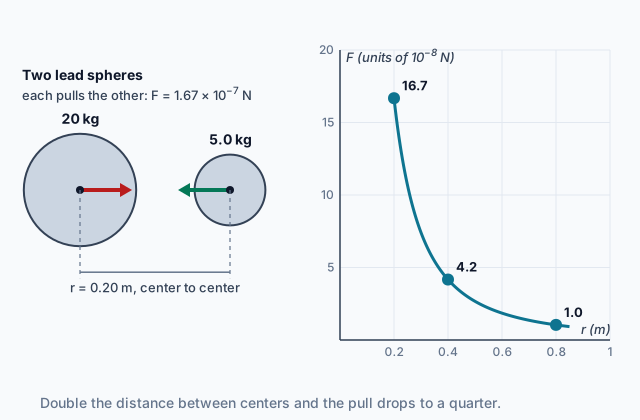 Tap to open the picture full size
Part 1 Think first Floating on the space station
Commit to a guess first. Being wrong now makes the right idea stick better.
Predict first
Astronauts on the International Space Station float around the cabin, about 400 km above the ground. How strong is Earth's gravitational pull on an astronaut up there, compared with its pull on her when she stands on the ground?
In short. Every two objects with mass attract each other with a gravitational force, and a planet's gravitational field is that force per kilogram of the object it pulls on.
- The force is proportional to each mass and to one over the square of the distance between the centers, , and it points along the line joining the centers.
- Near Earth's surface the field is about 10 N/kg, an object's weight is , and with gravity the only force its acceleration is numerically equal to the field.
- Apparent weight is the size of the normal force on a system, and it is not equal to the gravitational force when the system accelerates.
Part 2 Learn it Four short ideas, each checked as you go
2a. Every two masses pull on each other
Any two objects with mass pull on each other. Earth pulls on you, you pull on Earth, and two apples side by side on a table pull on each other, far too weakly to notice. Newton's law of universal gravitation gives the size of that pull:
Here , a constant so small that you only notice gravity when at least one of the masses is enormous.
The force is directly proportional to each mass, so doubling one mass doubles it. It is inversely proportional to the square of the distance : twice as far apart, a quarter of the force; three times as far, a ninth.
The gravitational force is always attractive, and it points along the line joining the two centers of mass. That center matters for the distance too. The gravitational force on a system can be treated as exerted at its center of mass, so runs from center to center, never from surface to surface. Near a planet, that means measuring from the middle of the planet. Earth's pull on a satellite points at Earth's center, whichever way the satellite happens to be moving.
Quick check · Multiple choice
Satellite A, of mass 1000 kg, orbits Earth at a distance from Earth's center. Satellite B, of mass 2000 kg, orbits at a distance from Earth's center. How does the gravitational force Earth exerts on satellite B compare with the force on satellite A, and which way does the force on B point?
2b. The gravitational field, and weight
Earth does not have to touch something to pull on it. A field models a noncontact force like this one: it says what force an object would feel at each position in space. The strength of the gravitational field at a point is the gravitational force on a test object placed there, divided by the test object's mass:
is the mass making the field. The test mass cancels, so the field depends on the planet and the place, not on what you put there. Its unit is the newton per kilogram.
When gravity is the only force on an object, its acceleration in m/s² is the same number as the field in N/kg. That is why a hammer and a feather dropped together on the airless Moon land together.
Near Earth's surface the field is about N/kg. The gravitational force an astronomical body exerts on a small nearby object is that object's weight, . A 50 kg student weighs 500 N.
Earth's radius is about 6400 km, so rising a few kilometers barely changes . When the force changes by a negligible amount over a trip, treat the gravitational force as constant the whole way.
Quick check · Calculate
On a small moon with no air, the gravitational force the moon exerts on a 0.50 kg test mass is 0.80 N. An astronaut there drops a 3.0 kg hammer from rest. What is the size of the hammer's acceleration as it falls? Give your answer to the nearest 0.1 m/s².
2c. What a scale really reads
A bathroom scale does not measure gravity. It measures how hard it pushes up on you: the normal force. The magnitude of the normal force on a system is its apparent weight.
Stand still on the scale and the floor's push balances Earth's pull, so the scale reads . Once you accelerate, the two are no longer equal. In an elevator speeding up on its way up, the floor has to push harder than gravity pulls, and you feel heavy. In an elevator slowing on its way up, your acceleration points down, the floor pushes less than , and you feel light. Through all of it, Earth's pull on you stays the same; only the normal force changes.
Take that to the limit. If you and the floor were both falling with acceleration , the floor would not push on you at all. A system appears weightless when gravity is the only force exerted on it, or when no forces are exerted on it, as on a probe drifting far from every star and planet. Astronauts in orbit are in the first case: gravity still pulls on them, and nothing else does.
Quick check · Decide and justify
A student stands on a bathroom scale at the end of a diving board and steps off. She and the scale fall together toward the pool, the scale still just touching the soles of her feet, and air resistance is negligible. What does the scale read while they fall?
Which reason supports your answer?
2d. Two kinds of mass
Mass does two different jobs in physics. Inertial mass, or inertia, sets how much an object's motion resists change when another object pushes or pulls on it. A loaded shopping cart is harder to start and harder to stop than an empty one, even on a level floor where gravity neither helps nor hinders. Gravitational mass sets how strongly an object takes part in gravitational attraction: it is the in .
Nothing in those two definitions says they must be the same. Experiments have compared them to very high precision, and they come out equivalent. That is why, with air resistance negligible, a bowling ball and a marble fall with the same acceleration: the bowling ball has more gravitational mass, so Earth pulls it harder, and exactly as much more inertial mass, so it is that much harder to speed up.
Picture a closed room with no windows, in a rocket far from any planet, speeding up at 10 m/s². The floor pushes up on you, and a pen you let go of falls toward the floor with an acceleration of 10 m/s² relative to the room. The equivalence principle says that an observer in a noninertial reference frame like this one cannot tell apparent weight apart from the gravitational force a field exerts.
Quick check · Decide and justify
Dana is shut inside a cabin with no windows. She stands on the floor, and a ball she lets go of falls to the floor with an acceleration of 4 m/s² relative to the cabin. Her friend says the cabin must be resting on a planet whose gravitational field strength is 4 N/kg. Is the friend right?
Which reason supports your answer?
Part 3 Watch it done A research satellite one Earth radius up
Watch each step, then finish the problem yourself.
A 500 kg research satellite orbits Earth at a height above the surface equal to Earth's radius, . At Earth's surface the gravitational field strength is 10 N/kg. Find the size of the gravitational force Earth exerts on the satellite.
Step 1 · Write the field at any distance
Earth's field at a distance from its center is . At the surface , and there N/kg.
Step 2 · Measure from Earth's center
The satellite is above the surface, and the surface is from the center, so .
Why this step?
Why is twice Earth's radius, rather than the satellite's height of one Earth radius?
The law uses the distance between centers of mass. Earth's gravitational force acts as if all of Earth's mass sat at its center, and that center is a whole Earth radius below the ground. Using the height alone would treat the satellite as if it were sitting on the surface.
Step 3 · Compare with the surface
Divide the field at by the field at : . So the field where the satellite is works out to 2.5 N/kg. and Earth's mass cancel, so you never need their values.
Your step · Calculate
Finish it. A 500 kg research satellite orbits Earth at a height above the surface equal to Earth's radius. At Earth's surface the gravitational field strength is 10 N/kg. What is the size of the gravitational force Earth exerts on the satellite?
N
Part 4 Try it Pushed and pulled in odd places
A bathroom scale reports one thing: how hard it pushes on whoever stands on it, and a rocket's couch pushes on an astronaut the same way. Take that idea to two places the lesson has not been, the surface of a large planet and a rocket at liftoff. In each, work out what is pushing and what is pulling before you decide how big the push is.
Try it · Calculate
An exploration team lands on a planet with 3 times Earth's mass and 1.5 times Earth's radius. A 90 kg astronaut stands still on a bathroom scale on the planet's surface. At Earth's surface the gravitational field strength is 10 N/kg. What does the scale read?
Try it · Draw the forces
A rocket lifts off straight up from its pad, speeding up as it rises. An astronaut lies on her back on a padded couch that faces straight up, and nothing else touches her. Build her free-body diagram, and set each arrow's length to compare with the other.
The dot is the astronaut. One diagram that fits
Pick each force exerted on the astronaut, then choose the way it points and how long its arrow is compared with the others. The arrows are drawn for you.
Part 5 Explain it From the law to a number
Nothing you type leaves this page. Check your answer against the model and each scoring point.
Free response is 50% of the exam score. This one is shaped like Question 1, Mathematical Routines.
Free-response practice · Question 1 style
A planet has mass and radius , with its mass spread evenly in every direction about its center. A space probe of mass approaches it.
(a) Derive an expression for the gravitational field strength at the planet's surface, in terms of , and physical constants.
(b) On its way in, the probe passes a point at a height above the surface. Derive an expression for the ratio of the gravitational force on the probe at that point to the gravitational force on it at the surface.
(c) The planet's mass is kg and its radius is m. Calculate , using .
(d) Inside the probe, a 2.0 kg instrument rests on a level shelf. Just above the surface, the probe moves straight down while slowing, with a constant acceleration of 1.5 m/s² directed upward. Calculate the instrument's apparent weight, and state whether it is greater than, less than or equal to the gravitational force on the instrument.
Model answer
(a) Treat the planet as if its mass were at its center. A test object of mass on the surface is from that center, so . The field is the force per unit mass: .
(b) At a height the probe is from the center. Then .
(c) N/kg.
(d) Take up as positive. The forces on the instrument are the shelf's normal force, up, and gravity, down, so with m/s². Then N. The apparent weight is 10.4 N, greater than the gravitational force on the instrument, N, because the instrument accelerates upward.
Score your own answer. This is a self-check, not a grade. Tick each point your answer makes.
Part 6 Check yourself An elevator ride
Both case questions use the elevator ride's table.
A student stands on a scale that reads in newtons, in an elevator that starts at rest on the ground floor and rides up to a floor about 30 m higher. She records the scale reading during each stage of the trip.
| Time (s) | Elevator's motion | Scale reading (N) |
|---|---|---|
| 0 to 2 | Moving up, speeding up | 690 |
| 2 to 10 | Moving up at a steady speed | 600 |
| 10 to 13 | Moving up, slowing down | 540 |
Case question 1 · Calculate
Using the elevator ride's table, take up as positive. What is the elevator's acceleration from 10 s to 13 s? Give your answer to the nearest 0.1 m/s².
Case question 2 · Multiple choice
Using the elevator ride's table: from 10 s to 13 s the scale reads 540 N, less than the 600 N it reads at a steady speed. Which statement explains the lower reading?
The rest stand on their own and do not use the case.
Check yourself · Sort it
Earth's radius is about 6400 km. Tap each motion near Earth, then whether the gravitational force on the moving object can be treated as constant through it.
Treat it as constant
It changes too much
Check yourself · Spot the error
Two 4.0 kg bowling balls, each of radius 0.10 m, rest on a rack with 0.20 m of empty space between their surfaces. A student finds the size of the gravitational force between them, using . Tap the first line that goes wrong.
Check yourself · Fill the statement
On the space station, an astronaut compares two closed boxes that look identical. Tap a blank, then a word.
She shakes each box back and forth and feels which one is harder to speed up and slow down. That compares their mass. Back on Earth, she hangs each box from a spring scale, which compares how strongly Earth attracts them: their mass. Experiments have shown that these two kinds of mass are .
Part 7 Keep it Bring back earlier ideas
Pulling an older idea back up is what makes it last.
From 2.3 Newton’s Third Law · Match
Tap a force, then the force that is its third-law partner.
From 2.2 Forces and Free-Body Diagrams · Draw the forces
You toss a ball straight up. It has left your hand and is still rising. Air resistance is negligible. Build the free-body diagram of the ball.
The dot is the ball. One diagram that fits
Pick each force exerted on the ball, then choose the way it points. The arrows are drawn for you.
In three lines
- Every two masses attract along the line between their centers, , with measured center to center.
- The field is , about 10 N/kg near Earth's surface, where weight is and can be treated as constant.
- A scale reads apparent weight, the normal force, which differs from when you accelerate and is zero when gravity is the only force.
Vocabulary
- Newton's law of universal gravitation
- The gravitational force between two objects or systems is directly proportional to each of their masses and inversely proportional to the square of the distance between their centers of mass, .
- Gravitational field
- A model of the effect of gravity on an object at each position in space, whose strength at a point is the gravitational force on a test object there divided by the test object's mass.
- Weight
- The gravitational force exerted by an astronomical body on a relatively small nearby object, .
- Apparent weight
- The magnitude of the normal force exerted on a system, which is not equal to the gravitational force on the system when the system is accelerating.
- Equivalence principle
- The principle that an observer in a noninertial reference frame cannot distinguish between an object's apparent weight and the gravitational force exerted on the object by a gravitational field.
- Inertial mass
- The property of an object, also called inertia, that determines how much its motion resists changes when it interacts with another object.
- Gravitational mass
- The property of an object or system that determines the force of attraction between it and another system with mass.
Course alignment, for teachers
AP Physics 1: Algebra-Based topic 2.6, Unit 2: Force and Translational Dynamics.
- Skill 1.A: Create diagrams, tables, charts, or schematics to represent physical situations.
- Skill 2.A: Derive a symbolic expression from known quantities by selecting and following a logical mathematical pathway.
- Skill 2.D: Predict new values or factors of change of physical quantities using functional dependence between variables.
- Skill 3.C: Justify or support a claim using evidence from experimental data, physical representations, or physical principles or laws.
This lesson maps all 17 essential knowledge statements of the topic to the part that teaches each one: 17 are checked by a scored question. The map is in the lesson file.