Unit 6 · Topic 6.4 · about 30 minutes · 7 parts · 12 scored checks, 1 of them multiple choice
AP Physics 1: Algebra-Based 6.4: Conservation of Angular Momentum
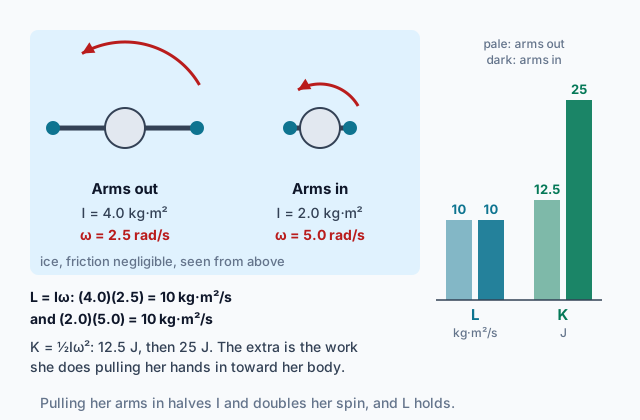 Tap to open the picture full size
Part 1 Think first A helicopter with no tail rotor
Commit to a guess first. Being wrong now makes the right idea stick better.
Predict first
A model helicopter with no tail rotor hangs at rest from a thread tied to the top of its rotor shaft, and the thread twists freely. Its motor sits in the body and turns the main rotor. You switch it on, and seen from above, the rotor spins up counterclockwise. What does the body do while the rotor spins up?
In short. Conservation of angular momentum says a system's total angular momentum about an axis stays constant whenever the net external torque on it is zero, and the system you choose decides whether that is so.
- A system's total angular momentum about an axis is the sum of its parts' angular momenta about that same axis, each with its sign, clockwise or counterclockwise.
- Angular momentum is conserved in every interaction. When a system's angular momentum does change, the change equals the angular impulse exerted on it from outside.
- A system that changes shape keeps its angular momentum: moving mass toward the axis lowers its rotational inertia and raises its angular speed, while its kinetic energy can change.
Part 2 Learn it Three short ideas, each checked as you go
2a. Adding up a system's angular momentum
In 4.3 Conservation of Linear Momentum a system's momentum was the sum of its parts' momenta. Angular momentum adds up the same way. The total angular momentum of a system about an axis is the sum of the angular momenta of its parts about that same axis:
Each part counts with its sign. Pick one sense, clockwise or counterclockwise, as positive, and a part turning the other way gets a negative . A turning part adds from 6.3 Angular Momentum and Angular Impulse. A part moving in a line adds about the axis. A part at rest adds nothing.
Take the hanging helicopter, seen from above, with counterclockwise positive and air resistance negligible. At one instant its rotor, with kg·m², spins counterclockwise at 200 rad/s, so kg·m²/s. Its body, with kg·m², turns clockwise at 20 rad/s, so kg·m²/s. The total is zero, just as it was before you switched on. Add the sizes instead and you get 1.2 kg·m²/s, and the cancellation disappears.
Quick check · Calculate
A camera drone has two rotors, one above the other, that turn about the same vertical axis, and its body is not turning. Viewed from overhead, the upper rotor, with a rotational inertia of 0.0020 kg·m² about that axis, spins counterclockwise at 300 rad/s. The lower rotor, with a rotational inertia of 0.0025 kg·m², spins clockwise at 200 rad/s. Take counterclockwise as positive. What is the total angular momentum of the drone about the axis? Include the sign, and give your answer to the nearest 0.01 kg·m²/s.
2b. The system decides
Why does the helicopter's body turn? The motor in the body exerts a counterclockwise torque on the rotor, and by Newton's third law the rotor exerts an equal and opposite torque on the motor, for exactly as long. So the angular impulses they exert on each other, from 6.3 Angular Momentum and Angular Impulse, are equal and opposite. Whatever angular momentum the rotor gains, the body loses. Angular momentum is conserved in every interaction.
Whether a particular system's angular momentum stays constant depends on what you put inside it. Draw the boundary around the rotor and the body, and their torques on each other are internal. The two angular impulses cancel, and the total holds. You can always choose a system this way.
Draw it around the rotor alone, and the body is outside. Its torque is now external, and the rotor's angular momentum changes by the angular impulse exerted on it:
If the net external torque on a system is zero, its total angular momentum is constant. If it is not zero, angular momentum is transferred between the system and its environment. An axle's force acts at the axis and exerts no torque about it, so a frictionless axle never changes a system's angular momentum.
Quick check · Sort it
Each card describes an event and names a system. Tap a card, then what happens to that system's total angular momentum about the axis of rotation during the event.
Stays constant
Changes
2c. A system that changes shape
A rigid wheel changes its angular velocity only when a torque acts on it. A skater is not rigid. She can move her own mass toward her spin axis or away from it, and that changes her rotational inertia, since mass close to the axis counts for less, as in 5.4 Rotational Inertia.
The diagram shows her. With friction from the ice negligible, gravity and the ice's push are vertical, along her spin axis, so nothing exerts a torque about it and her angular momentum stays the same. Arms out, kg·m² and rad/s, so kg·m²/s. Pulling her arms in halves her rotational inertia to 2.0 kg·m², so
Halve and doubles. Let her arms back out and she slows down again.
Her kinetic energy does not stay the same. from 6.1 Rotational Kinetic Energy goes from 12.5 J to 25 J. The extra comes from her muscles: she pulls her hands inward, they move inward, so she does positive work on them. Clay that lands on a spinning turntable and slides before it sticks goes the other way. The angular momentum holds, while some kinetic energy becomes thermal energy and sound, as in the collisions of 4.4 Elastic and Inelastic Collisions.
Quick check · Decide and justify
A figure skater spins on ice with her arms pulled in, and friction from the ice and air resistance are negligible. She stretches her arms straight out to the sides. Take the skater as the system. While she stretches her arms out, what happens to her angular momentum about her spin axis?
Which reason supports your answer?
Part 3 Watch it done A child jumps onto a merry-go-round
Watch each step, then finish the problem yourself.
A playground merry-go-round with a rotational inertia of 400 kg·m² about its axle sits at rest, and friction at its axle is negligible. A 25 kg child runs at 4.0 m/s along a straight line that just touches the rim, 2.0 m from the axle, and jumps on at the rim. Treat the child as a point. Find the merry-go-round's angular speed just after she lands.
Step 1 · Choose the system
Take the child and the merry-go-round together. As she lands, her feet and the rim push on each other, and their equal and opposite angular impulses cancel inside the system. The axle's force acts at the axis, friction there is negligible, and gravity and the ground's push are vertical, along the axle, so the net external torque about the axle is zero. The total angular momentum just after equals the total just before.
Why this step?
Why choose the child and the merry-go-round together, instead of the merry-go-round alone?
With both inside, the hard push between her feet and the rim is internal, so one equation, total before equals total after, holds whatever that push was. With the merry-go-round alone, her push is an external torque, and you would need its angular impulse, which nobody measured.
Step 2 · Angular momentum before
The merry-go-round is at rest, so it has none. The child moves in a straight line, and as in 6.3 Angular Momentum and Angular Impulse she has about the axle. Her path passes 2.0 m from the axle, so m and kg·m²/s.
Step 3 · Rotational inertia after
She rides at the rim as a point, adding kg·m², so the system has kg·m² about the axle, as in 5.4 Rotational Inertia.
Your step · Calculate
Finish it. A merry-go-round with a rotational inertia of 400 kg·m² about its axle sits at rest, and friction at its axle is negligible. A 25 kg child runs at 4.0 m/s along a straight line that passes 2.0 m from the axle and jumps on at the rim, where she rides as a point. What is the merry-go-round's angular speed just after she lands? Give your answer to the nearest 0.01 rad/s.
rad/s
Part 4 Try it A stool and two dumbbells
A new situation, and this time you build the rotational inertias yourself before you use them. A student sits on a stool that turns freely and pulls two dumbbells in toward her chest. Then practice with a figure skater, with new numbers each time.
Try it · Calculate
A student sits on a stool that turns on a frictionless bearing. She holds a 2.0 kg dumbbell in each hand with her arms out, each dumbbell 0.70 m from the stool's axis, and turns at 1.5 rad/s. She pulls both dumbbells in to 0.20 m from the axis. Without the dumbbells, she and the stool have a rotational inertia of 1.2 kg·m² about the axis; treat that as unchanged, and each dumbbell as a point. What is her angular speed with the dumbbells in? Give your answer to the nearest 0.1 rad/s.
Part 5 Explain it Design a test with a dropped ring
Nothing you type leaves this page. Check your answer against the model and each scoring point.
Free response is 50% of the exam score. This one is shaped like Question 3, Experimental Design and Analysis.
Free-response practice · Question 3 style
A student wants to test whether the angular momentum of a system is conserved when a ring is dropped onto a spinning turntable. The turntable's platter turns on a vertical axle with negligible friction, and the maker gives its rotational inertia about the axle, . She also has a thin metal ring, whose mass all sits close to one radius from its center, a rotary motion sensor on the axle that records angular velocity against time, a balance and a meterstick.
(a) Describe a procedure for measuring the platter's angular velocity just before the ring lands, , and the angular velocity once the ring and platter turn together, , for at least five values of . Say what she measures, with which equipment, and give enough detail that another student could repeat it.
(b) Take the platter and the ring as the system. Explain why its angular momentum about the axle should be constant while the ring lands. Then derive an expression for in terms of , , the ring's mass and , for a ring dropped from rest so that it lands centered on the axle. Identify a graph of her measurements that should be a straight line, and state what its slope should be.
The maker gives kg·m². The balance gives 0.400 kg for the ring, and the meterstick gives m. Her averaged results:
- rad/s, rad/s
- rad/s, rad/s
- rad/s, rad/s
- rad/s, rad/s
- rad/s, rad/s
(c) Calculate the slope your expression from (b) predicts. On paper, plot the graph you named in (b) and draw a best-fit line. Calculate its slope, and explain whether her data support the claim that the system's angular momentum is conserved.
(d) Her partner repeats every run on a second turntable that is identical except that its axle is worn, so friction at the axle exerts a noticeable torque on the platter. He reads just before the ring lands and at the moment the ring and platter first turn together, so between his two readings the axle's torque acts only while the ring slips. Explain whether the slope of his graph would be larger than, smaller than or equal to the slope of hers.
Model answer
(a) Measure the ring's mass on the balance, and its diameter with the meterstick, halving it to get . Spin the platter by hand and let go, so nothing touches it but the axle. Hold the ring level and centered, a few millimeters above the platter, and let go without pushing or twisting it. The sensor's angular velocity graph shows just before the ring lands, a short stretch where it drops while the ring slips, and then a level stretch once the two turn together, which gives . Do three runs at each starting speed and average them, for at least five values of from slow to fast.
(b) The ring and the platter rub against each other while it slips, and the angular impulses they exert on each other are equal and opposite, so they cancel inside the system. The axle's force acts at the axis and its friction is negligible, and gravity and the platter's upward push are vertical, along the axle, so no external torque acts about the axle. So the system's angular momentum is constant. The ring falls straight down and is not turning, so before it lands only the platter has angular momentum, . Afterward the ring's mass all sits at , so it adds . Then , and
A graph of against should be a straight line through the origin with slope .
(c) kg·m², so the predicted slope is . The points lie close to one straight line through the origin. Two points on my best-fit line, not data points, are and rad/s, so its slope is , with no unit. That is within about 1.5 percent of 0.750, and every run's angular momentum after, , is within 2 percent of its angular momentum before, . So the data support the claim: the angular momentum the platter lost is the angular momentum the ring gained. All five ratios , from 0.737 to 0.744, sit below 0.750, so the shortfall is on one side only. That points to a small loss, such as a little friction at the axle, but at under 2 percent it does not overturn the conclusion.
(d) Smaller. The worn axle is outside the system, and while the ring slips its friction exerts a torque on the platter against its rotation. That external angular impulse carries angular momentum out of the system, so each comes out lower than hers. Lower points alone would not settle the slope: if he lost the same angular momentum on every run, his line would only shift down, with the same slope. But the loss grows with . The ring rubs on the platter with about the same friction whatever the speed, so the faster the platter starts, the longer the ring slips before the two turn together, and the longer the axle's torque acts. The angular impulse it removes grows in proportion to , so every is the same fraction lower and his line through the origin is less steep. Angular momentum is still conserved; some of it left through the axle.
Score your own answer. This is a self-check, not a grade. Tick each point your answer makes.
Part 6 Check yourself A clutch test
Both case questions use the clutch table.
A student tests a model clutch. Disk A, a heavy steel disk with a rotational inertia of 0.40 kg·m² about a vertical axle, spins counterclockwise, seen from above, which she takes as positive. At 0 s she drops disk B, which is not turning, from just above disk A onto it, centered on the same axle. The disks slip against each other until they turn together. Friction at the axle and air resistance are negligible. A rotary sensor on each disk records its angular velocity.
| Time (s) | Disk A (rad/s) | Disk B (rad/s) |
|---|---|---|
| 0 | 10.0 | 0.0 |
| 0.1 | 8.5 | 1.0 |
| 0.2 | 7.0 | 2.0 |
| 0.3 | 5.5 | 3.0 |
| 0.4 | 4.0 | 4.0 |
| 0.5 | 4.0 | 4.0 |
Case question 1 · Calculate
Using the clutch table, with counterclockwise as positive, what is the rotational inertia of disk B about the axle? Give your answer to the nearest 0.01 kg·m².
Case question 2 · Multiple choice
Using the clutch table, with counterclockwise as positive, which describes the angular impulse that disk B exerted on disk A from 0 s to 0.4 s?
The rest stand on their own and do not use the case.
Check yourself · Spot the error
A turntable with a rotational inertia of 0.012 kg·m² about its frictionless axle spins at 5.0 rad/s. A 0.20 kg lump of clay is dropped straight down onto it, lands 0.10 m from the axle, slides a little and sticks. Treating the clay as a point, a student finds the turntable's angular speed afterward. Tap the first line that goes wrong.
Check yourself · Match
Tap a statement about a system, then what follows from it.
Check yourself · Fill the statement
Tap a blank, then an answer.
A diver leaves the board turning slowly with her body straight, then pulls into a tight tuck. Gravity acts at her center of mass, so it exerts no torque about an axis through that point, and air resistance is negligible. The tuck her rotational inertia about that axis, her angular momentum about it , and her angular speed .
Part 7 Keep it Bring back earlier ideas
Pulling an older idea back up is what makes it last.
From 6.3 Angular Momentum and Angular Impulse · Decide and justify
A bicycle wheel spins clockwise on a stand, as you see it from where you stand. You press a brake pad on its rim for 2 seconds, and the pad exerts a counterclockwise torque on the wheel about its axle. When you let go, the wheel is slower but still turning clockwise. In which sense is the angular impulse the brake pad delivered to the wheel?
Which reason supports your answer?
From 4.3 Conservation of Linear Momentum · Decide and justify
A loaded 12,000 kg truck and a 1,200 kg car collide head-on on a highway. During the collision, how does the size of the car's change in momentum compare with the size of the truck's?
Which reason supports your answer?
In three lines
- A system's total angular momentum about an axis is the sum of its parts' angular momenta about that axis, each with its sign.
- Parts exert equal and opposite angular impulses on each other, so with zero net external torque the total is constant; an external torque transfers angular momentum in or out.
- A nonrigid system that moves mass toward its axis spins faster with the same angular momentum, while its kinetic energy can change.
Vocabulary
- Total angular momentum
- The sum of the angular momenta of a system's constituent parts about one rotational axis, each with its sense, clockwise or counterclockwise.
- Conservation of angular momentum
- The principle that angular momentum is conserved in all interactions, so a system's total angular momentum is constant whenever the net external torque on it is zero.
- Angular impulse
- The torque exerted on an object or system times the time interval it acts, ; parts of a system exert equal and opposite angular impulses on each other.
- Nonrigid system
- A system whose parts can move relative to one another, so it can change shape and move mass closer to or farther from its rotational axis.
Course alignment, for teachers
AP Physics 1: Algebra-Based topic 6.4, Unit 6: Energy and Momentum of Rotating Systems.
- Skill 1.B: Create quantitative graphs with appropriate scales and units, including plotting data.
- Skill 2.D: Predict new values or factors of change of physical quantities using functional dependence between variables.
- Skill 3.A: Create experimental procedures that are appropriate for a given scientific question.
- Skill 3.B: Apply an appropriate law, definition, theoretical relationship, or model to make a claim.
- Skill 3.C: Justify or support a claim using evidence from experimental data, physical representations, or physical principles or laws.
This lesson maps all 9 essential knowledge statements of the topic to the part that teaches each one: 9 are checked by a scored question. The map is in the lesson file.