Unit 11 check
Unit 11 check: Electric Circuits
10 questions from 8 lessons in Unit 11. Answer each one, and if you miss, follow the link back to where it is taught, then try again. Your score counts first tries.
Question 1 · from 11.1 · Decide and justify
In wire P, 30 C of charge passes through a cross section in 10 s. In wire Q, 12 C passes through a cross section in 2.0 s. A classmate says P has the larger current, because more charge passes through it. Is the classmate right?
Which reason supports your answer?
Question 2 · from 11.2 · Multiple choice
Bulbs A and B are joined in one loop with a battery by ideal wires, and both glow. An ideal wire is then connected from one contact of bulb B to its other contact. What happens?
Question 3 · from 11.3 · Decide and justify
A student tests a small lamp. With 2.0 V across it the current is 0.20 A, and with 6.0 V across it the current is 0.40 A. Is the lamp's filament ohmic?
Which reason supports your answer?
Setup for question 4
Now draw how a resistor's power depends on its current. Before you drag anything, say what doubling the current does to the power.
Question 4 · from 11.4 · Sketch the graph
An ohmic 4.0 resistor carries a current that is raised in steps from 0 to 2.0 A. Sketch the power in the resistor against the current. The first point is fixed at 0 W.
One shape that fits
Drag a point up or down, or tap it and use the arrow keys. Only the shape is checked.
Setup for question 5
Rank the bulbs below before you work anything out. Then check your ranking: reduce the circuit, and use the power from the last lesson.
Question 5 · from 11.5 · Rank it
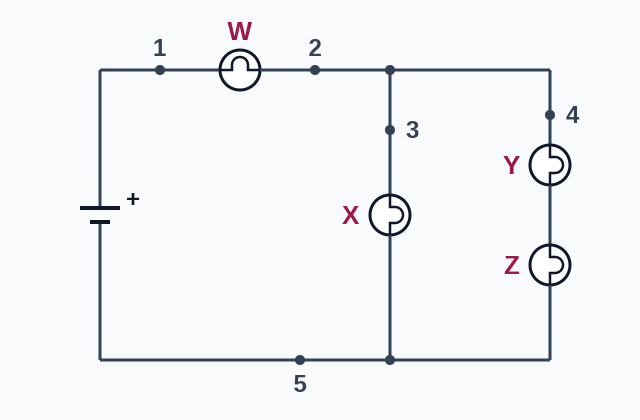
Four identical bulbs are joined to an ideal battery by ideal wires. Bulb W is on the main wire, and all of the battery's current passes through it. Past W the circuit splits into two branches that meet again before the wire returns to the battery: one branch holds bulb X alone, and the other holds bulbs Y and Z, one after the other. Treat each bulb's resistance as fixed. Rank the bulbs by brightness.
Brightest first
Give each one a place, 1 for first. Give two the same place if they are equal.
Your ranking: none yet
Setup for question 6
Now the signs. Going around a loop in a chosen direction, each crossing changes the potential by one of these.
Question 6 · from 11.6 · Match
You go around a loop of a circuit made of ideal batteries, resistors and ideal wires, in a chosen direction, and the current in each resistor has size . Tap each crossing, then the change in potential it adds to the loop rule.
Setup for question 7
 Tap to open the picture full size
Question 7 · from 11.7 · Calculate
In the circuit of four identical bulbs, an ideal ammeter placed at point 1 reads 0.90 A. What would an ideal ammeter placed at point 4, just above bulb Y, read? Give your answer to the nearest 0.01 A.
Setup for question 8
 Tap to open the picture full size
Question 8 · from 11.8 · Rank it
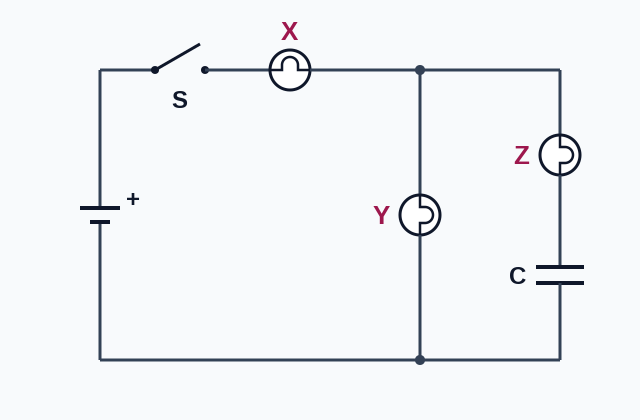
Three identical bulbs, each with a fixed resistance, an ideal battery, ideal wires and an open switch S are connected. Bulb X is on the main wire next to S. Past X the circuit splits into two branches that meet again: one holds bulb Y, and the other holds bulb Z in series with an uncharged capacitor. A bulb's brightness is set only by its power. Rank the bulbs by brightness just after S closes.
Brightest first
Give each one a place, 1 for first. Give two the same place if they are equal.
Your ranking: none yet
Question 9 · from 11.1 · Sort it
Each card describes a copper wire at one moment. Tap a card, then whether there is a current in that wire.
Current in the wire
No current in the wire
Question 10 · from 11.2 · Select all
A battery is joined to two branches by ideal wires. One branch holds bulb P alone. The other holds switch S, bulb Q and bulb R, one after another. With S closed all three bulbs glow. S is then opened. Which two statements are true? Pick two.
Select 2 answers, then check.
0 of 10 answered.