Unit 15 check
Unit 15 check: Modern Physics
10 questions from 8 lessons in Unit 15. Answer each one, and if you miss, follow the link back to where it is taught, then try again. Your score counts first tries.
Question 1 · from 15.1 · Sort it
Each card describes something seen in an experiment. Tap a card, then the kind of behavior it shows.
Particle-like behavior
Wave-like behavior
Question 2 · from 15.2 · Fill the statement
An iron ion is written . Tap a blank, then an answer.
The ion has protons, neutrons and electrons.
Question 3 · from 15.3 · Fill the statement
Tap a blank, then an answer.
A glowing gas shows bright lines, and their wavelengths tell . Light containing every wavelength, sent through a cool gas of the same element, shows dark lines whose wavelengths are some of those bright lines, because the gas only photons whose energies match gaps between its levels.
Question 4 · from 15.4 · Calculate
A blackbody's absolute temperature is doubled while its surface area is cut in half. By what factor does the power it emits change?
Setup for question 5
Predict first: light that frees electrons from one metal falls on a second metal with a larger work function. Do electrons still leave? Then judge a claim, and sketch how the fastest electrons' energy depends on the energy of each photon.
Question 5 · from 15.5 · Sketch the graph
Light shines on a metal whose work function is 2.0 eV. Its frequency is raised in steps, so that each photon carries 1.0, 2.0, 3.0, 4.0 and then 5.0 eV. Sketch the maximum kinetic energy of the emitted electrons against the energy of each photon. Where no electrons are emitted, draw 0.
One shape that fits
Drag a point up or down, or tap it and use the arrow keys. The shape is checked, and so are the values the question lets you work out.
Setup for question 6
Predict first: two X-ray photons of different wavelengths scatter off free electrons through the same angle. Which loses the larger fraction of its energy? Then judge a claim, and find how hard a photon hits an electron.
Question 6 · from 15.6 · Calculate
An X-ray photon of wavelength 40.0 pm strikes a free electron at rest and is scattered through 90°, leaving with a wavelength of 42.4 pm (1 pm is m). What is the magnitude of the electron's momentum afterward? Use J·s, and give your answer in units of kg·m/s.
Setup for question 7
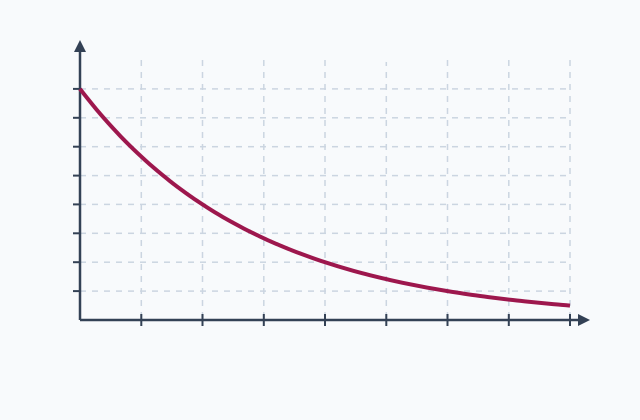
The graph shows the number of undecayed nuclei in a sample of one radioactive isotope over 12 hours.
Question 7 · from 15.7 · Calculate
Using the graph: what is the decay constant of this isotope? Give your answer in per hour.
Setup for question 8
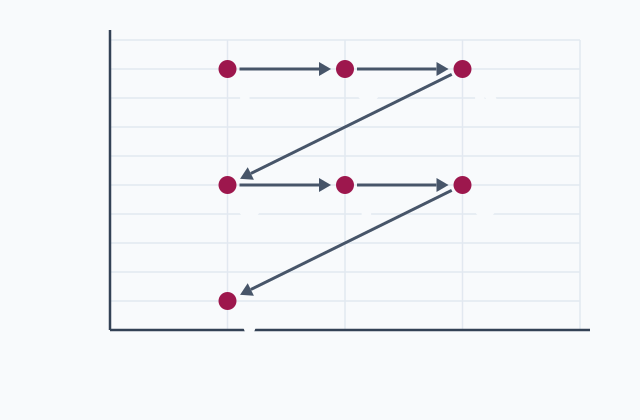
The chart shows part of a decay chain. Each nucleus is a lettered point, placed by its atomic number and mass number, and each arrow is one decay.
Question 8 · from 15.8 · Multiple choice
Using the chart: what happens in the step from P to Q?
Question 9 · from 15.1 · Calculate
A blue-green laser emits light with a wavelength of 496 nm. How much energy does each of its photons carry? Use eV·nm, and give your answer in electron volts.
Question 10 · from 15.2 · Multiple choice
In the Bohr model of hydrogen, which statement correctly describes the forces on the orbiting electron?
0 of 10 answered.