Unit 1 · Topic 1.1 · about 30 minutes · 7 parts · 12 scored checks, 3 of them multiple choice
AP Environmental Science 1.1: Introduction to Ecosystems
Unit 1: 6 to 8% of the multiple-choice section
What you'll be able to do
- Explain how the amount of a resource available shapes the ways species interact: as predator and prey, in symbiosis, and in competition.
Key vocabulary
| Term | What it means | The exam trap |
|---|---|---|
| Predator | An organism that eats another organism. | One organism can be a predator in one relationship and prey in another, so read which pair a question asks about. |
| Prey | An organism that is eaten by a predator. | An organism is prey only to something that eats it, so check which way the eating goes in each pair. |
| Symbiosis | A close and long-term interaction between two species in an ecosystem. | Symbiosis names how close the relationship is; the three types are told apart by who gains and who is harmed. |
| Mutualism | Symbiosis in which both species benefit. | Name what each species gains before you call it mutualism. |
| Commensalism | Symbiosis in which one species benefits and the other is neither helped nor harmed. | Read carefully what the description says happens to the second species. |
| Parasitism | Symbiosis in which one species, the parasite, benefits and the other, the host, is harmed. | A parasite lives on or in its host over time, which is what makes it symbiosis. |
| Competition | An interaction in which organisms need the same limited resource, within one species or between species. | Ask how much of the resource there is, not only who uses it. |
| Resource partitioning | Using the resources in different ways, places or at different times, which can reduce the negative impact of competition on survival. | Say which of the three it is: a different way, a different place or a different time. |
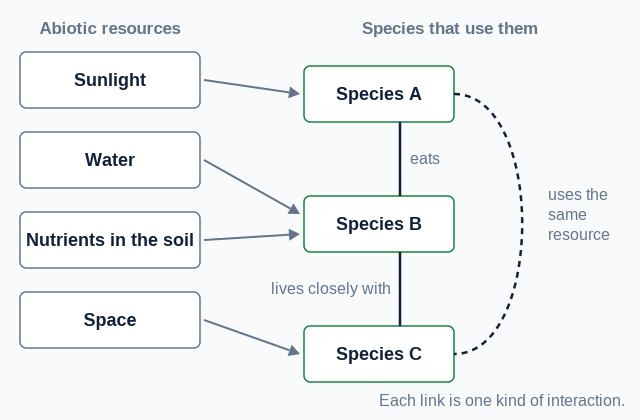 Tap to open the picture full size
Part 1 Think first When the mice disappear
Commit to a guess first. Being wrong now makes the right idea stick better.
Predict first
Barn owls in a farm valley hunt mostly mice. One spring, a disease kills most of the valley's mice. What do you predict happens to the barn owls there over the next year?
In short. An ecosystem's species interact as predators and prey, in close long-term partnerships called symbiosis, and as competitors for limited resources.
- A predator is an organism that eats another organism, its prey.
- Symbiosis is a close, long-term interaction between two species, and it comes in three types: mutualism, commensalism and parasitism.
- Competition happens within or between species when a resource is limited, and resource partitioning (using the resource in different ways, places or times) can reduce its harm to survival.
Part 2 Learn it How species interact
2a. Predators and prey
Every ecosystem is a set of living things (its biotic parts) and nonliving things (its abiotic parts) acting on each other. The species in it interact in a few basic ways, and the first is eating.
In a predator-prey relationship, the predator is an organism that eats another organism, the prey. A fox that catches a rabbit is the predator, and the rabbit is its prey.
One organism can be both. In a pond where frogs eat dragonflies and herons eat frogs, a frog is a predator of dragonflies and prey for herons.
Prey is a resource for its predator, the same way water or light is a resource for a plant. So the amount of prey shapes the predators. When rabbits are plentiful, foxes find food easily and raise more young. When rabbits become scarce, fewer young foxes survive, and some foxes hunt other animals. The prey depend on their own resources, too: a dry year with little grass means fewer rabbits, and then fewer foxes.
Quick check · Multiple choice
In a desert, hawks eat snakes, and snakes eat lizards. Which describes the snakes?
2b. Symbiosis: living closely together
Symbiosis is a close and long-term interaction between two species in an ecosystem. The two species live together, or in contact, for much of their lives. A fox catching a rabbit is over in minutes, so it is not symbiosis.
There are three types, told apart by who gains and who is harmed:
- Mutualism: both species benefit. In a lichen, a fungus and an alga live together for their whole lives: the alga makes sugar from sunlight and shares it, and the fungus shelters the alga and holds water for it.
- Commensalism: one species benefits, and the other is neither helped nor harmed. A bird that builds its nest in a large tree gains a safe place, and the tree is not affected.
- Parasitism: one species, the parasite, benefits, and the other, the host, is harmed. A tick feeds on a deer's blood for days while attached to it.
Resources are usually what the partners gain: food, shelter, a place to grow. To name the type, ask what each species gets and what each loses.
Quick check · Sort it
Each card describes a close, long-term interaction between two species. Tap a card, then the type of symbiosis it is.
Mutualism
Commensalism
Parasitism
2c. Competition for limited resources
Competition occurs when organisms need the same resource and there is not enough of it for all of them. It can occur within one species or between different species.
- Within a species: oak seedlings that sprout close together on a forest floor all need the same light, water and soil nutrients, and the seedlings that get less grow slowly or die.
- Between species: lions and hyenas both hunt zebras, so every zebra one species takes is a meal the other does not get.
Competition happens where resources are limited. In a wet year with more water and light than a forest's seedlings can use, they do not compete much for water. In a drought, when water runs short, the same seedlings compete hard for it. So the strength of competition rises and falls with the amount of the resource.
Competition harms both sides: each competitor ends up with less than it would have had alone, which can lower its survival.
Quick check · Decide and justify
A new stone jetty in a bay has far more bare rock than the bay's barnacles can cover, even though hundreds of barnacles have settled on it. A student says the barnacles on the jetty must be competing hard for space, because so many of them live there. Is the student right?
Which reason supports your answer?
2d. Resource partitioning
When two species need the same limited resource, they often do not use it in exactly the same way. Resource partitioning is using the resources in different ways, places or at different times, and it can reduce the negative impact of competition on survival.
- Different places: two lizard species hunt insects on the same trees, one on the trunks and one out on the thin branches.
- Different times: hawks and owls both hunt small mammals in one field, hawks by day and owls at night.
- Different ways: two finch species feed on the same bushes at the same time, one cracking the large seeds and one eating only the small ones.
The species still use the same kind of resource, so the competition does not vanish. But each species meets the other less often at the same food or the same space, so each loses less of what it needs, and both are more likely to survive in the same ecosystem.
Quick check · Match
Each pair of species shares a resource in a lake. Match each pair to the kind of resource partitioning it shows.
Part 3 Watch it done Two warblers in one forest
Open each step in turn, answer the why, then finish the description yourself.
Two species of warblers, both small insect-eating birds, feed in the same spruce forest. A birdwatcher's notes say one species feeds mostly near the tops of the trees and the other mostly on the lower branches close to the trunk. Describe the interaction between the two species, and how their way of feeding affects it.
Step 1 · Name the resource
Both species eat insects in the same trees, so insects are the resource they share. When there are not enough insects for both, they compete for them.
Step 2 · Name the interaction
Two different species competing for one resource is competition between species. Neither warbler eats the other, and they do not live in a close partnership that benefits or harms one of them, so this is not predation or symbiosis.
Step 3 · Name what the feeding pattern is
Compare where, when and how each species feeds. Then match the difference to one of the three kinds of resource partitioning from chunk 2d.
Why this step?
Why does it matter that the two species feed in different parts of the trees?
Birds feeding in different places meet less often at the same insects, so each species takes fewer of the insects the other one needs.
Your step · Fill the statement
Finish it. Two warbler species eat insects in the same spruce trees, one mostly near the treetops and one mostly near the trunk. Tap a blank, then an answer.
Feeding in different in the trees is resource partitioning. It the negative impact of competition on each species' .
Part 4 Try it New pairs of species
Each question gives two species you have not met in this lesson. Before you answer, name the resource and say what each species gains or loses.
Try it · Select all
Which two of these interactions are examples of symbiosis? Pick two.
Select 2 answers, then check.
Try it · Spot the error
A student describes the interaction between remoras, small fish that ride on sharks, and the sharks. Tap the first line that goes wrong.
Try it · Multiple choice
Two species of ground finches on an island eat small seeds and drink from the same rock pools. This year heavy rain kept every pool full, but the plants made few small seeds. Which statement best describes the competition between the two species this year?
Part 5 Explain it Design an investigation of competition
Write your answer first. Nothing you type here leaves this page. Then compare it with the model and each scoring point.
Free response is 40% of the exam score. This one is shaped like Question 1, Design an investigation.
Free-response practice · Question 1 style
Two species of ants, a red ant and a black ant, collect the same kind of seeds from the ground in a grassland. A student suspects that the two species compete for the seeds.
(a) Identify the type of species interaction the student suspects, and the resource involved.
(b) Describe an investigation the student could do in the grassland to test whether the black ants reduce the amount of seeds the red ants collect.
(c) Identify the independent variable and the dependent variable in your investigation.
(d) The student later notices that the red ants collect seeds in the morning and the black ants in the afternoon. Explain how this could affect the competition between the two species.
Model answer
(a) Competition between species, for seeds, a resource that is limited in the grassland.
(b) Mark out ten plots of the same size in the same grassland. In five, remove the black ant colonies and keep black ants out, for example with a barrier around the plot. Leave the other five unchanged as the control. For several weeks, count the seeds the red ants carry into their nests each day in every plot, and compare the two groups.
(c) The independent variable is whether black ants are present. The dependent variable is the amount of seeds the red ants collect, such as seeds per day.
(d) Collecting the seeds at different times is resource partitioning. The two species meet less often at the same seeds, so each loses less of the food it needs, which reduces the negative impact of competition on their survival.
Score your own answer. This is a self-check, not a grade. Tick each point your answer makes.
Part 6 Check yourself Ladybugs and aphids in a rose garden
The first two questions use the table.
Ladybugs eat aphids, small insects that suck sap from rose bushes. Suppose a gardener counts both on the same rose bushes each summer for six years. The numbers below are made up for practice.
| Year | Aphids | Ladybugs |
|---|---|---|
| 1 | 120 | 4 |
| 2 | 260 | 6 |
| 3 | 310 | 12 |
| 4 | 150 | 14 |
| 5 | 90 | 7 |
| 6 | 200 | 5 |
Case question 1 · Multiple choice
Using the table of aphids and ladybugs: which statement best describes how the aphids affected the ladybugs?
Case question 2 · Decide and justify
The gardener says the ladybugs and aphids in the table are in a mutualism, because both live on the rose bushes all summer. Is the gardener right?
Which reason supports your answer?
The rest stand on their own and do not use the case.
Check yourself · Put it in order
In a forest, weasels hunt voles, and voles eat seeds. One year the trees drop very few seeds. Put the events in the order they happen.
Check yourself · Sort it
Each card describes competition for a limited resource. Tap a card, then the kind of competition it shows.
Competition within a species
Competition between species
Part 7 Keep it Keep it
This is the first topic of the course, so there are no earlier questions to bring back yet. Read the three lines below once more before you move on.
In three lines
- A predator eats another organism, its prey, and the amount of prey available shapes how many predators an area can feed.
- Symbiosis is a close, long-term interaction: mutualism (both benefit), commensalism (one benefits, the other is unaffected) or parasitism (one benefits, its host is harmed).
- Competition occurs within or between species when a resource is limited, and resource partitioning by way, place or time reduces its harm to survival.
Exam strategy for this topic
- Section I, Multiple Choice: 80 questions in 90 minutes.
- Section II, Free Response: 3 questions in 70 minutes.
- This lesson's Explain it is shaped like free-response question 1, Design an investigation.
- A four-function, scientific, or graphing calculator is allowed on both sections of the exam.
When a question asks you to describe an interaction, name it, say what each species gains or loses, and name the resource involved, such as food, light, water or space.
Questions students ask
What are the main species interactions in AP Environmental Science?
Predator and prey, symbiosis (mutualism, commensalism and parasitism), and competition, within a species or between species, for a limited resource.
How do I tell mutualism, commensalism and parasitism apart?
Ask what each species gains or loses. Both benefit in mutualism; one benefits and the other is unaffected in commensalism; one benefits and its host is harmed in parasitism.
Is a predator eating its prey a kind of symbiosis?
No. Symbiosis is a close and long-term interaction. A predator catching its prey is a separate kind of interaction, the predator-prey relationship.
What is resource partitioning?
Using the resources in different ways, places or at different times. It can reduce the negative impact of competition on the survival of the species that share a resource.
How does the amount of a resource affect species interactions?
When a resource is limited, competition for it is stronger, and when prey is scarce, fewer predators survive or they hunt other food. When a resource is plentiful, both effects weaken.
Course alignment, for teachers
AP Environmental Science topic 1.1, Unit 1: The Living World: Ecosystems.
- Skill 1.A: Describe environmental concepts and processes.
This lesson maps all 3 essential knowledge statements of the topic to the part that teaches each one: 3 are checked by a scored question. The map is in the lesson file.