Unit 1 · Topic 1.8 · about 30 minutes · 7 parts · 10 scored checks, 2 of them multiple choice, plus 2 from earlier lessons
AP Environmental Science 1.8: Primary Productivity
Unit 1: 6 to 8% of the multiple-choice section
What you'll be able to do
- Explain how solar energy is acquired and transferred by living organisms: how producers capture it by photosynthesis, how much they store, and how light changes with depth in water.
Key vocabulary
| Term | What it means | The exam trap |
|---|---|---|
| Primary productivity | The rate at which producers turn the energy of sunlight into organic compounds by photosynthesis. | Primary productivity can be stated as gross or as net, so check which one a figure is. |
| Gross primary productivity | The total rate of photosynthesis in a given area. | A question may give the gross rate while asking about something else; read what it wants before you use the number. |
| Net primary productivity | The rate at which photosynthesizers store energy in a given area. | A question may give two figures for the producers; decide which one the question needs before you calculate. |
| Cellular respiration | The process cells use to release the energy stored in organic compounds such as sugars. | Respiration releases stored energy; it does not capture new energy from sunlight. |
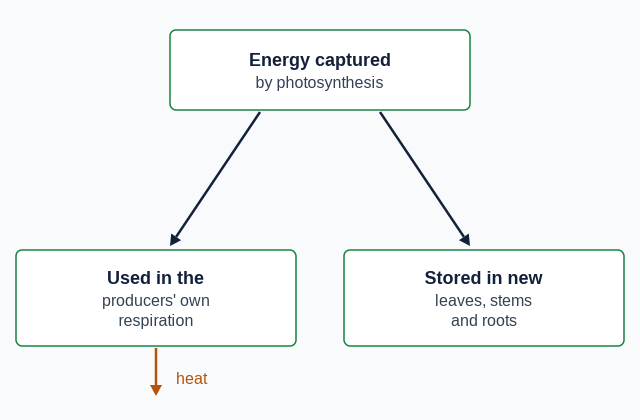 Tap to open the picture full size
Part 1 Think first The pond and the cornfield
Commit to a guess first. Being wrong now makes the right idea stick better.
Predict first
Two students study producers. One finds that the algae in a pond store 8 kcal/m²/day. The other finds that a cornfield's plants store 2,000 kcal/m²/yr. The numbers are made up for practice. The second student says the cornfield is clearly more productive, since 2,000 is far larger than 8. What do you predict?
In short. Primary productivity is the rate at which producers convert solar energy into organic compounds by photosynthesis.
- Gross primary productivity is the total rate of photosynthesis in a given area.
- Net primary productivity is the rate of energy storage by photosynthesizers in a given area, after subtracting the energy lost to respiration.
- Most red light is absorbed in the upper meter of water, and blue light penetrates deeper than 100 meters only in the clearest water, so aquatic photosynthesizers have adapted to the light they get.
Part 2 Learn it Primary productivity
2a. A rate, per area, per time
Producers such as plants, algae and phytoplankton capture the energy of sunlight by photosynthesis and store it in organic compounds, such as sugars, that build their leaves, stems and roots.
Primary productivity is the rate at which solar energy is converted into organic compounds by photosynthesis over a unit of time. It is a rate, so it always says how much energy in how much time.
To compare a pond with a field, the rate also has to be for the same area. So productivity is measured in units of energy per unit area per unit time, for example kilocalories per square meter per year, written kcal/m²/yr. Read it as "kilocalories in each square meter, each year."
A figure such as 500 kcal is not a productivity until you know the area and the time it covers, and two figures can be compared only when they are in the same units.
Quick check · Multiple choice
A student wants to report the primary productivity of a meadow. Which of these could be a correct unit for it?
2b. Gross and net
Producers do not keep all the energy they capture. Like every living thing, they carry out cellular respiration, breaking down some of their sugars to power their own cells, and that energy leaves them, mostly as heat.
- Gross primary productivity (GPP) is the total rate of photosynthesis in a given area.
- Net primary productivity (NPP) is the rate of energy storage by photosynthesizers in a given area, after subtracting the energy lost to respiration.
So NPP = GPP minus respiration, with all three in the same units.
Suppose a swamp's producers have a GPP of 18,000 kcal/m²/yr and use 7,000 kcal/m²/yr in respiration. Their NPP is 18,000 - 7,000 = 11,000 kcal/m²/yr. That stored energy, in leaves, wood, roots and seeds, is what animals that eat the producers can draw on. The energy used in respiration is gone before any animal arrives.
Quick check · Calculate
In a meadow, the producers' gross primary productivity is 7,000 kcal/m²/yr, and they use 3,000 kcal/m²/yr in their own respiration. What is the meadow's net primary productivity? Give your answer in kcal/m²/yr.
2c. Light under water
Sunlight is a mix of colors, and producers use mainly the red and blue parts of it. Water absorbs those colors at different depths.
- Most red light is absorbed in the upper 1 meter of water.
- Blue light penetrates deeper than 100 meters only in the clearest water. In murky water, with sediment or plankton in it, light of every color fades much sooner.
This affects photosynthesis in aquatic ecosystems. A few meters down there is little red light left, and far below, little visible light of any color. Aquatic photosynthesizers have adapted mechanisms to deal with this lack of visible light. Many deep-living algae, for example, can capture the blue light that still reaches them.
So in a lake or the ocean, primary productivity is usually highest near the surface and falls off with depth.
Quick check · Decide and justify
Algae live 40 meters deep in very clear ocean water, where almost no red light reaches. A student says they can still photosynthesize at that depth. Is the student right?
Which reason supports your answer?
Part 3 Watch it done From a day to a year
Open each step in turn, answer the why, then finish the calculation yourself.
Suppose the algae in a pond have a gross primary productivity of 12 kcal/m²/day and use 5 kcal/m²/day in their own respiration. The numbers are made up for practice. What is the pond's net primary productivity in kcal/m²/yr?
Step 1 · Name each number
12 kcal/m²/day is the gross primary productivity, the total rate of photosynthesis. 5 kcal/m²/day is the energy the algae use in respiration.
Step 2 · Find the net per day
Net primary productivity = gross minus respiration: kcal/m²/day.
Step 3 · Set up the change of units
The question asks per year, and there are 365 days in a year: . The days cancel, leaving kcal/m²/yr. The area unit does not change.
Why this step?
Why subtract respiration before converting, rather than convert the gross figure?
The question asks for net productivity, the energy the algae store. Either order gives the same answer if you convert both numbers, but converting only the gross figure leaves out the energy the algae use themselves.
Your step · Calculate
Finish it. In a made-up pond, the algae have a gross primary productivity of 12 kcal/m²/day and use 5 kcal/m²/day in their own respiration. What is the pond's net primary productivity per year? Use 365 days in a year, and give your answer in kcal/m²/yr.
kcal/m²/yr
Converting the gross figure instead would give 4,380 kcal/m²/yr, far more than the algae actually store.
Part 4 Try it Working backward, and what counts
The same relationship works in either direction. If you know what producers store and what they use, you can find the total they captured.
Try it · Calculate
Suppose a rain forest's producers have a net primary productivity of 6,000 kcal/m²/yr and use 9,000 kcal/m²/yr in their own respiration. The numbers are made up for practice. What is the forest's gross primary productivity? Give your answer in kcal/m²/yr.
Try it · Sort it
Each card is a kind of growth. Tap a card, then whether it is part of an ecosystem's primary productivity.
Part of primary productivity
Not part of primary productivity
Part 5 Explain it Calculate a kelp bed's productivity
Write your answer first. Nothing you type here leaves this page. Then compare it with the model and each scoring point.
Free response is 40% of the exam score. This one is shaped like Question 3, Analyze an environmental problem doing calculations.
Free-response practice · Question 3 style
Suppose the kelp in a kelp bed has a gross primary productivity of 30 kcal/m²/day and uses 18 kcal/m²/day in its own respiration. The kelp bed covers 500 m². The numbers are made up for practice.
(a) Calculate the net primary productivity of the kelp. Show your work and include units.
(b) Calculate the percent of the gross primary productivity that the kelp uses in respiration. Show your work.
(c) Calculate the net primary productivity of the whole kelp bed in one day, in kcal/day. Show your work.
(d) Sea urchins graze on the kelp. Explain why the net primary productivity, and not the gross, is the energy available to the urchins.
Model answer
(a) Net = gross minus respiration: kcal/m²/day.
(b) of the gross primary productivity is used in respiration.
(c) kcal/day for the whole bed.
(d) Gross primary productivity is the total rate of photosynthesis. The kelp uses part of that energy in its own cellular respiration, and that energy leaves the kelp, mostly as heat. Only the energy the kelp stores in its tissue, the net primary productivity, is there for urchins to eat.
Score your own answer. This is a self-check, not a grade. Tick each point your answer makes.
Part 6 Check yourself Four ecosystems compared
The first two questions use the table.
Suppose ecologists estimate the gross primary productivity of four ecosystems and the energy their producers use in respiration. The numbers below are made up for practice.
| Ecosystem | Gross primary productivity | Used in the producers' respiration |
|---|---|---|
| Desert scrub | 2,000 | 1,200 |
| Grassland | 10,000 | 3,000 |
| Marsh | 25,000 | 15,000 |
| Forest | 20,000 | 8,000 |
Case question 1 · Multiple choice
Using the table of the four ecosystems: in which one do the producers store the most energy each year for primary consumers to eat?
Case question 2 · Calculate
Using the table of the four ecosystems: what percent of the marsh's gross primary productivity is stored as net primary productivity? Give your answer as a percent.
The rest stand on their own and do not use the case.
Check yourself · Rank it
Three samples of the same kind of algae are held for a week at three places in the water. Rank them by how much photosynthesis they will carry out.
Most photosynthesis first
Give each one a place, 1 for first. Give two the same place if they are equal.
Your ranking: none yet
Check yourself · Select all
Which two statements about light in water are correct? Pick two.
Select 2 answers, then check.
Part 7 Keep it Bring back earlier ideas
Two questions from earlier topics: whether groundwater is a source or a sink, and why nitrogen limits plants.
From 1.7 The Hydrologic (Water) Cycle · Decide and justify
A town's wells pump water out of the ground faster than rain soaks back in to replace it. A student says the groundwater under the town is acting as a sink. Is the student right?
Which reason supports your answer?
From 1.5 The Nitrogen Cycle · Multiple choice
The atmosphere is the largest reservoir of nitrogen, yet nitrogen compounds in the soil often limit how much plants grow. Why?
In three lines
- Primary productivity is the rate at which solar energy is converted into organic compounds by photosynthesis, measured in energy per unit area per unit time, such as kcal/m²/yr.
- Gross primary productivity is the total rate of photosynthesis; net primary productivity is what producers store after subtracting the energy lost to respiration.
- Most red light is absorbed in the upper meter of water, blue light reaches below 100 meters only in the clearest water, and aquatic producers are adapted to the light they get.
Exam strategy for this topic
- Section I, Multiple Choice: 80 questions in 90 minutes.
- Section II, Free Response: 3 questions in 70 minutes.
- This lesson's Explain it is shaped like free-response question 3, Analyze an environmental problem doing calculations.
- A four-function, scientific, or graphing calculator is allowed on both sections of the exam.
In a productivity calculation, write the units on every line, and check whether the question wants gross or net productivity, per square meter or for a whole area, and per day or per year.
Questions students ask
What is primary productivity?
The rate at which solar energy is converted into organic compounds by photosynthesis over a unit of time.
What is the difference between gross and net primary productivity?
Gross primary productivity is the total rate of photosynthesis in an area. Net primary productivity is the rate of energy storage after subtracting the energy the producers lose to respiration.
How do you calculate net primary productivity?
Subtract the energy producers use in respiration from the gross primary productivity, with both in the same units.
What units is productivity measured in?
Units of energy per unit area per unit time, such as kcal/m²/yr.
Why does light limit photosynthesis in deep water?
Most red light is absorbed in the upper meter of water, and blue light penetrates deeper than 100 meters only in the clearest water, so aquatic photosynthesizers have adapted to the little visible light that reaches them.
Course alignment, for teachers
AP Environmental Science topic 1.8, Unit 1: The Living World: Ecosystems.
- Skill 1.A: Describe environmental concepts and processes.
This lesson maps all 5 essential knowledge statements of the topic to the part that teaches each one: 5 are checked by a scored question. The map is in the lesson file.