Unit 7 · Topic 7.7 · about 35 minutes · 7 parts · 11 scored checks, 2 of them multiple choice, plus 2 from earlier lessons
AP Environmental Science 7.7: Acid Rain
Unit 7: 7 to 10% of the multiple-choice section
What you'll be able to do
- Describe acid deposition.
- Describe the effects of acid deposition on the environment.
Key vocabulary
| Term | What it means | The exam trap |
|---|---|---|
| Acid deposition | Acid that reaches the ground from the air, in rain, snow or fog, or as dry particles and gases that settle out. | Acid deposition is not only rain; dry particles and gases that settle out count too. |
| Anthropogenic | Caused or produced by people. | Anthropogenic is not the same as harmful; it says only that people caused it. |
| Bedrock | The solid rock that lies beneath the soil. | Bedrock lies under all land, not only where rock shows at the surface. |
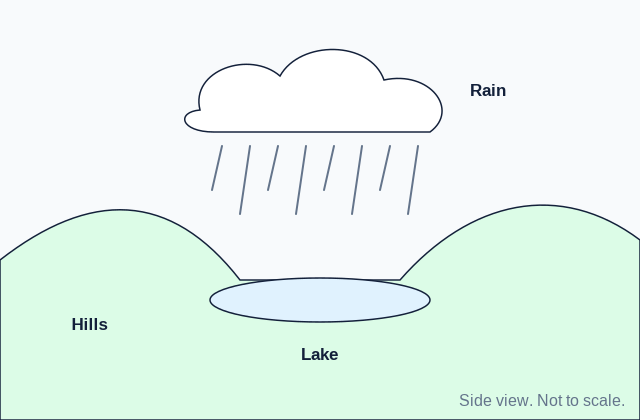 Tap to open the picture full size
Part 1 Think first Two kinds of rain
Commit to a guess first. Being wrong now makes the right idea stick better.
Predict first
Rain collected in a made-up industrial region is far more acidic than rain collected on a remote island far out at sea. What do you predict most likely made the region's rain more acidic?
In short. Acid deposition is acid that reaches the ground from the air, falling in rain, snow or fog or settling out dry.
- It comes down mainly on communities downwind of its sources.
- It can make soils, lakes and streams more acidic and wear away stone and metal that people have built.
- Limestone bedrock can neutralize its effect on lakes and ponds, so the same rain harms some regions less than others.
Part 2 Learn it From gas to acid on the ground
2a. The gases and their sources
Acid rain and other acid deposition are due to nitrogen oxides and sulfur oxides in the atmosphere, released by human activities and by natural sources.
Acid deposition is acid reaching the ground from the air: in rain, snow or fog, or as dry particles and gases that settle out. In the air, these oxides react to form acids; 7.1 showed nitrogen oxides converting to nitric acid.
- Human sources, also called anthropogenic sources: nitrogen oxides come from motor vehicles and from coal-burning power plants. Sulfur dioxide, a sulfur oxide, comes from coal-burning power plants.
- Natural sources add some of the same gases. Background: volcanoes give off sulfur gases, and lightning makes nitrogen oxides.
So the order is: the gas is released, the acid forms in the air, and the acid comes down to the ground.
Quick check · Multiple choice
A made-up region's monitors track the nitrogen oxides and sulfur oxides in its air. Which statement about where such gases come from is accurate?
2b. Where the acid comes down
Acid deposition mainly affects communities downwind from coal-burning power plants.
Downwind means in the direction the wind blows toward. A coal-burning plant releases its nitrogen oxides and sulfur dioxide from tall stacks, and the wind carries the gases away while they react to form acids. The acid comes down where the air has traveled, not where it started.
For example, if the winds at a made-up plant blow mostly from the south, towns and forests to its north receive most of its acid, while towns to its south, upwind, receive little of it.
Background: tall stacks lift the gases high, so they can travel a long way before coming down.
Quick check · Decide and justify
A made-up power company plans a new coal-burning plant on a coast where the winds blow mostly out to sea, away from the inland towns. A student says the inland towns will receive less acid deposition from it than from the same plant built on their upwind side. Is the student right?
Which reason supports your answer?
2c. Soils, waters and structures
Acid rain and deposition can lead to the acidification of soils and bodies of water and the corrosion of human-made structures.
pH is a scale of how acidic a liquid is: the lower the number, the more acidic, and 7 is neutral. The pH figures in this lesson are made up for practice.
- Soils: acid soaking in year after year leaves the soil more acidic.
- Bodies of water: lakes, ponds and streams take in acid from rain, from snowmelt and from water running off the land, and their water grows more acidic.
- Human-made structures: acids eat away at stone, such as the marble and limestone of buildings and statues, and corrode metal, such as railings and bridges. Carved details blur and wear away.
For example, a made-up mountain pond whose water read pH 6.5 in 1970 read pH 5.1 in 2020: its water has grown more acidic.
Quick check · Select all
A made-up town receives acid rain for decades. Which two changes could the acid rain cause there? Pick two.
Select 2 answers, then check.
2d. Bedrock makes a difference
Regional differences in soils and bedrock change how much harm acid deposition does, as limestone bedrock can neutralize the effect of acid rain on lakes and ponds.
Bedrock is the solid rock beneath the soil. Water that soaks through the ground and runs into a lake has passed over it.
To neutralize an acid is to cancel out its effect. Limestone reacts with acid and uses it up, so water that has run over limestone carries less acid into a lake, and the lake stays closer to neutral. The more limestone the water passes over, the more acid it can cancel.
So two lakes can receive the very same acid rain and change very differently. A lake in limestone country may change little, while a lake on rock with no limestone has nothing to cancel the acid and can grow far more acidic. Soils differ from region to region as well, and they also change how much harm the same rain does.
For example, two made-up ponds 10 km apart get the same rain: the one in a limestone valley has kept its pH, while the one on bare volcanic rock has not.
Quick check · Rank it
Three made-up lakes receive the same acid rain for 30 years, and each has the same thin soil around it. Rank them from least acidified to most.
Least acidified first
Give each one a place, 1 for first. Give two the same place if they are equal.
Your ranking: none yet
Part 3 Watch it done How long until the lettering is gone?
Open each step in turn, answer the why, then finish the calculation yourself.
A made-up marble grave marker in a town that receives acid rain lost 2.2 millimeters (mm) of its surface in its first 40 years. Its carved lettering is 9.9 mm deep. If the surface keeps wearing away at the same rate, how many years after carving will the lettering be gone?
Step 1 · Find the rate of wear
mm of surface lost each year.
Why this step?
Why does the marker's stone wear away at all?
Acid deposition corrodes human-made structures, and a carved stone marker is one: the acid eats away at its surface year after year.
Step 2 · Choose the operation
The lettering is 9.9 mm deep and the surface loses 0.055 mm a year, so divide the depth by the yearly loss: .
Your step · Calculate
Finish it. The lettering is 9.9 mm deep and the surface wears away 0.055 mm a year. How many years after carving will the lettering be gone?
years
One marker's lettering lasts about two centuries, but the same slow wear works on every stone wall, statue and railing the acid reaches, all at once.
Part 4 Try it Fill in a valley, then check an account
First complete an account of a made-up valley. Then find where a student's account of acid rain goes wrong.
Try it · Fill the statement
Complete the account of a made-up valley.
Nitrogen oxides from the city's drift over the valley and come down as acid rain, leaving the hillside's more acidic each decade.
Try it · Spot the error
A student describes acid rain in a made-up lake district. Tap the first line that goes wrong.
Part 5 Explain it Limestone in a jar
Write your answer first. Nothing you type here leaves this page. Then compare it with the model and each scoring point.
Free response is 40% of the exam score. This one is shaped like Question 1, Design an investigation.
Free-response practice · Question 1 style
A class wants to test how the amount of crushed limestone affects how acidic a sample of made-up acid rain stays. They have four identical jars, a large bottle of one weak acid solution standing in for acid rain, a balance, crushed limestone all from one bag, and a pH meter, which reads how acidic a liquid is (the lower the number, the more acidic).
(a) Identify a testable hypothesis for the investigation.
(b) Identify the independent variable and the dependent variable.
(c) Describe one variable the class should keep the same for every jar, and why.
(d) Describe the results the class would expect if your hypothesis is correct.
(e) Explain how the results relate to lakes on different kinds of bedrock.
Model answer
(a) If more crushed limestone is added to the acid solution, then the solution's pH will rise more, so it will end up less acidic.
(b) Independent variable: the mass of crushed limestone in each jar (for example 0, 10, 20 and 40 grams). Dependent variable: the pH of the solution in each jar after 24 hours, read with the pH meter.
(c) The volume of acid solution in each jar, for example 500 milliliters in every jar, because a jar with more solution would hold more acid for the same limestone to cancel. (The same starting solution, the same time and the same room temperature also fit.)
(d) The jar with no limestone keeps the lowest pH, the most acidic, and the pH rises as the mass of limestone rises, with the 40 gram jar the least acidic.
(e) Limestone bedrock can neutralize the effect of acid rain on lakes and ponds. A lake whose water runs over limestone is like a jar with more limestone, so it stays less acidic than a lake on rock with none, which is why the same acid rain harms some regions more than others.
Score your own answer. This is a self-check, not a grade. Tick each point your answer makes.
Part 6 Check yourself Deposition around a power plant
The first two questions use the table.
A made-up coal-burning power plant stands on flat farmland where the winds blow mostly from the west toward the east. Scientists place identical collectors at five sites around it and measure the acid deposited over one year. The numbers are made up for practice.
| Site (direction and distance from the plant) | Acid deposited (kg per hectare) |
|---|---|
| West, 30 km | 6 |
| East, 60 km | 18 |
| North, 30 km | 9 |
| East, 30 km | 27 |
| South, 30 km | 8 |
Case question 1 · Multiple choice
Which statement do the data best support?
Case question 2 · Calculate
Using the table: by what percent was the acid deposited at the site 30 km east greater than at the site 30 km west?
The rest stand on their own and do not use the case.
Check yourself · Sort it
Does each made-up release lead to acid deposition? Tap a card, then its group.
Leads to acid deposition
Does not lead to acid deposition
Check yourself · Match
Match each made-up observation to what it shows about acid deposition.
Part 7 Keep it Bring back earlier ideas
Two questions from earlier topics in this unit: pollution controls in a made-up town, and a student's account of natural sources of carbon dioxide and particulates.
First fill in the devices at work in a made-up town. Then find where a student's account of a drive goes wrong.
From 7.6 Reduction of Air Pollutants · Fill the statement
Complete the account of pollution controls in a made-up town.
On the town's streets, the in each car's exhaust pipe changes carbon monoxide into carbon dioxide, and at the edge of town the in the coal plant's exhaust gives ash particles a charge and collects them on plates.
First complete a sentence about a made-up place. Then find where a student's account goes wrong.
From 7.4 Atmospheric CO2 and Particulates · Spot the error
A student describes the natural sources of carbon dioxide and particulates in a made-up park. Tap the first line that goes wrong.
In three lines
- Acid rain and deposition are due to nitrogen oxides and sulfur oxides from human and natural sources: nitrogen oxides from motor vehicles and coal-burning power plants, and sulfur dioxide from coal-burning power plants.
- Acid deposition mainly affects communities downwind from coal-burning power plants.
- It can acidify soils and bodies of water and corrode human-made structures, and limestone bedrock can neutralize its effect on lakes and ponds.
Exam strategy for this topic
- Section I, Multiple Choice: 80 questions in 90 minutes.
- Section II, Free Response: 3 questions in 70 minutes.
- This lesson's Explain it is shaped like free-response question 1, Design an investigation.
- A four-function, scientific, or graphing calculator is allowed on both sections of the exam.
When a question asks about acid deposition, name the gases (nitrogen oxides and sulfur oxides) and their sources, say where the acid comes down, name what it harms, and for a lake or pond, consider the bedrock beneath it.
Questions students ask
What causes acid rain?
Acid rain and deposition are due to nitrogen oxides and sulfur oxides in the atmosphere, from human and natural sources. Nitrogen oxides come from motor vehicles and coal-burning power plants, and sulfur dioxide from coal-burning power plants.
Which places does acid deposition affect most?
It mainly affects communities downwind from coal-burning power plants.
What does acid deposition do to the environment?
It can acidify soils and bodies of water and corrode human-made structures.
Why does acid rain harm some lakes less than others?
Regional differences in soils and bedrock change its impact; limestone bedrock can neutralize the effect of acid rain on lakes and ponds.
Course alignment, for teachers
AP Environmental Science topic 7.7, Unit 7: Atmospheric Pollution.
- Skill 4.B: Identify a research method, design, and/or measure used.
This lesson maps all 5 essential knowledge statements of the topic to the part that teaches each one: 5 are checked by a scored question. The map is in the lesson file.