Unit 4 · Topic 4.5 · about 30 minutes · 7 parts · 10 scored checks, 3 of them multiple choice, plus 2 from earlier lessons
AP Environmental Science 4.5: Global Wind Patterns
Unit 4: 10 to 15% of the multiple-choice section
What you'll be able to do
- Explain how environmental factors can result in atmospheric circulation: the most intense solar radiation arriving at the equator, the density differences it causes, and the Coriolis effect.
Key vocabulary
| Term | What it means | The exam trap |
|---|---|---|
| Solar radiation | Energy from the sun that reaches Earth as light. | Solar radiation is energy arriving as light; it is not warm air carried from the sun. |
| Density | How much mass is packed into a given volume. | Density is not weight. A big volume of air can weigh more and still be less dense. |
| Coriolis effect | The turning of the paths of moving air caused by Earth's rotation. | Its name sounds like a push, but no force shoves the air sideways: the ground turns beneath it. |
| Latitude | How far north or south of the equator a place is, in degrees from 0° to 90°. | Latitude runs north and south; it says nothing about how far east or west a place is. |
 Tap to open the picture full size
Part 1 Think first A wind on a spinning planet
Commit to a guess first. Being wrong now makes the right idea stick better.
Predict first
Air near the ground at about 30° N moves south toward the equator, across a planet that is spinning. Which path do you predict the air follows?
In short. Global winds start with uneven heating: the sun warms the equator most, warm air rises and cooler air flows in, and Earth's rotation also shapes the winds.
- The most intense solar radiation arrives at the equator.
- Warmed air becomes less dense and rises; cooler, denser air sinks and flows in to replace it.
- Earth's rotation also shapes global winds, through what is called the Coriolis effect.
Part 2 Learn it Why the air moves, and why it curves
2a. Where the sunlight is most intense
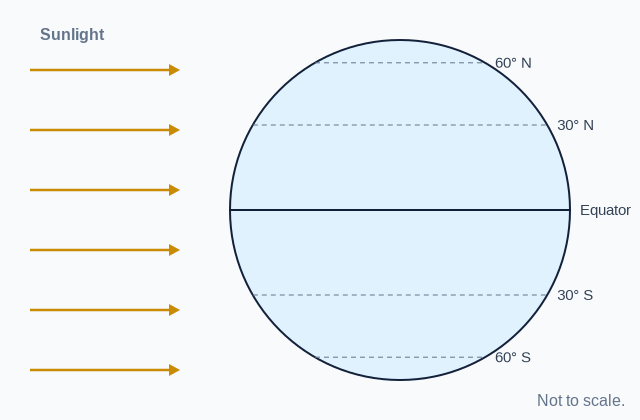
Global wind patterns primarily result from the most intense solar radiation arriving at the equator. Near the equator the sun's rays strike the ground nearly straight on, so each square meter of ground there gets the most energy. Farther north or south, the same rays come in at a slant and spread over more ground. (Topic 4.7 works through the angles.)
So Earth is heated unevenly: most at the equator, less elsewhere. The air touching the ground is warmed by it, so the air over the equator ends up warmer than the air to its north and south. That difference is where the winds begin.
Quick check · Multiple choice
Four made-up weather stations measure the sunlight reaching each square meter of their ground over a whole year. Which station is most likely to record the most intense solar radiation?
2b. Warm air rises, dense air sinks
The uneven heating results in density differences. Density is how much mass is packed into a given volume. When air is warmed, it expands: the same mass of air takes up more space, so it becomes less dense. Less dense air is pushed upward by the denser air around it, so warm air rises. Cooler air is denser, so it sinks.
At the equator, warmed air rises. Cooler, denser air from the north and south flows in along the ground to take its place. High up, the risen air spreads out toward the poles, cools, becomes denser and sinks. The sinking air then flows along the ground back toward the equator, completing a loop.
Background: each of these loops of rising and sinking air is called a circulation cell. The loop nearest the equator rises at the equator and sinks at about 30° north and south of it.
Quick check · Decide and justify
A student says the warm air over the equator sinks toward the ground, since warm air is denser than cooler air. Is the student right?
Which reason supports your answer?
2c. The Coriolis effect
Global wind patterns also result from the Coriolis effect: the turning of the paths of moving air caused by Earth's rotation. Earth spins beneath the air as the air moves from one latitude to another, so the air's path across the ground curves instead of running straight north or south.
- In the Northern Hemisphere, moving air is turned to the right of the way it is heading.
- In the Southern Hemisphere, it is turned to the left.
The Coriolis effect does not start the air moving; the density differences do that. It changes the direction the moving air takes.
Background: the surface air flowing back toward the equator is turned toward the west in both hemispheres. These steady winds are the trade winds. Between about 30° and 60° north and south, surface winds are turned toward the east; these are the westerlies, named for the west they blow from.
Quick check · Select all
A made-up planet is heated most at its equator, as Earth is, but it does not rotate. Compared with Earth, which two would be true of its winds? Pick two.
Select 2 answers, then check.
Part 3 Watch it done How much less dense does warmed air get?
Open each step in turn, answer the why, then finish the calculation yourself.
Suppose a made-up parcel of air near the equator has a mass of 1.20 kg and fills 1.000 cubic meter. The sun warms it, and it expands to fill 1.068 cubic meters. Its mass does not change. What is its density after it is warmed, in kilograms per cubic meter?
Step 1 · Name what changes
The air is the same air, so its mass stays 1.20 kg. Only its volume grows, from 1.000 to 1.068 cubic meters.
Step 2 · Find the density before
Density = mass volume, so before warming it is kg per cubic meter.
Why this step?
Why does a lower density make the parcel rise?
The denser air around it is pulled down more strongly for each cubic meter, so it pushes in underneath and lifts the less dense parcel, the way water pushes a cork up.
Step 3 · Set up the density after
Divide the same mass by the new, larger volume.
Your step · Calculate
Finish it. A made-up parcel of air has a mass of 1.20 kg. Warmed by the sun, it expands from 1.000 to 1.068 cubic meters, with no change in mass. What is its density after it is warmed, in kilograms per cubic meter?
kg per cubic meter
The warmed parcel's density fell from 1.20 to about 1.12 kg per cubic meter. Less dense than the cooler air around it, it rises: the start of the loop that sets global winds moving.
Part 4 Try it A chain of reasoning, and a wind in the south
First find where a student's account of the winds goes wrong. Then use a rule you are given to turn a wind in the Southern Hemisphere.
Try it · Spot the error
A student explains how global winds start. Tap the first line that goes wrong.
Try it · Multiple choice
In the Southern Hemisphere, the Coriolis effect turns moving air to the left of the way it is heading. Surface air there moves north from about 30° S toward the equator. Which way is the air moving as it nears the equator?
Part 5 Explain it Sunlight and air from the equator to 60° N
Write your answer first. Nothing you type here leaves this page. Then compare it with the model and each scoring point.
Free response is 40% of the exam score. This one is shaped like Question 2, Analyze and interpret quantitative data.
Free-response practice · Question 2 style
Suppose students collect made-up yearly averages at five latitudes in the Northern Hemisphere: the solar radiation reaching each square meter of ground, in watts per square meter, and the density of the air near the ground, in kilograms per cubic meter. The numbers are made up for practice.
- 0° (equator): 420 W per square meter; 1.16 kg per cubic meter
- 15° N: 405 W per square meter; 1.17 kg per cubic meter
- 30° N: 365 W per square meter; 1.19 kg per cubic meter
- 45° N: 300 W per square meter; 1.22 kg per cubic meter
- 60° N: 230 W per square meter; 1.25 kg per cubic meter
(a) Describe the relationship between latitude and solar radiation in these data.
(b) Calculate the percent by which the solar radiation at 60° N is less than at the equator. Show your work.
(c) Identify the latitude in the data where air near the ground is most likely to rise, and explain why, using the density data.
(d) Surface air flows from 30° N toward the equator. Explain why it does not blow straight south.
Model answer
(a) Solar radiation decreases as latitude increases: from 420 W per square meter at the equator to 230 at 60° N.
(b) . less at 60° N.
(c) The equator. Its air near the ground is the least dense, 1.16 kg per cubic meter, because it is heated by the most intense radiation. Less dense air is pushed up by the denser air around it, so it rises.
(d) Earth's rotation turns the path of moving air, the Coriolis effect. As the air moves south, Earth spins beneath it, so its path curves instead of running straight south.
Score your own answer. This is a self-check, not a grade. Tick each point your answer makes.
Part 6 Check yourself One loop of moving air
The first two questions use the figure.
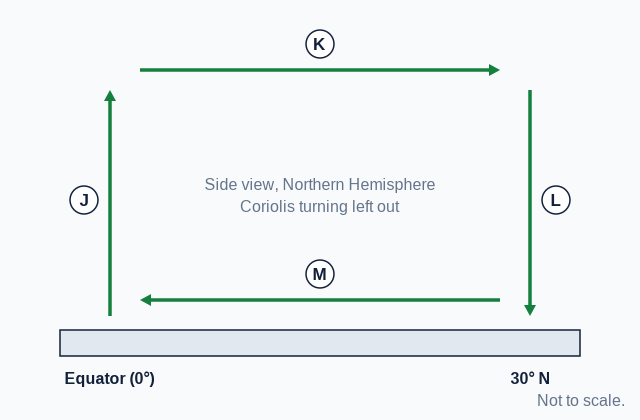
The figure is a made-up side view of the air between the equator and 30° N, as if the atmosphere were sliced from the ground up. Arrows J, K, L and M show which way the air moves in one loop. The Coriolis turning is left out, so the arrows show only up, down, north and south.
Case question 1 · Multiple choice
Using the figure: what most directly sends the surface air at M toward the equator?
Case question 2 · Match
Using the figure: match each place to what is happening to the air there.
The rest stand on their own and do not use the case.
Check yourself · Sort it
Each card is part of how global winds form. Tap a card, then its part.
Sets the air moving
Changes the moving air's direction
Check yourself · Decide and justify
A student says that the most intense solar radiation arriving at the equator is the first step in setting Earth's global winds moving. Is the student right?
Which reason supports your answer?
Part 7 Keep it Bring back earlier ideas
Two questions from earlier topics: the real layers of the atmosphere, and how soil is weathered, transported or deposited.
First pick the real layers of the atmosphere out of a list. Then find where a student's account of the air goes wrong.
From 4.4 Earth’s Atmosphere · Select all
A student writes four words while studying Earth's systems. Which two name layers of the atmosphere? Pick two.
Select 2 answers, then check.
First pick out the scenes that show erosion. Then sort what happens to parent material into the three steps of soil formation.
From 4.2 Soil Formation and Erosion · Sort it
Each card is something that happens to parent material. Tap a card, then the step of soil formation it shows.
Weathered
Transported
Deposited
In three lines
- Global wind patterns primarily result from the most intense solar radiation arriving at the equator.
- The uneven heating results in density differences: warmed air becomes less dense and rises, and cooler, denser air sinks and flows in.
- The Coriolis effect, from Earth's rotation, turns moving air: to the right in the Northern Hemisphere and to the left in the Southern.
Exam strategy for this topic
- Section I, Multiple Choice: 80 questions in 90 minutes.
- Section II, Free Response: 3 questions in 70 minutes.
- This lesson's Explain it is shaped like free-response question 2, Analyze and interpret quantitative data.
- A four-function, scientific, or graphing calculator is allowed on both sections of the exam.
To explain a global wind, give the chain: the most intense solar radiation at the equator, then density differences (warm air less dense and rising, cool air denser and sinking), then the Coriolis effect turning the moving air.
Questions students ask
What causes global wind patterns?
They primarily result from the most intense solar radiation arriving at the equator, resulting in density differences and the Coriolis effect.
Why does warm air rise?
Warmed air expands, so the same mass takes up more space and becomes less dense. The denser air around it pushes it upward.
What is the Coriolis effect?
The turning of moving air's path by Earth's rotation: to the right in the Northern Hemisphere and to the left in the Southern Hemisphere.
Course alignment, for teachers
AP Environmental Science topic 4.5, Unit 4: Earth Systems and Resources.
- Skill 2.B: Explain relationships between different characteristics of environmental concepts, processes, or models represented visually:
This lesson maps the one essential knowledge statement of the topic to the part that teaches each one: 1 is checked by a scored question. The map is in the lesson file.