Unit 5 · Topic 5.4 · about 30 minutes · 7 parts · 10 scored checks, 2 of them multiple choice, plus 2 from earlier lessons
AP Environmental Science 5.4: Impacts of Agricultural Practices
Unit 5: 10 to 15% of the multiple-choice section
What you'll be able to do
- Describe agricultural practices that cause environmental damage: tilling, slash-and-burn farming and the use of fertilizers.
Key vocabulary
| Term | What it means | The exam trap |
|---|---|---|
| Tilling | Turning over the soil, usually with a plow, before planting. | It is done to help planting; it is not the same as planting. |
| Slash-and-burn farming | Clearing a patch of forest for crops by cutting the plants and burning them. | It is a farming method, not a wildfire. |
| Fertilizer | A substance spread on soil to supply nutrients, mostly nitrogen and phosphorus, to plants. | More fertilizer is not always taken up by more crop growth. |
| Runoff | Water that flows over the land's surface instead of soaking in, and what it carries with it. | Runoff carries what is on the ground, not only water. |
 Tap to open the picture full size
Part 1 Think first A bare field in winter
Commit to a guess first. Being wrong now makes the right idea stick better.
Predict first
After harvest, a farmer plows a field so its soil is loose and bare, and leaves it unplanted until spring. What do you predict happens to the field during the winter's wind and rainstorms?
In short. Agricultural practices that can cause environmental damage include tilling, slash-and-burn farming and the use of fertilizers.
- Tilling is turning over the soil, usually with a plow, before planting.
- Slash-and-burn farming clears a patch of forest for crops by cutting and burning it.
- Fertilizer adds nutrients, mostly nitrogen and phosphorus, so crops grow larger.
Part 2 Learn it Three practices, three kinds of damage
2a. Tilling
Agricultural practices that can cause environmental damage include tilling, slash-and-burn farming, and the use of fertilizers. This lesson takes them one at a time.
Tilling is turning over the soil, usually with a plow, to bury weeds and old crop stalks and loosen a seedbed. It helps planting, and that is why farmers do it.
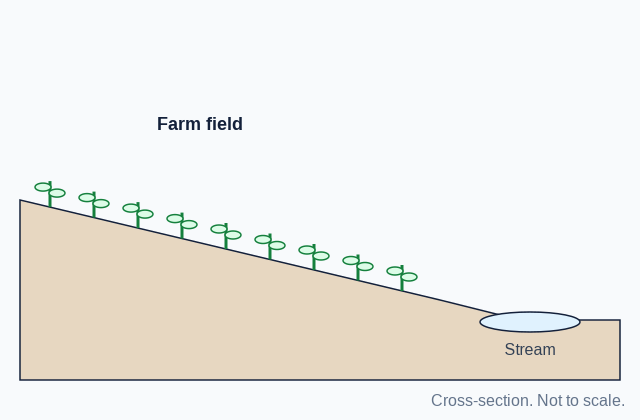
How the damage happens: tilling breaks up the clumps that hold soil together and buries the plant cover that shields the surface. Until a new crop covers it, the field is loose and exposed. Wind can blow the fine soil away, and rain can wash it downhill into ditches and streams. The topsoil lost this way is the richest layer, and it forms far more slowly than a few storms can remove it.
The longer tilled ground stays bare, and the steeper the field, the more soil it can lose.
Quick check · Multiple choice
Two fields have the same slope, soil and weather. One is tilled every fall and left bare; the other is not tilled, and last year's crop stubble stays on it all winter. Which is expected?
2b. Slash-and-burn farming
Slash-and-burn farming clears a patch of forest for crops: the trees and brush are cut (slashed), left to dry, and burned.
How the damage happens: the ash adds nutrients to the soil, so the first harvests can be good. In many tropical forests, though, most nutrients are held in the plants rather than the soil, and rain soon washes the ash's nutrients away. After a few seasons the plot no longer grows good crops, and farmers clear a new patch.
Each cycle removes forest. The burning releases the carbon stored in the trees as carbon dioxide, the cleared ground is open to erosion, and the animals and plants that lived in the forest lose their habitat. Where few people farm a large forest and plots are left for many years, the forest can regrow; where farmers return to a plot quickly, it may not.
Quick check · Decide and justify
A student says slash-and-burn farming does no lasting environmental damage, because the ash from the burned trees fertilizes the crops. Is the student right?
Which reason supports your answer?
2c. The use of fertilizers
Fertilizers add nutrients, mostly nitrogen and phosphorus, so crops grow larger. Used well, they raise yields on the same land.
How the damage happens: a crop takes up only part of what is spread. The rest can wash off the field with rain or irrigation water into ditches, streams and lakes, or soak down into the groundwater, especially when a farmer spreads more than the crop can use or spreads it just before heavy rain.
In water, the extra nutrients feed the rapid growth of algae. Background: when the algae die and decay, the water can run short of oxygen, and fish can die, and nitrate that reaches groundwater can make well water unsafe to drink. Later topics on water pollution teach these in full.
The damage comes from fertilizer that does not stay where it was spread.
Quick check · Select all
A farmer spreads more fertilizer than the crop can take up, the day before a heavy rain. Which two are likely results? Pick two.
Select 2 answers, then check.
Part 3 Watch it done How much fertilizer does the crop miss?
Open each step in turn, answer the why, then finish the calculation yourself.
On a made-up cornfield, a farmer spreads 200 kg of nitrogen per hectare. Tests at harvest show the crop took up 124 kg per hectare. What percent of the nitrogen spread did the crop not take up?
Step 1 · Find the nitrogen not taken up
kg per hectare.
Why this step?
Why does the nitrogen the crop missed matter?
Nitrogen the crop does not take up can wash off the field into water or soak into the groundwater. That share is where the damage comes from.
Step 2 · Pick the whole
The question asks for a percent of the nitrogen spread, so the whole is 200 kg.
Step 3 · Set up the percent
Divide the part missed by the amount spread, and multiply by 100.
Your step · Calculate
Finish it. A farmer spreads 200 kg of nitrogen per hectare on a made-up cornfield, and the crop takes up 124 kg per hectare. What percent of the nitrogen spread did the crop not take up?
%
Over a third of the nitrogen, 38%, was left where rain could carry it to water. Spreading less, or nearer the time the crop needs it, shrinks that share.
Part 4 Try it Name the practice, then check an account
First sort six farm scenes by the practice each shows. Then find where a student's account of fertilizer goes wrong.
Try it · Sort it
Which practice does each farm scene show? Tap a card, then its group.
Tilling
Slash-and-burn farming
Use of fertilizers
Try it · Spot the error
A student explains how fertilizer can harm the environment. Tap the first line that goes wrong.
Part 5 Explain it Does tilling cost soil?
Write your answer first. Nothing you type here leaves this page. Then compare it with the model and each scoring point.
Free response is 40% of the exam score. This one is shaped like Question 1, Design an investigation.
Free-response practice · Question 1 style
A student wants to find out whether tilling a field increases the amount of soil that rain washes off it. The student has six identical trays of the same field soil, a watering can that sprinkles water like rain, a stand to tilt each tray to the same slope, and containers to catch the water that runs off.
(a) Identify a testable hypothesis for the investigation.
(b) Identify the independent variable and the dependent variable.
(c) Describe how the student should set up the trays to test the hypothesis, including how many trays get each treatment.
(d) Describe how the student could measure the dependent variable.
(e) Describe the results that would support the hypothesis, and explain why tilling would cause them.
Model answer
(a) If soil is tilled, then more soil will wash off it in simulated rain than off soil that is not tilled.
(b) Independent variable: whether the soil is tilled. Dependent variable: the mass of soil washed off each tray.
(c) Leave three trays with their surface undisturbed and a cover of dead stalks, as an untilled field has; turn over and loosen the soil in the other three, burying the stalks, as tilling does. Set all six at the same slope and pour the same amount of water the same way on each.
(d) Collect the runoff from each tray, let the soil settle or filter it out, dry it, and weigh it.
(e) The tilled trays lose more soil than the untilled trays. Tilling loosens the soil and buries the cover that shields it, so the water carries more of it away.
Score your own answer. This is a self-check, not a grade. Tick each point your answer makes.
Part 6 Check yourself How much fertilizer?
The first two questions use the table.
A farm tests four amounts of nitrogen fertilizer on four identical plots of corn. It measures the nitrate in the water running off each plot after a storm, and each plot's yield. The numbers are made up for practice.
| Nitrogen spread (kg per hectare) | Nitrate in runoff (mg per liter) | Yield (metric tons per hectare) |
|---|---|---|
| 0 | 1.0 | 4.0 |
| 100 | 2.5 | 7.5 |
| 200 | 6.0 | 8.6 |
| 300 | 11.0 | 8.8 |
Case question 1 · Multiple choice
Using the table: what happens when the nitrogen spread rises from 200 to 300 kg per hectare?
Case question 2 · Calculate
Using the table: by what percent does the nitrate in the runoff rise when the nitrogen spread goes from 200 to 300 kg per hectare?
The rest stand on their own and do not use the case.
Check yourself · Fill the statement
Complete the description of slash-and-burn farming.
A patch of forest is , crops grow well on the ash for a few seasons, and then the farmers .
Check yourself · Rank it
Three made-up fields have the same slope and soil, with storms spread evenly through the year, and each is tilled once a year. Rank them by the soil they are likely to lose in a year.
Most soil lost first
Give each one a place, 1 for first. Give two the same place if they are equal.
Your ranking: none yet
Part 7 Keep it Bring back earlier ideas
Two questions from earlier topics: what each Green Revolution method does, and a student's account of a shared lake.
First match each Green Revolution method with what it does. Then find where a student's account goes wrong.
From 5.3 The Green Revolution · Match
Match each Green Revolution method with what it does.
First put the steps of a tragedy of the commons in order. Then find where a student's account of a shared lake goes wrong.
From 5.1 The Tragedy of the Commons · Spot the error
A student explains how a tragedy of the commons could happen at a lake. Tap the first line that goes wrong.
In three lines
- Agricultural practices that can cause environmental damage include tilling, slash-and-burn farming and the use of fertilizers.
- Tilling leaves loose, bare soil for wind and water to erode; slash-and-burn removes forest, releases its carbon and destroys habitat.
- Fertilizer a crop does not take up can wash into streams and lakes or soak into groundwater.
Exam strategy for this topic
- Section I, Multiple Choice: 80 questions in 90 minutes.
- Section II, Free Response: 3 questions in 70 minutes.
- This lesson's Explain it is shaped like free-response question 1, Design an investigation.
- A four-function, scientific, or graphing calculator is allowed on both sections of the exam.
When a question asks how a farming practice damages the environment, name the practice and the path: tilled soil is eroded by wind and water, slash-and-burn removes forest and releases carbon, and fertilizer runs off into water.
Questions students ask
Which agricultural practices can damage the environment?
Tilling, slash-and-burn farming and the use of fertilizers.
How does tilling damage the environment?
It loosens the soil and leaves it bare, so wind and water can erode it.
How do fertilizers damage the environment?
Fertilizer that crops do not take up can wash off fields into streams and lakes, or soak into groundwater.
Course alignment, for teachers
AP Environmental Science topic 5.4, Unit 5: Land and Water Use.
- Skill 1.A: Describe environmental concepts and processes.
This lesson maps the one essential knowledge statement of the topic to the part that teaches each one: 1 is checked by a scored question. The map is in the lesson file.