Unit 7 · Topic 7.1 · about 35 minutes · 7 parts · 11 scored checks, 2 of them multiple choice, plus 2 from earlier lessons
AP Environmental Science 7.1: Introduction to Air Pollution
Unit 7: 7 to 10% of the multiple-choice section
What you'll be able to do
- Identify the sources and effects of air pollutants.
Key vocabulary
| Term | What it means | The exam trap |
|---|---|---|
| Combustion | Burning: a fuel reacting with oxygen and releasing energy as heat. | Combustion is a chemical change: the fuel is used up, not just warmed. |
| Particulates | Tiny solid particles or liquid droplets small enough to stay suspended in the air. | Particulates are a pollutant even though they are not a gas. |
| Environmental Protection Agency (EPA) | The United States government agency that writes and enforces rules to protect air, water and land. | The EPA is an agency that carries out laws; it is not itself a law. |
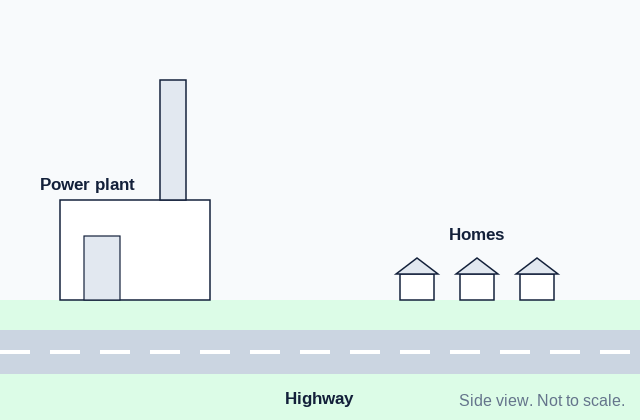 Tap to open the picture full size
Part 1 Think first Ozone by the highway
Commit to a guess first. Being wrong now makes the right idea stick better.
Predict first
Air monitors in a made-up city find the most ozone near the ground on sunny afternoons, downwind of its busiest highways. Where do you predict this ozone comes from?
In short. Air pollutants are substances in the air that harm living things, and burning coal and other fossil fuels releases many of them.
- Coal holds sulfur and metals as well as carbon, so its smoke carries more than carbon dioxide.
- Sulfur dioxide released as fossil fuels burn, mainly diesel fuels, lowers air quality.
- Rules on lead in fuels under the Clean Air Act cut the lead in United States air dramatically.
Part 2 Learn it What burning fuel puts in the air
2a. What burning coal releases
Burning coal releases several air pollutants: carbon dioxide, sulfur dioxide, toxic metals and particulates.
Coal is a fossil fuel. Burning it, or combustion, uses up oxygen from the air and does more than make heat and carbon dioxide, because coal holds other substances besides carbon, and its smoke carries them out too.
- Carbon dioxide: a gas made from the carbon in the coal.
- Sulfur dioxide: a gas made from the sulfur in the coal.
- Toxic metals: metals that are poisonous to living things, such as mercury.
- Particulates: tiny solid bits and liquid droplets small enough to float in the air, such as soot and ash.
A coal-burning power plant releases all four from its stack, in its smoke. Not every pollutant leaves a stack this way: nitric acid, for one, is not released by the plant but forms later in the air from other gases, as the next chunk shows.
Quick check · Multiple choice
A made-up paper mill burns coal in its boiler to make steam. Which list names four pollutants that burning the coal releases?
2b. Nitrogen oxides, and the rest of the exhaust
Burning fossil fuels releases nitrogen oxides, and once in the atmosphere they do not stay as they are.
Engines, furnaces and power plants that burn gasoline, diesel, natural gas or coal all release nitrogen oxides. Once in the air, nitrogen oxides:
- lead to the production of ozone, a gas, near the ground;
- lead to the formation of photochemical smog, a haze over many cities (the next topic);
- convert to nitric acid in the atmosphere, which falls as acid rain.
Burning fossil fuels releases other pollutants as well:
- carbon monoxide, a poisonous gas;
- hydrocarbons, compounds of hydrogen and carbon, such as fuel that did not burn;
- particulate matter, the particulates of the last chunk.
Quick check · Decide and justify
A student says a made-up car that burns gasoline releases nitrogen oxides and no other air pollutant. Is the student right?
Which reason supports your answer?
2c. Sulfur dioxide and lead
Sulfur dioxide released when fossil fuels burn, mainly diesel fuels, lowers air quality.
Diesel fuel runs many trucks, buses, ships, trains and generators. As it burns, it releases sulfur dioxide along with the nitrogen oxides and other pollutants of the last chunk.
Lead is a pollutant that was cut sharply. Under the Clean Air Act, a United States law, the Environmental Protection Agency (EPA) regulated the use of lead, particularly in fuels. Burning fuels that held lead had spread it through the air. Regulating lead dramatically decreased the amount of lead in the atmosphere.
Quick check · Select all
A made-up port city reviews its air records. Which two statements about its air are accurate? Pick two.
Select 2 answers, then check.
2d. Primary and secondary pollutants
Air pollutants can be primary or secondary.
- A primary pollutant is released into the air directly from its source. Carbon monoxide leaving a car's tailpipe is primary.
- A secondary pollutant is not released by any source. It forms in the atmosphere when other substances react. Ozone near the ground is secondary: no tailpipe releases it, but the nitrogen oxides a tailpipe releases lead to its production.
To classify a pollutant, ask what it was when it left the source. If it came out as itself, it is primary. If it was made later, in the air, from something else, it is secondary.
Quick check · Sort it
Is each made-up pollutant primary or secondary? Tap a card, then its group.
Primary
Secondary
Part 3 Watch it done How far did the lead fall?
Open each step in turn, answer the why, then finish the calculation yourself.
A made-up city's air held an average of 1.24 micrograms of lead per cubic meter before rules on lead in fuels took effect. Twenty years later it held 0.031 micrograms per cubic meter. By what percent did the lead in the city's air fall?
Step 1 · Find the fall
micrograms per cubic meter less lead.
Why this step?
Why did the lead in the air fall so far?
Under the Clean Air Act the EPA regulated the use of lead, particularly in fuels, so burning fuel stopped spreading lead through the air.
Step 2 · Choose what to divide by
A fall is measured from the starting amount, the reading before the rules. Divide the fall by it, then multiply by 100.
Your step · Calculate
Finish it. The lead fell by 1.209 micrograms per cubic meter from a starting 1.24. By what percent did it fall?
%
Almost all of the lead is gone from the city's air. A rule aimed at one pollutant in one kind of product changed the air a whole country breathes.
Part 4 Try it Order the gases, then check an account
First put the steps from a made-up power plant to acid rain in order. Then find where a student's account of a city's air goes wrong.
Try it · Put it in order
Put the steps from a made-up power plant to acid rain in order, first to last.
Try it · Spot the error
A student describes the air of a made-up city. Tap the first line that goes wrong.
Part 5 Explain it Samplers along a highway
Write your answer first. Nothing you type here leaves this page. Then compare it with the model and each scoring point.
Free response is 40% of the exam score. This one is shaped like Question 1, Design an investigation.
Free-response practice · Question 1 style
A class wants to test how distance from a busy highway affects the amount of nitrogen oxides in the air. They have eight identical passive samplers, small tubes that absorb nitrogen oxides from the air around them over a week; posts that hold each sampler 2 meters above the ground; and a lab that reports what each sampler absorbed as micrograms of nitrogen oxides per cubic meter of air.
(a) Identify a testable hypothesis for the investigation.
(b) Identify the independent variable and the dependent variable.
(c) Describe one variable the class should keep the same for every sampler, and why.
(d) Describe the results the class would expect if your hypothesis is correct.
(e) Explain how the results would change if the class set out the samplers during a week when the highway was closed to traffic.
Model answer
(a) If a sampler is placed closer to the highway, then it will measure more nitrogen oxides in the air.
(b) Independent variable: the distance of each sampler from the highway (for example, two samplers each at 10, 50, 150 and 400 meters). Dependent variable: the nitrogen oxides each sampler measures, in micrograms per cubic meter.
(c) The height of each sampler, 2 meters above the ground on the same kind of post, because air at a different height could hold a different amount of exhaust. (The week the samplers are out and the side of the highway they stand on also fit.)
(d) The samplers at 10 meters measure the most nitrogen oxides, and the amount falls as distance rises, with the samplers at 400 meters measuring the least.
(e) With the highway closed, no engines would burn fossil fuel on it, so no nitrogen oxides would be released there. The readings close to the highway would drop toward the readings far away, and the difference with distance would shrink or disappear.
Score your own answer. This is a self-check, not a grade. Tick each point your answer makes.
Part 6 Check yourself Sticky cards around town
The first two questions use the table.
A made-up class sets out sticky cards for one week at four sites around its town, then counts the particles stuck to each card under a microscope. One site is 1 km downwind of a coal-burning power plant and also beside a highway. The numbers are made up for practice.
| Site | Particles per square centimeter |
|---|---|
| Park 3 km upwind of the plant | 32 |
| Bus depot | 248 |
| 1 km downwind of the coal plant, beside a highway | 186 |
| School yard | 96 |
Case question 1 · Multiple choice
The class concludes that the coal plant caused the high count at the downwind site. A student points out that the site also sits beside a highway. Which change to the procedure would best test whether the plant is the main source of the particles there?
Case question 2 · Calculate
Using the table: by what percent is the bus depot's count greater than the park's count?
The rest stand on their own and do not use the case.
Check yourself · Fill the statement
Complete the account of a made-up power plant's nitrogen oxides.
Downwind of a made-up gas-fired power plant, the nitrogen oxides from its stack help produce in the air and change into , which comes down in the rain.
Check yourself · Match
Match each made-up observation to the pollutant it describes.
Part 7 Keep it Bring back earlier ideas
Two questions from earlier topics: a plan to save energy at home and on the way to work, and a student's account of a fuel cell bus.
First complete a made-up town's conservation plan. Then find where a student's account of another town's plan goes wrong.
From 6.13 Energy Conservation · Fill the statement
Complete the account of a made-up town's plan.
Families are asked to lower their thermostats in winter to reduce the use of , and commuters are offered a new so fewer of them drive alone.
First put the steps from water to a fuel cell's emission in order. Then find where a student's account of a fuel cell bus goes wrong.
From 6.11 Hydrogen Fuel Cell · Spot the error
A student describes a made-up city's fuel cell bus. Tap the first line that goes wrong.
In three lines
- Coal combustion releases carbon dioxide, sulfur dioxide, toxic metals and particulates, and burning fossil fuels, mainly diesel fuels, releases sulfur dioxide.
- Fossil fuel combustion releases nitrogen oxides, which lead to ozone, photochemical smog and nitric acid, along with carbon monoxide, hydrocarbons and particulate matter.
- Under the Clean Air Act the EPA regulated lead, particularly in fuels, cutting lead in the air sharply. Pollutants can be primary or secondary.
Exam strategy for this topic
- Section I, Multiple Choice: 80 questions in 90 minutes.
- Section II, Free Response: 3 questions in 70 minutes.
- This lesson's Explain it is shaped like free-response question 1, Design an investigation.
- A four-function, scientific, or graphing calculator is allowed on both sections of the exam.
When a question asks for the sources of an air pollutant, name the fuel and how it is burned. When it asks for effects, say what the pollutant does in the air, such as nitrogen oxides leading to ozone, smog and acid rain.
Questions students ask
What air pollutants does burning coal release?
Coal combustion releases carbon dioxide, sulfur dioxide, toxic metals and particulates.
What happens to nitrogen oxides in the atmosphere?
They lead to the production of ozone and the formation of photochemical smog, and they convert to nitric acid, causing acid rain.
How did the Clean Air Act change the lead in the air?
Through the Clean Air Act, the EPA regulated the use of lead, particularly in fuels, which dramatically decreased the amount of lead in the atmosphere.
What is the difference between a primary and a secondary pollutant?
A primary pollutant is released directly from its source; a secondary pollutant forms in the atmosphere when other substances react.
Course alignment, for teachers
AP Environmental Science topic 7.1, Unit 7: Atmospheric Pollution.
- Skill 4.E: Explain modifications to an experimental procedure that will alter results.
This lesson maps all 5 essential knowledge statements of the topic to the part that teaches each one: 5 are checked by a scored question. The map is in the lesson file.