Unit 6 · Topic 6.12 · about 30 minutes · 7 parts · 10 scored checks, 2 of them multiple choice, plus 2 from earlier lessons
AP Environmental Science 6.12: Wind Energy
Unit 6: 10 to 15% of the multiple-choice section
What you'll be able to do
- Describe the use of wind energy in power generation.
- Describe the effects of the use of wind energy in power generation on the environment.
Key vocabulary
| Term | What it means | The exam trap |
|---|---|---|
| Kinetic energy | The energy an object has because it is moving. | Anything moving has kinetic energy, including air and water, not only solid objects. |
| Wind farm | A group of wind turbines in one place, on land or offshore, wired to the same power lines. | A wind farm grows no crops; "farm" here means a collection of turbines. |
| Megawatt-hour (MWh) | A unit of electrical energy equal to 1,000 kilowatt-hours. | A megawatt-hour is an amount of energy, not a rate of power. |
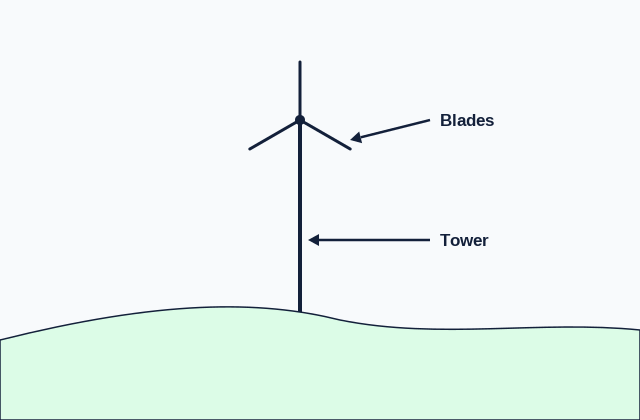 Tap to open the picture full size
Part 1 Think first Turbines on a hawk ridge
Commit to a guess first. Being wrong now makes the right idea stick better.
Predict first
A made-up company builds tall wind turbines along a ridge where hawks fly past each fall and bats hunt insects on summer nights. How do you predict the turbines could affect these animals?
In short. Wind energy turns the motion of the air into electricity, and it has its own effects on the environment.
- How moving air turns a turbine and a generator.
- Whether wind counts as a renewable source and a clean one, and why.
- The environmental effects of a wind farm.
Part 2 Learn it Electricity from moving air
2a. Moving air turns the blades
Wind turbines use the kinetic energy of moving air to spin a turbine, which spins a generator, producing electricity.
Kinetic energy is the energy of motion. Wind is moving air, so it carries kinetic energy.
- The wind pushes on the turbine's long blades and turns them.
- The blades turn a shaft, the turbine.
- The shaft spins a generator in the housing at the top of the tower.
- The generator produces electricity, which runs down the tower to power lines.
No fuel burns and no water boils. The air's own motion does the work. Background: faster wind carries more kinetic energy, so turbines are placed on ridges, open plains and coasts, and offshore, where the wind is strong and steady.
Quick check · Multiple choice
At a made-up wind farm, what turns each turbine's generator?
2b. Renewable and clean
Wind energy is a renewable, clean source of energy.
- Renewable: the wind is driven by the sun heating the Earth unevenly, so new moving air keeps arriving. A turbine that uses today's wind does not use up tomorrow's. In 6.1's terms, it is replenished naturally at or near the rate it is used.
- Clean: a turbine burns no fuel as it runs, so it gives off no smoke, exhaust gases or carbon dioxide while making electricity.
Background: a turbine stops when the wind drops, so the electricity comes and goes with the weather. Calm days do not use up the wind; they are a reason a wind farm does not run all the time.
Quick check · Decide and justify
A student says a made-up wind farm is not a clean source of energy, because the turbines must release something as they spin. Is the student right?
Which reason supports your answer?
2c. Birds and bats
However, birds and bats may be killed if they fly into the spinning turbine blades.
A large turbine's blades can be longer than a school bus, and their tips move fast. Birds flying past, such as hawks and eagles hunting or migrating, and bats feeding at night can be struck.
That is the main drawback named for wind energy: clean and renewable, but a risk to animals that fly. Background: one response is to site wind farms away from the routes birds follow when they migrate.
Quick check · Select all
A made-up county reviews a plan for a wind farm on open plains that flocks of geese cross each spring. Which two statements about the plan are accurate? Pick two.
Select 2 answers, then check.
Part 3 Watch it done How many homes can a wind farm run?
Open each step in turn, answer the why, then finish the calculation yourself.
A made-up wind farm has 40 turbines. Each produces 7,500 megawatt-hours (MWh) of electricity a year. A home in the region uses 10 MWh a year. How many homes' worth of electricity does the farm produce?
Step 1 · Find the farm's total
MWh a year from all the turbines.
Why this step?
Why does each turbine produce electricity with no fuel delivered?
The kinetic energy of the moving air spins the turbine, which spins a generator, so the wind itself supplies the energy.
Step 2 · Choose the operation
Each home uses 10 MWh, so divide the total by the use per home: .
Your step · Calculate
Finish it. The farm produces 300,000 MWh a year, and a home uses 10 MWh a year. How many homes' worth is that?
homes
Thirty thousand homes run on moving air, with no fuel burned. The rest of the lesson weighs that against the risk the spinning blades pose to animals that fly.
Part 4 Try it Order the turbine, then check an account
First put the steps in a made-up wind turbine in order. Then find where a student's account of a wind farm goes wrong.
Try it · Put it in order
Put the steps in a made-up wind turbine in order, first to last.
Try it · Spot the error
A student describes a made-up wind farm. Tap the first line that goes wrong.
Part 5 Explain it Fifteen years of wind power
Write your answer first. Nothing you type here leaves this page. Then compare it with the model and each scoring point.
Free response is 40% of the exam score. This one is shaped like Question 2, Analyze and interpret quantitative data.
Free-response practice · Question 2 style
A made-up country's electricity from wind, in terawatt-hours (TWh), made up for practice:
- 2010: 12 TWh
- 2015: 30 TWh
- 2020: 58 TWh
- 2025: 90 TWh, out of 300 TWh of electricity from all sources
(a) Describe the trend in the country's electricity from wind.
(b) Calculate the percent of the country's electricity in 2025 that came from wind. Show your work.
(c) Calculate the percent increase in electricity from wind from 2010 to 2025. Show your work.
(d) Explain why wind energy is considered a renewable, clean source.
(e) Explain one environmental drawback of the country's growing number of wind turbines.
Model answer
(a) Electricity from wind rose every five years, from 12 TWh in 2010 to 90 TWh in 2025.
(b) of the country's electricity came from wind.
(c) increase.
(d) The wind keeps arriving, driven by the sun heating the Earth, so using it does not use it up, which makes it renewable; the turbines burn no fuel, so they release no air pollutants as they run, which makes it clean.
(e) Birds and bats may be killed if they fly into the spinning turbine blades, so more turbines put more flying animals at risk.
Score your own answer. This is a self-check, not a grade. Tick each point your answer makes.
Part 6 Check yourself A wind farm changes its nights
The first two questions use the table.
A made-up wind farm counts the bats and birds found under its turbines. In year 1 the blades spin at every wind speed. In year 2 the blades are held still on summer nights when the wind is light. The numbers are made up for practice.
| Measure | Year 1 | Year 2 |
|---|---|---|
| Birds found killed | 96 | 90 |
| Electricity produced (MWh) | 312,000 | 309,000 |
| Bats found killed | 640 | 208 |
Case question 1 · Multiple choice
Which statement do the data best support?
Case question 2 · Calculate
Using the table: by what percent did the number of bats found killed fall from year 1 to year 2?
The rest stand on their own and do not use the case.
Check yourself · Sort it
What does each made-up observation at a wind farm show about wind energy? Tap a card, then its group.
Renewable
Clean
A risk to animals that fly
Check yourself · Fill the statement
Complete the account of a made-up offshore wind farm.
The farm's turbines draw on wind, a source, though seabirds that fly into the spinning blades may be .
Part 7 Keep it Bring back earlier ideas
Two questions from earlier topics: the steps from water to a fuel cell's emission, and a student's account of a dam.
First put the steps from water to a fuel cell's emission in order. Then find where a student's account of a fuel cell bus goes wrong.
From 6.11 Hydrogen Fuel Cell · Put it in order
Put the steps for a made-up fuel cell car in order, first to last.
First sort made-up power plants by how they use water. Then find where a student's account of a dam goes wrong.
From 6.9 Hydroelectric Power · Spot the error
A student describes a made-up dam. Tap the first line that goes wrong.
In three lines
- Wind turbines use the kinetic energy of moving air to spin a turbine, which spins a generator, producing electricity.
- Wind energy is a renewable, clean source of energy.
- Birds and bats may be killed if they fly into the spinning turbine blades.
Exam strategy for this topic
- Section I, Multiple Choice: 80 questions in 90 minutes.
- Section II, Free Response: 3 questions in 70 minutes.
- This lesson's Explain it is shaped like free-response question 2, Analyze and interpret quantitative data.
- A four-function, scientific, or graphing calculator is allowed on both sections of the exam.
When a question asks how wind turbines work, trace kinetic energy of moving air to the turbine, the generator and electricity. For effects, say renewable and clean, then name the risk to birds and bats.
Questions students ask
How do wind turbines make electricity?
They use the kinetic energy of moving air to spin a turbine, which spins a generator, producing electricity.
Is wind energy renewable and clean?
Yes. Wind energy is a renewable, clean source of energy.
What is the main environmental drawback of wind turbines?
Birds and bats may be killed if they fly into the spinning turbine blades.
Course alignment, for teachers
AP Environmental Science topic 6.12, Unit 6: Energy Resources and Consumption.
- Skill 7.B: Describe potential responses or approaches to environmental problems.
This lesson maps all 2 essential knowledge statements of the topic to the part that teaches each one: 2 are checked by a scored question. The map is in the lesson file.