Unit 5 · Topic 5.10 · about 30 minutes · 7 parts · 11 scored checks, 2 of them multiple choice, plus 2 from earlier lessons
AP Environmental Science 5.10: Impacts of Urbanization
Unit 5: 10 to 15% of the multiple-choice section
What you'll be able to do
- Describe the effects of urbanization on the environment.
Key vocabulary
| Term | What it means | The exam trap |
|---|---|---|
| Urbanization | The growth of cities, as more people come to live in them and the built-up area spreads. | It changes the land, the water and the air around a city, not only the city itself. |
| Saltwater intrusion | Salt water moving into an aquifer that held fresh water. | It happens underground, long before anyone tastes it in a well. |
| Urban sprawl | The spread of a city's people from dense neighborhoods out to low-density suburbs on rural land. | The low-density suburbs it builds sit on what was farmland, forest or field. |
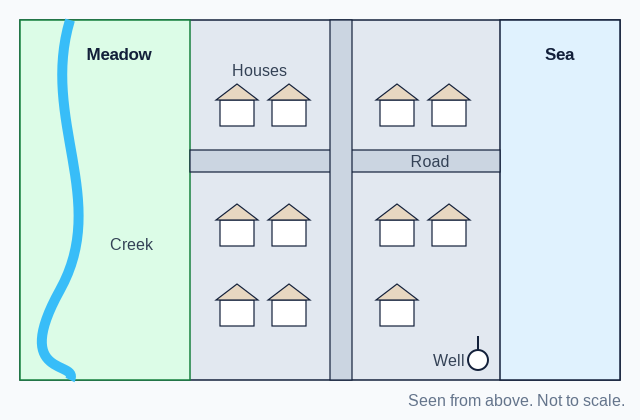 Tap to open the picture full size
Part 1 Think first Paving the meadow up the hill
Commit to a guess first. Being wrong now makes the right idea stick better.
Predict first
A growing town paves a large meadow on the hill above its creek for a shopping center: a big roof, a parking lot and sidewalks, with storm drains that empty into the creek. A row of houses stands beside the creek a kilometer downhill, and nothing is built or paved where they stand. The next heavy storm brings the same rain as before. What do you predict for those houses?
In short. Urbanization, the growth of cities, covers the ground, can use up resources, adds carbon dioxide to the atmosphere through burning fossil fuels and landfills, and can spread people out into suburbs on rural land.
- Impervious surfaces, such as roads, buildings, sidewalks and parking lots, do not let water reach the soil, which leads to flooding.
- A growing city can deplete the water and other resources it draws on, and near a coast it can lead to saltwater intrusion.
- Urban sprawl moves people from high-density areas to low-density suburbs that spread into rural land.
Part 2 Learn it What a growing city does to land, water and air
2a. Surfaces water cannot pass
Urbanization is the growth of cities, as more people come to live in them and the built-up area spreads.
Impervious surfaces are human-made structures, such as roads, buildings, sidewalks, and parking lots, that do not allow water to reach the soil, leading to flooding. "Impervious" means water cannot pass through.
Background, how the flooding happens: on a field or a forest floor, much of a storm's rain soaks into the soil and reaches a stream slowly. On a roof or a road it cannot soak in. It runs off at once into gutters and storm drains, and from them into the nearest stream, which rises faster and higher than it did before the land was built on. The more of a town that is paved and roofed, the more of each storm runs off.
Quick check · Multiple choice
A made-up neighborhood of houses is built on what was farmland. During a storm, on which part of it can rain still reach the soil?
2b. Using up water, and salt in the wells
Urbanization can lead to depletion of resources and saltwater intrusion in the hydrologic cycle.
A city needs water, land, energy and materials for its people, homes and businesses. As it grows, it draws more from the rivers, lakes and aquifers around it. Background: when a city takes water faster than rain and streams replace it, the source is drawn down and can be depleted.
Saltwater intrusion is salt water moving into an aquifer that held fresh water. Background: along a coast, fresh groundwater lies against salt water from the sea underground. Pumping a lot of fresh water from wells near the shore lowers it and lets the salt water move inland, until some wells draw salty water no one can drink or use on crops. A coastal city that grows by drilling more wells can make its own water worse.
Quick check · Select all
A made-up inland city's population doubles in 25 years. It meets the new demand by taking more water from its lake and pumping more from its wells. Which two are likely results? Pick two.
Select 2 answers, then check.
2c. More carbon dioxide
Urbanization, through the burning of fossil fuels and landfills, affects the carbon cycle by increasing the amount of carbon dioxide in the atmosphere.
A city's cars, buses and trucks burn gasoline and diesel; its buildings are heated with natural gas or oil; and some of its electricity comes from power plants that burn coal or natural gas. Background: these are fossil fuels, and burning them releases their carbon into the air as carbon dioxide.
A city also throws away a great deal, and most of it is buried in landfills. Background: as the food, paper, wood and yard waste in a landfill break down, they release carbon dioxide. So the carbon cycle around a city moves more carbon into the atmosphere than it did before the city grew.
Quick check · Decide and justify
A city manager says the city's new landfill adds no carbon dioxide to the atmosphere, as its waste is buried, not burned. Is the manager right?
Which reason supports your answer?
2d. Spreading out
Population density is the number of people living on each unit of land, such as each square kilometer.
Urban sprawl is the change in population distribution from high population density areas to low density suburbs that spread into rural lands, leading to potential environmental problems. In a dense neighborhood, apartments and row houses put many people on each block. In a low-density suburb, houses sit on large lots, so the same number of people covers far more ground, and the suburbs grow out over farms, forests and fields.
Background: the potential problems include farmland and habitat built over, more land under roads and roofs, and longer drives that burn more fuel.
Quick check · Sort it
Is each change urban sprawl? Tap a card, then its group.
Urban sprawl
Not urban sprawl
Part 3 Watch it done How much land does sprawl take?
Open each step in turn, answer the why, then finish the calculation yourself.
A made-up city expects 36,000 new residents. Its existing neighborhoods hold 4,500 people per square kilometer; the planned suburbs at its edge would hold 800 people per square kilometer. How many more square kilometers of land would the suburbs cover than housing the same people at the city's density?
Step 1 · Land from people and density
Density is people per square kilometer, so the land needed is the people divided by the density.
Why this step?
Why does the lower density need more land?
Each square kilometer of suburb holds fewer people, so it takes more square kilometers to hold the same 36,000 people.
Step 2 · Land for the suburbs
square kilometers.
Step 3 · Land at the city's density, then the difference
Divide 36,000 by 4,500 the same way, then subtract that from the suburbs' land.
Your step · Calculate
Finish it. The suburbs need 45 square kilometers for 36,000 people. How many more square kilometers is that than housing them at the city's 4,500 people per square kilometer?
square kilometers
The suburbs cover 45 square kilometers, more than five times the 8 the city's density would need, and the extra 37 come out of the farms and woods at the city's edge. That is what spreading into rural lands means in numbers.
Part 4 Try it Match the changes, then check an account
First match each change in a growing city to its most likely result. Then find where a student's account of a spreading county goes wrong.
Try it · Match
A made-up coastal city is growing fast. Match each change to its most likely result.
Try it · Spot the error
A student explains how a made-up county changed as it grew. Tap the first line that goes wrong.
Part 5 Explain it Does paving add runoff?
Write your answer first. Nothing you type here leaves this page. Then compare it with the model and each scoring point.
Free response is 40% of the exam score. This one is shaped like Question 1, Design an investigation.
Free-response practice · Question 1 style
A student wants to find out whether covering soil with pavement increases the amount of rain that runs off it. The student has six identical trays filled with the same soil, concrete paving slabs cut to fit three of the trays, a stand that tilts each tray to the same slope, a watering can that sprinkles water like rain, and containers and a measuring cylinder to catch and measure the water that runs off.
(a) Identify a testable hypothesis for the investigation.
(b) Identify the independent variable and the dependent variable.
(c) Describe how the student should set up the trays, including how many trays get each treatment and what is kept the same.
(d) Describe how the student could measure the dependent variable.
(e) Describe the results that would support the hypothesis, and explain how those results relate to flooding in a city.
Model answer
(a) If soil is covered with pavement, then more of the water sprinkled on it will run off than off bare soil.
(b) Independent variable: whether the soil is covered with paving slabs. Dependent variable: the volume of water that runs off each tray.
(c) Cover the soil in three trays with the paving slabs, sealed at the edges, and leave the other three trays as bare soil. Tilt all six to the same slope and sprinkle the same volume of water on each, from the same height, over the same time.
(d) Catch the water that runs off the low end of each tray in a container and measure its volume with the measuring cylinder.
(e) The paved trays lose more water as runoff than the bare-soil trays. Pavement is an impervious surface: it does not let water reach the soil, so in a city the rain runs off roads and parking lots into drains and streams, which can lead to flooding.
Score your own answer. This is a self-check, not a grade. Tick each point your answer makes.
Part 6 Check yourself Salt in the wells
The first two questions use the table.
A made-up coastal city grew for thirty years. To supply its new residents, it drilled more wells near the shore and pumped more groundwater. The city also tested the water from one well 2 kilometers from the sea for chloride, a part of sea salt. The numbers are made up for practice.
| Year | Population (thousands) | Groundwater pumped (million cubic meters per year) | Chloride in the coastal well (milligrams per liter) |
|---|---|---|---|
| 1990 | 120 | 14 | 40 |
| 2000 | 180 | 21 | 65 |
| 2010 | 260 | 30 | 150 |
| 2020 | 340 | 38 | 290 |
Case question 1 · Multiple choice
The city met its growing demand by pumping more groundwater near the shore. Using the table, which describes an unintended consequence of that solution?
Case question 2 · Calculate
Using the table: by what percent did the chloride in the coastal well rise from 2000 to 2020?
The rest stand on their own and do not use the case.
Check yourself · Fill the statement
Complete the description of how a growing city adds carbon dioxide to the atmosphere.
Its cars, buses and power plants burn , and the waste it throws away is buried in , where it breaks down.
Check yourself · Rank it
Three made-up neighborhoods of the same size and slope each drain into their own small creek. The same heavy storm falls on all three. Rank the creeks by how high each likely rises during the storm.
Highest creek first
Give each one a place, 1 for first. Give two the same place if they are equal.
Your ranking: none yet
Part 7 Keep it Bring back earlier ideas
Two questions from earlier topics: what leaves a mine, and a student's account of overgrazing.
First sort what leaves a mine into wastes and products. Then find where a student's account of deep coal goes wrong.
From 5.9 Impacts of Mining · Sort it
What is each thing that leaves a mine? Tap a card, then its group.
Moved soil and rock
Slag and tailings
Product
First decide whether a shopper reads a meat label rightly. Then find where a student's account of overgrazing goes wrong.
From 5.7 Meat Production Methods · Spot the error
A student explains how overgrazing can lead to desertification. Tap the first line that goes wrong.
In three lines
- Impervious surfaces, such as roads, buildings, sidewalks and parking lots, do not let water reach the soil, which leads to flooding.
- Urbanization can deplete resources and, near a coast, lead to saltwater intrusion; burning fossil fuels and landfills add carbon dioxide.
- Urban sprawl moves people from high-density areas to low-density suburbs that spread into rural land, with potential environmental problems.
Exam strategy for this topic
- Section I, Multiple Choice: 80 questions in 90 minutes.
- Section II, Free Response: 3 questions in 70 minutes.
- This lesson's Explain it is shaped like free-response question 1, Design an investigation.
- A four-function, scientific, or graphing calculator is allowed on both sections of the exam.
When a question asks how a city changes a cycle, name the cycle and the change: in the water cycle, impervious surfaces keep rain from the soil and pumping can bring in salt water; in the carbon cycle, burning fossil fuels and landfills add carbon dioxide to the atmosphere.
Questions students ask
What are impervious surfaces?
Human-made structures, such as roads, buildings, sidewalks and parking lots, that do not allow water to reach the soil, leading to flooding.
How does urbanization add carbon dioxide to the atmosphere?
Through the burning of fossil fuels and through landfills, both of which increase the amount of carbon dioxide in the atmosphere.
What is urban sprawl?
The change in population distribution from high population density areas to low density suburbs that spread into rural lands, leading to potential environmental problems.
Course alignment, for teachers
AP Environmental Science topic 5.10, Unit 5: Land and Water Use.
- Skill 7.C: Describe disadvantages, advantages, or unintended consequences for potential solutions.
This lesson maps all 4 essential knowledge statements of the topic to the part that teaches each one: 4 are checked by a scored question. The map is in the lesson file.