Unit 4 · Topic 4.4 · about 30 minutes · 7 parts · 10 scored checks, 2 of them multiple choice, plus 2 from earlier lessons
AP Environmental Science 4.4: Earth’s Atmosphere
Unit 4: 10 to 15% of the multiple-choice section
What you'll be able to do
- Describe the structure and composition of the Earth's atmosphere: its major gases and their relative abundance, and its five layers, set by temperature gradients.
Key vocabulary
| Term | What it means | The exam trap |
|---|---|---|
| Atmosphere | The layer of gases held around Earth by gravity. | It is a mix of several gases, not one gas. |
| Relative abundance | A part's share of a whole mixture, compared with the other parts. | It is a share, so the shares of all the parts add up to the whole. |
| Temperature gradient | How temperature changes with height: in which direction, and how fast. | A gradient has a direction. Temperature can fall or rise as you go up. |
 Tap to open the picture full size
Part 1 Think first One deep breath
Commit to a guess first. Being wrong now makes the right idea stick better.
Predict first
Take one deep breath. Which gas do you predict makes up the largest share of the air you just breathed in?
In short. The atmosphere is a mix of gases in very different amounts, and it is divided into layers by how its temperature changes with height.
- Each major gas in the atmosphere has its own relative abundance, its share of the whole mix.
- From the ground up, the layers are the troposphere, stratosphere, mesosphere, thermosphere and exosphere.
- A layer ends where the direction of temperature change with height switches.
Part 2 Learn it What the air is made of, and how it is layered
2a. The gases of the atmosphere
The atmosphere is made up of major gases, each with its own relative abundance. Relative abundance is a gas's share of the whole mix, compared with the other gases.
Background: these are the widely measured shares of dry air, which is air with its water vapor left out.
- Nitrogen is about 78 percent.
- Oxygen is about 21 percent.
- Argon is just under 1 percent.
- Carbon dioxide is about 0.04 percent, a tiny share.
Water vapor is left out of the list because its share changes from place to place and day to day, from almost none in cold, dry air to a few percent in warm, humid air.
A gas's share says nothing about how much it matters. Carbon dioxide is a tiny share of the air, yet plants take it in for photosynthesis, and a later unit shows how a change in it can warm the planet.
Quick check · Multiple choice
Which list puts four gases of dry air in order from the largest share to the smallest?
2b. The five layers
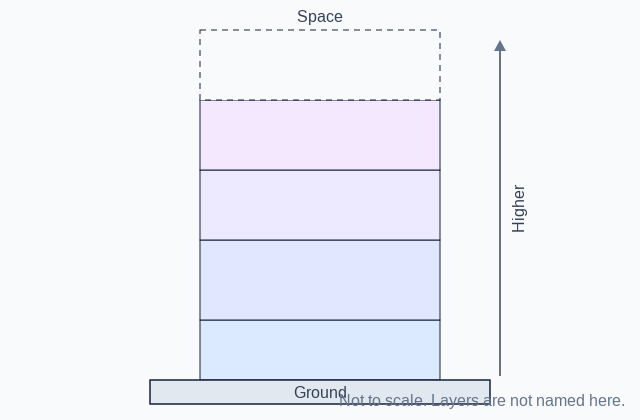
The atmosphere is not the same all the way up. The layers of the atmosphere include the troposphere, stratosphere, mesosphere, thermosphere and exosphere. That is their order from the ground up.
- The troposphere starts at the ground. It is the air we live in.
- The stratosphere sits on top of the troposphere.
- The mesosphere is above the stratosphere.
- The thermosphere is above the mesosphere.
- The exosphere is the outermost layer, where the air thins out into space.
Background: the troposphere reaches roughly 8 to 15 km up, the stratosphere to about 50 km and the mesosphere to about 85 km. The thermosphere reaches hundreds of kilometers, and the exosphere goes on beyond it. The heights shift from place to place and season to season, which is a clue that the layers are not set by distance.
Quick check · Put it in order
Put the five layers of the atmosphere in order, starting with the layer at the ground and ending with the layer farthest out.
2c. What sets a layer
The layers of the atmosphere are based on temperature gradients. A temperature gradient is how temperature changes with height: which way it goes, and how fast.
Go up from the ground and the temperature does not simply fall. In the troposphere it falls with height. In the stratosphere it rises with height. In the mesosphere it falls again, and in the thermosphere it rises again.
So a layer is a stretch of the atmosphere with one direction of change. Where the temperature stops falling and starts rising, or stops rising and starts falling, one layer ends and the next begins. That is why the boundaries are found by measuring temperature, not by marking off equal distances.
Background: the stratosphere warms with height because ozone there absorbs ultraviolet light from the sun.
Quick check · Decide and justify
A made-up probe rises through the air. Its readings show temperature falling with height from the ground up to 14 km, then rising with height from 14 km up to 48 km. A student says 14 km marks the top of one layer and the bottom of the next. Is the student right?
Which reason supports your answer?
Part 3 Watch it done How fast does it cool going up?
Open each step in turn, answer the why, then finish the calculation yourself.
Suppose a made-up weather balloon reads 18 °C at the ground. Temperature falls steadily with height until the balloon reaches the top of the layer, at 12 km, where it reads -54 °C. By how many degrees does the temperature fall for each kilometer of height?
Step 1 · Name the layer
The readings start at the ground and fall steadily with height, so the balloon is in the troposphere.
Step 2 · Find the change
Temperature change = final - starting = °C. The minus sign means it fell by 72 °C.
Why this step?
Why work it out per kilometer?
Layers differ in thickness. A rate per kilometer lets you compare how steeply temperature changes in one layer with another, or in one place with another, whatever the heights.
Step 3 · Set up the rate
Fall per kilometer = the size of the change the height gained.
Your step · Calculate
Finish it. A made-up balloon reads 18 °C at the ground and -54 °C at 12 km, with temperature falling steadily in between. By how many degrees Celsius does the temperature fall for each kilometer of height?
°C per km
Temperature in this made-up troposphere falls 6 °C for each kilometer. Above 12 km the readings would start to rise: a new gradient, and so a new layer.
Part 4 Try it A list of layers, and a list of gases
First pick the real layers of the atmosphere out of a list. Then find where a student's account of the air goes wrong.
Try it · Select all
A student writes four words while studying Earth's systems. Which two name layers of the atmosphere? Pick two.
Select 2 answers, then check.
Try it · Spot the error
A student describes the gases in dry air. Tap the first line that goes wrong.
Part 5 Explain it A probe's trip up through the air
Write your answer first. Nothing you type here leaves this page. Then compare it with the model and each scoring point.
Free response is 40% of the exam score. This one is shaped like Question 2, Analyze and interpret quantitative data.
Free-response practice · Question 2 style
Suppose a made-up rocket probe records the air temperature every 10 km as it rises. The numbers are made up for practice, but they follow the measured pattern.
- 0 km: 15 °C
- 10 km: -50 °C
- 20 km: -45 °C
- 30 km: -38 °C
- 40 km: -22 °C
- 50 km: -2 °C
- 60 km: -18 °C
- 70 km: -48 °C
- 80 km: -86 °C
- 90 km: -70 °C
- 100 km: -40 °C
(a) Describe how temperature changes with height from 0 km to 10 km in these data.
(b) Calculate the average change in temperature per kilometer from 10 km to 50 km. Show your work.
(c) Identify the height in these data that marks the boundary between the second and third layers from the ground, and justify your choice with the data.
(d) Identify the layer in which the reading at 90 km was taken, and explain your answer using the data.
Model answer
(a) Temperature falls as height increases, from 15 °C at the ground to -50 °C at 10 km, a drop of 65 °C.
(b) °C, a rise. km. °C per km, rising with height.
(c) 50 km. Temperature rises with height from 10 km up to 50 km, then falls with height above it (-2 °C at 50 km, -18 °C at 60 km). The direction of change switches there, so one layer ends and the next begins.
(d) The thermosphere. The data show four stretches: falling to 10 km, rising to 50 km, falling to 80 km, then rising again above 80 km (-86 °C at 80 km, -70 °C at 90 km). The reading at 90 km is in the fourth stretch from the ground, which is the thermosphere.
Score your own answer. This is a self-check, not a grade. Tick each point your answer makes.
Part 6 Check yourself Four bands on a temperature graph
The first two questions use the graph.
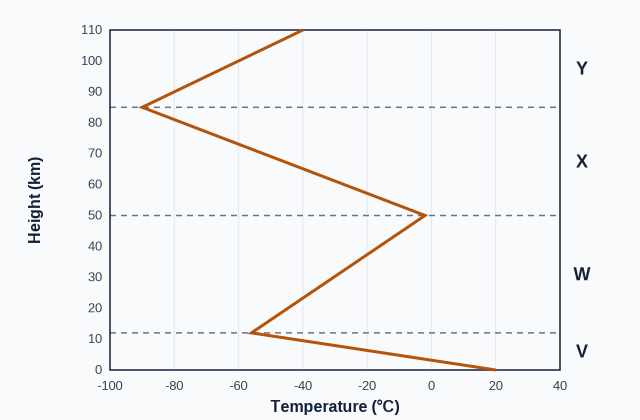
Suppose a class plots the temperatures a made-up balloon and rocket probe recorded at each height. The line is made up for practice, but its shape follows the measured pattern. The class splits the graph into four bands, V, W, X and Y, from the ground up.
Case question 1 · Multiple choice
Using the graph: what marks the boundary between band V and band W?
Case question 2 · Sort it
Using the graph: tap a band, then how its temperature changes as height increases.
Falls with height
Rises with height
The rest stand on their own and do not use the case.
Check yourself · Calculate
A made-up tank holds 500 L of dry air. Oxygen makes up about 21 percent of dry air. About how many liters of the air in the tank are oxygen?
Check yourself · Fill the statement
Describe where three made-up instruments sit in the atmosphere. Tap a blank, then an answer.
A thermometer on a pole in a schoolyard measures the air of the . A detector carried just above the top of the stratosphere is in the . A probe at the outer edge of the atmosphere, far above the thermosphere, is in the .
Part 7 Keep it Bring back earlier ideas
Two questions from earlier topics: ranking soils by how easily water moves through them, and a student's account of a plate boundary.
First rank three soils from a drainage test. Then read what a texture triangle result means for a farm.
From 4.3 Soil Composition and Properties · Rank it
Three made-up soils are packed into identical columns, and the same volume of water is poured onto each. The water takes 2 minutes to drain through soil X, 40 minutes through soil Y and 9 minutes through soil Z. Rank the soils by permeability.
Highest permeability first
Give each one a place, 1 for first. Give two the same place if they are equal.
Your ranking: none yet
First decide which hazard a boundary brings. Then find the first mistake in a student's reasoning.
From 4.1 Plate Tectonics · Spot the error
A student explains what can happen at a made-up boundary in the open ocean. Tap the first line that goes wrong.
In three lines
- The atmosphere is made up of major gases, each with its own relative abundance; in dry air nitrogen has the largest share and carbon dioxide a tiny one.
- From the ground up, the layers are the troposphere, stratosphere, mesosphere, thermosphere and exosphere.
- The layers are based on temperature gradients: a boundary sits where temperature switches from falling to rising with height, or the reverse.
Exam strategy for this topic
- Section I, Multiple Choice: 80 questions in 90 minutes.
- Section II, Free Response: 3 questions in 70 minutes.
- This lesson's Explain it is shaped like free-response question 2, Analyze and interpret quantitative data.
- A four-function, scientific, or graphing calculator is allowed on both sections of the exam.
When a question shows temperature against height, find each place the line changes direction: those are the layer boundaries. Count stretches from the ground to name a layer.
Questions students ask
What gases make up the atmosphere?
The atmosphere is made up of major gases, each with its own relative abundance. In dry air, nitrogen is about 78 percent, oxygen about 21, argon just under 1 and carbon dioxide about 0.04.
What are the layers of the atmosphere?
From the ground up: the troposphere, stratosphere, mesosphere, thermosphere and exosphere.
How are the layers of the atmosphere defined?
By temperature gradients. Each layer is a stretch where temperature changes in one direction with height, and a boundary sits where that direction switches.
Course alignment, for teachers
AP Environmental Science topic 4.4, Unit 4: Earth Systems and Resources.
- Skill 2.A: Describe characteristics of an environmental concept, process, or model represented visually.
This lesson maps all 2 essential knowledge statements of the topic to the part that teaches each one: 2 are checked by a scored question. The map is in the lesson file.