Unit 4 · Topic 4.7 · about 30 minutes · 7 parts · 10 scored checks, 2 of them multiple choice, plus 2 from earlier lessons
AP Environmental Science 4.7: Solar Radiation and Earth’s Seasons
Unit 4: 10 to 15% of the multiple-choice section
What you'll be able to do
- Explain how the sun's energy affects the Earth's surface: insolation, the angle of the sun's rays, the change with latitude and season, and the tilt of Earth's axis.
Key vocabulary
| Term | What it means | The exam trap |
|---|---|---|
| Insolation | Incoming solar radiation: the sun's energy arriving at Earth. | It is not insulation. It is energy coming in, not something keeping heat in. |
| Intensity | The energy arriving on each square meter of a surface. | Two beams can carry the same energy and still differ in intensity, if one is spread over more area. |
| Directly horizontal | The latitude that faces the sun's rays head on, where the noon sun is straight overhead. | It describes the ground meeting the rays straight on, not the rays skimming flat along the ground. |
| Latitude | How far north or south of the equator a place lies, measured in degrees. | Latitude is north or south of the equator; position east or west is longitude. |
 Tap to open the picture full size
Part 1 Think first Why is winter cold?
Commit to a guess first. Being wrong now makes the right idea stick better.
Predict first
In most of the United States, summer is warm and winter is cold. What do you predict is the main cause of the seasons?
In short. Most of the energy that reaches Earth's surface comes from the sun, and how much arrives on each square meter depends on the angle of the sun's rays.
- Incoming solar radiation, insolation, is Earth's main source of energy, and it depends on season and latitude.
- Rays that strike the ground straight on deliver the most energy to each square meter; slanted rays spread the same energy over more ground.
- The equator receives the highest solar radiation per unit area, and it decreases toward the poles.
Part 2 Learn it How the sun's energy reaches the ground
2a. Insolation
Incoming solar radiation (insolation) is the Earth's main source of energy and is dependent on season and latitude. Sunlight warms the land, the oceans and the air, powers photosynthesis, and evaporates water into the water cycle.
Earth's hot interior does give off some heat, but it is much less than what arrives from the sun.
The insolation a place receives is not fixed. It changes with latitude, how far north or south of the equator the place is, and with the season. The rest of this lesson is about why.
Quick check · Decide and justify
A student says most of the energy that warms Earth's surface comes from heat rising out of Earth's hot interior. Is the student right?
Which reason supports your answer?
2b. The angle of the rays
The angle of the sun's rays determines the intensity of the solar radiation. Intensity is the energy arriving on each square meter of ground.
Picture a flashlight. Point it straight down and it lights a small, bright circle. Tilt it and the same light spreads into a larger, dimmer oval. The flashlight gives off just as much light, but each bit of the floor gets less. Sunlight works the same way: rays that strike the ground straight on pack their energy into the least area, and rays that come in at a slant spread the same energy over more ground.
Due to the shape of the Earth, the latitude that is directly horizontal to the solar radiation receives the most intensity. Earth is a sphere, so the rays meet its surface at a different angle at each latitude. At one latitude the ground faces the rays head on, and the noon sun is straight overhead; there the intensity is greatest. North and south of it, the ground curves away and the rays arrive more and more slanted.
The highest solar radiation per unit area is received at the equator and decreases toward the poles. Over a year, the rays strike the equator most nearly straight on, and the polar regions only at a low slant.
Quick check · Multiple choice
Two identical made-up solar panels stand side by side at noon on a winter day, when the sun is low in the sky. One lies flat on the ground. The other is tilted to face the low sun. Which is true?
2c. Tilt, seasons and daylight
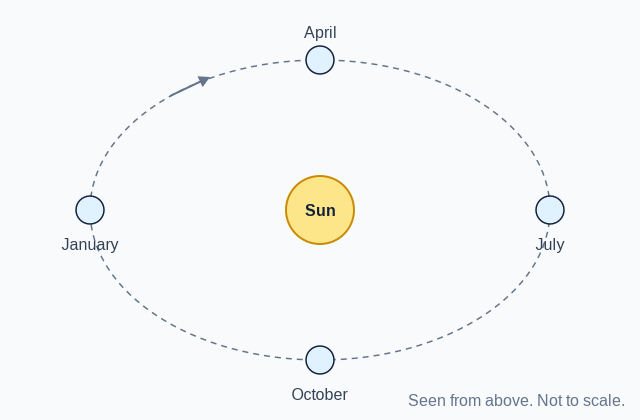
The tilt of Earth's axis of rotation causes the Earth's seasons and the number of hours of daylight in a particular location on the Earth's surface. Earth spins once a day around its axis of rotation, an imaginary line through the North and South Poles. That axis is tilted, about 23.5° (background), and it keeps pointing the same way in space all year as Earth travels around the sun.
So for part of the year the Northern Hemisphere leans toward the sun. Its noon sun stands higher, its rays arrive more nearly straight on, and its days are longer: summer. Half a year later the Northern Hemisphere leans away. Its rays arrive at a lower slant and its days are shorter: winter. The Southern Hemisphere has the opposite season at the same time.
The solar radiation received at a location on the Earth's surface varies seasonally, with the most radiation received during the location's longest summer day and the least on the shortest winter day. On the longest day, the noon sun is at its highest and the sun is up the most hours. The hottest weather often comes weeks later, because land and water take time to warm up, but the most radiation arrives on the longest day.
Background: Earth's distance from the sun changes only a little through the year, and Earth is closest in early January, during the Northern Hemisphere's winter. Distance does not cause the seasons.
Quick check · Select all
Which two are caused by the tilt of Earth's axis? Pick two.
Select 2 answers, then check.
Part 3 Watch it done How much weaker is a slanted beam?
Open each step in turn, answer the why, then finish the calculation yourself.
Suppose a made-up beam of sunlight carries 1,000 W. Where it strikes the ground straight on, it covers 1.0 square meter. At a higher latitude, the same beam arrives at a slant and covers 1.6 square meters. What is its intensity there, in watts per square meter?
Step 1 · Name what stays the same
It is the same beam, so the energy it carries stays 1,000 W. Only the ground it covers changes.
Step 2 · Find the intensity straight on
Intensity = power area, so straight on it is W per square meter.
Why this step?
Why does the slanted beam cover more ground?
Earth's surface curves away from the rays at higher latitudes, so the rays meet the ground at a slant and spread out along it, like a tilted flashlight beam.
Step 3 · Set up the slanted case
Divide the same power by the larger area.
Your step · Calculate
Finish it. A made-up beam of sunlight carrying 1,000 W strikes the ground at a slant and covers 1.6 square meters. What is its intensity, in watts per square meter?
W per square meter
The slanted beam delivers 625 W per square meter, not 1,000: the same energy, spread thinner. That is why the angle of the rays determines the intensity.
Part 4 Try it Four latitudes, and a town's sunniest day
First rank four places by the solar radiation they receive. Then find where a student's account of one town's year goes wrong.
Try it · Rank it
Four made-up weather stations stand at different latitudes. Rank them by the solar radiation they receive per unit area over a year.
Most solar radiation per unit area first
Give each one a place, 1 for first. Give two the same place if they are equal.
Your ranking: none yet
Try it · Spot the error
A student describes the solar radiation a made-up town at 40° N receives through the year. Tap the first line that goes wrong.
Part 5 Explain it A lamp at different angles
Write your answer first. Nothing you type here leaves this page. Then compare it with the model and each scoring point.
Free response is 40% of the exam score. This one is shaped like Question 1, Design an investigation.
Free-response practice · Question 1 style
A class wants to test how the angle at which light strikes a surface affects how much the surface warms. They have a lamp, several identical black cardboard squares, a thermometer taped under each square, a protractor to set the angle of each square, and a timer.
(a) Identify a testable hypothesis for the investigation.
(b) Identify the independent variable and the dependent variable.
(c) Describe one variable the class should keep the same for every square, and why.
(d) Describe the results the class would expect if your hypothesis is correct.
(e) Explain how the results relate to why the equator receives the highest solar radiation per unit area.
Model answer
(a) If light strikes a surface more nearly straight on, then the surface will warm more in the same time than one the light strikes at a slant.
(b) Independent variable: the angle at which the light strikes each square (for example 90°, 60°, 30°). Dependent variable: the rise in temperature of each square after a set time.
(c) The distance from the lamp to each square, because a square placed closer would receive more light whatever its angle. (The lamp, the time and the starting temperature also fit.)
(d) The square the light strikes straight on, at 90°, warms the most, and the warming gets smaller as the angle gets lower.
(e) The angle of the rays determines the intensity. At the equator the sun's rays strike the ground most nearly straight on, like the 90° square, so each square meter receives the most energy; toward the poles the rays arrive at a lower slant, like the low-angle squares.
Score your own answer. This is a self-check, not a grade. Tick each point your answer makes.
Part 6 Check yourself A city's year of sunlight
The first two questions use the chart.
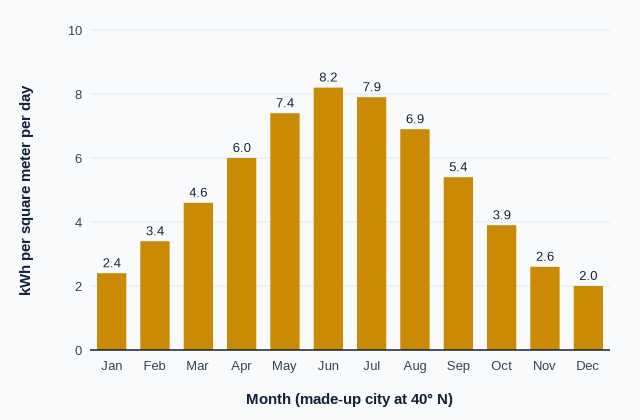
The chart shows the solar radiation that reaches each square meter of ground on a cloudless day in the middle of each month, at a made-up city at 40° N. The values are made up for practice, but they follow the measured pattern.
Case question 1 · Multiple choice
Using the chart: in which month does the city receive the most solar radiation, and why that month?
Case question 2 · Calculate
Using the chart: by what percent is the city's June value greater than its December value?
The rest stand on their own and do not use the case.
Check yourself · Decide and justify
On a made-up date, the noon sun is straight overhead at 10° S, so its rays strike the ground there head on. A student says that at noon that day, the ground at 10° S receives more intense solar radiation than the ground at the equator. Is the student right?
Which reason supports your answer?
Check yourself · Sort it
Each card describes Chicago, at about 42° N, on one day of the year. Tap a card, then the season it describes.
Northern Hemisphere summer
Northern Hemisphere winter
Part 7 Keep it Bring back earlier ideas
Two questions from earlier topics: two watersheds with different soils, and a student's account of the gases in dry air.
First use given soil data to compare two watersheds. Then judge a claim about what counts as part of a watershed.
From 4.6 Watersheds · Select all
Two made-up watersheds get the same storm. They have the same area, length, slope and vegetation. Watershed F's soil is sandy, and water soaks into it quickly. Watershed G's soil is clay, and water soaks into it slowly. Which two are most likely? Pick two.
Select 2 answers, then check.
First pick the real layers of the atmosphere out of a list. Then find where a student's account of the air goes wrong.
From 4.4 Earth’s Atmosphere · Spot the error
A student describes the gases in dry air. Tap the first line that goes wrong.
In three lines
- Insolation is Earth's main source of energy, and it depends on season and latitude.
- The angle of the rays determines intensity: the latitude facing the rays head on receives the most, and per unit area the equator receives the most, decreasing toward the poles.
- The tilt of Earth's axis causes the seasons and the hours of daylight; a place receives the most radiation on its longest summer day and the least on its shortest winter day.
Exam strategy for this topic
- Section I, Multiple Choice: 80 questions in 90 minutes.
- Section II, Free Response: 3 questions in 70 minutes.
- This lesson's Explain it is shaped like free-response question 1, Design an investigation.
- A four-function, scientific, or graphing calculator is allowed on both sections of the exam.
When a question asks why a place gets more or less solar radiation, give the angle of the rays. When it asks about the seasons, give the tilt of Earth's axis, not the distance from the sun.
Questions students ask
What is insolation?
Incoming solar radiation. It is Earth's main source of energy and depends on season and latitude.
Why does the equator receive the most solar radiation?
The angle of the sun's rays determines intensity. Over a year the rays strike the equator most nearly straight on, so it receives the highest solar radiation per unit area, decreasing toward the poles.
What causes the seasons?
The tilt of Earth's axis of rotation. It causes the seasons and the number of hours of daylight in a place.
Course alignment, for teachers
AP Environmental Science topic 4.7, Unit 4: Earth Systems and Resources.
- Skill 2.A: Describe characteristics of an environmental concept, process, or model represented visually.
This lesson maps all 5 essential knowledge statements of the topic to the part that teaches each one: 5 are checked by a scored question. The map is in the lesson file.