Unit 8 · Topic 8.4 · about 30 minutes · 7 parts · 10 scored checks, 2 of them multiple choice, plus 2 from earlier lessons
AP Environmental Science 8.4: Human Impacts on Wetlands and Mangroves
Unit 8: 7 to 10% of the multiple-choice section
What you'll be able to do
- Describe the impacts of human activity on wetlands and mangroves.
Key vocabulary
| Term | What it means | The exam trap |
|---|---|---|
| Wetland | An area where water covers the soil, either part or all of the time. | A wetland is defined by water over its soil, not by the kind of plants that happen to grow there. |
| Mangrove | A tree that grows in salty water along warm coasts, forming a kind of coastal wetland. | Mangroves grow in salty coastal water, not along freshwater rivers far inland. |
| Ecological service | A benefit that people and other living things get from an ecosystem without having to build it. | A service is something the ecosystem does, not a product someone makes from it. |
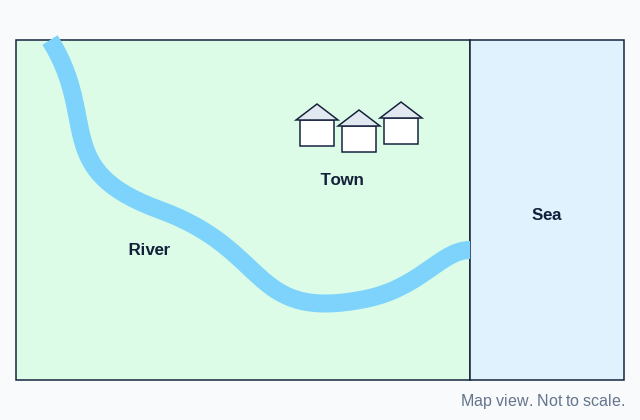 Tap to open the picture full size
Part 1 Think first A marsh becomes a shopping center
Commit to a guess first. Being wrong now makes the right idea stick better.
Predict first
A made-up coastal town fills in a marsh at its edge and paves it for a shopping center. In the next big spring storm, the streets beside the old marsh flood worse than they ever had. What do you predict best explains it?
In short. A wetland is an area where water covers the soil, either part or all of the time; mangroves are coastal wetlands of salt-tolerant trees.
- Wetlands clean and filter water and give many animals a place to live.
- Commercial development, dam construction and overfishing all threaten wetlands and mangroves.
- Pollutants from agriculture and from industrial waste are threats too.
Part 2 Learn it Wetlands and what threatens them
2a. What makes an area a wetland
Wetlands are areas where water covers the soil, either part or all of the time.
So a wetland does not have to be under water all year. What counts is water over the soil itself, for some or all of the year:
- A cypress swamp may be flooded every month of the year.
- A salt marsh along a bay may be covered at each high tide and bare at each low tide.
Mangroves are trees that grow in salty water along warm coasts, their roots standing in the mud of the shore. A mangrove stand is a kind of coastal wetland.
Soil that is only damp, with no water over it, does not meet the description.
Quick check · Multiple choice
Which made-up place fits the description of a wetland?
2b. What wetlands give
Wetlands provide a variety of ecological services, including water purification, flood protection, water filtration, and habitat.
An ecological service is a benefit that people and other living things get from an ecosystem without having to build it.
- Water purification and filtration: water moves slowly through a wetland, so mud and other particles settle out, and plants and microbes take up some of the pollutants. The water that leaves is cleaner than the water that came in.
- Flood protection: a wetland soaks up water like a sponge during a storm or a spring flood and lets it go slowly, so less of it rushes over the land nearby.
- Habitat: many fish, birds, frogs and insects feed, shelter or raise their young in wetlands.
For example, a made-up delta marsh holds back a river's spring flood for weeks while geese nest in its grass.
Quick check · Decide and justify
A made-up county plans to drain a small marsh beside a creek and plant a lawn in its place. A council member says the county will lose nothing but a home for some birds. Is the council member right?
Which reason supports your answer?
2c. Threats to wetlands and mangroves
Threats to wetlands and mangroves include commercial development, dam construction, overfishing, and pollutants from agriculture and industrial waste.
- Commercial development: filling or clearing a wetland to build shops, hotels, farms for shrimp or other businesses.
- Dam construction: a dam changes how much water reaches the land below it, so a wetland that needed that water can dry out.
- Overfishing: taking fish faster than they can replace themselves.
- Pollutants from agriculture and industrial waste: fertilizers, pesticides and factory wastes that wash or drain into the water.
A response to a threat is an action that removes it or reduces it. For example, a made-up coast where a resort cleared mangroves and boats emptied the lagoon of fish could limit new building on the shore and set a limit on the catch.
Quick check · Select all
A made-up mangrove coast is shrinking. Which two responses would reduce a threat to it? Pick two.
Select 2 answers, then check.
Part 3 Watch it done How much wetland is left?
Open each step in turn, answer the why, then finish the calculation yourself.
A made-up county had 3,600 hectares of wetland in 1980. By 2020, 1,350 hectares had been filled for commercial development and 270 hectares had dried out below a new dam. What percent of the 1980 wetland area is left?
Step 1 · Add up the area lost
hectares lost to development and the dam.
Why this step?
Why might a county keep track of how much wetland it has left?
Each hectare lost takes its ecological services with it, from flood protection to a home for wildlife, so the area left shows how much of those services the county still has.
Step 2 · Find the area left
hectares left. Divide by the 1980 area for the percent left.
Your step · Calculate
Finish it. 1,980 of the county's 3,600 hectares of wetland are left. What percent of the 1980 wetland area is left?
%
A little over half of the county's wetland is left. The rest of the lesson asks what each kind of loss does, and which response would save the most.
Part 4 Try it Put a marsh's story in order, then check an account
First put the events at a made-up marsh in order. Then find where a student's account of a mangrove coast goes wrong.
Try it · Put it in order
Put the events at a made-up floodplain marsh in order, first to last.
Try it · Spot the error
A student describes a made-up mangrove coast. Tap the first line that goes wrong.
Part 5 Explain it Marsh plants and muddy water
Write your answer first. Nothing you type here leaves this page. Then compare it with the model and each scoring point.
Free response is 40% of the exam score. This one is shaped like Question 1, Design an investigation.
Free-response practice · Question 1 style
A class wants to test how the number of marsh plants in a channel affects how clear muddy water is after it flows through. They have four identical plastic gutters, each 100 cm long and filled with the same depth of the same soil, young marsh plants of one kind, a large bucket of one batch of muddy water, a measuring cup, and a turbidity tube, which measures how cloudy water is (the higher the reading, the cloudier the water).
(a) Identify a testable hypothesis for the investigation.
(b) Identify the independent variable and the dependent variable.
(c) Describe one variable the class should keep the same for every gutter, and why.
(d) Describe the results the class would expect if your hypothesis is correct.
(e) Describe one approach a town could take to reduce a threat to a wetland near it.
Model answer
(a) If a gutter holds more marsh plants, then the muddy water that flows out of it will be less cloudy.
(b) Independent variable: the number of marsh plants planted in each gutter (for example 0, 5, 10 and 20), all planted two weeks before the test. Dependent variable: the cloudiness of the water that flows out, read with the turbidity tube.
(c) The slope of the gutters, for example every gutter tilted at the same angle, because water that runs down a steeper gutter moves faster and has less time to drop its mud. (The same volume of muddy water, poured at the same speed, also fits.)
(d) The water from the gutter with no plants is the cloudiest, and the readings fall as the number of plants rises, with the 20-plant gutter giving the clearest water.
(e) The town could limit how much fertilizer and pesticide the farms around the wetland may spread, which reduces the pollutants from agriculture that reach it. (Limits on building on the wetland, or on the waste a factory may release, also fit.)
Score your own answer. This is a self-check, not a grade. Tick each point your answer makes.
Part 6 Check yourself Four wetlands, four causes
The first two questions use the table.
A made-up state surveys four of its wetlands and records how much area each lost from 2000 to 2025, in hectares (ha), and the main cause of each loss. The numbers are made up for practice.
| Wetland | Lost (ha) | Main cause |
|---|---|---|
| W: river marsh | 310 | A dam upstream |
| X: lake marsh | 120 | Runoff from farms |
| Y: mangrove coast | 840 | Shrimp farms and resorts |
| Z: estuary marsh | 460 | Waste from a pulp mill |
Case question 1 · Multiple choice
The state can afford one response. If each wetland's main cause of loss keeps acting the way it did from 2000 to 2025, which response would protect the most wetland area?
Case question 2 · Calculate
Using the table: what percent of all the wetland area the four wetlands lost was lost at the mangrove coast? Give the percent to the nearest tenth.
The rest stand on their own and do not use the case.
Check yourself · Fill the statement
Complete the account of a made-up marsh.
Muddy water from a farm valley seeps slowly through the marsh and comes out clearer, an example of , and herons raise their chicks in its reeds each spring, which shows the marsh's .
Check yourself · Match
Match each made-up observation to what it shows.
Part 7 Keep it Bring back earlier ideas
Two questions from earlier topics in this unit.
First complete an account of a made-up stream. Then find where a student's account of a farm's ponds goes wrong.
From 8.3 Endocrine Disruptors · Fill the statement
Complete the account of a made-up endocrine disruptor in a stream.
A chemical from a plastics plant reaches the fish in a stream and interferes with their , and the next spring more of their young hatch with .
First complete a description of two made-up sources. Then find where a student's account goes wrong.
From 8.1 Sources of Pollution · Spot the error
A student describes the sources of pollution around a made-up harbor. Tap the first line that goes wrong.
In three lines
- Wetlands are areas where water covers the soil, either part or all of the time.
- Their ecological services include water purification, flood protection, water filtration and habitat.
- Threats include commercial development, dam construction, overfishing, and pollutants from agriculture and industrial waste.
Exam strategy for this topic
- Section I, Multiple Choice: 80 questions in 90 minutes.
- Section II, Free Response: 3 questions in 70 minutes.
- This lesson's Explain it is shaped like free-response question 1, Design an investigation.
- A four-function, scientific, or graphing calculator is allowed on both sections of the exam.
When a question asks about a wetland, name the specific service at stake (water purification, flood protection, water filtration or habitat) and the specific threat (commercial development, dam construction, overfishing, or pollutants from agriculture or industrial waste), then match any response to that threat.
Questions students ask
What is a wetland?
An area where water covers the soil, either part or all of the time.
What ecological services do wetlands provide?
Water purification, flood protection, water filtration and habitat, among others.
What threatens wetlands and mangroves?
Commercial development, dam construction, overfishing, and pollutants from agriculture and industrial waste.
Course alignment, for teachers
AP Environmental Science topic 8.4, Unit 8: Aquatic and Terrestrial Pollution.
- Skill 7.B: Describe potential responses or approaches to environmental problems.
This lesson maps all 3 essential knowledge statements of the topic to the part that teaches each one: 3 are checked by a scored question. The map is in the lesson file.