Unit 4 · Topic 4.9 · about 30 minutes · 7 parts · 10 scored checks, 2 of them multiple choice, plus 2 from earlier lessons
AP Environmental Science 4.9: El Niño and La Niña
Unit 4: 10 to 15% of the multiple-choice section
What you'll be able to do
- Describe the environmental changes and effects that result from El Niño or La Niña events (El Niño-Southern Oscillation).
Key vocabulary
| Term | What it means | The exam trap |
|---|---|---|
| Trade winds | Steady surface winds that blow toward the equator from the east, on both sides of it. | A wind is named for where it comes from, so winds from the east blow toward the west. |
| Sea surface temperature | The temperature of the top layer of ocean water. | It can differ by several degrees from the water a few hundred meters down. |
| Upwelling | Cold water from deep in the ocean rising toward the surface. | The deep water is often richer in nutrients than the surface water it replaces, not poorer. |
| Tropical | In the region near the equator, between about 23.5° N and 23.5° S. | It is a band around the whole Earth, not one ocean. |
 Tap to open the picture full size
Part 1 Think first A warmer Pacific
Commit to a guess first. Being wrong now makes the right idea stick better.
Predict first
Every few years, the surface water across a wide band of the tropical Pacific Ocean turns warmer than usual and stays that way for months. What do you predict this does?
In short. El Niño and La Niña are changes in the surface temperature of the Pacific Ocean, and the planet's geography shapes them.
- El Niño and La Niña are phenomena associated with changing ocean surface temperatures in the Pacific Ocean.
- El Niño and La Niña events are both part of one pattern, the El Niño-Southern Oscillation.
- El Niño and La Niña are influenced by geological and geographic factors.
Part 2 Learn it El Niño, La Niña and their effects
2a. A change in the Pacific
El Niño and La Niña are phenomena associated with changing ocean surface temperatures in the Pacific Ocean.
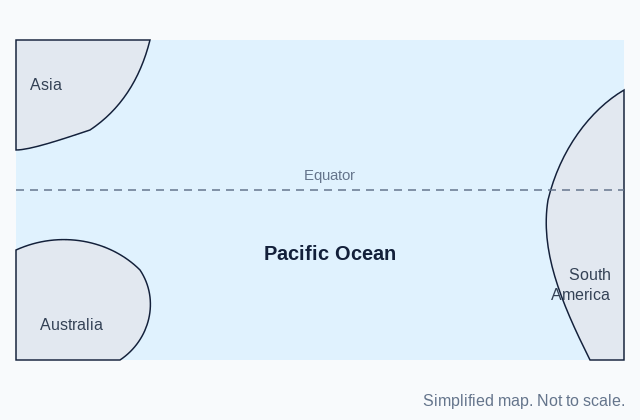
Background: in most years, the trade winds blow from east to west along the equator and push warm surface water toward Asia and Australia. Off the coast of South America, cold water from the deep ocean rises to take its place (upwelling), so the surface of the eastern tropical Pacific stays cool.
Background: every few years the pattern shifts. In an El Niño, the trade winds weaken, warm surface water spreads east across the Pacific, and the central and eastern tropical Pacific turns warmer than usual. In a La Niña, the trade winds strengthen and the same water turns cooler than usual. Either one can last for months, often about a year. The whole back-and-forth pattern, together with the shifts in air pressure across the Pacific that go with it, is called the El Niño-Southern Oscillation.
Quick check · Decide and justify
A student says El Niño is a powerful storm that forms over the Atlantic Ocean. Is the student right?
Which reason supports your answer?
2b. Effects around the world
These phenomena can cause global changes to rainfall, wind, and ocean circulation patterns. A change in the surface temperature of a huge stretch of ocean changes where air rises, where clouds build and where storms form. That shifts winds and rainfall far beyond the Pacific.
Background: in a typical El Niño, the dry coast of Peru and Ecuador can get heavy rain and floods, while Indonesia and parts of Australia can face drought and wildfires. Off South America, the warm surface water also changes the usual pattern of upwelling. A La Niña tends to push many of these changes the other way.
Changes like these become environmental problems for the people and ecosystems in their path.
Quick check · Select all
A made-up report describes a strong El Niño. Which two are kinds of change that El Niño and La Niña can cause? Pick two.
Select 2 answers, then check.
2c. Why places differ
El Niño and La Niña are influenced by geological and geographic factors and can affect different locations in different ways. The shape of the land and the ocean around the Pacific helps set how these events form and where their effects land. Background: for example, the Andes Mountains along South America's west coast steer winds and rain, so what reaches the land behind them differs from what falls on the coast.
The effects differ from place to place for the same reasons. In a single El Niño, one region can be much wetter than usual while another is much drier, and a third may see little clear change. So the useful question is not "what does El Niño do?" but "what does it do here?"
Quick check · Multiple choice
During one made-up El Niño winter, a town in the southern United States gets twice its usual rain, while a town in southern Africa gets about half its usual rain. A student says the records must be wrong, because El Niño should change rainfall the same way everywhere. Which response is best?
Part 3 Watch it done How dry was the El Niño year?
Open each step in turn, answer the why, then finish the calculation yourself.
A made-up town usually receives 1,250 mm of rain a year. In one El Niño year, it receives 400 mm. By what percent did its rainfall decrease?
Step 1 · Name the starting value
The usual 1,250 mm is the starting value. The El Niño year's 400 mm is the new value.
Step 2 · Find the change
mm less than usual.
Why this step?
Why can this town get far less rain in an El Niño year while another town gets more?
El Niño can cause global changes to rainfall patterns, and it can affect different locations in different ways, so one place's rain can fall while another's rises.
Step 3 · Set up the percent
Divide the change by the starting value and multiply by 100.
Your step · Calculate
Finish it. A made-up town usually receives 1,250 mm of rain a year, and in one El Niño year it receives 400 mm. By what percent did its rainfall decrease?
%
A 68% drop is a severe drought: the kind of environmental problem an El Niño or La Niña can bring to a place whose rainfall shifts.
Part 4 Try it An El Niño year, and five records
First find where a student's description of an El Niño year goes wrong. Then match five made-up records to the problem each one points to.
Try it · Spot the error
A student describes a made-up El Niño year. Tap the first line that goes wrong.
Try it · Match
Each made-up record comes from a place during an El Niño or La Niña year. Match it to the environmental problem it most likely points to.
Part 5 Explain it A reservoir in an El Niño year
Write your answer first. Nothing you type here leaves this page. Then compare it with the model and each scoring point.
Free response is 40% of the exam score. This one is shaped like Question 3, Analyze an environmental problem doing calculations.
Free-response practice · Question 3 style
A made-up town gets its water from a reservoir. The reservoir is filled by rain on a catchment of 60 square kilometers that usually receives 900 mm of rain a year. Forecasters expect an El Niño next year and predict only 540 mm of rain on the catchment. The town uses 40,000,000 cubic meters of water a year. Assume all the rain that falls on the catchment reaches the reservoir, and that the reservoir starts the year with little water stored. The numbers are made up for practice.
(a) Calculate the volume of rain that would fall on the catchment in the forecast year, in cubic meters. Show your work. (1 square kilometer = 1,000,000 square meters.)
(b) Calculate the percent of the town's yearly water use that this volume would supply. Show your work.
(c) Describe one environmental problem the town or the land around it could face in the forecast year.
(d) A town on the far side of the Pacific expects more rain than usual in the same year. Explain how both forecasts can be right.
(e) Propose one step the town could take before the forecast year to reduce the problem you described in (c), and explain how it would help.
Model answer
(a) , and m. cubic meters.
(b) of the town's yearly use.
(c) A water shortage: the reservoir would supply only about 81% of what the town uses, so supplies could run short unless people use less. (Stress on crops and other plants from drought, or a higher risk of wildfire, also fits.)
(d) El Niño can cause global changes to rainfall patterns, and it can affect different locations in different ways. One place can get less rain than usual in the same El Niño that brings another place more.
(e) Start asking people to use less water, for example by limiting lawn watering, before the El Niño year, so that use falls toward the 81% the reservoir can supply. (Storing extra water while the reservoir is full, or lining up a backup source such as groundwater, also fits.)
Score your own answer. This is a self-check, not a grade. Tick each point your answer makes.
Part 6 Check yourself Five years in the Pacific
The first two questions use the table.
The table gives made-up records for five years: how the surface temperature of the eastern tropical Pacific compared with its long-term average, and the yearly rainfall at two made-up towns. Coast Town is on the desert coast of South America and averages 150 mm of rain a year. Island Town is on an island in the western Pacific and averages 2,000 mm a year. The values are made up for practice.
| Year | Eastern Pacific surface temperature compared with average (°C) | Coast Town rainfall (mm) | Island Town rainfall (mm) |
|---|---|---|---|
| 1 | 0.0 | 150 | 2,000 |
| 2 | +2.1 | 1,020 | 900 |
| 3 | -1.2 | 40 | 2,600 |
| 4 | +0.3 | 180 | 1,900 |
| 5 | -0.1 | 140 | 2,050 |
Case question 1 · Multiple choice
Using the table: in Year 2, the eastern Pacific's surface water was 2.1 °C warmer than average. Which environmental problem was Island Town most likely to face that year?
Case question 2 · Calculate
Using the table: by what percent was Coast Town's Year 2 rainfall greater than its average?
The rest stand on their own and do not use the case.
Check yourself · Decide and justify
A student says the Pacific Ocean's great width and the positions of the continents around it help shape El Niño and La Niña. Is the student right?
Which reason supports your answer?
Check yourself · Put it in order
In a made-up El Niño year, warm surface water spreads over a desert coast where cold, nutrient-rich water usually rises from the deep. Put what follows in order, first to last.
Part 7 Keep it Bring back earlier ideas
Two questions from earlier topics: a student's description of a mountain range, and whether paving a forest changes a watershed.
First find where a student's description of a mountain range goes wrong. Then sort four differences between towns by the factor behind each one.
From 4.8 Earth’s Geography and Climate · Spot the error
A student describes a made-up coastal mountain range. Tap the first line that goes wrong.
First use given soil data to compare two watersheds. Then judge a claim about what counts as part of a watershed.
From 4.6 Watersheds · Decide and justify
Forest covers most of a made-up watershed. A student says paving over the forest for a parking lot would not change the watershed's characteristics, since only its area, length and slope count. Is the student right?
Which reason supports your answer?
In three lines
- El Niño and La Niña are phenomena associated with changing ocean surface temperatures in the Pacific Ocean.
- They can cause global changes to rainfall, wind and ocean circulation patterns, which can bring floods, drought, wildfires and smaller fishing catches.
- They are influenced by geological and geographic factors and can affect different locations in different ways.
Exam strategy for this topic
- Section I, Multiple Choice: 80 questions in 90 minutes.
- Section II, Free Response: 3 questions in 70 minutes.
- This lesson's Explain it is shaped like free-response question 3, Analyze an environmental problem doing calculations.
- A four-function, scientific, or graphing calculator is allowed on both sections of the exam.
When a question asks about El Niño or La Niña, name the change in the Pacific's surface temperature, then describe the effect at the place given, using the question's data for its direction. Do not assume every place changes the same way.
Questions students ask
What are El Niño and La Niña?
Phenomena associated with changing ocean surface temperatures in the Pacific Ocean. Background: in an El Niño, the central and eastern tropical Pacific turns warmer than usual; in a La Niña, cooler.
What can El Niño and La Niña change?
They can cause global changes to rainfall, wind and ocean circulation patterns, and they can affect different locations in different ways.
What is the El Niño-Southern Oscillation?
The name for the whole pattern: El Niño, La Niña and the shifts in air pressure across the Pacific that go with them.
Course alignment, for teachers
AP Environmental Science topic 4.9, Unit 4: Earth Systems and Resources.
- Skill 7.A: Describe environmental problems.
This lesson maps all 2 essential knowledge statements of the topic to the part that teaches each one: 2 are checked by a scored question. The map is in the lesson file.