Unit 4 · Topic 4.2 · about 30 minutes · 7 parts · 10 scored checks, 2 of them multiple choice, plus 2 from earlier lessons
AP Environmental Science 4.2: Soil Formation and Erosion
Unit 4: 10 to 15% of the multiple-choice section
What you'll be able to do
- Describe the characteristics and formation of soil: how it forms from parent material, how its horizons differ, how wind and water erode it, and how it filters and cleans water.
Key vocabulary
| Term | What it means | The exam trap |
|---|---|---|
| Parent material | The rock or other material that a soil forms from. | Parent material is the starting material, not the finished soil. |
| Weathering | The breaking of rock into smaller pieces, by water, ice, plant roots or chemical reactions. | Weathering breaks rock down; it does not carry the pieces away. |
| Horizon | A layer of soil that differs from the layers above and below it. | A horizon is a layer within the soil, not the bedrock beneath it. |
| Organic material | Material from living things, such as fallen leaves, dead roots and animal waste. | Mineral grains from rock are not organic material. |
| Erosion | The removal of soil from where it formed or settled. | Erosion moves soil away; weathering breaks rock down. |
 Tap to open the picture full size
Part 1 Think first Where did the farm's soil come from?
Commit to a guess first. Being wrong now makes the right idea stick better.
Predict first
A made-up farm sits on flat land beside a wide river. Its soil is deep and fine, but the solid rock under the farm is a different kind of rock from the grains in the soil. Where do you predict most of the soil came from?
In short. Soil is a layered mix of broken-down rock, organic material, water and air that covers much of the land.
- Soil horizons are layers told apart by their composition and organic material.
- Wind and water can erode soil.
- Soil filters and cleans the water that moves through it.
Part 2 Learn it How soil forms, and how it is lost
2a. From rock to soil
Soils are formed when parent material is weathered, transported and deposited. Parent material is the rock, or other material, that a soil forms from.
- Weathered: the parent material is broken into smaller pieces, by freezing and thawing water, plant roots, rain and chemical reactions.
- Transported: the pieces are carried away, by rivers, wind, glaciers or gravity.
- Deposited: where the water or wind slows down, the pieces are dropped and build up.
A floodplain beside a river, for example, is built from grains weathered out of rock upstream, carried down by the river and dropped when it floods. Over time, plants grow in the deposits, and their dead leaves and roots add organic material.
Quick check · Put it in order
Suppose thick soil forms on the plains east of a made-up desert. Put the steps in the order they happen, first to last.
2b. Soil horizons
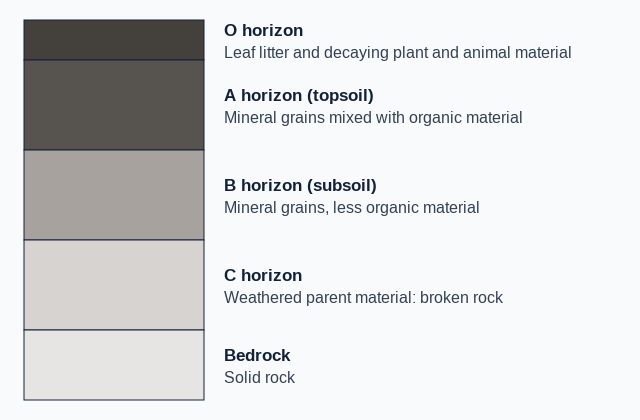
Soils are generally categorized by horizons based on their composition and organic material. A horizon is a layer of soil that differs from the layers above and below it in what it is made of. Dig a pit and you can see them.
Background: the common names, from the top down, are in the figure. The O horizon is mostly leaf litter and decaying material, so it holds the most organic material. Each layer below holds less organic material and more mineral grains, down to the C horizon of broken parent rock.
Organic material comes from living things, which are mostly at the surface, so it is richest near the top and thins out with depth. Two layers count as separate horizons because their make-up differs, not because one lies a set distance below the other.
Quick check · Multiple choice
A student digs a pit in a made-up meadow and calls every 30 cm of soil a new horizon, whatever it looks like. What is wrong with this?
2c. Erosion, and soil as a water filter
Soils can be eroded by winds or water. Erosion is the removal of soil from where it formed or settled.
- Water: rain and runoff carry soil downhill into streams and lakes. Bare, sloping ground is the most exposed.
- Wind: on dry, bare ground, wind lifts loose soil and carries it off as dust.
Protecting soils can protect water quality, as soils effectively filter and clean water that moves through them. Rain that soaks into soil passes through the tiny spaces between grains, which trap particles the water carries, so water that has moved through soil reaches streams and wells cleaner. When soil is eroded, there is less soil left to filter the water, and the eroded soil itself ends up in the water.
Quick check · Decide and justify
A made-up town gets its drinking water from a reservoir in a valley. The town pays farmers on the hills above to keep their fields planted all year, so the soil is not washed away. A council member says this could help keep the town's water clean. Is the council member right?
Which reason supports your answer?
Part 3 Watch it done Two plots after a rainy season
Open each step in turn, answer the why, then finish the calculation yourself.
Suppose researchers set up two made-up plots of the same size and slope on a farm. After a season of rain, they collect the soil washed off each plot: 12 kg from the bare plot and 1.8 kg from the plot covered with grass. By what percent did the grass cover reduce the soil lost, compared with the bare plot?
Step 1 · Name what is happening
Rain carried soil off both plots, so this is erosion by water. The plots differ only in their cover.
Step 2 · Find the difference
kg less soil was lost from the grass plot.
Why this step?
Why divide by the bare plot's loss, not the grass plot's?
The question asks how much the cover reduced the loss compared with bare ground, so the bare plot's 12 kg is the amount the reduction is a share of.
Step 3 · Set up the percent
Percent reduction = reduction soil lost from the bare plot .
Your step · Calculate
Finish it. On two made-up plots of the same size and slope, a season of rain washed 12 kg of soil off the bare plot and 1.8 kg off the plot covered with grass. By what percent did the grass cover reduce the soil lost, compared with the bare plot?
%
The grass cut the soil lost to water by 85%. That is soil kept on the farm, and soil kept out of the streams below.
Part 4 Try it Erosion or not, and the three steps
First pick out the scenes that show erosion. Then sort what happens to parent material into the three steps of soil formation.
Try it · Select all
Which two describe soil being eroded? Pick two.
Select 2 answers, then check.
Try it · Sort it
Each card is something that happens to parent material. Tap a card, then the step of soil formation it shows.
Weathered
Transported
Deposited
Part 5 Explain it Does deeper soil clean more water?
Write your answer first. Nothing you type here leaves this page. Then compare it with the model and each scoring point.
Free response is 40% of the exam score. This one is shaped like Question 1, Design an investigation.
Free-response practice · Question 1 style
Suppose a student wants to test whether a deeper layer of soil cleans more of the cloudiness out of water that passes through it. The student has eight identical clear tubes with mesh across the bottom, a bag of garden soil, a jug of muddy pond water, and a meter that measures how cloudy water is. The situation is made up for practice.
(a) Identify a testable hypothesis for the investigation.
(b) Identify the independent variable and the dependent variable.
(c) Describe the control, and identify one variable that should be held constant.
(d) Describe one way the design makes its results more reliable.
(e) Explain how results that support the hypothesis would support protecting the soil on the hills around a town's reservoir.
Model answer
(a) If muddy water passes through a deeper layer of soil, then the water that drains out will be less cloudy.
(b) The independent variable is the depth of soil in the tube: for example 5, 10 and 20 cm. The dependent variable is the cloudiness of the water that drains out, measured with the meter.
(c) The control is two tubes with mesh but no soil, with the same muddy water poured through, which shows how cloudy the water is when no soil filters it. Held constant: the volume of muddy water poured into each tube.
(d) Two tubes at each depth, so each result can be checked against a repeat and the two averaged.
(e) The results would show that more soil cleans more of the water passing through it. Soil kept in place on the hills, not eroded away, is soil that filters the water soaking through it before that water reaches the reservoir.
Score your own answer. This is a self-check, not a grade. Tick each point your answer makes.
Part 6 Check yourself Trays in the rain
The first two questions use the study below.
Suppose a class tests how ground cover affects erosion by water. They fill six identical trays with the same soil and tilt each one at the same angle. Two trays are left bare, two are covered with straw, and two are planted with grass. Each tray gets 2 liters of water from the same watering can, held at the same height. The class catches the water that runs off each tray, lets the soil in it settle, dries that soil and weighs it. They also give the runoff a cloudiness score from 0 (clear) to 5 (very cloudy). The results are made up for practice.
| Cover | Tray | Dry soil caught (g) | Cloudiness score (0 to 5) |
|---|---|---|---|
| Bare | 1 | 48 | 5 |
| Bare | 2 | 52 | 5 |
| Straw | 3 | 15 | 3 |
| Straw | 4 | 13 | 2 |
| Grass | 5 | 6 | 1 |
| Grass | 6 | 8 | 1 |
Case question 1 · Multiple choice
Using the study: which is the measure the class uses for how much soil each tray lost to erosion?
Case question 2 · Spot the error
Using the study: a student writes up what the results show. Tap the first line that goes wrong.
The rest stand on their own and do not use the case.
Check yourself · Fill the statement
A student describes a soil pit dug in a made-up forest. Tap a blank, then an answer.
The top layer is dark and spongy, and its rotting leaves make it the layer richest in material. Lower down, the layers hold less of it and more mineral grains. The bottom layer is mostly broken pieces of the bedrock just beneath it, the soil's material.
Check yourself · Decide and justify
A made-up farm field is flat and dry, and no water ever runs off it. The farmer says the field's bare soil cannot be eroded. Is the farmer right?
Which reason supports your answer?
Part 7 Keep it Bring back earlier ideas
Two questions from earlier topics: a town beside a sliding plate boundary, and how long a growing city takes to double.
First decide which hazard a boundary brings. Then find the first mistake in a student's reasoning.
From 4.1 Plate Tectonics · Multiple choice
A made-up town is built beside a boundary where two plates slide past each other sideways. Which hazard should the town plan for?
First find where an argument about limits to growth goes wrong. Then estimate a doubling time the lesson has not shown.
From 3.8 Human Population Dynamics · Multiple choice
A made-up city's population grows by 3.5% per year, and the rate does not change. About how long will the population take to double?
In three lines
- Soils are formed when parent material is weathered, transported and deposited.
- Soils are categorized by horizons, based on their composition and organic material.
- Wind and water can erode soil, and protecting soil protects water, because soil filters and cleans the water that moves through it.
Exam strategy for this topic
- Section I, Multiple Choice: 80 questions in 90 minutes.
- Section II, Free Response: 3 questions in 70 minutes.
- This lesson's Explain it is shaped like free-response question 1, Design an investigation.
- A four-function, scientific, or graphing calculator is allowed on both sections of the exam.
When a question asks how a soil formed, look for all three steps: weathered, transported, deposited. When it asks about erosion, check both wind and water.
Questions students ask
How does soil form?
Soils are formed when parent material is weathered, transported and deposited.
What are soil horizons?
Layers of soil, categorized by their composition and organic material.
What erodes soil?
Soils can be eroded by winds or by water.
Why does protecting soil protect water quality?
Soils effectively filter and clean water that moves through them, so keeping soil in place helps keep water clean.
Course alignment, for teachers
AP Environmental Science topic 4.2, Unit 4: Earth Systems and Resources.
- Skill 4.B: Identify a research method, design, and/or measure used.
This lesson maps all 3 essential knowledge statements of the topic to the part that teaches each one: 3 are checked by a scored question. The map is in the lesson file.