Unit 5 · Topic 5.9 · about 30 minutes · 7 parts · 10 scored checks, 2 of them multiple choice, plus 2 from earlier lessons
AP Environmental Science 5.9: Impacts of Mining
Unit 5: 10 to 15% of the multiple-choice section
What you'll be able to do
- Describe natural resource extraction through mining.
- Describe ecological and economic impacts of natural resource extraction through mining.
Key vocabulary
| Term | What it means | The exam trap |
|---|---|---|
| Ore | Rock with enough of a valuable mineral in it to be worth mining. | Ore is mostly ordinary rock; the mineral is a share of it. |
| Overburden | The soil and rock above an ore or coal seam. | It is not what the mine is after. |
| Subsurface mining | Mining that reaches ore or coal deep underground through shafts and tunnels. | It leaves the surface in place over most of the mine. |
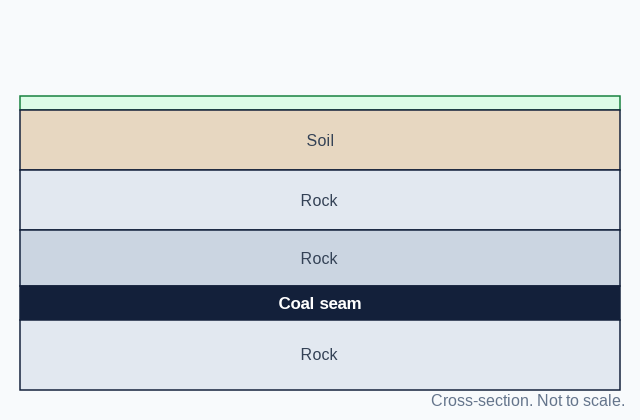 Tap to open the picture full size
Part 1 Think first Thinner ore
Commit to a guess first. Being wrong now makes the right idea stick better.
Predict first
A copper mine has worked the same district for a century. The ore it mined early on held 4% copper; the ore it mines today holds 0.5%. To produce the same metric ton of copper today, what do you predict the mine must do?
In short. Mining takes ores and coal from the ground, and what it takes, moves and leaves behind changes as the best deposits run out.
- Surface mining, strip mining and subsurface mining each reach ore or coal in their own way.
- A mine leaves more behind than the hole it digs.
- This lesson weighs what mining provides against what it costs the land, the water and the air.
Part 2 Learn it Digging out ores and coal
2a. When the best ore is gone
An ore is rock with enough of a valuable mineral, such as copper or iron, to be worth mining. Its grade is the share of that mineral it holds: a 2% copper ore has 2 metric tons of copper in every 100 metric tons of rock.
As the more accessible ores are mined to depletion, mining operations are forced to access lower grade ores. Miners work the richest, easiest deposits first. When those run out, what is left is thinner or harder to reach.
Accessing these ores requires increased use of resources that can cause increased waste and pollution. A lower grade means more rock for each metric ton of metal: more fuel for blasting and hauling, more electricity for crushing, more water for separating the mineral, and more crushed rock left over. Each of those can pollute the air, the water or the land.
Quick check · Multiple choice
A made-up gold mine's ore falls from 8 grams of gold per metric ton to 2 grams per metric ton. Compared with before, producing each kilogram of gold now likely takes
2b. Surface mining and its wastes
Surface mining is the removal of large portions of soil and rock, called overburden, in order to access the ore underneath. The overburden is not the ore; it is what lies on top of it.
An example is strip mining, which removes the vegetation from an area, making the area more susceptible to erosion. Strip mining takes away the land's cover in long strips to reach a shallow seam of coal or ore. With no plants or roots to hold it, the bare ground washes and blows away.
Mining wastes include the soil and rocks that are moved to gain access to the ore, and the waste, called slag and tailings, that remains when the minerals have been removed from the ore. Background: tailings are often finely crushed rock left from separating the mineral, and slag is left from melting metal out of ore. Both are piled or ponded near the mine.
Quick check · Select all
A company strip mines a forested hillside to reach a shallow coal seam. Which two are likely results? Pick two.
Select 2 answers, then check.
2c. Coal: benefits, harms and cost
Mining helps to provide low cost energy and material necessary to make products. The steel in a car, the copper in its wiring and much of the electricity in many regions begin in a mine.
It also does damage. The mining of coal can destroy habitats, contaminate ground water, and release dust particles and methane. Habitats are dug up or buried under waste; water seeping through broken rock and waste can carry harmful substances down into ground water; blasting and hauling raise dust; and methane trapped in coal seams escapes when they are opened.
Cost rises as coal runs short. As coal reserves get smaller, due to a lack of easily accessible reserves, it becomes necessary to access coal through subsurface mining, which is very expensive. Subsurface mining reaches deep coal through shafts and tunnels, which must be dug, held up, ventilated and drained.
Quick check · Decide and justify
A town council says a new coal mine on the ridge outside town will help keep the region's electricity cheap, and that it could also harm the deer and birds that live on the ridge. Is the council right?
Which reason supports your answer?
Part 3 Watch it done How much ore for the copper?
Open each step in turn, answer the why, then finish the calculation yourself.
A made-up copper mine's ore is 0.6% copper. How many metric tons of ore must the mine dig and process to get 4.5 metric tons of copper?
Step 1 · Write the grade as a decimal
, so each metric ton of ore holds 0.006 metric tons of copper.
Why this step?
Why does the answer come out so much larger than 4.5?
Only a small share of each metric ton of ore is copper. The rest is rock that must still be dug, crushed and left as waste.
Step 2 · Set up the equation
metric tons of copper.
Step 3 · Solve for the ore
Divide the copper wanted by the share of copper in each metric ton of ore.
Your step · Calculate
Finish it. A made-up copper mine's ore is 0.6% copper. How many metric tons of ore must it dig and process to get 4.5 metric tons of copper?
metric tons
Seven hundred fifty metric tons of rock for 4.5 metric tons of copper, and 745.5 metric tons of it end up as waste. Halve the grade and the rock, the energy to crush it and the waste all double.
Part 4 Try it Sort the mine's output, then check an account
First sort what leaves a mine into wastes and products. Then find where a student's account of deep coal goes wrong.
Try it · Sort it
What is each thing that leaves a mine? Tap a card, then its group.
Moved soil and rock
Slag and tailings
Product
Try it · Spot the error
A student explains what happens to coal mining as reserves shrink. Tap the first line that goes wrong.
Part 5 Explain it A strip mine on a hillside
Write your answer first. Nothing you type here leaves this page. Then compare it with the model and each scoring point.
Free response is 40% of the exam score. This one is shaped like Question 3, Analyze an environmental problem doing calculations.
Free-response practice · Question 3 style
A made-up company plans to strip mine a grassy hillside above a river. On each hectare (10,000 square meters), a coal seam 3 meters thick lies under 30 meters of soil and rock.
(a) Calculate the volume of soil and rock that must be removed from each hectare. Show your work.
(b) Calculate how many cubic meters of soil and rock must be removed for each cubic meter of coal. Show your work.
(c) Describe how strip mining the hillside could affect the river below.
(d) Propose one action the company could take after mining to reduce that effect, and explain how it would work.
(e) Identify one way strip mining the hillside could harm the animals that live on it.
Model answer
(a) cubic meters of soil and rock per hectare.
(b) The coal is cubic meters, so cubic meters of soil and rock for each cubic meter of coal.
(c) Strip mining removes the grass and soil cover, so the bare hillside is more susceptible to erosion, and rain can wash soil down into the river.
(d) Put the soil back over the mined area and replant it with grasses, so roots hold the soil and the ground is covered again, slowing erosion.
(e) Removing the grass and soil destroys the habitat the hillside's animals live in.
Score your own answer. This is a self-check, not a grade. Tick each point your answer makes.
Part 6 Check yourself A century of copper
The first two questions use the table.
A made-up copper district records the average grade of the ore it mines, and the rock moved and water used for each metric ton of copper produced. The numbers are made up for practice.
| Year | Ore grade (% copper) | Rock moved (metric tons per metric ton of copper) | Water used (cubic meters per metric ton of copper) |
|---|---|---|---|
| 1960 | 2.0 | 50 | 60 |
| 1980 | 1.2 | 83 | 95 |
| 2000 | 0.8 | 125 | 140 |
| 2020 | 0.5 | 200 | 220 |
Case question 1 · Multiple choice
Using the table: which statement do the data support?
Case question 2 · Calculate
Using the table: by what percent did the water used per metric ton of copper rise from 1960 to 2020?
The rest stand on their own and do not use the case.
Check yourself · Fill the statement
Complete the account of one coal mine.
At a made-up coal mine, opening the seam lets trapped in the coal escape into the air, and rain down through the waste piles can contaminate the town's ground water.
Check yourself · Rank it
Three made-up coal seams are the same thickness and size. Rank them by how expensive the coal is likely to be to reach.
Most expensive first
Give each one a place, 1 for first. Give two the same place if they are equal.
Your ranking: none yet
Part 7 Keep it Bring back earlier ideas
Two questions from earlier topics: causes and problems of overfishing, and a student's account of pest control.
First sort six statements into causes of overfishing and problems it leads to. Then find where a student's account of a fishing town goes wrong.
From 5.8 Impacts of Overfishing · Sort it
Is each statement a cause of overfishing or a problem it leads to? Tap a card, then its group.
Cause
Problem it leads to
First put the steps of resistance in order. Then find where a student's account of pest control goes wrong.
From 5.6 Pest Control Methods · Spot the error
A student explains the benefits and drawbacks of pest control. Tap the first line that goes wrong.
In three lines
- As accessible ores run out, mines turn to lower-grade ores, which take more resources and cause more waste and pollution.
- Surface mining removes overburden; strip mining also removes vegetation, leaving land open to erosion; wastes include moved rock, slag and tailings.
- Mining provides low-cost energy and materials, but coal mining can destroy habitats, contaminate ground water and release dust and methane, and deep coal is very expensive.
Exam strategy for this topic
- Section I, Multiple Choice: 80 questions in 90 minutes.
- Section II, Free Response: 3 questions in 70 minutes.
- This lesson's Explain it is shaped like free-response question 3, Analyze an environmental problem doing calculations.
- A four-function, scientific, or graphing calculator is allowed on both sections of the exam.
When a question asks why mining grows more harmful or costly over time, name the cause: the accessible ores and coal are used first, so later mining must reach lower-grade ores or deeper coal, which takes more resources, makes more waste and costs more.
Questions students ask
Why do mines turn to lower-grade ores?
As the more accessible ores are mined to depletion, mining operations are forced to access lower grade ores, which take more resources and can cause more waste and pollution.
What is overburden?
The soil and rock removed in surface mining to reach the ore underneath.
What are slag and tailings?
Mining wastes that remain when the minerals have been removed from the ore.
Course alignment, for teachers
AP Environmental Science topic 5.9, Unit 5: Land and Water Use.
- Skill 7.E: Make a claim that proposes a solution to an environmental problem in an applied context.
This lesson maps all 4 essential knowledge statements of the topic to the part that teaches each one: 4 are checked by a scored question. The map is in the lesson file.