Unit 7 · Topic 7.2 · about 35 minutes · 7 parts · 11 scored checks, 2 of them multiple choice, plus 2 from earlier lessons
AP Environmental Science 7.2: Photochemical Smog
Unit 7: 7 to 10% of the multiple-choice section
What you'll be able to do
- Explain the causes and effects of photochemical smog and methods to reduce it.
Key vocabulary
| Term | What it means | The exam trap |
|---|---|---|
| Photochemical | Driven by light: a chemical reaction that needs light to happen. | A photochemical reaction needs light, not just warmth. |
| Ozone | A gas whose molecules are made of three oxygen atoms. Near the ground it is a pollutant. | Near the ground, ozone is a pollutant to cut, not a gas to protect. |
| Parts per billion (ppb) | A unit for tiny amounts of a gas: how many parts of the gas there are in every billion parts of air. | A reading in ppb is a concentration, not a total amount released. |
 Tap to open the picture full size
Part 1 Think first A city and a farm town
Commit to a guess first. Being wrong now makes the right idea stick better.
Predict first
Two made-up places get the same strong summer sunshine: a big city with heavy traffic, and a small farm town 200 km away with little traffic. Where do you predict smog forms more often?
In short. Photochemical smog is a haze of ozone and a variety of other pollutants, made by chemical reactions that light drives.
- Ozone in smog builds through the day to peak in the afternoon, and it runs higher in summer than in winter.
- VOCs, such as formaldehyde, evaporate or sublimate at room temperature, and trees give off VOCs naturally.
- Smog can harm health, causing breathing problems and irritated eyes.
Part 2 Learn it How smog forms and how to cut it
2a. What smog forms from
Photochemical smog forms when nitrogen oxides and volatile organic hydrocarbons react with heat and sunlight, producing a variety of pollutants.
Photochemical means driven by light. Two kinds of gases go into the reaction:
- nitrogen oxides, released when fossil fuels burn (7.1);
- volatile organic hydrocarbons, carbon compounds that become gases easily. This lesson calls them VOCs, volatile organic compounds, the name the next chunk uses.
Heat and sunlight drive the reaction. Its products include ozone and a variety of other pollutants, which together make the haze.
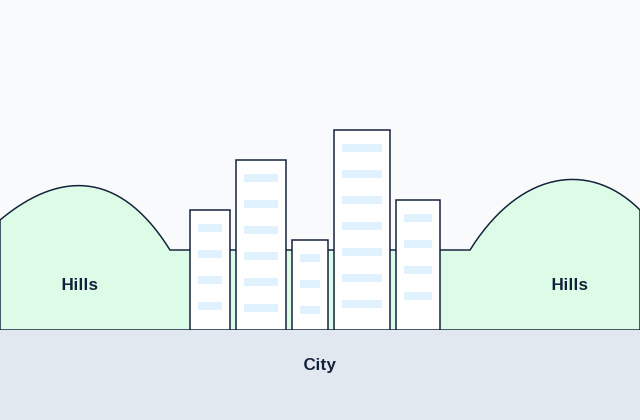
Many environmental factors affect how much smog forms, among them how strong the sunlight is, how hot the air is, and how much of each gas is in it. Background: still air, or a city ringed by hills, can also let smog build up.
Quick check · Multiple choice
A made-up town's smog forms on hot, sunny days. Which pair of substances reacts in that heat and sunlight to form it?
2b. VOCs, from tanks and from trees
Volatile organic compounds (VOCs), such as formaldehyde and gasoline, evaporate or sublimate at room temperature.
Volatile means a substance becomes a gas easily. A VOC does not need to be burned or heated to reach the air:
- liquids such as gasoline evaporate, turning to gas at ordinary temperatures;
- some solids sublimate, turning straight from a solid to a gas without melting first.
Formaldehyde, a chemical in some glues and building products, is a VOC, and so is gasoline.
Trees are a natural source of VOCs. Their leaves give off VOCs, so even a forest far from any road has some VOCs in its air. Background: leaves give off more on hot days.
Quick check · Decide and justify
A student says vapor escaping from open cans of paint thinner in a made-up furniture workshop can add to smog, even though the thinner is never burned. Is the student right?
Which reason supports your answer?
2c. Morning, afternoon and summer
Nitrogen oxide is produced early in the day. Ozone concentrations peak in the afternoon and are higher in the summer.
- Early in the day: morning traffic burns fuel, so nitrogen oxide in the air climbs first.
- Through the day: ozone is produced by chemical reactions between oxygen and sunlight, so it builds through the sunny hours and reaches its peak in the afternoon.
- Through the year: summer brings the most sunlight, so ozone concentrations run higher in summer than in winter.
A smoggy day has an order to it: the gases from traffic come first, and the ozone comes later.
Quick check · Select all
A made-up city in the United States tracks its ozone through the day and through the year. Which two statements fit the pattern the lesson describes? Pick two.
Select 2 answers, then check.
2d. Cities, health and cutting smog
Photochemical smog often forms in urban areas because of the large number of motor vehicles there. Cars, trucks and buses release nitrogen oxides, and fueling them adds VOCs, so a city puts both ingredients into the same air.
Smog can harm human health in several ways, including respiratory problems and eye irritation. Ozone and the other gases in smog irritate the lungs and airways, so people cough and find it harder to breathe, and they make eyes sting and water.
Smog can be reduced through reducing nitrogen oxides and VOCs. With less of either ingredient in the air, less smog forms in the same heat and sunlight. Driving less is one example.
Quick check · Sort it
Does each made-up step cut an ingredient of smog? Tap a card, then its group.
Cuts an ingredient of smog
Leaves smog's ingredients the same
Part 3 Watch it done How much does one plan cut?
Open each step in turn, answer the why, then finish the calculation yourself.
Each day a made-up city's air receives volatile organic compounds (VOCs): 260 metric tons from vehicles, 140 metric tons from other human sources such as paints and fuel storage, and 100 metric tons from its trees. A plan cuts the vehicles' VOCs by 45 percent. What percent of the city's total daily VOCs does the plan remove?
Step 1 · Find the cut
metric tons a day less from vehicles.
Why this step?
Why can cutting VOCs from vehicles reduce smog?
VOCs are one of the two kinds of gas that react in heat and sunlight to form smog, so less of them means less smog can form.
Step 2 · Find the total
Every source sends its VOCs into the same air, so add all three: metric tons a day.
Your step · Calculate
Finish it. The plan removes 117 metric tons a day out of a total of 500. What percent of the city's daily VOCs is that?
%
Nearly a quarter of the city's VOCs are gone from one plan aimed at vehicles. The trees' share is untouched by a plan aimed at vehicles, since trees are a natural source.
Part 4 Try it Fill in the effects, then check an account
First complete an account of a smoggy city's problem and its fix. Then find where a student's account of a smoggy day goes wrong.
Try it · Fill the statement
Complete the account of a made-up city's smog.
Smog over the city can cause breathing problems and . The city can reduce it by cutting the two gases it forms from, nitrogen oxides and .
Try it · Spot the error
A student describes a smoggy day in a made-up city. Tap the first line that goes wrong.
Part 5 Explain it Fewer days over the limit
Write your answer first. Nothing you type here leaves this page. Then compare it with the model and each scoring point.
Free response is 40% of the exam score. This one is shaped like Question 2, Analyze and interpret quantitative data.
Free-response practice · Question 2 style
A made-up city counted the days each year that its ozone went over a health limit, made up for practice:
- 2000: 84 days
- 2010: 61 days
- 2020: 38 days
- 2025: 27 days
Over those years the city tightened its rules on nitrogen oxides from vehicles and on VOCs from fuel pumps and paints.
(a) Describe the trend in the number of days over the limit.
(b) Calculate the percent decrease in days over the limit from 2000 to 2025. Show your work.
(c) Calculate the average decrease in days over the limit per year from 2000 to 2025. Show your work.
(d) Explain how the city's rules could have caused the trend.
(e) Explain one way that smog harms human health.
Model answer
(a) The number of days over the limit fell in every period, from 84 days in 2000 to 27 days in 2025.
(b) fewer days. decrease.
(c) fewer days per year on average.
(d) Photochemical smog, and the ozone in it, forms when nitrogen oxides and VOCs react with heat and sunlight. Rules that cut both ingredients leave less of them to react, so fewer days build enough ozone to pass the limit.
(e) Smog irritates the lungs and airways, causing respiratory problems such as coughing and trouble breathing. (Eye irritation also fits.)
Score your own answer. This is a self-check, not a grade. Tick each point your answer makes.
Part 6 Check yourself One summer day by a busy road
The first two questions use the table.
A made-up city measures nitrogen oxide and ozone beside a busy road through one clear summer day, in parts per billion (ppb). The numbers are made up for practice.
| Time | Nitrogen oxide (ppb) | Ozone (ppb) |
|---|---|---|
| 6 a.m. | 18 | 22 |
| 9 a.m. | 64 | 31 |
| Noon | 29 | 68 |
| 3 p.m. | 12 | 94 |
| 6 p.m. | 21 | 57 |
Case question 1 · Multiple choice
Which statement correctly describes when each gas peaked in the data?
Case question 2 · Calculate
Using the table: by what percent did ozone rise from 6 a.m. to 3 p.m.? Round to the nearest tenth of a percent.
The rest stand on their own and do not use the case.
Check yourself · Rank it
A made-up city in the United States has heavy traffic. Rank three days there from the most photochemical smog expected to the least. Assume the wind is the same on all three days, and that twice the traffic gives off twice the nitrogen oxides and VOCs.
Most smog first
Give each one a place, 1 for first. Give two the same place if they are equal.
Your ranking: none yet
Check yourself · Sort it
Is each made-up source of VOCs natural or human? Tap a card, then its group.
Natural source
Human source
Part 7 Keep it Bring back earlier ideas
Two questions from earlier topics: the steps from a power plant to acid rain, and a student's account of a wind farm.
First put the steps from a made-up power plant to acid rain in order. Then find where a student's account of a city's air goes wrong.
From 7.1 Introduction to Air Pollution · Put it in order
Put the steps from a made-up power plant to acid rain in order, first to last.
First put the steps in a made-up wind turbine in order. Then find where a student's account of a wind farm goes wrong.
From 6.12 Wind Energy · Spot the error
A student describes a made-up wind farm. Tap the first line that goes wrong.
In three lines
- Photochemical smog forms when nitrogen oxides and VOCs react with heat and sunlight. VOCs such as gasoline and formaldehyde evaporate at room temperature, and trees are a natural source.
- Nitrogen oxide is produced early in the day; ozone peaks in the afternoon and is higher in the summer.
- Smog often forms in cities because of their many vehicles, causes respiratory problems and eye irritation, and is reduced by cutting nitrogen oxides and VOCs.
Exam strategy for this topic
- Section I, Multiple Choice: 80 questions in 90 minutes.
- Section II, Free Response: 3 questions in 70 minutes.
- This lesson's Explain it is shaped like free-response question 2, Analyze and interpret quantitative data.
- A four-function, scientific, or graphing calculator is allowed on both sections of the exam.
When a question asks how photochemical smog forms, name both ingredients, nitrogen oxides and VOCs, and both drivers, heat and sunlight.
Questions students ask
How does photochemical smog form?
Nitrogen oxides and volatile organic hydrocarbons react with heat and sunlight to produce a variety of pollutants, including ozone.
When is ozone highest?
Ozone concentrations peak in the afternoon and are higher in the summer, because ozone is produced by reactions between oxygen and sunlight.
How can photochemical smog be reduced?
By reducing nitrogen oxides and VOCs, the two ingredients it forms from.
Course alignment, for teachers
AP Environmental Science topic 7.2, Unit 7: Atmospheric Pollution.
- Skill 5.B: Describe relationships among variables in data represented.
This lesson maps all 7 essential knowledge statements of the topic to the part that teaches each one: 7 are checked by a scored question. The map is in the lesson file.