Unit 6 · Topic 6.10 · about 30 minutes · 7 parts · 10 scored checks, 2 of them multiple choice, plus 2 from earlier lessons
AP Environmental Science 6.10: Geothermal Energy
Unit 6: 10 to 15% of the multiple-choice section
What you'll be able to do
- Describe the use of geothermal energy in power generation.
- Describe the effects of the use of geothermal energy in power generation on the environment.
Key vocabulary
| Term | What it means | The exam trap |
|---|---|---|
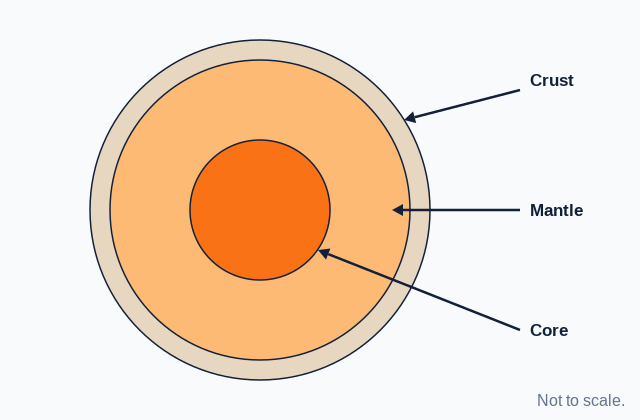
| Crust | The Earth's thin, rocky outer layer, on which people live and drill. | The crust is thinnest under the oceans and thickest under mountains. |
| Hot spring | A place where naturally warm water flows out of the ground. | Not every warm pool is a hot spring; the water has to come up out of the ground. |
| Parts per billion (ppb) | A unit for very small amounts: how many parts of a substance are in a billion parts of air or water. | One part per billion is a thousand times smaller than one part per million. |
 Tap to open the picture full size
Part 1 Think first An island with hot springs
Commit to a guess first. Being wrong now makes the right idea stick better.
Predict first
A made-up volcanic island has hot springs and vents where steam hisses out of the ground. It has no coal, oil or gas. How do you predict it could make electricity from the heat underground?
In short. Geothermal energy is heat from inside the Earth, put to work making electricity where it can be reached.
- How the heat inside the Earth becomes electricity.
- What it costs to reach that heat, and why, in much of the world.
- What can come up from the ground along with the steam.
Part 2 Learn it Heat from inside the Earth
2a. Heat to steam to electricity
Geothermal energy is obtained by using the heat stored in the Earth's interior to heat up water, which is brought back to the surface as steam. The steam is used to drive an electric generator.
Geothermal means "earth heat". The Earth's interior is very hot, and that heat warms the rock above it.
- Water underground, from rain that soaked in or water pumped down a well, is heated by the hot rock.
- A well brings it back up to the surface as steam.
- The steam turns a turbine, which drives a generator.
No fuel is burned. The heat was already in the ground. Background: the cooled water is often pumped back down to be heated again, and in some places geothermal heat warms buildings directly without making electricity.
Quick check · Multiple choice
At a made-up geothermal power plant, what heats the water that becomes the steam?
2b. Out of reach in many places
The cost of accessing geothermal energy can be prohibitively expensive, because in many parts of the world it is not easily accessible.
Prohibitively expensive means so costly that the project is not worth doing or cannot be paid for. Not easily accessible means the heat cannot be reached without great effort. The two go together: where the heat is hard to reach, reaching it is what costs so much.
Background: the Earth's interior is hot everywhere, but in most places rock hot enough for a power plant lies kilometers down, and the deeper a well has to go through hard rock, the more it costs. In a few places, such as volcanic regions and the edges of tectonic plates, very hot rock lies close to the surface, and hot springs and steam vents show it. So geothermal power is built mostly where the heat is close at hand.
Quick check · Decide and justify
A made-up country has no volcanoes or hot springs; rock hot enough for a power plant lies 8 kilometers down there. On a made-up volcanic island the same heat lies 1 kilometer down. Each kilometer of well costs about the same to drill in both places. A student says the country can reach its heat as cheaply as the island. Is the student right?
Which reason supports your answer?
2c. A gas with the steam
In addition, it can cause the release of hydrogen sulfide.
Hydrogen sulfide is a gas made of hydrogen and sulfur. It smells like rotten eggs, and it is poisonous to breathe in high amounts.
The water and steam deep in the ground pick up gases from the rock around them, and hydrogen sulfide is one of them. When a geothermal plant brings the steam up, the gas can come with it and be released into the air around the plant.
So a geothermal plant burns nothing and releases no smoke, yet it is not free of air pollution. Background: many plants now capture the gas, or pump it back underground with the cooled water.
Quick check · Select all
A made-up town debates building a geothermal power plant. Which two are drawbacks of the plant? Pick two.
Select 2 answers, then check.
Part 3 Watch it done How deep is the heat?
Open each step in turn, answer the why, then finish the calculation yourself.
In a made-up region the ground at the surface is 15 °C, and the rock gets 25 °C hotter for every kilometer down. A geothermal plant needs rock at 240 °C. How deep must its wells go?
Step 1 · Find the rise needed
The rock must be °C hotter than the surface.
Why this step?
Why does the depth of the hot rock matter to a geothermal plant?
Heat that lies deep is not easily accessible: the wells must go farther to reach it, and that is where the cost of accessing geothermal energy can become prohibitive.
Step 2 · Choose the operation
Each kilometer adds 25 °C, so divide the rise needed by the rise per kilometer: .
Your step · Calculate
Finish it. The rock must be 225 °C hotter than the surface, and it warms 25 °C per kilometer. How deep must the wells go?
km
Background: nine kilometers is deeper than most wells are drilled. Here geothermal energy is not easily accessible, and the cost of reaching it would be prohibitive. On a volcanic island the same heat may lie less than a kilometer down.
Part 4 Try it Order the plant, then check an account
First put a made-up geothermal plant's steps in order. Then find where a student's account of a plant goes wrong.
Try it · Put it in order
Put the steps at a made-up geothermal power plant in order, first to last.
Try it · Spot the error
A student describes a made-up geothermal plant. Tap the first line that goes wrong.
Part 5 Explain it A smell downwind
Write your answer first. Nothing you type here leaves this page. Then compare it with the model and each scoring point.
Free response is 40% of the exam score. This one is shaped like Question 1, Design an investigation.
Free-response practice · Question 1 style
A team wants to test how distance from a made-up geothermal power plant affects the amount of hydrogen sulfide in the air. They have a portable meter that measures hydrogen sulfide in parts per billion, a map, a wind vane, and a vehicle to reach points 0.5, 1, 2 and 4 kilometers from the plant.
(a) Identify a testable hypothesis for the investigation.
(b) Identify the independent variable and the dependent variable.
(c) Describe one variable the team should keep the same for every measurement, and why.
(d) Describe the results the team would expect if your hypothesis is correct.
(e) Explain how the results relate to an environmental effect of using geothermal energy.
Model answer
(a) If a point is closer to the geothermal plant, then the air there will hold more hydrogen sulfide.
(b) Independent variable: the distance from the plant (0.5, 1, 2 and 4 kilometers). Dependent variable: the hydrogen sulfide in the air, in parts per billion.
(c) The direction from the plant: every point should lie downwind, checked with the wind vane, because a point upwind would get little of the plant's gas at any distance. (The height of the meter above the ground, the time of day and the same meter also fit.)
(d) The highest reading is at 0.5 kilometers, and the readings fall as the distance grows.
(e) Geothermal energy can cause the release of hydrogen sulfide, which comes up with the steam. Higher readings near the plant would show that the plant is the source, and that the gas reaches the air around it.
Score your own answer. This is a self-check, not a grade. Tick each point your answer makes.
Part 6 Check yourself Four regions weigh geothermal power
The first two questions use the table.
A made-up energy agency compares four regions that are thinking about geothermal power. It lists how deep wells must go to reach rock hot enough for a plant, and what one well would cost. The numbers are made up for practice.
| Region | Depth to hot rock (km) | Cost of one well (million dollars) |
|---|---|---|
| South Plain | 6.0 | 31 |
| North Ridge | 1.5 | 4 |
| West Basin | 9.0 | 58 |
| East Hills | 3.0 | 11 |
Case question 1 · Multiple choice
Which statement do the data best support?
Case question 2 · Calculate
Using the table: how many times as much does one well cost in West Basin as in North Ridge?
The rest stand on their own and do not use the case.
Check yourself · Match
Match each made-up observation to what it shows about geothermal energy.
Check yourself · Fill the statement
Complete the account of a made-up country.
The country's hot rock lies so deep that drilling to it would be expensive, and in much of the world geothermal energy is likewise not easily .
Part 7 Keep it Bring back earlier ideas
Two questions from earlier topics: sorting hydroelectric plants by how they use water, and a student's account of a village's fuel.
First sort made-up power plants by how they use water. Then find where a student's account of a dam goes wrong.
From 6.9 Hydroelectric Power · Sort it
How does each made-up plant use moving water? Tap a card, then its group.
Dam and reservoir
Turbine in a small river
Tidal flow
First sort made-up fuels into biomass and fossil fuels. Then find where a student's account of a village's wood use goes wrong.
From 6.7 Energy from Biomass · Spot the error
A student describes a made-up mountain village's fuel. Tap the first line that goes wrong.
In three lines
- Geothermal energy uses heat stored in the Earth's interior to heat water, which comes back up as steam to drive an electric generator.
- Accessing it can be prohibitively expensive, because it is not easily accessible in many parts of the world.
- It can cause the release of hydrogen sulfide.
Exam strategy for this topic
- Section I, Multiple Choice: 80 questions in 90 minutes.
- Section II, Free Response: 3 questions in 70 minutes.
- This lesson's Explain it is shaped like free-response question 1, Design an investigation.
- A four-function, scientific, or graphing calculator is allowed on both sections of the exam.
When a question asks how geothermal energy makes electricity, trace it: interior heat, heated water, steam, generator. For its effects, name the cost, which comes from limited access in many places, and hydrogen sulfide.
Questions students ask
How does geothermal energy make electricity?
Heat stored in the Earth's interior heats water underground, which is brought up as steam to drive an electric generator.
Why isn't geothermal energy used everywhere?
Accessing it can be prohibitively expensive, because it is not easily accessible in many parts of the world.
Does geothermal energy cause pollution?
It burns no fuel, but it can cause the release of hydrogen sulfide.
Course alignment, for teachers
AP Environmental Science topic 6.10, Unit 6: Energy Resources and Consumption.
- Skill 1.B: Explain environmental concepts and processes.
This lesson maps all 2 essential knowledge statements of the topic to the part that teaches each one: 2 are checked by a scored question. The map is in the lesson file.