Unit 6 · Topic 6.2 · about 30 minutes · 7 parts · 11 scored checks, 2 of them multiple choice, plus 2 from earlier lessons
AP Environmental Science 6.2: Global Energy Consumption
Unit 6: 10 to 15% of the multiple-choice section
What you'll be able to do
- Describe trends in energy consumption.
Key vocabulary
| Term | What it means | The exam trap |
|---|---|---|
| Developed country | A country with high average incomes, widespread industry and services, and electricity in most homes. | Development is about income and industry, not land area or the number of people. |
| Industrialization | The growth of factories, mines and machine-powered work in an economy. | Industrialization describes how work gets done, not how many people live in a place. |
| Fossil fuel | A fuel formed from the buried remains of ancient organisms: coal, oil or natural gas. | Wood and charcoal come from plants growing today, so they are not fossil fuels. |
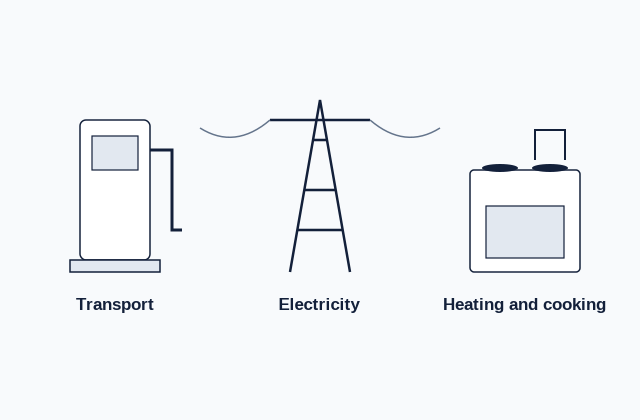 Tap to open the picture full size
Part 1 Think first Two countries, one size
Commit to a guess first. Being wrong now makes the right idea stick better.
Predict first
Two made-up countries have about the same number of people. In the first, most homes have heating, a car and many appliances. In the second, most families cook over wood fires and few own a car. How do you predict their energy use per person compares?
In short. Global energy consumption is how much energy the world uses, which sources supply it, and what shapes those choices.
- The lesson compares how developed and developing countries use energy.
- It names the sources that supply most of the world's energy and asks what industrializing does to demand.
- Availability, price and governmental regulations influence which energy sources people use and how they use them.
Part 2 Learn it Who uses energy, and from what
2a. Uneven use
The use of energy resources is not evenly distributed between developed and developing countries.
A developed country has high average incomes, widespread industry and electricity in most homes. A developing country has lower incomes and is still building that industry. Energy use per person, the total a country uses divided by its population, can differ many times over between the two.
Background: on average, a person in a developed country uses many times the energy of a person in a developing country, for cars, heating, cooling, appliances and the factories that make goods.
Compare countries per person, not only by total. A country with a huge population can use a large total while each person uses little.
Quick check · Multiple choice
In a made-up world, developed countries hold one-fifth of the people and use three-fifths of the energy. Which statement best describes this pattern?
2b. Fossil fuels lead
The most widely used sources of energy globally are fossil fuels. As developing countries become more developed, their reliance on fossil fuels for energy increases.
Fossil fuels are coal, oil and natural gas. Power plants, vehicles, furnaces and factories around the world burn them, and together they supply more of the world's energy than every other kind of source.
Development pulls in the same direction. A country that builds power plants, roads and factories comes to depend more on fossil fuels than it did when most energy came from muscle and firewood. Background: coal, oil and gas pack a lot of energy into fuel that is easy to move and store, which suits the plants and engines a growing economy builds.
Quick check · Decide and justify
A made-up news story says the world's solar panel capacity doubled in five years. A student concludes that solar power is now the world's most widely used energy source. Is the student right?
Which reason supports your answer?
2c. Industry raises demand
As the world becomes more industrialized, the demand for energy increases.
Industrialization is the growth of factories, mines and machine-powered work. Each step adds machines that run on energy: mills and smelters, trucks and trains, power lines to new towns, lights and appliances in new homes.
So world demand for energy climbs as more of the world industrializes. One country building its first steel mill raises its own demand; many countries doing the same raise the world's.
Demand here means the total amount of energy people want to use in a set time, such as exajoules a year. An exajoule (EJ) is a very large unit of energy, used for whole countries and the world.
Quick check · Select all
Over 20 years a made-up developing country builds steel mills, car plants and a national rail network. Which two changes would you predict? Pick two.
Select 2 answers, then check.
2d. What steers the choice
Availability, price and governmental regulations influence which energy sources people use and how they use them.
- Availability: whether a source is at hand. A region on top of a gas field, or with no power lines, starts from what it has.
- Price: what a source costs compared with the others. A cheaper fuel draws buyers, and a costly one makes people use less of it.
- Governmental regulations: rules and taxes set by governments, such as limits on a fuel's smoke or a tax on gasoline.
Each factor can change two things: which source people pick, such as a factory changing fuels, and how they use it, such as drivers taking fewer trips.
Quick check · Sort it
Which factor is steering each made-up change in energy use? Tap a card, then its group.
Availability
Price
Governmental regulation
Part 3 Watch it done How fast did demand grow?
Open each step in turn, answer the why, then finish the calculation yourself.
A made-up world used 440 exajoules (EJ) of energy in 1995. By 2025, as factories spread to more countries, it used 583 EJ. By what percent did energy demand rise?
Step 1 · Find the change
EJ more in 2025.
Why this step?
Why did demand rise as factories spread?
As the world becomes more industrialized, it runs more machines, plants and vehicles, so its demand for energy increases.
Step 2 · Choose what to divide by
A percent change is measured from the starting amount, the 1995 figure. Divide the change by it, then multiply by 100.
Your step · Calculate
Finish it. Demand rose by 143 EJ from 440 EJ in 1995. By what percent did it rise?
%
World demand rose 32.5% in thirty years as industry spread. The rest of the lesson asks which sources met that demand and what steers people toward one source or another.
Part 4 Try it Match the trends, then check an account
First match made-up observations to the trend each one shows. Then find where a student's account of a country's development goes wrong.
Try it · Match
Match each made-up observation to the trend in energy consumption it shows.
Try it · Spot the error
A student describes how a made-up country's energy use changed over 40 years. Tap the first line that goes wrong.
Part 5 Explain it Twenty years of world energy
Write your answer first. Nothing you type here leaves this page. Then compare it with the model and each scoring point.
Free response is 40% of the exam score. This one is shaped like Question 2, Analyze and interpret quantitative data.
Free-response practice · Question 2 style
A made-up world's energy use, in exajoules (EJ), made up for practice:
- 2000: fossil fuels 330 EJ; all other sources 70 EJ
- 2010: fossil fuels 410 EJ; all other sources 90 EJ
- 2020: fossil fuels 445 EJ; all other sources 125 EJ
(a) Identify the group of sources that supplied the most energy in every year shown.
(b) Calculate the percent of the world's total energy use in 2020 that came from fossil fuels. Show your work.
(c) Calculate the percent increase in total energy use from 2000 to 2020. Show your work.
(d) Explain one reason the world's total energy use could rise as it did.
(e) Explain how a governmental regulation could change which energy sources a country uses.
Model answer
(a) Fossil fuels supplied the most energy in 2000, 2010 and 2020.
(b) Total in 2020: EJ. from fossil fuels.
(c) Total in 2000: EJ. increase.
(d) As more of the world industrialized, factories, vehicles and power lines spread, and an industrializing world demands more energy.
(e) A government could limit the smoke a power plant may release, so plants switch from coal to a cleaner-burning fuel; a tax or a ban changes which sources are used.
Score your own answer. This is a self-check, not a grade. Tick each point your answer makes.
Part 6 Check yourself Forty years in two countries
The first two questions use the table.
Researchers compare two made-up countries. Country K was a developing country in 1985 and has industrialized since; Country M was already developed. Energy use is in gigajoules (GJ) per person per year. The numbers are made up for practice.
| Measure | 1985 | 2005 | 2025 |
|---|---|---|---|
| Country M: energy use per person (GJ) | 165 | 170 | 158 |
| Country K: share of energy from fossil fuels (percent) | 38 | 61 | 79 |
| Country K: energy use per person (GJ) | 12 | 31 | 58 |
Case question 1 · Multiple choice
Which statement do the data best support?
Case question 2 · Calculate
Using the table: by what percent did Country K's energy use per person rise from 1985 to 2025?
The rest stand on their own and do not use the case.
Check yourself · Fill the statement
Complete the account of a made-up region.
As the region builds factories and highways, its demand for energy , and like most of the world it gets the largest share of that energy from .
Check yourself · Rank it
Three made-up countries report their yearly energy use and population. One petajoule (PJ) is 1,000,000 gigajoules (GJ). Rank them by energy use per person.
Most energy per person first
Give each one a place, 1 for first. Give two the same place if they are equal.
Your ranking: none yet
Part 7 Keep it Bring back earlier ideas
Two questions from earlier topics: sorting energy supplies as renewable or nonrenewable, and a student's account of a salmon farm.
First sort made-up energy supplies by how each is being used. Then find where a student's account of a town's energy goes wrong.
From 6.1 Renewable and Nonrenewable Resources · Sort it
Is each made-up supply being used as a renewable or a nonrenewable source? Tap a card, then its group.
Renewable
Nonrenewable
First sort results of fish farming into benefits and drawbacks. Then find where a student's account of a salmon farm goes wrong.
From 5.16 Aquaculture · Spot the error
A student explains how a made-up salmon farm in a bay works. Tap the first line that goes wrong.
In three lines
- Energy use is not evenly distributed between developed and developing countries, and fossil fuels are the most widely used sources globally.
- As developing countries develop, their reliance on fossil fuels increases, and as the world industrializes, its demand for energy increases.
- Availability, price and governmental regulations influence which sources people use and how they use them.
Exam strategy for this topic
- Section I, Multiple Choice: 80 questions in 90 minutes.
- Section II, Free Response: 3 questions in 70 minutes.
- This lesson's Explain it is shaped like free-response question 2, Analyze and interpret quantitative data.
- A four-function, scientific, or graphing calculator is allowed on both sections of the exam.
When a question gives energy totals and populations, divide to get use per person before comparing countries, and show the units. When it asks which sources lead, the answer is fossil fuels.
Questions students ask
Which energy sources does the world use most?
Fossil fuels: coal, oil and natural gas are the most widely used sources of energy globally.
How does development change a country's energy use?
As developing countries become more developed, their reliance on fossil fuels for energy increases, and as the world industrializes, its demand for energy rises.
What decides which energy sources people use?
Availability, price and governmental regulations influence which sources people use and how they use them.
Course alignment, for teachers
AP Environmental Science topic 6.2, Unit 6: Energy Resources and Consumption.
- Skill 6.C: Calculate an accurate numeric answer with appropriate units.
This lesson maps all 5 essential knowledge statements of the topic to the part that teaches each one: 5 are checked by a scored question. The map is in the lesson file.