Unit 5 · Topic 5.2 · about 30 minutes · 7 parts · 10 scored checks, 2 of them multiple choice, plus 2 from earlier lessons
AP Environmental Science 5.2: Clearcutting
Unit 5: 10 to 15% of the multiple-choice section
What you'll be able to do
- Describe the effect of clearcutting on forests: its economic advantage, soil erosion, warmer soil and streams, flooding, and the release of stored carbon dioxide.
Key vocabulary
| Term | What it means | The exam trap |
|---|---|---|
| Clearcutting | Cutting down all or nearly all the trees in an area at one time. | It is a way of harvesting, not the same as clearing land for farms, though both remove the trees. |
| Soil erosion | The removal of soil from where it formed or settled, by water or wind. | Erosion moves soil; it does not have to leave a gully to count. |
| Climate change | A long-term change in Earth's climate, including a rise in average temperatures. | It is a change over decades, not one hot season. |
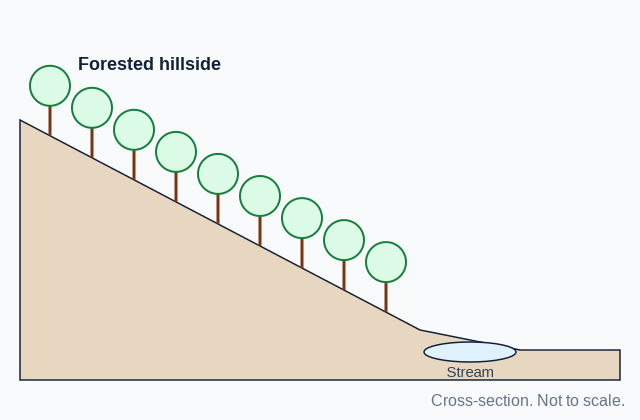 Tap to open the picture full size
Part 1 Think first All the trees, or a few?
Commit to a guess first. Being wrong now makes the right idea stick better.
Predict first
A timber company can harvest a hillside by cutting every tree at once, or by picking out a few trees each year and leaving the rest standing. Many companies choose to cut every tree at once. What do you predict is the main reason?
In short. Clearcutting is cutting down all or nearly all the trees in an area at one time.
- A timber company can cut every tree in an area at once, or pick out a few trees at a time.
- Each way of harvesting changes the soil, the streams below and the air in its own way.
- Trees hold carbon, so what happens to a forest's wood matters for climate.
Part 2 Learn it What clearcutting does
2a. Why companies clearcut
Clearcutting is cutting down all or nearly all the trees in an area at one time. The other way to harvest is to cut selected trees and leave the rest of the forest standing.
Clearcutting can be economically advantageous. With every tree coming out, a company brings its heavy machines in once, builds one set of roads, and harvests the whole stand in one operation. Fewer trips and less careful work around standing trees usually mean a lower cost for each tree cut.
That is the side of clearcutting the company sees. The land sees another side: the same clearcut "leads to soil erosion, increased soil and stream temperatures, and flooding." The next chunk takes each of those in turn.
Quick check · Multiple choice
A paper mill needs wood and is choosing how to harvest a stand of pine it owns. Which is an economic advantage of clearcutting the stand?
2b. Soil, streams and floods
Clearcutting leads to soil erosion, increased soil and stream temperatures, and flooding.
- Soil erosion. Tree roots hold soil in place, and leaves and fallen litter soften the rain before it hits the ground. With the trees gone, rain strikes bare soil and washes it downhill, often into streams.
- Warmer soil and streams. A forest shades its ground and its streams. Cleared, the soil sits in full sun and warms, and so does the water in an unshaded stream.
- Flooding. Background, how it happens: living trees take up large amounts of water through their roots, and the forest floor soaks up rain and lets it out slowly. On cleared land, more of each storm's rain runs off at once, so streams below rise faster and higher.
Background: these effects are often strongest on steep slopes and in the first years after the cut, before new plants cover the ground.
Quick check · Select all
A slope above a trout stream is clearcut. Which two changes would you expect in the next few years? Pick two.
Select 2 answers, then check.
2c. Forests and carbon
Forests contain trees that absorb pollutants and store carbon dioxide. As trees grow, they take carbon dioxide from the air and build its carbon into wood, roots and leaves, where it can stay for decades. Their leaves also take up some pollutants from the air.
The cutting and burning of trees releases carbon dioxide and contributes to climate change. After a clearcut, branches and other leftover wood are often burned, and the carbon they held goes back into the air as carbon dioxide. Carbon dioxide traps heat in the atmosphere, so adding it contributes to climate change.
So a clearcut works on the air twice over: the stored carbon comes out, and for years afterward the cleared land has no large trees taking more in.
Quick check · Sort it
Does each event take carbon dioxide out of the air, or put it into the air? Tap a card, then its group.
Takes carbon dioxide out of the air
Puts carbon dioxide into the air
Part 3 Watch it done How much warmer is the stream?
Open each step in turn, answer the why, then finish the calculation yourself.
On summer afternoons, a made-up stream under forest shade runs at 16.0 °C. After the slope above it is clearcut, it runs at 21.6 °C on similar afternoons. By what percent did the stream's temperature rise?
Step 1 · Find the change
°C warmer.
Why this step?
Why compare similar afternoons, not any two days?
Air temperature and sunshine change from day to day. Comparing similar afternoons keeps those the same, so the difference points to the lost shade.
Step 2 · Pick the starting value
A percent rise compares the change with where the temperature started, the 16.0 °C under shade.
Step 3 · Set up the percent
Divide the change by the starting value and multiply by 100.
Your step · Calculate
Finish it. A made-up stream ran at 16.0 °C on summer afternoons under forest shade and at 21.6 °C after the slope above it was clearcut. By what percent did its temperature rise?
%
A 35% rise, from losing the shade alone. Many stream animals, such as trout, need cool water, so a warmer stream can lose them.
Part 4 Try it Each effect, and its cause
First match each result of a clearcut with what causes it. Then find where a student's account of a forest's carbon goes wrong.
Try it · Match
Match each result of clearcutting a hillside with its cause.
Try it · Spot the error
A student explains what a forest does for the air. Tap the first line that goes wrong.
Part 5 Explain it Does a clearcut warm the stream?
Write your answer first. Nothing you type here leaves this page. Then compare it with the model and each scoring point.
Free response is 40% of the exam score. This one is shaped like Question 1, Design an investigation.
Free-response practice · Question 1 style
A forest agency will clearcut one of two neighboring hillsides next year. Each hillside drains into its own stream, and the two streams are similar in size, depth and elevation. A student wants to find out whether clearcutting raises stream temperature.
(a) Identify a testable hypothesis for the investigation.
(b) Identify the independent variable and the dependent variable.
(c) Identify the control in this investigation, and explain its purpose.
(d) Describe how the student should collect the temperature data so that the two streams can be fairly compared.
(e) Describe the results that would support the hypothesis, and explain why clearcutting would cause them.
Model answer
(a) If a hillside is clearcut, then the stream below it will be warmer in summer than the stream below the uncut hillside.
(b) Independent variable: whether the hillside is clearcut or left forested. Dependent variable: the temperature of the stream water.
(c) The stream below the uncut hillside is the control. It shows what the temperature would have been without the cut, so a difference can be linked to the clearcut and not to the weather that year.
(d) Measure both streams on the same days, at the same time of day, at the same depth, with the same kind of thermometer, both the summer before the cut and the summer after it.
(e) Before the cut the two streams are about the same temperature; after it, the stream below the clearcut is warmer than the control. Clearcutting removes the trees that shaded the stream, so more sunlight warms its water.
Score your own answer. This is a self-check, not a grade. Tick each point your answer makes.
Part 6 Check yourself Two watersheds
The first two questions use the table.
Two neighboring watersheds have the same rock, slope and rainfall. Two years ago one was clearcut; the other was left as forest. The table shows measurements of the stream draining each one. The numbers are made up for practice.
| Measurement | Uncut watershed | Clearcut watershed |
|---|---|---|
| Sediment carried by the stream (kg per day) | 18 | 120 |
| Summer afternoon water temperature (°C) | 15.5 | 20.5 |
| Highest flow after a large storm (cubic meters per second) | 2.5 | 4.0 |
Case question 1 · Multiple choice
Using the table: which effect of clearcutting does the sediment row show?
Case question 2 · Calculate
Using the table: by what percent was the highest flow after a large storm greater in the clearcut watershed's stream than in the uncut one's?
The rest stand on their own and do not use the case.
Check yourself · Fill the statement
Complete the account of one clearcut.
A company clearcuts a pine stand because one harvest of every tree is . In the summers after the cut, the creek below the stand runs than before.
Check yourself · Decide and justify
In the years after a hillside above a town is clearcut, the town's creek floods more often after storms. A student says the clearcut cannot be the cause, because cutting trees does not add any water to the creek. Is the student right?
Which reason supports your answer?
Part 7 Keep it Bring back earlier ideas
Two questions from earlier topics: the steps of a tragedy of the commons, and what makes towns at the same latitude differ in weather.
First put the steps of a tragedy of the commons in order. Then find where a student's account of a shared lake goes wrong.
From 5.1 The Tragedy of the Commons · Put it in order
Put these steps of a tragedy of the commons in order, first to last.
First find where a student's description of a mountain range goes wrong. Then sort four differences between towns by the factor behind each one.
From 4.8 Earth’s Geography and Climate · Sort it
Each card describes how one made-up town's weather differs from that of other towns at the same latitude. Tap a card, then the factor most likely behind it.
Ocean temperature
A mountain range
In three lines
- Clearcutting, cutting all or nearly all trees in an area at once, can be economically advantageous.
- It leads to soil erosion, increased soil and stream temperatures, and flooding.
- Forest trees absorb pollutants and store carbon dioxide; cutting and burning them releases it and contributes to climate change.
Exam strategy for this topic
- Section I, Multiple Choice: 80 questions in 90 minutes.
- Section II, Free Response: 3 questions in 70 minutes.
- This lesson's Explain it is shaped like free-response question 1, Design an investigation.
- A four-function, scientific, or graphing calculator is allowed on both sections of the exam.
When a question asks for effects of clearcutting, name them from the list: soil erosion, increased soil and stream temperatures, flooding, and released carbon dioxide. Then give the cause of the one you choose, such as lost shade for a warmer stream.
Questions students ask
What is clearcutting?
Cutting down all or nearly all the trees in an area at one time.
Why do companies clearcut?
Clearcutting can be economically advantageous: harvesting a whole stand in one operation usually lowers the cost of each tree.
How does clearcutting affect climate?
Forests store carbon dioxide. Cutting and burning the trees releases it, which contributes to climate change.
Course alignment, for teachers
AP Environmental Science topic 5.2, Unit 5: Land and Water Use.
- Skill 1.A: Describe environmental concepts and processes.
This lesson maps all 2 essential knowledge statements of the topic to the part that teaches each one: 2 are checked by a scored question. The map is in the lesson file.