Unit 8 · Topic 8.11 · about 35 minutes · 7 parts · 11 scored checks, 2 of them multiple choice, plus 2 from earlier lessons
AP Environmental Science 8.11: Sewage Treatment
Unit 8: 7 to 10% of the multiple-choice section
What you'll be able to do
- Describe best practices in sewage treatment.
Key vocabulary
| Term | What it means | The exam trap |
|---|---|---|
| Sewage | The wastewater that drains from toilets, sinks and showers, with everything it carries. | It carries dissolved pollutants and living bacteria as well as the solids you can see. |
| Aeration | Pumping air into water. | It is one step within one stage of treatment, not a stage of its own. |
| Sludge | The solid material that settles to the bottom of a treatment tank. | It is what settles out of the water, not what flows on to the next stage. |
| Discharge | The release of treated water into a river, lake or ocean. | What happens just before discharge is a separate step from the three treatment stages. |
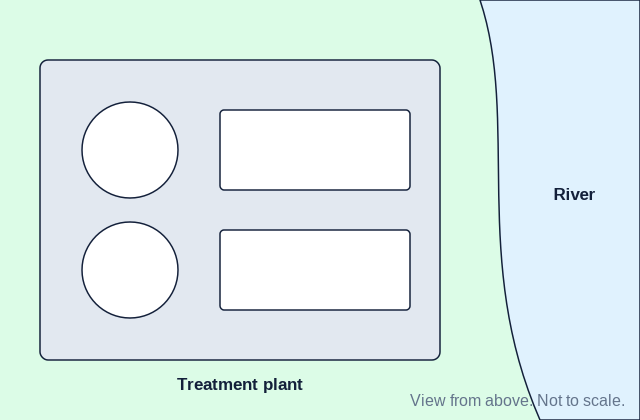 Tap to open the picture full size
Part 1 Think first Rags at the gate
Commit to a guess first. Being wrong now makes the right idea stick better.
Predict first
Wastewater reaches a made-up city's treatment plant carrying rags, sticks and plastic wrappers along with everything else. What do you predict the plant does with the rags, sticks and wrappers?
In short. Sewage treatment is the series of stages a plant uses to clean wastewater from homes and businesses before it is released.
- Secondary treatment is a biological stage: bacteria break down organic matter, and the inorganic sludge they leave settles.
- Tertiary treatment removes pollutants that are still in the water after the first two stages.
- Before discharge, the treated water is disinfected, for example with ozone or UV light.
Part 2 Learn it Cleaning wastewater in stages
2a. Primary treatment
Sewage is the wastewater that drains from toilets, sinks and showers, with everything it carries.
Primary treatment of sewage is the physical removal of large objects, often through the use of screens and grates, followed by the settling of solid waste in the bottom of a tank.
- Physical removal: the objects are caught or strained out, with no living things or chemicals doing the work.
- Settling: in still water, solids that are heavier than water sink to the bottom of the tank, where they can be scraped or pumped away.
For example, at a made-up plant a steel bar screen catches a soccer ball that rolled into a storm drain, and the water then moves slowly through a long basin.
Quick check · Multiple choice
After passing the screens, a made-up plant's wastewater sits for hours in a still tank. What happens to much of the solid waste that the screens missed?
2b. Secondary treatment
Secondary treatment is a biological process in which bacteria break down organic matter into carbon dioxide and inorganic sludge, which settles in the bottom of a tank. The tank is aerated to increase the rate at which the bacteria break down the organic matter.
- Biological: living things, here bacteria, do the work.
- Organic matter: material from living things, such as food waste and human waste.
- Inorganic sludge: the solid left behind, which settles.
- Aerated: air is pumped into the water.
For example, at a made-up plant, pipes along the floor of a tank blow a steady stream of bubbles up through the water while the bacteria feed.
Quick check · Decide and justify
A made-up plant's secondary treatment tank breaks down organic matter too slowly. An operator suggests sealing the tank so that no air reaches the water. Would sealing the tank speed up the breakdown?
Which reason supports your answer?
2c. Tertiary treatment
Tertiary treatment is the use of ecological or chemical processes to remove any pollutants left in the water after primary and secondary treatment.
- Ecological processes use living things, such as plants and the microbes around their roots, to take pollutants out of the water.
- Chemical processes add a substance that reacts with a leftover pollutant and pulls it out.
Water can look clear after the first two stages and still carry pollutants, such as dissolved nutrients that would feed algae in a river. For example, a made-up plant runs its water through a bed of charcoal that holds onto leftover chemicals.
Quick check · Select all
After primary and secondary treatment, a made-up plant's water still carries dissolved nutrients. Which two steps could be tertiary treatment? Pick two.
Select 2 answers, then check.
2d. Disinfection before discharge
Prior to discharge, the treated water is exposed to one or more disinfectants (usually, chlorine, ozone, or UV light) to kill bacteria.
Discharge is the release of the treated water into a river, lake or ocean. A disinfectant is anything that kills microbes. UV light is the invisible ultraviolet part of sunlight, made by special lamps.
For example, a made-up plant bubbles ozone gas through its water in a covered channel just before the outfall pipe.
Quick check · Fill the statement
Complete the account of a made-up plant's last stage.
Just before the treated water flows into the bay, the plant adds to it to kill the that are still in the water.
Part 3 Watch it done How much air does the tank need?
Open each step in turn, answer the why, then finish the calculation yourself.
A made-up plant's secondary treatment tank holds 2,400 cubic meters of wastewater. The plant's rule is 1.5 cubic meters of air per minute for every 100 cubic meters of water. How many cubic meters of air must the blowers supply per hour?
Step 1 · Count the hundreds of cubic meters
groups of 100 cubic meters.
Why this step?
Why does the plant pump air into this tank at all?
The tank is aerated to increase the rate at which the bacteria break down the organic matter.
Step 2 · Find the air per minute
cubic meters of air per minute. Then convert to an hour.
Your step · Calculate
Finish it. The blowers supply 36 cubic meters of air per minute. How many cubic meters of air do they supply per hour?
cubic meters
The blowers move 2,160 cubic meters of air an hour into that one tank. Carry the units at each step: cubic meters per minute, times minutes per hour, gives cubic meters per hour.
Part 4 Try it Put the stages in order, then check a tour
First put a made-up plant's steps in order. Then find where a student's account of a plant tour goes wrong.
Try it · Put it in order
Put the steps at a made-up plant in order, first to last, starting where the water leaves the primary settling tank.
Try it · Spot the error
A student describes a tour of a made-up treatment plant. Tap the first line that goes wrong.
Part 5 Explain it How long under the lamps?
Write your answer first. Nothing you type here leaves this page. Then compare it with the model and each scoring point.
Free response is 40% of the exam score. This one is shaped like Question 1, Design an investigation.
Free-response practice · Question 1 style
A made-up plant disinfects its treated water with UV light. An operator wants to find out how the time water spends under the UV lamps affects how many bacteria survive. The plant has a supply of treated water from one tank, five identical small trays, one UV lamp of the kind the plant uses, a timer, and a lab that can count the living bacteria in a water sample.
(a) Identify a testable hypothesis for the investigation.
(b) Identify the independent variable and the dependent variable.
(c) Describe one variable the operator should keep the same for every tray, and why.
(d) Describe the results the operator would expect if your hypothesis is correct.
(e) Explain why a plant disinfects its water before discharge.
Model answer
(a) If treated water spends longer under the UV lamp, then fewer bacteria in it will survive.
(b) Independent variable: the time each tray spends under the lamp (for example 0, 10, 20, 40 and 80 seconds). Dependent variable: the number of living bacteria counted in a sample from each tray afterward.
(c) The depth of water in each tray, for example 2 centimeters in every tray, because light passing through deeper water would reach fewer of the bacteria. (The same distance from the lamp and the same source of water also fit.)
(d) The tray with no time under the lamp keeps the most living bacteria, and the count falls as the time under the lamp rises, with the 80 second tray lowest.
(e) Bacteria can survive the earlier stages, so before discharge the water is exposed to a disinfectant such as UV light, chlorine or ozone to kill them before the water reaches a river, lake or ocean.
Score your own answer. This is a self-check, not a grade. Tick each point your answer makes.
Part 6 Check yourself Four stages, lettered
The first two questions use the figure and the case.
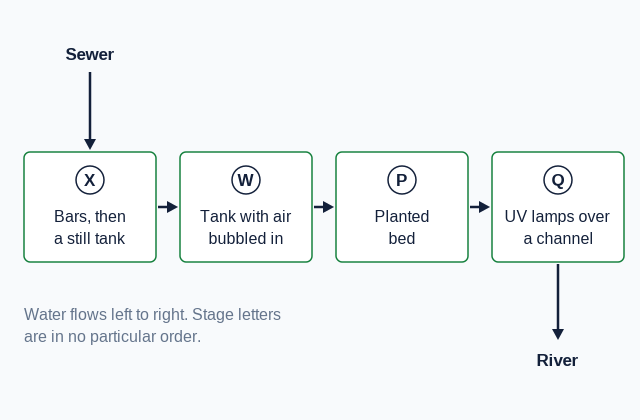
A made-up plant treats 45 million liters of wastewater a day. The figure shows its four stages in the order the water flows, from the sewer at the left to the river at the right, lettered in no particular order. Over 30 days, the bars at the plant's first stage caught 3.6 metric tons of rags, sticks and plastic. The numbers are made up for practice.
 Tap to open the picture full size
Case question 1 · Multiple choice
Which stage of the made-up plant in the figure is secondary treatment?
Case question 2 · Calculate
Using the case: how many kilograms of large objects did the bars catch per million liters of wastewater treated? Give the answer to the nearest hundredth.
The rest stand on their own and do not use the case.
Check yourself · Match
Match each made-up observation at a treatment plant to what it shows.
Check yourself · Sort it
Which of these made-up things in a city's wastewater would screens and grates take out? Tap a card, then its group.
Caught by screens and grates
Passes through the screens
Part 7 Keep it Bring back earlier ideas
Two questions from earlier topics in this unit.
First put a set of made-up events in order. Then find where a student's account goes wrong.
From 8.10 Waste Reduction Methods · Put it in order
Put the events at a made-up town in order, first to last.
First order a chain of made-up events. Then find the first line where a student's account goes wrong.
From 8.8 Bioaccumulation and Biomagnification · Spot the error
A student describes DDT in a made-up reservoir. Tap the first line that goes wrong.
In three lines
- Primary treatment removes large objects with screens and grates, then lets solid waste settle in a tank.
- Secondary treatment uses bacteria, in an aerated tank, to break organic matter into carbon dioxide and inorganic sludge; tertiary treatment removes what is left by ecological or chemical processes.
- Before discharge, a disinfectant, usually chlorine, ozone or UV light, kills bacteria in the treated water.
Exam strategy for this topic
- Section I, Multiple Choice: 80 questions in 90 minutes.
- Section II, Free Response: 3 questions in 70 minutes.
- This lesson's Explain it is shaped like free-response question 1, Design an investigation.
- A four-function, scientific, or graphing calculator is allowed on both sections of the exam.
When a question asks about sewage treatment, name the stage and what does its work: primary is physical (screens, grates, settling), secondary is biological (bacteria, with aeration), tertiary is ecological or chemical, and disinfection before discharge kills bacteria.
Questions students ask
What happens in primary sewage treatment?
Large objects are removed physically, often by screens and grates, and then solid waste settles in the bottom of a tank.
Why are secondary treatment tanks aerated?
Air increases the rate at which bacteria break down the organic matter into carbon dioxide and inorganic sludge.
How is treated sewage disinfected?
Before discharge the water is exposed to one or more disinfectants, usually chlorine, ozone or UV light, to kill bacteria.
Course alignment, for teachers
AP Environmental Science topic 8.11, Unit 8: Aquatic and Terrestrial Pollution.
- Skill 2.A: Describe characteristics of an environmental concept, process, or model represented visually.
This lesson maps all 4 essential knowledge statements of the topic to the part that teaches each one: 4 are checked by a scored question. The map is in the lesson file.