Unit 3 · Topic 3.2 · about 30 minutes · 7 parts · 11 scored checks, 3 of them multiple choice, plus 2 from earlier lessons
AP Environmental Science 3.2: K-Selected r-Selected Species
Unit 3: 10 to 15% of the multiple-choice section
What you'll be able to do
- Identify differences between K- and r-selected species: their traits, biotic potential, strategies that are not uniquely one or the other, and how each is affected by invasive species.
Key vocabulary
| Term | What it means | The exam trap |
|---|---|---|
| K-selected species | A species that tends to be large and long-lived and to have few offspring per reproduction event. | Few offspring per event does not mean it reproduces once; check how many times in its life. |
| r-selected species | A species that tends to be small and short-lived and to have many offspring. | Read every trait a question gives, not just one; a single trait can mislead. |
| Biotic potential | The maximum reproductive rate of a population in ideal conditions. | Biotic potential is a rate, not a count of individuals. |
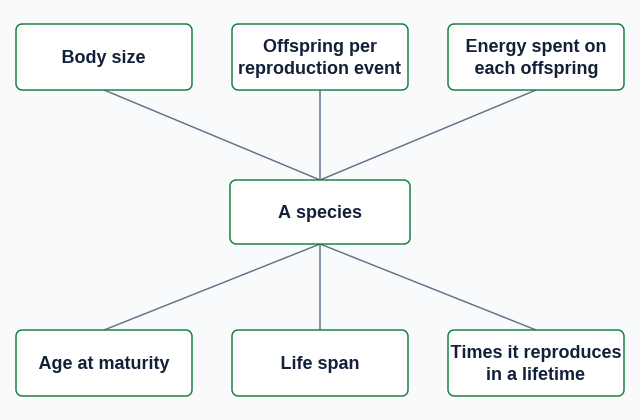 Tap to open the picture full size
Part 1 Think first A cold snap, a beetle and a bear
Commit to a guess first. Being wrong now makes the right idea stick better.
Predict first
Suppose a hard cold snap kills 90% of two populations in a valley. One is a beetle that lays hundreds of eggs and whose young can breed a few weeks after hatching. The other is a bear that has one or two cubs every few years and cares for them for two years. The situation is made up for practice. Which population do you predict gets back to its old size first?
In short. K-selected and r-selected species are two reproductive strategies, told apart by traits such as body size, offspring number, energy per offspring and life span.
- Biotic potential is the maximum reproductive rate of a population in ideal conditions.
- Many species are not uniquely r-selected or K-selected, or they change strategy with conditions.
- Most invasive species are r-selected, and K-selected species are typically more adversely affected by them.
Part 2 Learn it K-selected and r-selected species
2a. K-selected species
K-selected species tend to share a set of traits:
- They are large.
- They have few offspring per reproduction event, often just one.
- They expend significant energy on each offspring.
- They mature after many years of extended youth and parental care.
- They have long life spans.
- They reproduce more than once in their lifetime.
- They live in stable environments, where competition for resources is usually relatively high.
A made-up whale that is 15 m long, has one calf every three years, nurses it for a year, first breeds at 10 years old and lives 70 years fits every line.
Read few offspring per reproduction event carefully. It is about each event. A K-selected species has few young at a time, but it has young many times over its long life.
Quick check · Select all
Which two traits fit a K-selected species? Pick two.
Select 2 answers, then check.
2b. r-selected species
r-selected species tend to sit at the other end of each trait:
- They are small.
- They have many offspring.
- They expend or invest minimal energy on each offspring.
- They mature early.
- They have short life spans.
- They may reproduce only once in their lifetime.
- Competition for resources in their habitats is typically relatively low.
A made-up mosquito that lays 300 eggs at once, leaves them on the water, becomes an adult in two weeks and lives a month fits the list.
Notice the two words about competition. In a K-selected species' habitat it is usually relatively high; in an r-selected species' habitat it is typically relatively low. Both are comparisons, not absolutes.
Quick check · Sort it
Each card is a trait. Tap a card, then the strategy it fits.
K-selected
r-selected
2c. Biotic potential
Biotic potential refers to the maximum reproductive rate of a population in ideal conditions.
Ideal conditions means nothing holds the population back: plenty of food, water and space, and no disease or predators. Real populations almost never live like that, so the growth rate you measure in a real field or lake is usually lower than the biotic potential.
Think of it as a ceiling. A made-up fruit fly kept in a lab jar with unlimited food, at the best temperature, with no crowding, shows how fast it can reproduce. The same fly outdoors, with wasps, a cold night and a rotting apple that runs out, reproduces more slowly. Its biotic potential is the lab ceiling, not the outdoor rate.
Quick check · Decide and justify
Researchers measure how fast a rabbit population grows in a field with foxes, little rain and crowded burrows. A student calls this growth rate the rabbits' biotic potential. Is the student right?
Which reason supports your answer?
2d. Mixed strategies and invasive species
The two lists describe the ends of a range. Many species have reproductive strategies that are not uniquely r-selected or K-selected, or they change in different conditions at different times. A made-up lizard might be small and mature early, yet lay only two eggs at a time and guard them.
The strategies also matter when an invasive species arrives: a species brought into an area where it did not live before, often by people, that spreads there.
- Most invasive species are r-selected species.
- K-selected species are typically more adversely affected by invasive species than r-selected species, which are minimally affected by invasive species.
So if an invader reaches a forest, the natives to worry about first are the K-selected ones, such as a large parrot that raises one or two chicks a year.
Common mistakes are below.
Quick check · Multiple choice
A ship's ballast water brings two made-up species into a lake: a small snail that lays thousands of eggs a year and dies within a year, and a large turtle that lays a few eggs a year and lives 50 years. Which of the two has the reproductive strategy that most invasive species have?
Part 3 Watch it done Two mammals in a field guide
Open each step in turn, answer the why, then finish the calculation yourself.
Suppose a field guide lists two made-up mammals. Species P weighs 400 kg, has 1 young per birth, first breeds at 6 years, lives 35 years, gives birth 8 times in its life and nurses each young for 2 years. Species Q weighs 30 g, has 6 young per litter, first breeds at 6 weeks, lives about 1 year and has 4 litters in its life. How many times as many young does Q produce in a lifetime as P?
Step 1 · Compare size and young per event
P is large with 1 young per birth; Q is small with 6 per litter.
Step 2 · Compare maturity, life span and care
P breeds at 6 years, lives 35 years and nurses for 2 years, so it fits K-selected. Q breeds at 6 weeks and lives about a year, so it fits r-selected.
Why this step?
Why compare several traits, not just one?
Many species are not uniquely r-selected or K-selected. One trait can mislead; the pattern across traits shows the strategy.
Step 3 · Set up lifetime young
Lifetime young = young per event events in a lifetime, for each species.
Your step · Calculate
Finish it. Made-up species P has 1 young per birth and gives birth 8 times in its life. Made-up species Q has 6 young per litter and has 4 litters in its life. How many times as many young does Q produce in a lifetime as P?
times as many
Q produces 24 young in its short life; P produces 8 over 35 years, but nurses each for two years. Few offspring per event does not mean one in a lifetime: P reproduces 8 times.
Part 4 Try it A fish that switches, and an invader in a grassland
First decide what kind of strategy a fish has when it changes with the food supply. Then say which native species an invader affects most.
Try it · Multiple choice
A made-up fish lays thousands of small eggs in years when food is plentiful, but a few large eggs that it guards in years when food is scarce. Which statement fits this fish?
Try it · Fill the statement
Suppose an invasive weed spreads through a grassland where two native species live: a grasshopper that lives one season and lays hundreds of eggs, and a tortoise that lives 80 years and lays a few eggs a year. Tap a blank, then an answer.
The grasshopper is , the tortoise is , and the is typically more adversely affected by the invasive weed.
Part 5 Explain it Rats reach a seabird island
Write your answer first. Nothing you type here leaves this page. Then compare it with the model and each scoring point.
Free response is 40% of the exam score. This one is shaped like Question 2, Analyze and interpret quantitative data.
Free-response practice · Question 2 style
Suppose rats, an r-selected invasive species, reach an island. Researchers have data on two native species there. The numbers are made up for practice.
- Seabird: lays 1 egg per year, first breeds at 6 years, lives about 40 years, and parents feed each chick for 4 months. Count before the rats: 1,200. Count 5 years later: 420.
- Beetle: lays about 200 eggs at once, breeds at 3 months, and lives under a year, with no care of the eggs. Count before the rats: 50,000. Count 5 years later: 46,000.
(a) Describe how the two species differ in offspring per reproduction event and in life span.
(b) Identify which native species is K-selected and which is r-selected.
(c) Calculate the percent change in each species' count over the 5 years. Show your work.
(d) Explain how the results fit what is known about how invasive species affect K-selected and r-selected species.
Model answer
(a) The seabird has 1 egg per event and lives about 40 years; the beetle has about 200 eggs per event and lives under a year.
(b) The seabird is K-selected; the beetle is r-selected.
(c) Seabird: . Beetle: .
(d) K-selected species are typically more adversely affected by invasive species than r-selected species, which are minimally affected. The data fit: the K-selected seabird fell by 65% and the r-selected beetle by only 8%. A seabird pair raises one chick a year, so birds lost to the rats are replaced slowly, while the beetles' many eggs and early breeding replace losses quickly.
Score your own answer. This is a self-check, not a grade. Tick each point your answer makes.
Part 6 Check yourself Four species in one table
The first two questions use the table.
Suppose a field guide lists four made-up species. The numbers are made up for practice.
| Species | Body mass | Offspring per event | Age at first reproduction | Life span | Events in a lifetime | Care of young |
|---|---|---|---|---|---|---|
| W | 450 kg | 1 | 8 years | 40 years | 10 | Years |
| X | 20 g | 300 | 10 weeks | 1 year | 1 | None |
| Y | 1 g | 2,000 | 3 weeks | 2 months | 1 | None |
| Z | 60 kg | 2 | 5 years | 25 years | 8 | Months |
Case question 1 · Multiple choice
Using the table of four species: which statement describes a pattern in the data?
Case question 2 · Decide and justify
Using the table of four species: a student says species X and Y fit r-selected species. Is the student right?
Which reason supports your answer?
The rest stand on their own and do not use the case.
Check yourself · Spot the error
A student compares two made-up species, W and Y. Tap the first line that goes wrong.
Check yourself · Match
Match each made-up species to the strategy its traits fit.
Part 7 Keep it Bring back earlier ideas
Two questions from earlier topics: which habitats are changing ones, and the percent change in a count of long-legged lizards.
First decide which habitats are changing. Then find where a student's explanation goes wrong.
From 3.1 Generalist and Specialist Species · Select all
Which two of these are changing habitats, where generalist species tend to be advantaged? Pick two.
Select 2 answers, then check.
First put natural selection in order. Then work out a change in a count, which is a different number from a change in a share.
From 2.6 Adaptations · Calculate
Suppose 18 of 90 lizards on an island have long legs in generation 1, and 54 of 135 have long legs in generation 3. The numbers are made up for practice. What is the percent change in the number of long-legged lizards from generation 1 to generation 3? Give your answer as a percent.
In three lines
- K-selected species tend to be large, have few offspring per event, invest much in each, mature late, live long and reproduce more than once; r-selected species tend to be the opposite.
- Biotic potential is the maximum reproductive rate of a population in ideal conditions, and many species are not uniquely r- or K-selected.
- Most invasive species are r-selected, and K-selected species are typically more adversely affected by them.
Exam strategy for this topic
- Section I, Multiple Choice: 80 questions in 90 minutes.
- Section II, Free Response: 3 questions in 70 minutes.
- This lesson's Explain it is shaped like free-response question 2, Analyze and interpret quantitative data.
- A four-function, scientific, or graphing calculator is allowed on both sections of the exam.
In a traits table, compare the species trait by trait (size, offspring per event, maturity, life span, events in a lifetime, care), then name the strategy the pattern fits. Say mixed if the traits split.
Questions students ask
What traits do K-selected species tend to have?
Large size, few offspring per reproduction event, significant energy for each offspring, late maturity after extended youth and parental care, long life spans, more than one reproduction event, and stable environments where competition is usually relatively high.
What traits do r-selected species tend to have?
Small size, many offspring, minimal energy per offspring, early maturity, short life spans, possibly only one reproduction event, and typically relatively low competition.
What is biotic potential?
The maximum reproductive rate of a population in ideal conditions.
Is every species either r-selected or K-selected?
No. Many species have strategies that are not uniquely one or the other, or that change in different conditions at different times.
Which species do invasive species affect most?
K-selected species are typically more adversely affected than r-selected species. Most invasive species are themselves r-selected.
Course alignment, for teachers
AP Environmental Science topic 3.2, Unit 3: Populations.
- Skill 5.A: Describe patterns or trends in data.
This lesson maps all 5 essential knowledge statements of the topic to the part that teaches each one: 5 are checked by a scored question. The map is in the lesson file.