Unit 8 · Topic 8.6 · about 30 minutes · 7 parts · 10 scored checks, 2 of them multiple choice, plus 2 from earlier lessons
AP Environmental Science 8.6: Thermal Pollution
Unit 8: 7 to 10% of the multiple-choice section
What you'll be able to do
- Describe the effects of thermal pollution on aquatic ecosystems.
Key vocabulary
| Term | What it means | The exam trap |
|---|---|---|
| Thermal pollution | Heat released into water that produces negative effects on the organisms there. | It is about heat in water, not about warm air over a city. |
| Dissolved oxygen | The oxygen held in water, which fish take in through their gills. | It is oxygen gas held in the water, not the oxygen that is part of each water molecule. |
| Concentration | The amount of a substance in a given volume, such as milligrams of oxygen in each liter of water. | A higher concentration means more in each liter, not more water in all. |
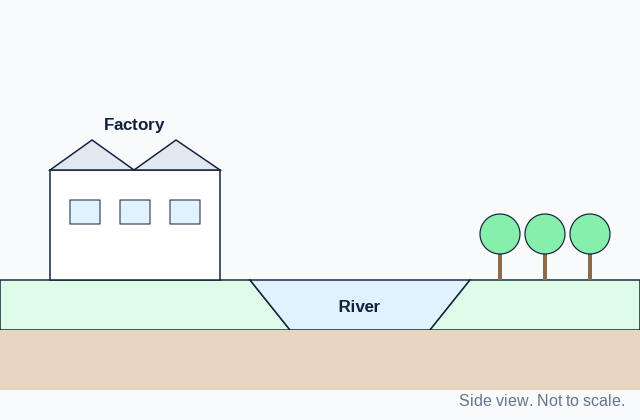 Tap to open the picture full size
Part 1 Think first A pond in January and August
Commit to a guess first. Being wrong now makes the right idea stick better.
Predict first
A made-up pond is tested on a cold January morning and again on a hot August afternoon, with nothing else about it changed. What do you predict about how much dissolved oxygen its water can hold?
In short. Thermal pollution occurs when heat released into water produces negative effects on the organisms living there.
- Variations in water temperature affect the concentration of dissolved oxygen.
- Fish and other organisms that need high dissolved oxygen are among those it can harm.
- Its harm is to the organisms of the ecosystem that the heated water enters.
Part 2 Learn it Heat as a pollutant
2a. When heat counts as pollution
Thermal pollution occurs when heat released into the water produces negative effects to the organisms in that ecosystem.
Two parts must both be there:
- Heat released into the water: water returned or discharged warmer than the water it enters.
- Negative effects on the organisms there: living things in that water are harmed, for example they grow poorly, fail to reproduce, leave or die.
Both parts must be there. Warm water that harms nothing living in it does not meet the description.
For example, a made-up power plant returns the river water it uses about 10 °C warmer, and the mayflies that once lived on the stones below it are gone. Background: power plants and factories often use water from a river, lake or bay to carry heat away from their machinery.
Quick check · Multiple choice
Which made-up release fits the description of thermal pollution?
2b. Warm water holds less oxygen
Variations in water temperature affect the concentration of dissolved oxygen because warm water does not contain as much oxygen as cold water.
Dissolved oxygen is the oxygen held in the water itself, which fish take in through their gills. Its concentration is how much is held in each liter, often given in milligrams per liter (mg/L).
The colder the water, the more dissolved oxygen it can hold; the warmer, the less. So when heat is released into a river, the warmed stretch can hold less oxygen than the water above it.
For example, a made-up mountain stream measured in January holds noticeably more dissolved oxygen than the same stream measured in July.
Quick check · Decide and justify
During a hot week, the water in a made-up trout farm's outdoor tank warms from 12 °C to 22 °C. The farmer says the tank now holds less dissolved oxygen for the trout. Is the farmer right?
Which reason supports your answer?
2c. What the heat does to living things
The two ideas work together. Heat released into the water can harm organisms that cannot live in warmer water, and the same warming leaves less dissolved oxygen for every organism that needs it. Fish that need a lot of oxygen are hit hard: they leave the warmed water if they can, and die if they cannot.
An effect on one organism can reach others. Animals that fed on the fish lose a food supply, and rooted plants and animals fixed in place cannot leave at all.
For example, below a made-up steel mill's warm outflow, mussels fixed to the riverbed die, while upstream they live.
Quick check · Select all
A made-up power plant begins releasing warm water into a lake cove. Which two changes in the cove would show thermal pollution? Pick two.
Select 2 answers, then check.
Part 3 Watch it done How much less oxygen below the outflow?
Open each step in turn, answer the why, then finish the calculation yourself.
Above a made-up factory's warm outflow, a river is 10 °C and holds 11.2 milligrams per liter (mg/L) of dissolved oxygen. Below it, the water is 28 °C and holds 7.84 mg/L. By what percent less dissolved oxygen does the water below the outflow hold?
Step 1 · Find the difference
mg/L less dissolved oxygen below the outflow.
Why this step?
Why does the water below the outflow hold less dissolved oxygen?
It is warmer, and warm water does not contain as much oxygen as cold water.
Step 2 · Choose the operation
A percent difference compares the difference with the starting level, so divide 3.36 by the level above the outflow.
Your step · Calculate
Finish it. The water below the outflow holds 3.36 mg/L less dissolved oxygen than the 11.2 mg/L above it. By what percent less?
%
Almost a third of the oxygen the river held above the outflow is missing below it. Next, use the definition and this effect on two new cases.
Part 4 Try it Fill in an account, then check another
First complete an account of a made-up pond. Then find where a student's account of a power plant goes wrong.
Try it · Fill the statement
Complete the account of a made-up factory's outflow.
The factory's warm outflow lowers the of the pond it drains into, and because the pond's dragonfly larvae then die off, the outflow is a case of .
Try it · Spot the error
A student describes a made-up power plant on a bay. Tap the first line that goes wrong.
Part 5 Explain it A power plant's cooling water
Write your answer first. Nothing you type here leaves this page. Then compare it with the model and each scoring point.
Free response is 40% of the exam score. This one is shaped like Question 3, Analyze an environmental problem doing calculations.
Free-response practice · Question 3 style
A made-up power plant draws 2,400,000 liters of river water each hour to carry heat away from its machinery and returns it to the river warmer. The water comes in holding 10.8 milligrams per liter (mg/L) of dissolved oxygen and goes back out at a temperature where it holds only 7.2 mg/L. The figures are made up for practice. One kilogram is 1,000,000 milligrams.
(a) Describe one way the warmer water could harm the fish below the plant.
(b) Calculate how many kilograms less dissolved oxygen the returned water holds each hour than it did when it came in. Show your work.
(c) Calculate that difference for one day, if the plant runs for 24 hours. Show your work.
(d) Explain why the warm water counts as thermal pollution only if it harms organisms in the river.
(e) Describe one approach the plant could take to reduce its thermal pollution.
Model answer
(a) Warm water does not contain as much oxygen as cold water, so the fish below the plant have less dissolved oxygen, and those that need a lot of it may leave or die.
(b) mg/L less. mg, and kg less each hour.
(c) kg less in one day.
(d) Thermal pollution occurs when heat released into the water produces negative effects on the organisms in that ecosystem. Warm water that harmed nothing living in the river would not meet that description.
(e) The plant could hold the warm water in a pond until it cools to near the river's temperature before releasing it. (Releasing it more slowly, or reusing it, also fits.)
Score your own answer. This is a self-check, not a grade. Tick each point your answer makes.
Part 6 Check yourself Four sites along a river
The first two questions use the table.
A made-up class measures water temperature and dissolved oxygen at four sites along a river on one summer afternoon. A factory's warm outflow enters the river between site X and the other three; "up" means upstream of the outflow and "down" means downstream. The numbers are made up for practice.
| Site | Where | Temp (°C) | Oxygen (mg/L) |
|---|---|---|---|
| W | 2 km down | 22 | 8.8 |
| X | 1 km up | 14 | 10.4 |
| Y | 6 km down | 16 | 10.0 |
| Z | 0.2 km down | 27 | 7.9 |
Case question 1 · Multiple choice
Which statement do the data in the table support?
Case question 2 · Calculate
Using the table: from site X to site Z, by how many milligrams per liter did dissolved oxygen fall for each degree the water was warmer, on average? Give the answer to the nearest hundredth.
The rest stand on their own and do not use the case.
Check yourself · Match
Six made-up samples of the same fresh water are each held at a different temperature until they hold as much dissolved oxygen as they can. Match each temperature to the dissolved oxygen its sample holds.
Check yourself · Put it in order
Put the events at a made-up river in order, first to last.
Part 7 Keep it Bring back earlier ideas
Two questions from earlier topics in this unit.
First put the events at a made-up lake in order. Then find where a student's account of a lake with two arms goes wrong.
From 8.5 Eutrophication · Put it in order
Put the events at a made-up lake in order, first to last.
First complete an account of a made-up stream. Then find where a student's account of a farm's ponds goes wrong.
From 8.3 Endocrine Disruptors · Spot the error
A student describes a made-up study of frogs near farm fields. Tap the first line that goes wrong.
In three lines
- Thermal pollution occurs when heat released into water produces negative effects on the organisms there.
- Warm water does not contain as much dissolved oxygen as cold water.
- So warming water can harm organisms directly and by leaving them less oxygen.
Exam strategy for this topic
- Section I, Multiple Choice: 80 questions in 90 minutes.
- Section II, Free Response: 3 questions in 70 minutes.
- This lesson's Explain it is shaped like free-response question 3, Analyze an environmental problem doing calculations.
- A four-function, scientific, or graphing calculator is allowed on both sections of the exam.
When a question involves warm water, link the two ideas: say that warm water does not contain as much dissolved oxygen as cold water, then name the negative effect on a specific organism, which is what makes the heat thermal pollution.
Questions students ask
What is thermal pollution?
It occurs when heat released into the water produces negative effects on the organisms in that ecosystem.
Why does warm water hold less oxygen?
Variations in water temperature affect the concentration of dissolved oxygen, because warm water does not contain as much oxygen as cold water.
How does thermal pollution harm fish?
Warmed water holds less dissolved oxygen, so fish that need a lot of it may leave or die, and some organisms cannot live in the warmer water at all.
Course alignment, for teachers
AP Environmental Science topic 8.6, Unit 8: Aquatic and Terrestrial Pollution.
- Skill 1.C: Explain environmental concepts, processes, or models in applied contexts.
This lesson maps all 2 essential knowledge statements of the topic to the part that teaches each one: 2 are checked by a scored question. The map is in the lesson file.