Unit 1 · Topic 1.11 · about 30 minutes · 7 parts · 14 scored checks, 5 of them multiple choice, plus 2 from earlier lessons
AP Environmental Science 1.11: Food Chains and Food Webs
Unit 1: 6 to 8% of the multiple-choice section
What you'll be able to do
- Describe food chains and food webs, and their constituent members by trophic level, including detritivores and decomposers and how a change to one species affects the rest of a web.
Key vocabulary
| Term | What it means | The exam trap |
|---|---|---|
| Food chain | A model of a single path of feeding links from a producer up to a top consumer. | One organism can sit in many chains, so a single chain never shows everything it eats. |
| Food web | A model of an interlocking pattern of food chains, showing the flow of energy and matter in two or more chains. | A web can look crowded; follow one chain at a time from a producer. |
| Detritivore | An animal that eats dead plant and animal matter. | Ask whether what is being eaten is alive or dead before placing the eater. |
| Decomposer | An organism, such as a fungus or a bacterium, that breaks dead matter and wastes down into simpler substances. | Decomposers feed on every level, so look for them beside a web, not on one link. |
| Feedback loop | A chain of effects in which a change in one part of a system comes back around to affect that same part. | Follow the loop all the way around before naming it. |
 Tap to open the picture full size
Part 1 Think first A valley without wolves
Commit to a guess first. Being wrong now makes the right idea stick better.
Predict first
In a made-up mountain valley, wolves hunt elk, and elk browse on the young willow shoots that grow along the streams. Then hunters remove every wolf from the valley. What do you predict happens over the next twenty years?
In short. A food chain shows energy and matter flowing from producers to the consumers that eat them, and a food web shows how two or more food chains interlock.
- Producers (autotrophs) are eaten by primary consumers (herbivores), which are eaten by secondary and tertiary consumers (omnivores and carnivores).
- Detritivores and decomposers play an essential role by returning nutrients from dead matter to the soil.
- Positive and negative feedback loops can each play a role in food webs, and adding or removing one species can affect the rest of the web.
Part 2 Learn it Food chains and food webs
2a. Food chains
A food chain depicts the flow of energy and matter from one organism to the next, through a single path of who eats whom. Each arrow points from the food to the eater: clover → vole → owl.
- Producers, or autotrophs, make their own food by photosynthesis: plants, algae, phytoplankton.
- Primary consumers, or herbivores, eat producers.
- Secondary consumers eat primary consumers, and tertiary consumers eat secondary consumers. These are carnivores, which eat animals, or omnivores, which eat both producers and consumers.
An omnivore such as a bear that eats berries and fish feeds at more than one level: a primary consumer when it eats the berries, and a secondary or higher consumer when it eats the fish. Place each consumer by what it eats in the chain you are reading.
Quick check · Match
A coastal food chain runs kelp → sea urchins → sea otters → orcas. Match each member to its place in the chain.
2b. Detritivores and decomposers
Every organism eventually dies, and every animal makes wastes. Two groups deal with that dead matter.
- Detritivores are animals that eat dead plant and animal matter, such as earthworms, millipedes and dung beetles. They break it into smaller pieces.
- Decomposers, such as fungi and bacteria, break dead matter and wastes down into simpler substances.
Together they play an essential role in food chains and food webs: they return nutrients to the soil. The nitrogen and phosphorus in a fallen leaf or a dead mouse end up back in the soil, where producers take them up again. Without them, nutrients would stay locked in dead matter and producers would run short.
Detritivores and decomposers feed on every level, so a diagram may show them to one side, joined to the whole web rather than to one link.
Quick check · Multiple choice
Under a rotting log, woodlice eat the soft, decaying wood, and molds grow through it and break it down. What role do they play in the forest's food web?
2c. Food webs
Few animals eat only one thing, and few are eaten by only one predator. So a single chain leaves out most of the links.
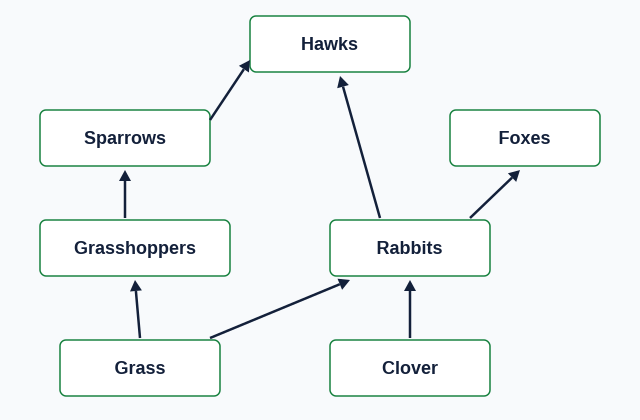
A food web is a model of an interlocking pattern of food chains. It depicts the flow of energy and matter in two or more food chains. In a meadow, grass may be eaten by rabbits and by grasshoppers, and rabbits may be eaten by foxes and by hawks. Each path from a producer to a top consumer is one chain, and the web shows them all at once.
To read a web, follow one chain at a time from a producer, along the arrows, to a consumer at the top. An organism that sits in more than one chain can be at a different level in each, as the omnivore was in the last chunk.
Quick check · Sort it
Each card describes a model of feeding links. Tap a card, then whether it is a food chain or a food web.
A food chain
A food web
2d. When one species changes
Because the chains in a web interlock, when one species is removed from or added to a food web, the rest of the web can be affected, including species it never eats.
Those effects can form feedback loops, chains of effects that come back around to the species where they started.
- A negative feedback loop counteracts a change. If a wet spring makes the grass grow thick, the grasshoppers that eat it have more food and increase; more grasshoppers eat more grass, and the grass falls back. The loop pushes the grass back toward where it was.
- A positive feedback loop amplifies a change. Suppose sea otters decline, so the urchins they eat increase and graze down the kelp, and with less kelp to shelter their pups, the otters decline further. The first change makes itself bigger.
To name a loop, follow it all the way around and ask whether the end result pushes back against the first change or adds to it.
Quick check · Sort it
Each card is a loop of effects in a food web. Tap a card, then the kind of feedback loop it is.
Negative feedback loop
Positive feedback loop
Part 3 Watch it done Placing every member of a pond web
Open each step in turn, answer the why, then finish the last step yourself.
Suppose a pond's food web works like this: algae and pondweed are eaten by snails and by tadpoles. Sunfish eat snails and tadpoles. Herons eat sunfish and tadpoles. Bacteria and fungi break down dead matter from every organism. Describe each member by its trophic level.
Step 1 · Find the producers
Algae and pondweed make their own food by photosynthesis. They are the producers, the autotrophs, at the lowest level.
Step 2 · Find the primary consumers
Snails and tadpoles eat only algae and pondweed. They are primary consumers, herbivores.
Step 3 · Move up a level
Sunfish eat snails and tadpoles, both primary consumers. So the sunfish are secondary consumers.
Why this step?
Why are the bacteria and fungi not placed at one trophic level?
They are decomposers. They feed on dead matter from every level, from algae to herons, and return its nutrients to the water and sediment, so they join the whole web rather than one link.
Your step · Fill the statement
Finish it. In a pond, snails and tadpoles eat only algae and pondweed, sunfish eat snails and tadpoles, and herons eat sunfish and tadpoles. Complete the description of the herons. Tap a blank, then an answer.
When a heron eats a sunfish, it is a consumer. When it eats a tadpole, it is a consumer. An animal that feeds at more than one level like this is one reason a models feeding better than a single chain.
Part 4 Try it A river web
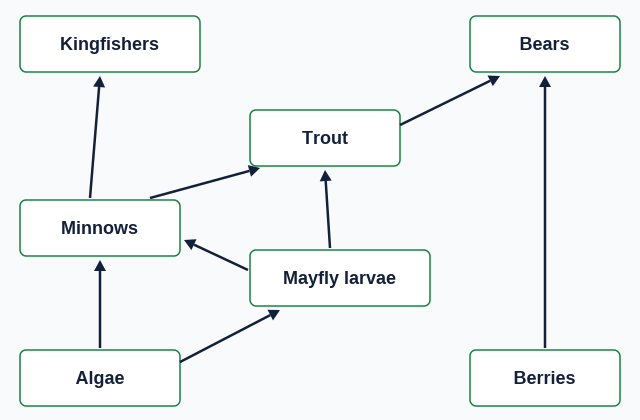
The drawing shows a river's food web, made up for practice. Each arrow runs from a food to the organism that eats it. Use it for the first two questions.
Try it · Select all
Use the drawing of the river food web. Which two of these are omnivores? Pick two.
Select 2 answers, then check.
Try it · Multiple choice
Use the drawing of the river food web. Along which food chain is the kingfisher a tertiary consumer?
Try it · Put it in order
A nitrogen atom starts in the soil of a meadow. Put the steps of its trip through a food chain and back into order.
Try it · Multiple choice
In a pond, algae are eaten by snails, and snails are eaten by sunfish. A crayfish that eats only snails is added to the pond. Which effect on the algae is most likely?
Part 5 Explain it Read eight years of rabbits and foxes
Write your answer first. Nothing you type here leaves this page. Then compare it with the model and each scoring point.
Free response is 40% of the exam score. This one is shaped like Question 2, Analyze and interpret quantitative data.
Free-response practice · Question 2 style
Suppose a team counts the rabbits and foxes on a large island every year for eight years. Foxes eat rabbits, and rabbits eat the island's grasses. The numbers below are made up for practice.
- Rabbits, years 1 to 8: 200, 320, 450, 380, 220, 160, 210, 300
- Foxes, years 1 to 8: 10, 14, 22, 30, 26, 16, 11, 13
(a) Identify the year with the most foxes.
(b) Describe how the fox numbers change in relation to the rabbit numbers.
(c) Use the numbers for years 3 to 7 to explain how the rabbits and foxes form a negative feedback loop.
(d) In year 9, goats that also eat the island's grasses are brought to the island. Explain how the rabbits and the foxes would most likely be affected.
Model answer
(a) Year 4, with 30 foxes.
(b) The foxes rise and fall after the rabbits do. The rabbits peak at 450 in year 3, and the foxes peak a year later at 30, in year 4. When the rabbits fall to 160 in year 6, the foxes fall too, to 11 in year 7.
(c) In year 3 the rabbits peak at 450, so the foxes have the most food, and their numbers climb to 30 in year 4. With more foxes eating them, the rabbits fall to 380 in year 4, 220 in year 5 and 160 in year 6. The rise in rabbits led, through the foxes, to a fall in rabbits, so the loop counteracts the first change: a negative feedback loop. The foxes then fall too, to 11 in year 7.
(d) The goats compete with the rabbits for the grasses, so less grass is left for the rabbits and the rabbits would decrease. With fewer rabbits to eat, the foxes would then decrease too. Adding one species affects the rest of the food web, even species it never eats.
Score your own answer. This is a self-check, not a grade. Tick each point your answer makes.
Part 6 Check yourself A new fish in the lake
The first three questions use the table.
Suppose a fish that eats zooplankton is added to a lake where it did not live before. Students compare the lake before it was added and three years after. The numbers below are made up for practice.
| Organism | What it eats | Before | Three years after |
|---|---|---|---|
| Algae (micrograms of chlorophyll per liter) | Makes its own food | 4 | 9 |
| Zooplankton (animals per liter) | Algae | 80 | 30 |
| Native minnows (per 100 m of shore) | Zooplankton | 40 | 15 |
| Added fish (per 100 m of shore) | Zooplankton | 0 | 25 |
| Herons (nests at the lake) | Minnows | 6 | 3 |
Case question 1 · Multiple choice
Using the table of the lake: which best explains why the algae increased after the new fish was added?
Case question 2 · Multiple choice
Using the table of the lake: which organism there is a secondary consumer?
Case question 3 · Decide and justify
Using the table of the lake, a student says the native minnows declined because the added fish competes with them for food, not because it eats them. Is the student right?
Which reason supports your answer?
The rest stand on their own and do not use the case.
Check yourself · Spot the error
A student describes the food chain grass → rabbit → fox. Tap the first line that goes wrong.
Check yourself · Select all
In a meadow, grass is eaten by grasshoppers and by rabbits, and the grasshoppers are eaten by sparrows and by shrews. A disease removes every grasshopper. Which two effects are most likely? Pick two.
Select 2 answers, then check.
Part 7 Keep it Bring back earlier ideas
Two questions from earlier topics: the energy a level below must store, and how light changes with depth in water.
Each question below changes something from the worked example: the levels being compared, the direction you work, or the percent passed on. Decide which before you calculate.
From 1.10 Energy Flow and the 10% Rule · Calculate
Owls in a woodland are secondary consumers: they eat mice, which eat plants. The owls store 25 kcal/m²/yr. Using the 10% rule, how much energy must the woodland's plants store to support them? Give your answer in kcal/m²/yr.
From 1.8 Primary Productivity · Select all
Which two statements about light in water are correct? Pick two.
Select 2 answers, then check.
In three lines
- A food chain shows energy and matter flowing from producers (autotrophs) to primary consumers (herbivores) and on to secondary and tertiary consumers (omnivores and carnivores).
- Detritivores and decomposers return nutrients from dead matter to the soil, and a food web shows two or more food chains interlocking.
- Adding or removing one species can affect the rest of a food web, and positive and negative feedback loops can each play a role.
Exam strategy for this topic
- Section I, Multiple Choice: 80 questions in 90 minutes.
- Section II, Free Response: 3 questions in 70 minutes.
- This lesson's Explain it is shaped like free-response question 2, Analyze and interpret quantitative data.
- A four-function, scientific, or graphing calculator is allowed on both sections of the exam.
When a question changes one species in a food web, follow each link out from that species one step at a time, saying whether each population rises or falls and why, until you reach the organism the question asks about.
Questions students ask
What is the difference between a food chain and a food web?
A food chain depicts one path of energy and matter from producers to consumers. A food web is a model of an interlocking pattern of food chains, showing two or more chains at once.
What do the arrows in a food chain show?
Each arrow shows energy and matter moving from the food to the organism that eats it.
What do detritivores and decomposers do?
They break down dead matter and wastes, and play an essential role in food chains and food webs by returning nutrients to the soil.
What happens when a species is removed from a food web?
The rest of the food web can be affected, including species that never ate it or were never eaten by it.
What is a feedback loop in a food web?
A chain of effects that comes back to the species where it started. A negative loop counteracts the first change, and a positive loop amplifies it.
Course alignment, for teachers
AP Environmental Science topic 1.11, Unit 1: The Living World: Ecosystems.
- Skill 2.A: Describe characteristics of an environmental concept, process, or model represented visually.
This lesson maps all 2 essential knowledge statements of the topic to the part that teaches each one: 2 are checked by a scored question. The map is in the lesson file.