Unit 6 · Topic 6.1 · about 30 minutes · 7 parts · 10 scored checks, 2 of them multiple choice, plus 2 from earlier lessons
AP Environmental Science 6.1: Renewable and Nonrenewable Resources
Unit 6: 10 to 15% of the multiple-choice section
What you'll be able to do
- Identify differences between nonrenewable and renewable energy sources.
Key vocabulary
| Term | What it means | The exam trap |
|---|---|---|
| Energy transformation | A change of energy from one form to another, such as the chemical energy in a fuel becoming heat as it burns. | A transformation changes the form of energy; it does not create new energy. |
| Rate of consumption | How much of a resource people use in a set time, such as metric tons of wood a year. | A rate needs a time: 3,000 metric tons is an amount, while 3,000 metric tons a year is a rate. |
| Replenish | To fill up or supply again, as rain refills a lake. | Replenishing adds new supply; moving the same supply to a new place does not replenish it. |
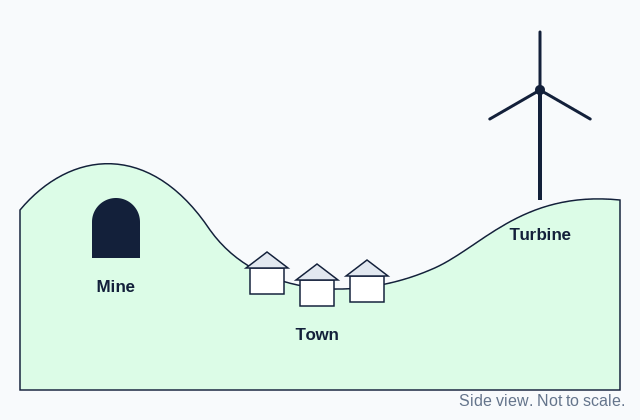 Tap to open the picture full size
Part 1 Think first Firewood for a village
Commit to a guess first. Being wrong now makes the right idea stick better.
Predict first
A made-up mountain village heats its homes with firewood cut from the woods around it. The villagers burn about 3,000 metric tons of wood a year, and the woods grow back about 300 metric tons a year. What do you predict happens to the village's wood supply over the next 50 years?
In short. Nonrenewable energy sources exist in a fixed amount and cannot be easily replaced once used; renewable energy sources can be replenished naturally and reused.
- Using a nonrenewable source transforms the energy stored in it, and that source cannot be easily replaced.
- A renewable source is supplied again by nature and can be drawn on again.
- The two kinds differ in whether a supply can be replaced, not in whether they make heat or electricity.
Part 2 Learn it Fixed amounts and natural supply
2a. Sources in a fixed amount
Nonrenewable energy sources exist in a fixed amount and involve energy transformation that cannot be easily replaced.
- A fixed amount: there is a set quantity of the source, and no natural process adds to it on any time scale people plan for. Each unit taken out leaves less behind.
- Energy transformation: using the source changes the energy stored in it into other forms, such as heat. Once a power plant has burned a metric ton of fuel, that metric ton's stored energy is spent, and the fuel cannot be easily replaced.
A coal seam in a mountain is one example. Mining it year after year draws it down, and the seam does not grow back. Background: coal, oil and natural gas formed from buried remains over millions of years, far slower than people use them. A later topic adds that nuclear power is nonrenewable too.
Quick check · Multiple choice
A made-up country pipes 20 billion cubic meters of natural gas a year from one underground field. Surveys over forty years find that no gas flows into the field from the rock around it. Which statement best explains why the gas is a nonrenewable energy source?
2b. Sources nature replenishes
Renewable energy sources can be replenished naturally and reused.
- Replenished naturally: a natural process supplies the source again. Rain refills a reservoir behind a dam each season; a forest grows new wood each year.
- Reused: because more keeps arriving, people can draw on the same source again and again. A dam can pass water through its turbines this year and next.
The difference from 2a is not what the source does in a power plant. A dam and a coal plant can both make electricity. The difference is what happens to the supply: the coal seam only shrinks, while the river behind the dam is filled again by rain.
Quick check · Decide and justify
A made-up farm puts up a wind turbine. A neighbor says wind counts as a renewable source for the farm. Is the neighbor right?
Which reason supports your answer?
2c. At or near the rate of use
A renewable source is replenished naturally at or near the rate of consumption.
The rate of consumption is how much people use in a set time, such as metric tons of wood a year. Nature has a rate too: how much it adds back in the same time. A supply works as a renewable source only when nature keeps up, adding back about as much as people take, or more.
The same kind of source can land on either side. Suppose a valley's woods regrow 500 metric tons of wood a year.
- A sawmill there burning 450 metric tons a year takes less than the woods add: the supply is replenished faster than it is used.
- A smelter burning 5,000 metric tons a year takes ten times what the woods add: the woods shrink, and for this smelter the wood is not being replaced at anything near the rate of use.
Quick check · Select all
Which two made-up supplies are being used as renewable sources, replenished at or near the rate of consumption? Pick two.
Select 2 answers, then check.
Part 3 Watch it done How long does a coal deposit last?
Open each step in turn, answer the why, then finish the calculation yourself.
A made-up country's only coal deposit holds 2,310 million metric tons. The country mines 55 million metric tons a year, and the rate stays the same. How many years until the deposit is used up?
Step 1 · What is fixed, and what is used
The deposit is 2,310 million metric tons in all. Each year 55 million metric tons come out of it.
Why this step?
Why can the calculation ignore any coal added to the deposit while it is mined?
Coal is a nonrenewable source: the deposit exists in a fixed amount, and no natural process adds to it while people mine it.
Step 2 · Set up the division
Years left = total amount ÷ amount used each year. Both are in millions of metric tons, so the units cancel and leave years.
Your step · Calculate
Finish it. The deposit holds 2,310 million metric tons and the country mines 55 million metric tons a year. How many years will it last?
years
At 55 million metric tons a year, the deposit lasts 42 years, and then it is gone: nothing replaces it. Mine faster and it ends sooner. A supply that nature refills has no such end date as long as people use it no faster than nature adds to it.
Part 4 Try it Sort the supplies, then check an account
First sort made-up energy supplies by how each is being used. Then find where a student's account of a town's energy goes wrong.
Try it · Sort it
Is each made-up supply being used as a renewable or a nonrenewable source? Tap a card, then its group.
Renewable
Nonrenewable
Try it · Spot the error
A student describes where a made-up town gets its energy. Tap the first line that goes wrong.
Part 5 Explain it Gas and firewood in one region
Write your answer first. Nothing you type here leaves this page. Then compare it with the model and each scoring point.
Free response is 40% of the exam score. This one is shaped like Question 3, Analyze an environmental problem doing calculations.
Free-response practice · Question 3 style
A made-up region has one natural gas field holding 900 billion cubic meters of gas, and no natural process adds to it. The region uses 24 billion cubic meters a year. Its forests grow 1.2 million metric tons of new wood a year, and the region burns 0.9 million metric tons of firewood a year. The numbers are made up for practice.
(a) Calculate how many years the gas field will last at the current rate. Show your work.
(b) Calculate how many years the field would last if use rose to 30 billion cubic meters a year. Show your work.
(c) Explain why the region's gas is a nonrenewable energy source.
(d) Explain whether the region is using its firewood as a renewable source, using the numbers given.
(e) Explain how your answer to (d) would change if the region burned 3 million metric tons of firewood a year.
Model answer
(a) years.
(b) years.
(c) The gas field exists in a fixed amount: nothing adds to it, and burning the gas transforms its stored energy in a way that cannot be easily replaced.
(d) Yes. The forests add 1.2 million metric tons of wood a year and the region burns 0.9 million, so the wood is replenished naturally at more than the rate of consumption.
(e) At 3 million metric tons a year the region would burn more than twice what the forests add. The wood would no longer be replenished at or near the rate of use, so the forests would shrink and the firewood would not be used as a renewable source.
Score your own answer. This is a self-check, not a grade. Tick each point your answer makes.
Part 6 Check yourself Four supplies on one island
The first two questions use the table.
Planners on a made-up island list four energy supplies, with how much energy nature adds to each supply in a year and how much the island uses from it in a year, both in terajoules (TJ). The numbers are made up for practice.
| Supply | Added by nature in a year (TJ) | Used by the island in a year (TJ) |
|---|---|---|
| Firewood from the hill forests | 150 | 625 |
| Oil from an offshore field | 0 | 260 |
| Water through the river dam | 400 | 390 |
| Coal from an inland seam | 0 | 180 |
Case question 1 · Multiple choice
Which supply do the data show the island using as a renewable source?
Case question 2 · Calculate
Using the table: the energy nature adds to the hill forests each year is what percent of the energy the island burns from them each year?
The rest stand on their own and do not use the case.
Check yourself · Fill the statement
Complete the account of a made-up lake town's energy.
The town's coal deposit exists in a fixed amount, so every trainload its plant burns leaves coal in the ground. Rain replenishes the lake behind its dam each spring, so the dam can pass the lake's water through its turbines next year.
Check yourself · Match
Match each made-up scene to the part of the definitions it shows.
Part 7 Keep it Bring back earlier ideas
Two questions from earlier topics: sorting ways to manage a forest, and a student's account of a farm that conserves its soil.
First sort forest practices by what they do. Then find where a student's account of a timber company goes wrong.
From 5.17 Sustainable Forestry · Sort it
What does each made-up practice do? Tap a card, then its group.
Mitigates deforestation
Protects trees from pathogens and insects
First match each made-up farm scene to the soil conservation method it shows. Then find where a student's account of strip cropping goes wrong.
From 5.15 Sustainable Agriculture · Spot the error
A student explains how strip cropping protects a made-up hillside field. Tap the first line that goes wrong.
In three lines
- Nonrenewable energy sources exist in a fixed amount and involve an energy transformation that cannot be easily replaced.
- Renewable energy sources can be replenished naturally and reused.
- A source is renewable when nature replenishes it at or near the rate people consume it.
Exam strategy for this topic
- Section I, Multiple Choice: 80 questions in 90 minutes.
- Section II, Free Response: 3 questions in 70 minutes.
- This lesson's Explain it is shaped like free-response question 3, Analyze an environmental problem doing calculations.
- A four-function, scientific, or graphing calculator is allowed on both sections of the exam.
When a question asks whether a source is renewable, compare how fast nature replenishes it with how fast people use it. A fixed amount that is not easily replaced is nonrenewable, however large it is.
Questions students ask
What is a nonrenewable energy source?
One that exists in a fixed amount and involves an energy transformation that cannot be easily replaced, such as a coal deposit.
What is a renewable energy source?
One that can be replenished naturally, at or near the rate of consumption, and reused.
Can wood be nonrenewable?
Wood can be replenished naturally, but a supply burned far faster than it regrows is not being replenished at or near the rate of consumption, so it shrinks.
Course alignment, for teachers
AP Environmental Science topic 6.1, Unit 6: Energy Resources and Consumption.
- Skill 1.C: Explain environmental concepts, processes, or models in applied contexts.
This lesson maps all 2 essential knowledge statements of the topic to the part that teaches each one: 2 are checked by a scored question. The map is in the lesson file.