Unit 8 · Topic 8.15 · about 30 minutes · 7 parts · 11 scored checks, 2 of them multiple choice, plus 2 from earlier lessons
AP Environmental Science 8.15: Pathogens and Infectious Diseases
Unit 8: 7 to 10% of the multiple-choice section
What you'll be able to do
- Explain human pathogens and their cycling through the environment.
Key vocabulary
| Term | What it means | The exam trap |
|---|---|---|
| Pathogen | A living thing or virus that causes disease, such as a bacterium, a parasite or a virus. | A pathogen is what causes a disease, not the disease itself. |
| Vector | An organism, such as a mosquito, that carries a pathogen to people. | The vector carries the pathogen; it is not the pathogen. |
| Equatorial-type climate zone | An area that is hot and wet all year, like the lands near the equator. | The name describes a kind of climate, not a fixed place on the map. |
 Tap to open the picture full size
Part 1 Think first A spotless reservoir
Commit to a guess first. Being wrong now makes the right idea stick better.
Predict first
A made-up town's tap water is clear, smells fine and comes from a spotless, tiled reservoir. Do you predict the water could carry living things that cause disease?
In short. Pathogens are the living things and viruses that cause infectious diseases, and they cycle through water, animals and people.
- Pathogens adapt to take new chances to infect people and spread among them.
- As hot, wet climates spread away from the equator, diseases and the vectors that carry them spread into places where they were unknown.
- Poor areas that lack sanitary waste disposal and clean drinking water are havens for infectious diseases.
Part 2 Learn it Pathogens on the move
2a. Pathogens adapt, and they can be anywhere
A pathogen is a living thing or virus that causes disease, such as a bacterium, a parasite or a virus.
Pathogens adapt to take advantage of new opportunities to infect and spread through human populations. When people move into a new place, crowd together, travel or come into closer contact with animals, a pathogen can gain a new way to reach people and pass among them.
Specific pathogens can occur in many environments regardless of the appearance of sanitary conditions. A place that looks clean can still hold pathogens, and a place that looks dirty is not proof that a given pathogen is there. Looks are not a test.
For example, a made-up bacterium that once lived only in a few farm animals turns up in people after the farms crowd more animals and workers into the same barns.
Quick check · Multiple choice
A made-up virus once infected only bats in a remote forest. A new road brings farms and workers into that forest, and the virus begins to infect people. Which statement best describes what happened?
2b. Warming climates and poverty
Two conditions help pathogens spread into new places or take hold where they are.
Warming climates. As equatorial-type climate zones, hot and wet all year like the lands near the equator, spread north and south into what are now subtropical zones, warm lands just outside the tropics, and temperate zones, with warm summers and cold winters, pathogens, infectious diseases and their vectors spread with them, into places where those diseases were not known before. A vector is an organism, such as a mosquito, that carries a pathogen to people.
Poverty. Poverty-stricken, low-income areas often lack sanitary waste disposal and have contaminated drinking water. Waste that is not carried away safely, and water that carries it, give pathogens a haven and an easy way from one person to the next.
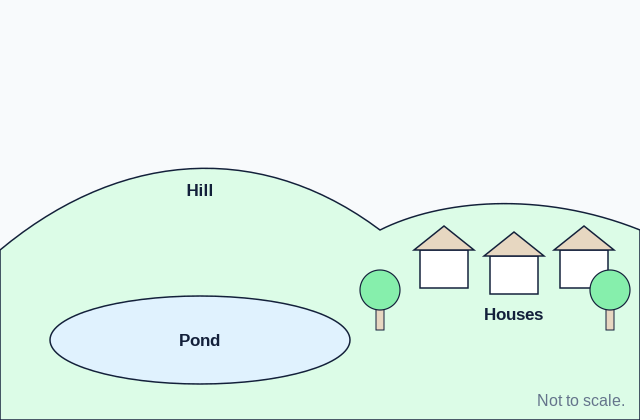
For example, a made-up hill town's winters warm over decades, and a mosquito that once lived only in the lowlands below begins to breed in its ponds.
Quick check · Decide and justify
In a made-up city, the poorest district has no sewer lines and its wells are contaminated; a wealthier district next to it has both sewers and clean tap water. A student says an outbreak of an infectious disease is more likely to take hold in the poorer district. Is the student right?
Which reason supports your answer?
2c. Diseases carried by bites and by water
Some diseases reach people through the bite of an infected organism, and some through water. A parasite is an organism that lives on or in another and harms it.
| Disease | What it is, and how it reaches people |
|---|---|
| Plague | Carried by organisms infected with plague bacteria; passed by the bite of an infected organism, or by contact with contaminated fluids or tissues |
| Malaria | A parasitic disease, most often found in sub-Saharan Africa; passed by bites from infected mosquitoes |
| West Nile virus | A virus passed by bites from infected mosquitoes |
| Zika | A virus passed by bites from infected mosquitoes, and also by sexual contact |
| Cholera | A bacterial disease caught from infected water |
For example, a made-up town that drains the standing water where mosquitoes breed cuts its risk of the diseases those mosquitoes carry, but does nothing about a disease that travels in its water.
Quick check · Select all
Which two diseases are caused by a virus that reaches people through bites from infected mosquitoes? Pick two.
Select 2 answers, then check.
2d. Diseases carried in breath, fluids and animals
Other diseases pass through the air people breathe, through fluids from a sick person, or from animals. Pneumonia is an infection of the lungs; respiratory means having to do with breathing. SARS stands for severe acute respiratory syndrome, and MERS for Middle East respiratory syndrome.
| Disease | What it is, and how it reaches people |
|---|---|
| Tuberculosis | A bacterial infection that typically attacks the lungs; spread by breathing in the bacteria from the bodily fluids of an infected person |
| SARS | A form of pneumonia, passed by inhaling or touching infected fluids |
| MERS | A viral respiratory illness passed from animals to humans |
For example, a made-up clinic seats patients who are coughing in a separate, well-aired room, so that fluids they cough out are less likely to be breathed in by others.
Quick check · Sort it
How does each disease reach people? Tap a card, then its group.
Bites from infected mosquitoes
Infected water
Breathing in or touching an infected person's fluids
Part 3 Watch it done A rate per 100,000 people
Open each step in turn, answer the why, then finish the calculation yourself.
A made-up district of 250,000 people reports 85 cases of tuberculosis in one year. Health officials compare districts by cases per 100,000 people. What is this district's rate per 100,000 people? The numbers are made up for practice.
Step 1 · Find the cases per person
cases per person.
Why this step?
Why compare districts by a rate instead of by their case counts?
Districts have different numbers of people, so a large district can have more cases just by being large. A rate per 100,000 people compares them on the same footing.
Step 2 · Scale up to 100,000 people
Multiply the cases per person by 100,000.
Your step · Calculate
Finish it. The district has 0.00034 cases of tuberculosis per person. How many cases is that per 100,000 people?
cases per 100,000 people
34 cases per 100,000 people. A rate like this lets officials see whether tuberculosis is more common in one district than in another of a different size.
Part 4 Try it Fill in two outbreaks, then check an account
First complete an account of two made-up outbreaks. Then find where a student's account of a neighborhood goes wrong.
Try it · Fill the statement
Complete the account of two made-up outbreaks.
Families in a low-income district with no sanitary waste disposal drink from a stream that carries waste, and the district becomes a haven for , a bacterial disease caught from infected water. Far to the north, milder winters let infected mosquitoes bring virus into towns where it was never known before.
Try it · Spot the error
A student describes a made-up neighborhood. Tap the first line that goes wrong.
Part 5 Explain it Cholera and a water project
Write your answer first. Nothing you type here leaves this page. Then compare it with the model and each scoring point.
Free response is 40% of the exam score. This one is shaped like Question 2, Analyze and interpret quantitative data.
Free-response practice · Question 2 style
A made-up low-income town had no sewer lines, and most families drew water from a river that carried waste. Late in 2019, after that year's count, a project piped clean drinking water to every home and laid sewer lines. The yearly counts of cholera cases below are made up for practice.
- 2015: 420 cases
- 2017: 390 cases
- 2019: 410 cases
- 2021: 160 cases
- 2023: 70 cases
(a) Describe the trend in cholera cases from 2015 to 2023.
(b) Calculate the percent decrease in cases from 2019 to 2023. Show your work.
(c) Calculate the average decrease in cases per year from 2019 to 2023. Show your work.
(d) Explain why the town had so many cases before the project.
(e) Describe one more action that could lower the town's cases further.
Model answer
(a) Cases stayed high and fairly steady from 2015 to 2019, between 390 and 420, then fell sharply after the project, to 70 by 2023.
(b) decrease.
(c) cases per year.
(d) Cholera is a bacterial disease contracted from infected water. With no sewer lines, waste reached the river the families drank from, so the town lacked sanitary waste disposal and had contaminated drinking water, which made it a haven for the disease.
(e) Treat the town's waste before it reaches the river, so water from it is safer for anyone still using it. (Testing the piped water, or fixing leaks in the new sewer lines, also fits.)
Score your own answer. This is a self-check, not a grade. Tick each point your answer makes.
Part 6 Check yourself A mosquito moves north
The first two questions use the graph.
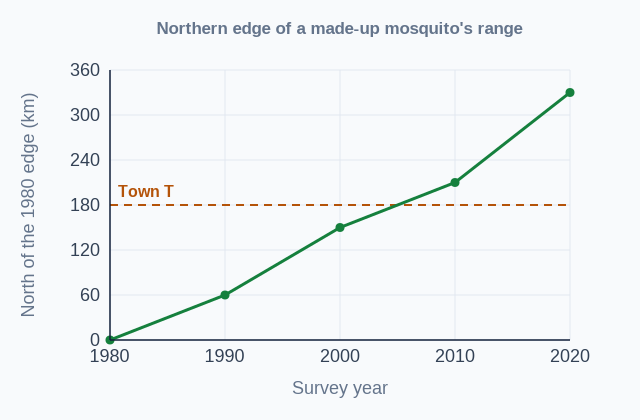
A made-up mosquito carries a virus that it passes to people through its bites. Over four decades, the winters in its region grew milder, and the northern edge of where the mosquito lives moved. The graph shows how far north of its 1980 edge the mosquito was found in each year of survey. Town T lies 180 km north of the 1980 edge. The numbers are made up for practice.
 Tap to open the picture full size
Case question 1 · Multiple choice
What does the graph imply about the virus the mosquito carries and town T?
Case question 2 · Calculate
Using the graph: on average, how many kilometers a year did the mosquito's northern edge move from 1980 to 2020? Give your answer to the nearest hundredth.
The rest stand on their own and do not use the case.
Check yourself · Put it in order
Put the events of a made-up case of tuberculosis passing between two people in order, first to last.
Check yourself · Match
Match each disease to the description that fits it.
Part 7 Keep it Bring back earlier ideas
Two questions from earlier topics in this unit, to bring them back before they fade.
First complete an account of a made-up city's summer. Then find where a student's account of a town's cancer cases goes wrong.
From 8.14 Pollution and Human Health · Fill the statement
Complete the account of a made-up city's summer.
On hot afternoons the city's ozone climbs, and more residents report problems; but because they also breathe traffic exhaust and wildfire smoke, linking those problems to ozone alone is hard.
First complete an account of a made-up test. Then find where a student's account goes wrong.
From 8.12 Lethal Dose 50% (LD50) · Spot the error
A student describes a made-up LD50 test. Tap the first line that goes wrong.
In three lines
- Pathogens adapt to new chances to spread, and they can be found in places however clean those places look.
- Warming climates carry diseases and their vectors into new areas, and poor areas without sanitation become havens for disease.
- Plague, malaria, West Nile virus and Zika come by bites, cholera by water, tuberculosis and SARS through fluids, and MERS from animals.
Exam strategy for this topic
- Section I, Multiple Choice: 80 questions in 90 minutes.
- Section II, Free Response: 3 questions in 70 minutes.
- This lesson's Explain it is shaped like free-response question 2, Analyze and interpret quantitative data.
- A four-function, scientific, or graphing calculator is allowed on both sections of the exam.
When a question names a disease, say how it reaches people (bites, water, fluids or animals) and what kind of illness it is; when it shows a vector's range or a poor area's water, connect the change to where the disease can now spread.
Questions students ask
What is a pathogen?
A living thing or virus that causes disease, such as a bacterium, a parasite or a virus.
Why are diseases spreading into temperate places?
As equatorial-type climate zones spread into subtropical and temperate zones, pathogens, diseases and their vectors spread into areas where the diseases were not known before.
Which diseases are spread by mosquitoes?
Malaria, West Nile virus and Zika are spread by bites from infected mosquitoes.
Why do low-income areas see more infectious disease?
They often lack sanitary waste disposal and have contaminated drinking water, which give diseases havens and chances to spread.
Course alignment, for teachers
AP Environmental Science topic 8.15, Unit 8: Aquatic and Terrestrial Pollution.
- Skill 2.B: Explain relationships between different characteristics of environmental concepts, processes, or models represented visually:
This lesson maps all 12 essential knowledge statements of the topic to the part that teaches each one: 12 are checked by a scored question. The map is in the lesson file.