Unit 4 · Topic 4.6 · about 30 minutes · 7 parts · 10 scored checks, 2 of them multiple choice, plus 2 from earlier lessons
AP Environmental Science 4.6: Watersheds
Unit 4: 10 to 15% of the multiple-choice section
What you'll be able to do
- Describe the characteristics of a watershed: its area, length, slope, soil, vegetation types and divides with adjoining watersheds.
Key vocabulary
| Term | What it means | The exam trap |
|---|---|---|
| Watershed | All the land that drains into one stream, river or lake. | It is the land, not just the river: it can reach far from the riverbanks. |
| Outlet | The place where a watershed's water leaves it, such as the mouth of its river. | The outlet is where the water leaves, not where the rain first lands. |
| Runoff | Rain or melted snow that flows over the surface of the ground instead of soaking in. | Runoff is water on the surface; water that soaks in is not runoff. |
| Slope | How steeply land rises or falls, such as the drop in height over a distance. | Slope is a steepness, not a height: a high plateau can be nearly flat. |
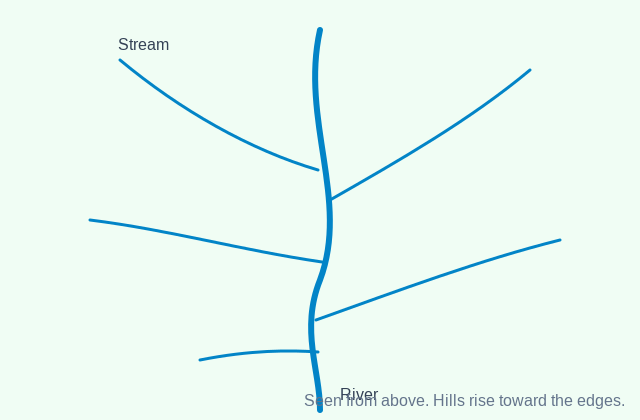 Tap to open the picture full size
Part 1 Think first Rain on a ridge
Commit to a guess first. Being wrong now makes the right idea stick better.
Predict first
A long ridge runs between two valleys, and each valley has its own river. Heavy rain falls right along the top of the ridge. Where do you predict the water that runs off goes?
In short. A watershed is all the land that drains into one stream, river or lake, and six characteristics describe it.
- Area and length give a watershed's size: the land it covers and how far its water travels to the outlet.
- Slope, soil and vegetation types describe the land the water crosses on the way.
- Divides are the boundaries a watershed shares with the watersheds next to it.
Part 2 Learn it Describing a watershed
2a. Area and length
A watershed is all the land that drains into one stream, river or lake. Rain that lands anywhere in it, and does not soak in or evaporate, ends up flowing to the same place: the watershed's outlet, where its water leaves.
Characteristics of a given watershed include its area, length, slope, soil, vegetation types and divides with adjoining watersheds. The first two give its size.
- Area is how much land the watershed covers, often given in square kilometers. A larger area catches rain over more land.
- Length is how far water must travel from the watershed's farthest point to its outlet, usually along its main channel. Water from the far end of a long watershed takes longer to reach the outlet than water from close by.
Two watersheds can have the same area and different lengths: one long and narrow, one short and wide.
Quick check · Multiple choice
Two made-up watersheds, P and Q, cover the same area and have the same slope, soil and vegetation. P's main channel runs 40 km from its farthest point to its outlet; Q's runs 15 km. The same storm soaks both at once. Hours after the flow at Q's outlet has peaked and begun to fall, the flow at P's outlet is still rising. Which best explains the difference?
2b. Slope, soil and vegetation types
Three more characteristics describe the land that water crosses on its way to the outlet.
- Slope is how steeply the land rises or falls. It can be given as the drop in height over a distance, such as 5 m of drop for every 100 m across.
- Soil is what the ground is made of: sandy, loam or clay, deep or thin. Topic 4.3 showed that soils differ in permeability, how easily water moves through them.
- Vegetation types are what covers the land: forest, grassland, crops, or little or nothing, as on rock or pavement.
Each of these changes what happens to rain once it lands: how much of it soaks into the ground, how much runs over the surface as runoff, and how quickly that runoff reaches a stream.
Quick check · Decide and justify
Two made-up watersheds have the same area, length, soil and vegetation, but the land in one is much steeper. After the same storm, the stream in the steep one rises to its highest level 2 hours after the rain; the stream in the other, 9 hours after. A student says slope is a characteristic that can change how fast storm water reaches a stream. Is the student right?
Which reason supports your answer?
2c. Divides
Every watershed has edges, and the last characteristic is its divides with adjoining watersheds. A divide is the high ground, often a ridge, that separates one watershed from the next. Rain landing on one side of a divide drains to one outlet, and rain on the other side drains to a different one.
So a divide decides where water, and anything the water carries, ends up.
On a map, a divide is drawn as a line along the highest ground between two river systems. To find which watershed a point is in, ask which way the ground slopes from it, down to which river.
Quick check · Multiple choice
A ridge forms the divide between a made-up Mill Creek watershed to the west and a made-up Stone River watershed to the east. A farm on the ridge's eastern slope spreads fertilizer on its fields, and heavy rain follows. A town that draws its water from Mill Creek wants to know whether to test its water for this farm's fertilizer. Which advice is best?
Part 3 Watch it done How big is the watershed?
Open each step in turn, answer the why, then finish the calculation yourself.
Suppose a student traces a made-up watershed's divides onto a map grid. Each grid square is 2 km on each side, and the traced watershed covers 37 squares. What is the watershed's area in square kilometers?
Step 1 · Name the characteristic
The land inside the traced divides is the watershed's area.
Step 2 · Find the area of one square
Each square is 2 km by 2 km: square kilometers.
Why this step?
Why trace the divides first?
The divides are the watershed's edges. Only the land inside them drains to this outlet, so only those squares count toward its area.
Step 3 · Set up the total
Area = number of squares the area of one square.
Your step · Calculate
Finish it. A made-up watershed traced on a map covers 37 grid squares, each 2 km on a side. What is the watershed's area, in square kilometers?
square km
The watershed covers 148 square kilometers. Every bit of rain that falls on that land and runs off ends up at the same outlet.
Part 4 Try it Two soils, and a forest paved over
First use given soil data to compare two watersheds. Then judge a claim about what counts as part of a watershed.
Try it · Select all
Two made-up watersheds get the same storm. They have the same area, length, slope and vegetation. Watershed F's soil is sandy, and water soaks into it quickly. Watershed G's soil is clay, and water soaks into it slowly. Which two are most likely? Pick two.
Select 2 answers, then check.
Try it · Decide and justify
Forest covers most of a made-up watershed. A student says paving over the forest for a parking lot would not change the watershed's characteristics, since only its area, length and slope count. Is the student right?
Which reason supports your answer?
Part 5 Explain it Houses where a forest was
Write your answer first. Nothing you type here leaves this page. Then compare it with the model and each scoring point.
Free response is 40% of the exam score. This one is shaped like Question 3, Analyze an environmental problem doing calculations.
Free-response practice · Question 3 style
Suppose a made-up watershed covers 85 square kilometers, most of it forest. A plan would clear much of the forest for houses and roads. Measurements from similar land suggest that 20% of a storm's rain becomes runoff now, and 45% would after the houses are built. A ridge forms the divide between this watershed and the one next to it. The numbers are made up for practice.
(a) A storm drops 40 mm of rain over the whole watershed. Calculate the volume of rain that falls on it, in cubic meters. Show your work. (1 square kilometer = 1,000,000 square meters.)
(b) Calculate how many more cubic meters of that storm's rain would become runoff after the houses are built. Show your work.
(c) Identify one characteristic of the watershed that the plan changes.
(d) A town draws water from the river in the next watershed, beyond the ridge. Explain why the extra runoff from this plan would not reach that town's river.
(e) Propose one way the plan could be changed to reduce the extra runoff.
Model answer
(a) , and m. cubic meters.
(b) more of the rain. more cubic meters of runoff.
(c) Its vegetation types: forest would be replaced by houses and roads. (Its soil, covered or packed down, also fits.)
(d) The ridge is a divide. Rain on this side of it drains to this watershed's outlet, so the extra runoff flows to this watershed's river, not to the river beyond the ridge.
(e) Keep strips of forest along the streams and steep slopes, so more rain soaks in before it reaches the stream. (Permeable paving, or a pond that holds storm water and lets it out slowly, also fits.)
Score your own answer. This is a self-check, not a grade. Tick each point your answer makes.
Part 6 Check yourself Two watersheds side by side
The first two questions use the map and the table.
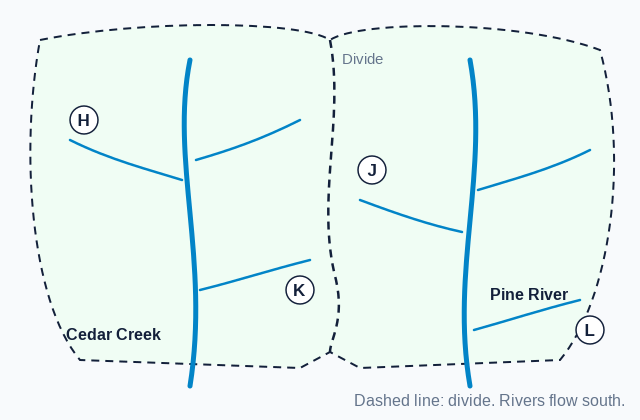
The map shows two made-up watersheds next to each other: Cedar Creek to the west and Pine River to the east. A dashed line marks the divide between them. Points H, J, K and L are places where rain falls. The table lists some of each watershed's characteristics, made up for practice.
| Watershed | Area (square km) | Length (km) | Slope (m of drop per 100 m) | Soil | Vegetation |
|---|---|---|---|---|---|
| Cedar Creek | 120 | 18 | 2 | Loam | Mostly forest |
| Pine River | 340 | 41 | 6 | Clay | Farm fields and towns |
Case question 1 · Sort it
Using the map: tap a point, then the river its runoff drains to.
Cedar Creek
Pine River
Case question 2 · Calculate
Using the table: a storm drops 20 mm of rain over all of the Pine River watershed. How many million cubic meters of rain fall on it? (1 square kilometer = 1,000,000 square meters.)
The rest stand on their own and do not use the case.
Check yourself · Put it in order
A raindrop lands in a made-up river's watershed, just downhill of the divide. It does not soak in. Put its trip in order, first to last.
Check yourself · Fill the statement
A park ranger describes a made-up watershed. Tap a blank, then the characteristic each sentence gives.
The land that drains to the lake covers 65 square kilometers: that is the watershed's . Water from its farthest stream travels 22 km to reach the lake: that is its . A line of hills along its eastern edge sends the rain on its far side to another river: that line of hills is the watershed's with the next one.
Part 7 Keep it Bring back earlier ideas
Two questions from earlier topics: a student's account of how global winds start, and what a loam result means.
First find where a student's account of the winds goes wrong. Then use a rule you are given to turn a wind in the Southern Hemisphere.
From 4.5 Global Wind Patterns · Spot the error
A student explains how global winds start. Tap the first line that goes wrong.
First rank three soils from a drainage test. Then read what a texture triangle result means for a farm.
From 4.3 Soil Composition and Properties · Multiple choice
A soil test places a made-up farm's soil in the loam area of a soil texture triangle. Which describes the soil?
In three lines
- A watershed is all the land that drains into one stream, river or lake.
- Its characteristics include its area and length, its slope, soil and vegetation types, and its divides with adjoining watersheds.
- Rain on one side of a divide drains to one outlet; rain on the other side drains to another.
Exam strategy for this topic
- Section I, Multiple Choice: 80 questions in 90 minutes.
- Section II, Free Response: 3 questions in 70 minutes.
- This lesson's Explain it is shaped like free-response question 3, Analyze an environmental problem doing calculations.
- A four-function, scientific, or graphing calculator is allowed on both sections of the exam.
When a question describes a watershed, sort the details into its characteristics: area, length, slope, soil, vegetation types and divides. For a calculation, put area in square meters and rain depth in meters before you multiply.
Questions students ask
What is a watershed?
All the land that drains into one stream, river or lake.
What are the characteristics of a watershed?
Its area, length, slope, soil, vegetation types and divides with adjoining watersheds.
What is a divide?
The high ground that separates one watershed from the next. Rain on each side of it drains to a different outlet.
Course alignment, for teachers
AP Environmental Science topic 4.6, Unit 4: Earth Systems and Resources.
- Skill 1.C: Explain environmental concepts, processes, or models in applied contexts.
This lesson maps the one essential knowledge statement of the topic to the part that teaches each one: 1 is checked by a scored question. The map is in the lesson file.