Unit 9 · Topic 9.2 · about 30 minutes · 7 parts · 10 scored checks, 2 of them multiple choice, plus 2 from earlier lessons
AP Environmental Science 9.2: Reducing Ozone Depletion
Unit 9: 15 to 20% of the multiple-choice section
What you'll be able to do
- Describe chemicals used to substitute for chlorofluorocarbons (CFCs).
Key vocabulary
| Term | What it means | The exam trap |
|---|---|---|
| Mitigate | To make a harm smaller or less severe. | To mitigate a problem is to lessen it, not always to end it. |
| Substitute | A chemical used in place of another. | A substitute does the old chemical's job; it is not the same chemical under a new name. |
| HFCs (hydrofluorocarbons) | A group of human-made gases that can do jobs CFCs once did, such as cooling. | HFCs and CFCs are different groups of gases, though their names look alike. |
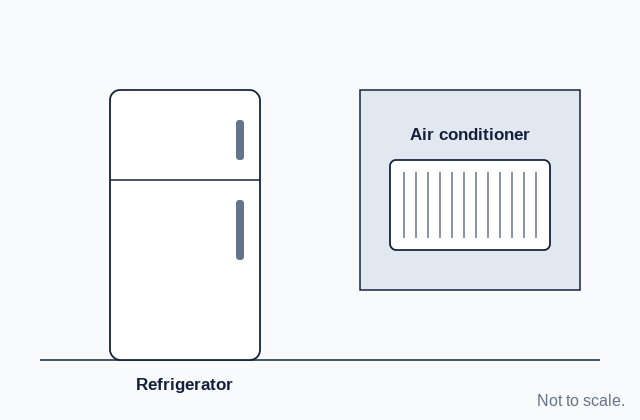 Tap to open the picture full size
Part 1 Think first A safer cooling gas?
Commit to a guess first. Being wrong now makes the right idea stick better.
Predict first
A made-up city replaces the CFCs in its air conditioners with a gas that does not harm the ozone layer. Do you predict the new gas could still harm the environment in some other way?
In short. Reducing ozone depletion means replacing the chemicals that thin the ozone layer, such as CFCs, with substitutes that do not.
- Swapping an ozone-depleting chemical for a substitute that spares the layer mitigates ozone depletion.
- HFCs (hydrofluorocarbons) are one group of gases used as a substitute for CFCs.
- Less ozone depletion means less of the extra UV that a thinner layer lets reach the surface.
Part 2 Learn it Swapping one chemical for another
2a. Replacing what thins the layer
In Topic 9.1, CFCs released near the ground spread up into the stratosphere and thin the ozone layer, and a thinner layer lets more UV rays reach the surface.
To mitigate a problem is to make its harm smaller. Ozone depletion can be mitigated by replacing ozone-depleting chemicals with substitutes that do not deplete the ozone layer. A substitute is a chemical used in place of another. If a product needs a cooling gas, a gas that does the same job but does not deplete the ozone layer can take the place of the CFC. Then leaks from the product no longer add to the thinning.
What makes a substitute fit this fix is not how well it cools or how cheap it is. It is that the substitute does not deplete the ozone layer.
For example, a made-up hospital swaps the CFC in its old freezers for a gas that does not deplete the ozone layer, so the freezers' leaks stop adding to the thinning.
Quick check · Multiple choice
A made-up company is choosing a new gas to replace the CFC in the spray cans it sells. Which property would make the new gas a fix for ozone depletion?
2b. HFCs, one replacement
Hydrofluorocarbons (HFCs) are one such replacement. HFCs are a group of gases made by people that can do jobs CFCs once did, such as cooling, and they do not deplete the ozone layer. When a product's CFC is replaced with an HFC, a leak from that product no longer thins the layer.
HFCs are one replacement among others. What they share with any good substitute for this fix is that they spare the ozone layer.
For example, a made-up bus company refits the air conditioners on its old buses to run on an HFC in place of a CFC.
Quick check · Decide and justify
A made-up repair shop replaces the CFC coolant in old refrigerators with an HFC. A customer asks whether the switch helps the ozone layer, and a worker says it does. Is the worker right?
Which reason supports your answer?
2c. A new problem from some HFCs
A greenhouse gas is a gas that traps heat in the atmosphere. As more of these gases build up, they add to global climate change, which Topics 9.3 to 9.5 cover.
Some HFCs are strong greenhouse gases. So a swap from a CFC to one of those HFCs eases ozone depletion but adds a gas that traps a lot of heat. Not every HFC is like this; the problem comes from the ones that are strong greenhouse gases.
This is why choosing a substitute is a response with more than one side. A substitute should spare the ozone layer, and it is better still if it does not trap a lot of heat.
For example, a made-up grocery chain compares two HFCs for its freezers and picks the one that traps less heat, since both spare the ozone layer.
Quick check · Select all
Which two statements about HFCs are correct? Pick two.
Select 2 answers, then check.
Part 3 Watch it done How fast did CFC use fall?
Open each step in turn, answer the why, then finish the calculation yourself.
A made-up country used 8,000 tons of CFCs a year in 1990. After it switched to substitutes, it used 600 tons a year in 2000. On average, by how many tons a year did its CFC use fall from 1990 to 2000? The numbers are made up for practice.
Step 1 · Find the total drop
tons a year less in 2000 than in 1990.
Why this step?
Why divide the total drop by the number of years?
An average yearly drop spreads the whole change evenly over the years it took, so it tells you how fast the use fell.
Step 2 · Count the years and divide
From 1990 to 2000 is years. Divide the total drop by 10.
Your step · Calculate
Finish it. The country's CFC use fell by 7,400 tons a year over the 10 years from 1990 to 2000. What was the average drop per year? Give a whole number.
tons a year
740 tons a year. Swapping CFCs for substitutes cut the country's use of them by that much each year, on average.
Part 4 Try it Complete a sentence, then check a city's account
First complete a sentence about what a swap from CFCs to HFCs does. Then find where a student's account of a made-up city's swap goes wrong.
Try it · Fill the statement
Complete the sentence about replacing CFCs with HFCs.
Replacing CFCs with HFCs eases , but some HFCs add to .
Try it · Spot the error
A student describes a made-up city's swap. Tap the first line that goes wrong.
Part 5 Explain it An ozone record after a swap
Write your answer first. Nothing you type here leaves this page. Then compare it with the model and each scoring point.
Free response is 40% of the exam score. This one is shaped like Question 2, Analyze and interpret quantitative data.
Free-response practice · Question 2 style
A made-up station measured the ozone above it in Dobson units (DU) at the same time each year. In this made-up record, the countries whose CFCs reached that air replaced their CFCs with substitutes during the 1990s. The readings below are made up for practice.
- 1980: 280 DU
- 1990: 190 DU
- 2000: 150 DU
- 2010: 165 DU
- 2020: 185 DU
(a) Describe the trend in the readings from 1980 to 2020.
(b) Calculate the percent increase in the reading from 2000 to 2020. Round to the nearest tenth of a percent. Show your work.
(c) Calculate the average change in the reading per year from 1980 to 2000. Show your work.
(d) Explain how replacing CFCs with substitutes could account for the change after 2000.
(e) Describe one problem that could come from choosing some HFCs as the substitute.
Model answer
(a) The reading fell from 280 DU in 1980 to 150 DU in 2000, then rose to 185 DU by 2020.
(b) increase.
(c) DU per year, a fall of 6.5 DU each year on average.
(d) The substitutes do not deplete the ozone layer, so as they replaced CFCs, less of the chemical that thins the layer was being added, and the ozone could build back up.
(e) Some HFCs are strong greenhouse gases, so leaks of them trap heat in the atmosphere and add to climate change.
Score your own answer. This is a self-check, not a grade. Tick each point your answer makes.
Part 6 Check yourself One country's cooling gases
The first two questions use the graph.
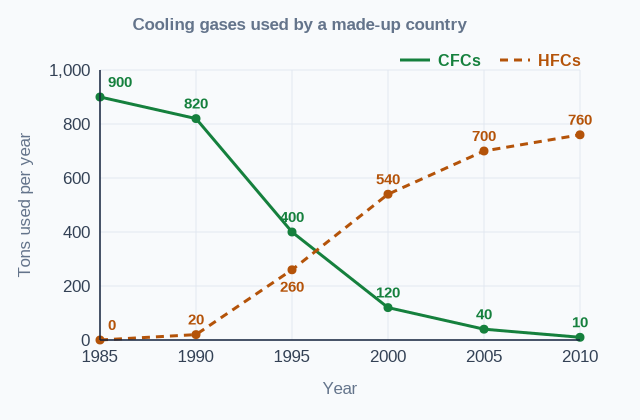
A made-up country tracked how many tons of CFCs and of HFCs it used each year, from 1985 to 2010. The graph shows both. The numbers are made up for practice.
 Tap to open the picture full size
Case question 1 · Multiple choice
In the graph, which statement describes the made-up country's response to ozone depletion?
Case question 2 · Calculate
Using the graph: by what percent did the country's HFC use rise from 1995 to 2010? Round to the nearest whole percent.
The rest stand on their own and do not use the case.
Check yourself · Put it in order
Put the events of a made-up country's search for a better freezer gas in order, first to last.
Check yourself · Match
Match each term to the description that fits it.
Part 7 Keep it Bring back earlier ideas
Two questions from earlier topics, to bring them back before they fade.
First complete two sentences about causes of ozone loss. Then find where a student's account of a made-up town goes wrong.
From 9.1 Stratospheric Ozone Depletion · Fill the statement
Complete the two sentences about causes of ozone depletion.
Leaks of CFCs from old refrigerators are causes of ozone depletion. Ice crystals melting in the atmosphere at the beginning of the Antarctic spring are causes.
First complete an account of a made-up city's summer. Then find where a student's account of a town's cancer cases goes wrong.
From 8.14 Pollution and Human Health · Spot the error
A student describes cancer cases in a made-up town. Tap the first line that goes wrong.
In three lines
- Replacing ozone-depleting chemicals with substitutes that do not deplete the layer mitigates ozone depletion.
- HFCs are one replacement for CFCs, and they spare the ozone layer.
- Some HFCs are strong greenhouse gases, so a substitute can ease one problem and add to another.
Exam strategy for this topic
- Section I, Multiple Choice: 80 questions in 90 minutes.
- Section II, Free Response: 3 questions in 70 minutes.
- This lesson's Explain it is shaped like free-response question 2, Analyze and interpret quantitative data.
- A four-function, scientific, or graphing calculator is allowed on both sections of the exam.
When a question asks how to reduce ozone depletion, describe replacing ozone-depleting chemicals such as CFCs with substitutes that do not deplete the layer, name HFCs as one, and say that some HFCs are strong greenhouse gases.
Questions students ask
How can ozone depletion be reduced?
By replacing ozone-depleting chemicals, such as CFCs, with substitutes that do not deplete the ozone layer.
What are HFCs?
Hydrofluorocarbons, a group of human-made gases used as one replacement for CFCs. They do not deplete the ozone layer.
Are HFCs a perfect replacement?
No. Some HFCs are strong greenhouse gases, so they can add to global climate change even though they spare the ozone layer.
What does it mean to mitigate ozone depletion?
To make its harm smaller, here by swapping the chemicals that cause it for ones that do not.
Course alignment, for teachers
AP Environmental Science topic 9.2, Unit 9: Global Change.
- Skill 7.B: Describe potential responses or approaches to environmental problems.
This lesson maps the one essential knowledge statement of the topic to the part that teaches each one: 1 is checked by a scored question. The map is in the lesson file.