Unit 6 check
Unit 6 check: Energy Resources and Consumption
13 questions from 13 lessons in Unit 6. Answer each one, and if you miss, follow the link back to where it is taught, then try again. Your score counts first tries.
Question 1 · from 6.1 · Multiple choice
A made-up country pipes 20 billion cubic meters of natural gas a year from one underground field. Surveys over forty years find that no gas flows into the field from the rock around it. Which statement best explains why the gas is a nonrenewable energy source?
Question 2 · from 6.2 · Decide and justify
A made-up news story says the world's solar panel capacity doubled in five years. A student concludes that solar power is now the world's most widely used energy source. Is the student right?
Which reason supports your answer?
Question 3 · from 6.3 · Select all
A made-up energy company sells natural gas and runs a tar sands mine. Which two statements about its fuels are accurate? Pick two.
Select 2 answers, then check.
Setup for question 4
Geologists map the deposits of a made-up continent with four regions and record each region's geologic history. Each oil symbol stands for 10 billion barrels. The map and numbers are made up for practice.
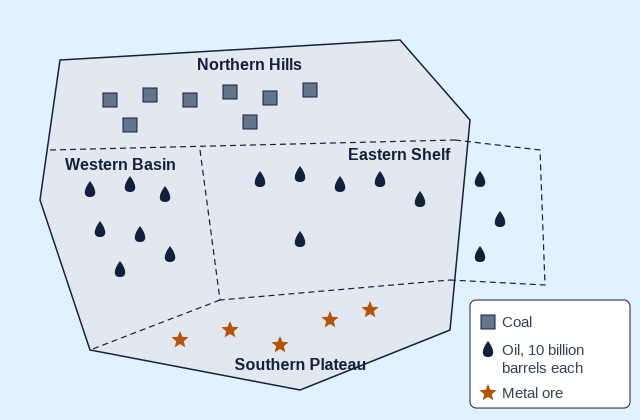
| Region | Geologic history |
|---|---|
| Eastern Shelf | Ancient sea floor buried under thick layers of sediment |
| Southern Plateau | Old volcanic rock cut by veins where hot fluids rose |
| Northern Hills | Ancient coastal swamps buried under thick rock |
| Western Basin | Ancient sea floor buried under thick layers of sediment |
Question 4 · from 6.4 · Multiple choice
Geologists study a fifth region, the Central Lowland, whose geologic history matches the Western Basin's. Which resource do the map and table suggest is most likely there?
Setup for question 5
A made-up county's water agency tests four groundwater wells around a new gas field, the year before fracking began and two years after. Each well is a different distance from the nearest fracked well. The chemical measured is one used in the fracking fluid, in micrograms per liter. The numbers are made up for practice.
| Well | Distance from nearest fracked well (km) | Before fracking | Two years after |
|---|---|---|---|
| Pine Road | 3.0 | 7 | 10 |
| Oak Farm | 0.4 | 6 | 41 |
| Fern Creek | 6.0 | 7 | 7 |
| Birch Lane | 1.5 | 8 | 21 |
Question 5 · from 6.5 · Multiple choice
Which statement do the data best support?
Setup for question 6
A made-up lab measures the radioactivity of a waste sample holding one made-up isotope, every 6 years for 24 years. The numbers are made up for practice.
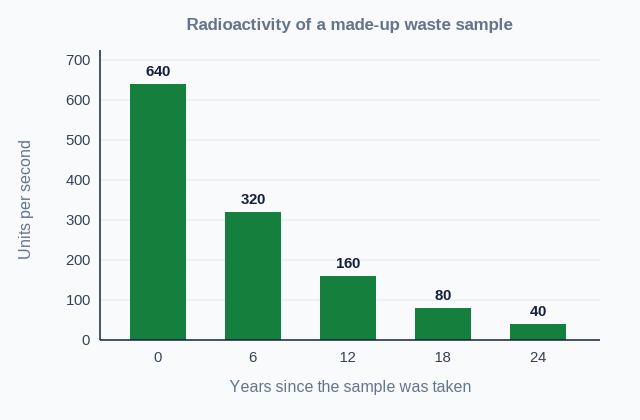 Tap to open the picture full size
Question 6 · from 6.6 · Calculate
Using the graph: if the pattern continues, how many units per second will the sample give off 36 years after it was taken?
Question 7 · from 6.7 · Match
Match each made-up observation to what it shows about biomass and ethanol.
Question 8 · from 6.8 · Decide and justify
A made-up school pumps water through black panels on its roof into an insulated tank, and the warm water runs the showers the next morning. A student calls this an active solar system. Is the student right?
Which reason supports your answer?
Question 9 · from 6.9 · Decide and justify
A made-up country has two plants: a dam across a river, and a barrier with turbines across the mouth of a sea inlet that no river feeds. A dry year leaves the river's reservoir low. A student says the barrier's electricity need not fall because of the dry year. Is the student right?
Which reason supports your answer?
Question 10 · from 6.10 · Select all
A made-up town debates building a geothermal power plant. Which two are drawbacks of the plant? Pick two.
Select 2 answers, then check.
Setup for question 11
A made-up city compares three kinds of bus before it buys new ones. The carbon dioxide figure counts both the bus's exhaust and the making of its fuel. Prices are in thousands of dollars. The numbers are made up for practice.
| Bus | Carbon dioxide per kilometer, fuel making and exhaust (grams) | Price of one bus (thousand dollars) |
|---|---|---|
| Fuel cell, hydrogen made from natural gas | 900 | 1,170 |
| Diesel | 1,300 | 450 |
| Fuel cell, hydrogen made from water with wind power | 0 | 1,170 |
Question 11 · from 6.11 · Multiple choice
Which statement do the data best support?
Setup for question 12
A made-up wind farm counts the bats and birds found under its turbines. In year 1 the blades spin at every wind speed. In year 2 the blades are held still on summer nights when the wind is light. The numbers are made up for practice.
| Measure | Year 1 | Year 2 |
|---|---|---|
| Birds found killed | 96 | 90 |
| Electricity produced (MWh) | 312,000 | 309,000 |
| Bats found killed | 640 | 208 |
Question 12 · from 6.12 · Calculate
Using the table: by what percent did the number of bats found killed fall from year 1 to year 2?
Setup for question 13
A made-up city opened a light rail line and raised the fuel economy required of new cars. Its transportation office compares 2015 with 2025. The numbers are made up for practice.
| Measure | 2015 | 2025 |
|---|---|---|
| Gasoline used each day (thousand liters) | 840 | 609 |
| Average fuel economy of the city's cars (kilometers per liter) | 11 | 14 |
| Light rail riders each day | 0 | 42,000 |
Question 13 · from 6.13 · Multiple choice
Which statement do the data best support?
0 of 13 answered.