Unit 1 · Topic 1.5 · about 30 minutes · 7 parts · 12 scored checks, 3 of them multiple choice, plus 2 from earlier lessons
AP Environmental Science 1.5: The Nitrogen Cycle
Unit 1: 6 to 8% of the multiple-choice section
What you'll be able to do
- Explain the steps of the nitrogen cycle and how its reservoirs interact, including why nitrogen compounds in soil so often limit primary production.
Key vocabulary
| Term | What it means | The exam trap |
|---|---|---|
| Nitrogen cycle | The movement of atoms and molecules containing nitrogen between sources and sinks. | Name the form nitrogen is in before and after each step, not only the step's name. |
| Nitrogen fixation | The step in which certain types of soil bacteria convert atmospheric nitrogen into ammonia. | Only certain bacteria do this, so ask which organisms a question describes. |
| Ammonium | A nitrogen compound in the soil that plants can take up; ammonia in soil quickly converts to it. | Ammonia and ammonium are different forms, so read which one a step starts and ends with. |
| Nitrate | A nitrogen compound in the soil, made from ammonium by bacteria, that plants can also take up. | Nitrate can go two ways, into plants or back to the air, so read the conditions in the question. |
| Limiting nutrient | The nutrient in shortest supply, so that adding it lets producers grow more while adding others does not. | Judge it from what an added nutrient changes, not from how much of an element exists somewhere else. |
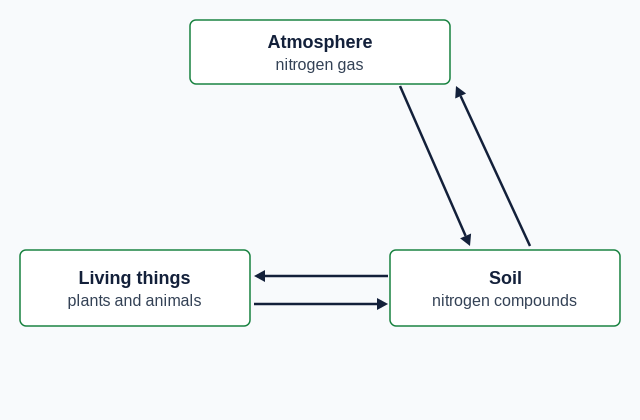 Tap to open the picture full size
Part 1 Think first Corn after soybeans
Commit to a guess first. Being wrong now makes the right idea stick better.
Predict first
A farmer notices that corn grows better in a field where soybeans grew the year before than in a field where corn grew the year before, with the same fertilizer on both. What do you predict explains the difference?
In short. The nitrogen cycle is the movement of nitrogen between sources and sinks through several steps (nitrogen fixation, assimilation, ammonification, nitrification and denitrification), and microorganisms in the soil play an important role in many of them.
- The largest reservoir of nitrogen is the atmosphere, and most reservoirs hold nitrogen compounds for relatively short periods.
- The rate of nitrogen fixation limits how much nitrogen is available in the soil.
- In many ecosystems, the nitrogen compounds available limit how much plants and other producers grow.
Part 2 Learn it The steps of the nitrogen cycle
2a. Fixation: from the air into the soil
The nitrogen cycle is the movement of atoms and molecules containing the element nitrogen between sources and sinks. The largest reservoir of nitrogen is the atmosphere, as nitrogen gas, .
Living things need nitrogen to build proteins and DNA, but plants and animals cannot use from the air. Its two atoms are held together too tightly for them to break apart.
Nitrogen fixation is the step that brings it in. Atmospheric nitrogen () is converted by certain types of soil bacteria into ammonia (). In the soil, ammonia quickly converts to ammonium (), which is available for biological uptake: plants can take it in through their roots.
Some of these bacteria live free in the soil. Others live in swellings on the roots of plants such as soybeans, peas and clover and pass the nitrogen they fix to the plant. When those plants' roots and stems decompose, the nitrogen reaches the soil, which is why those plants enrich the soil they grow in.
Quick check · Put it in order
A prairie grass needs nitrogen, and the air around it is mostly nitrogen gas. Put the events in order, from the air to the grass.
2b. The other four steps
Fixation is one of several steps. The nitrogen cycle also includes assimilation, ammonification, nitrification and denitrification, and microorganisms in the soil play an important role in many of them.
- Assimilation: plants take up nitrogen compounds (ammonium or nitrate) through their roots and build them into proteins and DNA. Animals get their nitrogen by eating plants or other animals.
- Ammonification: when organisms die or release wastes, decomposers (mostly bacteria and fungi) convert the nitrogen in them back into ammonia and ammonium.
- Nitrification: soil bacteria convert ammonium into nitrite and then nitrate (), another form plants can take up.
- Denitrification: other bacteria, mostly in soil with little oxygen such as waterlogged ground, convert nitrate back into nitrogen gas, which returns to the atmosphere.
Microorganisms in the soil carry out many of these steps; assimilation is done by the plant itself.
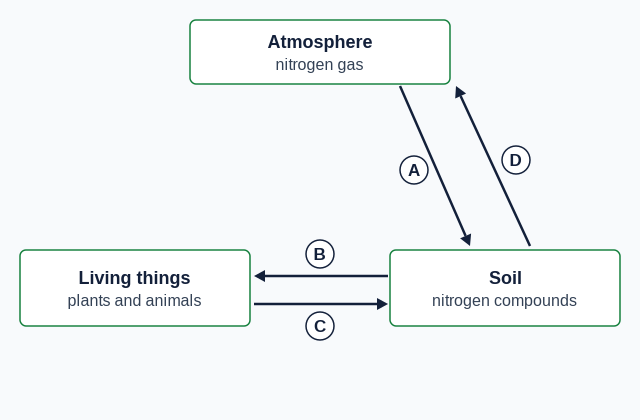
Quick check · Match
Use the drawing of the nitrogen loop with lettered arrows. Match each lettered arrow to the step of the nitrogen cycle it stands for.
2c. Why nitrogen so often runs short
There is more nitrogen in the air than anywhere else, yet plants can be short of it. The reason is the bottleneck in the first step: the availability of nitrogen compounds in the soil is limited by the rate of nitrogen fixation. Only certain bacteria can fix nitrogen, and they fix it slowly, so the soil gains usable nitrogen slowly.
In many ecosystems, the availability of nitrogen compounds limits primary production by plants and other producers. A resource is limiting when it is the one in shortest supply, so that adding more of it lets the producers grow more, while adding more of something already plentiful does not.
This is why farmers add nitrogen fertilizer, and why soybeans and clover, with fixing bacteria in their roots, can leave a field richer in nitrogen. It is also why an experiment can find the limiting nutrient: add one nutrient at a time to matching plots, and see which addition makes the producers grow more.
Quick check · Multiple choice
The atmosphere is the largest reservoir of nitrogen, yet nitrogen compounds in the soil often limit how much plants grow. Why?
2d. Where nitrogen waits
The atmosphere is the largest reservoir of nitrogen, as . Elsewhere, the stay is mostly short: most of the reservoirs in which nitrogen compounds occur in the nitrogen cycle hold those compounds for relatively short periods of time.
An ammonium ion in the soil may be taken up by a root within days, changed to nitrate by bacteria, or carried away in water. Nitrogen in a leaf returns to the soil when the leaf falls and decomposes, often within a year. Nitrate that is not taken up can be denitrified back to the air or washed into streams.
Compare carbon from the last topic, which can sit in fossil fuels for millions of years. Most other reservoirs hold nitrogen compounds only briefly, so nitrogen compounds in soil have to be replaced all the time, by fixation, by decomposition, or by fertilizer.
Quick check · Decide and justify
A student says that most of the ammonium added to a field's soil this spring will have left the soil within a few years: taken up by roots, changed by bacteria or washed away. Is the student right?
Which reason supports your answer?
Part 3 Watch it done One nitrogen atom's trip
Open each step in turn, answer the why, then finish the trip yourself.
Follow one nitrogen atom that starts as nitrogen gas in the air above a farm, ends up in a corn plant, and eventually returns to the air. Name the step of the nitrogen cycle at each move.
Step 1 · Into the soil
Free-living bacteria in the soil convert the nitrogen gas into ammonia: nitrogen fixation. In the soil the ammonia quickly becomes ammonium.
Step 2 · From ammonium to nitrate
Soil bacteria convert the ammonium into nitrite and then nitrate: nitrification.
Step 3 · Into the corn
The corn's roots take up the nitrate, and the plant builds the nitrogen into its proteins: assimilation.
Why this step?
Why did the atom need bacteria to get into the corn at all?
The corn cannot use nitrogen gas. Only certain bacteria can fix it into ammonia, which becomes ammonium in the soil, a form plants can take up.
Your step · Put it in order
Finish it. A nitrogen atom is in the proteins of a corn plant's leaf when the plant dies in the fall. Put the rest of its trip back to the air in order.
Part 4 Try it Nitrogen in new places
Before you answer, say what form the nitrogen is in at the start and at the end of each move.
Try it · Sort it
Each card describes a step in a meadow's nitrogen cycle. Tap a card, then what it does to the nitrogen compounds plants can take up from the soil.
Adds them to the soil
Removes them from the soil
Try it · Spot the error
A student explains why corn in the soggy low spots of a field grew pale and short. Tap the first line that goes wrong.
Try it · Multiple choice
In a grassland, the nitrogen compounds in the soil limit how much the grasses grow. Which change would most likely increase the grasses' growth?
Part 5 Explain it Design an investigation of a limiting nutrient
Write your answer first. Nothing you type here leaves this page. Then compare it with the model and each scoring point.
Free response is 40% of the exam score. This one is shaped like Question 1, Design an investigation.
Free-response practice · Question 1 style
A student thinks that nitrogen compounds in the soil limit how much a kind of wild grass grows in an old field.
(a) Identify a testable hypothesis for the student's idea.
(b) Describe an investigation the student could do in the field to test the hypothesis.
(c) Identify the independent variable, the dependent variable, and the control group in your investigation.
(d) The atmosphere above the field holds a large amount of nitrogen. Explain why nitrogen can still limit the grass's growth.
Model answer
(a) If nitrogen fertilizer is added to plots of the grass, then the grass will grow more than in plots without it.
(b) Mark out twenty plots of the same size where the grass grows, in the same part of the field. Add nitrogen fertilizer to ten plots, chosen at random, and add nothing to the other ten. After one growing season, cut the grass in each plot, dry it, and weigh it.
(c) The independent variable is whether nitrogen is added. The dependent variable is the dry mass of grass in each plot. The control group is the ten plots with no nitrogen added.
(d) The grass cannot use nitrogen gas from the air. Nitrogen reaches the soil in a usable form only when certain soil bacteria fix it into ammonia, which becomes ammonium, and the rate of that fixation limits how much nitrogen is available in the soil.
Score your own answer. This is a self-check, not a grade. Tick each point your answer makes.
Part 6 Check yourself A fertilizer trial
The first two questions use the table.
Suppose a class adds nutrients to matching plots of a meadow and weighs the dried plants at the end of the summer. The numbers below are made up for practice.
| Nutrient added | Average dry mass of plants (g/m²) |
|---|---|
| None | 200 |
| Nitrogen only | 340 |
| Phosphorus only | 210 |
| Nitrogen and phosphorus | 360 |
Case question 1 · Multiple choice
Using the table of the fertilizer trial: what do the results show about this meadow?
Case question 2 · Decide and justify
After seeing the trial's results, a student says that the meadow's plants are short of nitrogen because the air above the meadow is low in nitrogen gas. Is the student right?
Which reason supports your answer?
The rest stand on their own and do not use the case.
Check yourself · Fill the statement
Suppose a gardener heats a bag of potting soil until every microorganism in it is dead, then mixes in chopped dead leaves and seals the bag. Tap a blank, then an answer.
Months later, the nitrogen is still locked in the leaves, because no are left to carry out . With no bacteria left either, none of the soil's ammonium is changed into .
Check yourself · Select all
Which two of these steps of the nitrogen cycle are carried out by soil microorganisms? Pick two.
Select 2 answers, then check.
Part 7 Keep it Bring back earlier ideas
Two questions from earlier topics: how long carbon stays in living things, and how a biome can change.
From 1.4 The Carbon Cycle · Decide and justify
A carbon atom from the air is built into a maple leaf this spring. A student says the atom will most likely stay in the living world for millions of years. Is the student right?
Which reason supports your answer?
From 1.2 Terrestrial Biomes · Spot the error
A student explains what a lake's mud shows about a valley. Tap the first line that goes wrong.
In three lines
- Nitrogen fixation by certain soil bacteria converts atmospheric nitrogen gas into ammonia, which becomes ammonium in the soil and is available for uptake.
- Assimilation, ammonification, nitrification and denitrification move nitrogen on, and soil microorganisms carry out many of the steps.
- The atmosphere is the largest reservoir, but the rate of fixation limits soil nitrogen, which often limits primary production; most reservoirs hold nitrogen only briefly.
Exam strategy for this topic
- Section I, Multiple Choice: 80 questions in 90 minutes.
- Section II, Free Response: 3 questions in 70 minutes.
- This lesson's Explain it is shaped like free-response question 1, Design an investigation.
- A four-function, scientific, or graphing calculator is allowed on both sections of the exam.
On a nitrogen cycle diagram, label each arrow with its step and the forms of nitrogen at both ends (for example, ammonium to nitrate is nitrification), and name the microorganisms where they carry the step out.
Questions students ask
What are the steps of the nitrogen cycle?
Nitrogen fixation, assimilation, ammonification, nitrification and denitrification. Microorganisms in the soil play an important role in many of them.
What happens in nitrogen fixation?
Certain types of soil bacteria convert atmospheric nitrogen into ammonia. In the soil, ammonia quickly converts to ammonium, which plants can take up.
What is the largest reservoir of nitrogen?
The atmosphere. Most other reservoirs hold nitrogen compounds for relatively short periods of time.
Why does nitrogen often limit plant growth when the air is full of it?
Plants cannot use nitrogen gas. The rate of nitrogen fixation limits the nitrogen compounds available in the soil, and in many ecosystems those compounds limit primary production.
What is the difference between nitrification and denitrification?
Nitrification turns ammonium into nitrate, which stays in the soil. Denitrification turns nitrate into nitrogen gas, which returns to the atmosphere.
Course alignment, for teachers
AP Environmental Science topic 1.5, Unit 1: The Living World: Ecosystems.
- Skill 2.B: Explain relationships between different characteristics of environmental concepts, processes, or models represented visually:
This lesson maps all 4 essential knowledge statements of the topic to the part that teaches each one: 4 are checked by a scored question. The map is in the lesson file.