Unit 8 · Topic 8.5 · about 30 minutes · 7 parts · 11 scored checks, 2 of them multiple choice, plus 2 from earlier lessons
AP Environmental Science 8.5: Eutrophication
Unit 8: 7 to 10% of the multiple-choice section
What you'll be able to do
- Explain the environmental effects of excessive use of fertilizers and detergents on aquatic ecosystems.
Key vocabulary
| Term | What it means | The exam trap |
|---|---|---|
| Eutrophication | The enrichment of a body of water in nutrients. | The word names the enrichment itself, not the dead fish that may come weeks later. |
| Algal bloom | A fast rise in the algae in a body of water, often enough to turn it green. | A bloom can spread over a lake in a few weeks; it is not a slow change over years. |
| Hypoxic | Describes a body of water that is low in dissolved oxygen. | Hypoxic is about oxygen, not about how many nutrients the water holds. |
| Oligotrophic | Describes a waterway with very low amounts of nutrients, stable algae populations and high dissolved oxygen. | Low in nutrients is not the same as low in oxygen. |
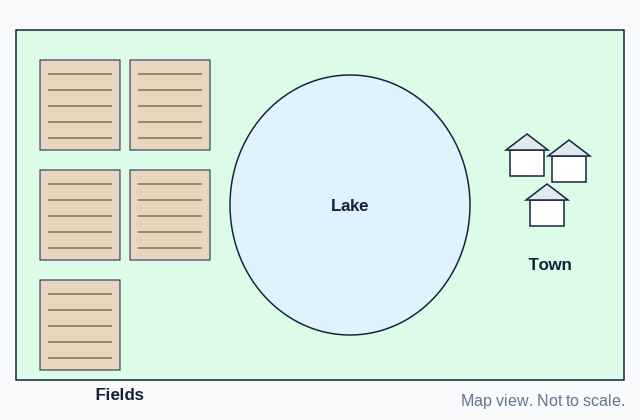 Tap to open the picture full size
Part 1 Think first Green water, then dead fish
Commit to a guess first. Being wrong now makes the right idea stick better.
Predict first
A made-up lake turns bright green in July. Three weeks later, after the green fades, dead fish wash up along its shore. What do you predict links the green water and the dead fish?
In short. Eutrophication occurs when a body of water is enriched in nutrients.
- Its human causes are agricultural runoff and wastewater release, which carry fertilizers and detergents.
- The extra nutrients set off an algal bloom, which can end in a large die-off of fish and other aquatic life.
- Water that is low in dissolved oxygen is called hypoxic.
Part 2 Learn it Too many nutrients
2a. When water gets too many nutrients
Eutrophication occurs when a body of water is enriched in nutrients.
Nutrients are the substances living things need to grow. Algae and plants in water need them too, and a lake or bay usually gets only a small, steady supply.
The anthropogenic causes of eutrophication are agricultural runoff and wastewater release. Anthropogenic means caused by people.
- Agricultural runoff: rain or irrigation water flowing off farmland carries fertilizer and manure with it into streams, lakes and bays.
- Wastewater release: used water from homes, towns and factories is piped into a river, lake or bay. Detergents used for washing can add nutrients to it.
For example, a made-up reservoir below a town's wastewater outlet grows richer in nutrients each year as the town's laundries and sinks drain into it.
Quick check · Multiple choice
Which made-up lake is undergoing eutrophication?
2b. From bloom to die-off
The increase in nutrients in eutrophic aquatic environments causes an algal bloom. An algal bloom is a fast rise in the algae in the water, often enough to turn it green.
What happens next is what harms the animals:
- The bloom dies.
- Microbes digest the dead algae, and as they do, they use the oxygen in the water.
- The dissolved oxygen in the water falls.
- The lack of dissolved oxygen can result in large die-offs of fish and other aquatic organisms.
Dissolved oxygen is the oxygen held in the water itself, the oxygen fish take in through their gills. It is often measured in milligrams per liter.
For example, in a made-up bay a spring bloom fades by June, and by July its deeper water runs short of oxygen.
Quick check · Decide and justify
In late August the algal bloom on a made-up lake dies off. A student says the lake's dissolved oxygen will now climb, since the bloom is gone. Is the student right?
Which reason supports your answer?
2c. Hypoxic water
Hypoxic waterways are those bodies of water that are low in dissolved oxygen.
When microbes digesting a dead bloom use up the dissolved oxygen, a waterway, or the deeper part of one, can become hypoxic. That is when the large die-offs of fish and other aquatic organisms happen.
For example, a made-up harbor's deepest basin goes hypoxic each August, and divers find the oysters on its floor dead while those in the shallows live.
Quick check · Select all
Readings at a made-up river mouth show dissolved oxygen far below normal each August. Which two statements about the river mouth fit the readings? Pick two.
Select 2 answers, then check.
2d. The other end: oligotrophic waters
Compared to eutrophic waterways, oligotrophic waterways have very low amounts of nutrients, stable algae populations, and high dissolved oxygen.
- Nutrients: very low in oligotrophic water; enriched in eutrophic water.
- Algae: stable in oligotrophic water; able to bloom in eutrophic water.
- Dissolved oxygen: high in oligotrophic water; able to fall low in eutrophic water.
For example, a made-up lake fed by snowmelt off bare rock stays low in nutrients, with algae that change little from month to month.
Quick check · Sort it
Which made-up lake does each reading describe? Tap a card, then its group.
Oligotrophic
Eutrophic
Part 3 Watch it done How much oxygen did the lake lose?
Open each step in turn, answer the why, then finish the calculation yourself.
A made-up lake's bottom water held 8.4 milligrams per liter (mg/L) of dissolved oxygen in June. By late August, after its algal bloom had died, it held 1.26 mg/L. By what percent did its dissolved oxygen fall?
Step 1 · Find the fall
mg/L less dissolved oxygen in late August.
Why this step?
Why would the bottom water lose oxygen after the bloom had died?
Microbes digest the dead algae, and as they do they use the oxygen in the water, so dissolved oxygen falls.
Step 2 · Choose the operation
A percent fall compares the fall with the starting level, so divide 7.14 by the June level.
Your step · Calculate
Finish it. The bottom water fell from 8.4 to 1.26 milligrams per liter, a fall of 7.14. By what percent did its dissolved oxygen fall?
%
Most of the oxygen in that water was gone by late August. Next, put the whole chain in order, from a farm field to the fish.
Part 4 Try it Put the chain in order, then check an account
First put the events at a made-up lake in order. Then find where a student's account of a lake with two arms goes wrong.
Try it · Put it in order
Put the events at a made-up lake in order, first to last.
Try it · Spot the error
A student describes a made-up lake with two arms. Tap the first line that goes wrong.
Part 5 Explain it Fertilizer and a bay's low-oxygen zone
Write your answer first. Nothing you type here leaves this page. Then compare it with the model and each scoring point.
Free response is 40% of the exam score. This one is shaped like Question 2, Analyze and interpret quantitative data.
Free-response practice · Question 2 style
A made-up river drains a large farming region and empties into a bay. Each summer part of the bay's bottom water becomes hypoxic. The figures below are made up for practice.
- 2005: 18,000 metric tons of fertilizer applied in the region; 42 square kilometers of the bay hypoxic
- 2010: 21,500 metric tons; 61 square kilometers
- 2015: 26,000 metric tons; 88 square kilometers
- 2020: 30,500 metric tons; 117 square kilometers
(a) Describe the relationship between the fertilizer applied and the bay's hypoxic area.
(b) Calculate the percent increase in the hypoxic area from 2005 to 2020. Round to the nearest tenth of a percent. Show your work.
(c) Calculate how many square kilometers of hypoxic area were added, on average, for each additional 1,000 metric tons of fertilizer from 2005 to 2020. Show your work.
(d) Explain how more fertilizer on the farmland could lead to a larger hypoxic area in the bay.
(e) Describe one approach that could reduce the hypoxic area in the bay.
Model answer
(a) As the fertilizer applied rose from 18,000 to 30,500 metric tons, the hypoxic area grew too, from 42 to 117 square kilometers: the more fertilizer, the larger the hypoxic area.
(b) increase.
(c) square kilometers added, and metric tons more fertilizer. square kilometers per 1,000 metric tons.
(d) Rain washes some of the fertilizer off the fields into the river, which carries the nutrients to the bay. The nutrients cause an algal bloom; when the bloom dies, microbes digest the algae and use up the dissolved oxygen, so more of the bay's bottom water becomes low in oxygen.
(e) Farmers could apply less fertilizer, or apply it when heavy rain is not expected, so less of it washes into the river. (Treating the region's wastewater to remove more nutrients before it is released also fits.)
Score your own answer. This is a self-check, not a grade. Tick each point your answer makes.
Part 6 Check yourself Two lakes through a summer
The first two questions use the figure.
A made-up team measures dissolved oxygen at the same depth in two lakes once a week for twelve weeks of summer. Lake P has farms along its shore and had an algal bloom in weeks 4 to 6; lake Q has none. The numbers are made up for practice.
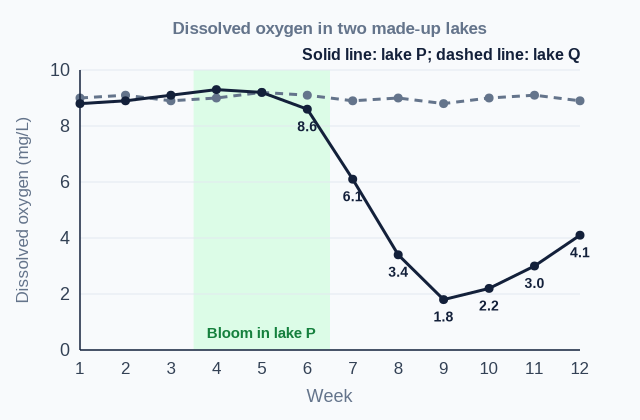 Tap to open the picture full size
Case question 1 · Multiple choice
Which conclusion about the two lakes does the figure support?
Case question 2 · Calculate
Using the figure: from week 6 to week 9, by how many milligrams per liter per week did lake P's dissolved oxygen fall, on average? Give the answer to the nearest hundredth.
The rest stand on their own and do not use the case.
Check yourself · Fill the statement
Complete the account of a made-up mountain lake.
Before a ski resort opened beside it, the lake had very few nutrients and steady numbers of algae, so it was . After ten years of the resort's wastewater, the lake is , enriched in nutrients, with algae that bloom and crash each summer.
Check yourself · Match
Match each made-up observation to what it shows.
Part 7 Keep it Bring back earlier ideas
Two questions from earlier topics in this unit.
First put the events at a made-up marsh in order. Then find where a student's account of a mangrove coast goes wrong.
From 8.4 Human Impacts on Wetlands and Mangroves · Put it in order
Put the events at a made-up floodplain marsh in order, first to last.
First complete an account of a made-up spill. Then find where a student's account of a reef goes wrong.
From 8.2 Human Impacts on Ecosystems · Spot the error
A student describes the threats to a made-up coral reef. Tap the first line that goes wrong.
In three lines
- Eutrophication occurs when a body of water is enriched in nutrients, mainly from agricultural runoff and wastewater release.
- The nutrients cause an algal bloom; when it dies, microbes digest it and use up dissolved oxygen, which can cause large die-offs.
- Hypoxic water is low in dissolved oxygen; oligotrophic water has very low nutrients, stable algae and high dissolved oxygen.
Exam strategy for this topic
- Section I, Multiple Choice: 80 questions in 90 minutes.
- Section II, Free Response: 3 questions in 70 minutes.
- This lesson's Explain it is shaped like free-response question 2, Analyze and interpret quantitative data.
- A four-function, scientific, or graphing calculator is allowed on both sections of the exam.
When a question shows eutrophication, walk the whole chain in order: the source of nutrients (agricultural runoff or wastewater release), the algal bloom, the bloom dying, microbes digesting it and using up dissolved oxygen, and the die-off that low oxygen can cause.
Questions students ask
What is eutrophication?
It occurs when a body of water is enriched in nutrients.
What causes eutrophication?
Its anthropogenic causes are agricultural runoff and wastewater release, which carry fertilizers and detergents.
Why does eutrophication kill fish?
The nutrients cause an algal bloom. When it dies, microbes digest the algae and use up the dissolved oxygen, and the lack of oxygen can cause large die-offs.
What is the difference between eutrophic and oligotrophic water?
Oligotrophic water has very low amounts of nutrients, stable algae populations and high dissolved oxygen, compared with eutrophic water.
Course alignment, for teachers
AP Environmental Science topic 8.5, Unit 8: Aquatic and Terrestrial Pollution.
- Skill 2.C: Explain how environmental concepts and processes represented visually relate to broader environmental issues.
This lesson maps all 5 essential knowledge statements of the topic to the part that teaches each one: 5 are checked by a scored question. The map is in the lesson file.